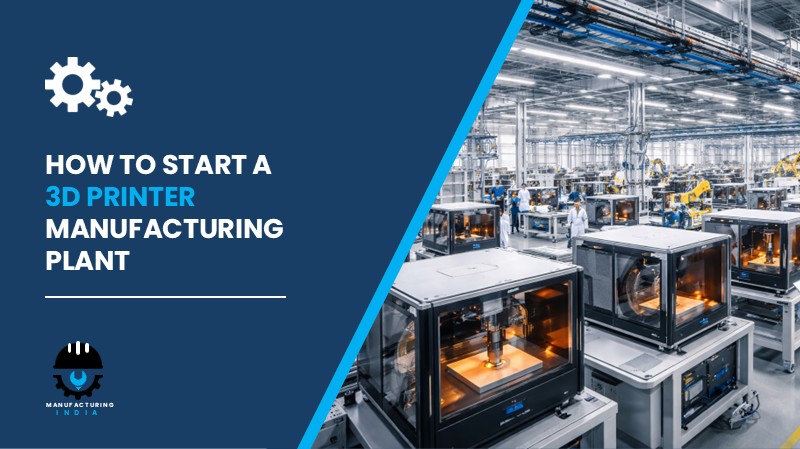
Setting up a 3D printer manufacturing plant in India presents a compelling investment case, driven by rapid adoption of additive manufacturing across aerospace, automotive, healthcare, education, and consumer goods sectors. As India’s industrial base deepens and digital manufacturing matures, the demand for advanced 3D printing equipment is accelerating. These devices are critical to India’s innovation economy because they enable rapid prototyping, complex geometry fabrication, mass customisation, and reduced material wastage — capabilities that are increasingly essential across modern production environments.
India’s advantages in this space are significant and multiplying. Urbanisation, infrastructure expansion, and the government’s Make in India initiative are collectively strengthening the domestic manufacturing ecosystem. States such as Gujarat and Maharashtra, with their established electronics and engineering clusters, offer investors ready access to supply chains, skilled labour, and logistics infrastructure. With global 3D printer demand rising and Indian end-use industries actively seeking localised supply, setting up production domestically positions investors ahead of an accelerating demand curve.
India’s 3D printer market, valued at USD 645.2 Million in 2025, is projected to reach USD 2,221.3 Million by 2034 at a CAGR of 14.28%. Policy support under Make in India, cost-competitive manufacturing, and surging demand from aerospace, healthcare, and automotive sectors make this one of the most viable advanced manufacturing investments available today, with gross margins of 40–50% and a net margin of 18–25%.
What is a 3D Printer?
A 3D printer is an advanced manufacturing device that creates three-dimensional objects by depositing material layer-by-layer based on digital design files, typically generated using computer-aided design (CAD) software. This process, known as additive manufacturing, contrasts with traditional subtractive manufacturing methods by building objects progressively rather than removing material. 3D printers utilise a variety of materials including thermoplastics, resins, metals, ceramics, and composite powders depending on the printing technology employed.
Common printing technologies include Fused Deposition Modeling (FDM), Stereolithography (SLA), Selective Laser Sintering (SLS), and Direct Metal Laser Sintering (DMLS). These machines enable rapid prototyping, complex geometry fabrication, mass customisation, and reduced material wastage. The primary production method used in a 3D printer manufacturing plant involves precision injection moulding, CNC machining, and laser sintering. End-use industries served include rapid prototyping, aerospace, automotive, healthcare (dental and medical), education, and consumer goods.
Cost of Setting Up a 3D Printer Manufacturing Plant in India
The total cost of establishing a 3D printer manufacturing plant in India depends on several variables including production capacity, technology selection, geographic location, level of automation, and regulatory compliance obligations. Investors must account for both one-time capital outlays and recurring operational expenses to build an accurate financial model.
1. Capital Expenditure (CapEx)
The capital investment for this facility spans several major heads. Land and site development costs, which include land registration, boundary development, and related charges, form a substantial part of the overall investment. Locating the plant within a Special Economic Zone (SEZ) or notified industrial estate in states such as Gujarat, Maharashtra, or Tamil Nadu can reduce land acquisition costs and avail additional fiscal benefits.
Civil works and construction costs cover the manufacturing shed, quality control laboratory, raw material storage area, finished goods warehouse, and administrative block. These must be engineered to meet both production workflow needs and safety compliance requirements.
Machinery and equipment costs represent the largest single component of capital expenditure. Key machinery required includes:
- 3D printers
- Filament extruders
- Powder bed fusion systems
- SLA/DLP units
- Sintering furnaces
- Washing and curing stations
- Post-processing tools
- Automated assembly lines
Other capital costs include effluent treatment plant (ETP) installation, pre-operative expenses, commissioning charges, and import duties applicable to specific high-precision equipment not manufactured domestically.
Request a Sample Report for In-Depth Market Insights: https://www.imarcgroup.com/3d-printer-manufacturing-plant-project-report/requestsample
2. Operational Expenditure (OpEx)
Raw material cost is the dominant driver of operating expenditure, accounting for approximately 65–75% of total OpEx. Key raw materials required include electronic components (PCBs, stepper motors), metal and plastic frames, and print heads and extruders. Securing long-term supplier contracts will help mitigate price volatility and ensure supply continuity, which is especially critical given global semiconductor supply sensitivities.
Utility costs, covering electricity, water, and process support systems, account for a further 5–10% of OpEx. Other recurring operating costs include transportation and logistics, packaging materials, salaries and wages, routine maintenance, depreciation on machinery and civil assets, and applicable taxes. By the fifth year of operations, total operational costs are projected to increase substantially due to inflation, market fluctuations, potential rises in raw material prices, supply chain disruptions, and shifts in global economic conditions.
3. Plant Capacity
The proposed 3D printer manufacturing facility is designed with an annual production capacity ranging between 10,000 and 50,000 units, enabling economies of scale while maintaining operational flexibility. Capacity can be customised to align with investor requirements and phased investment strategies. As with most manufacturing plants, profitability improves meaningfully with higher capacity utilisation, since fixed costs are distributed across a greater production volume.
4. Profit Margins and Financial Projections
The financial projections for this investment demonstrate healthy profitability potential under normal operating conditions. Gross profit margins typically range between 40–50%, supported by stable demand and value-added applications across multiple industries. Net profit margins range between 18–25%, which is strong relative to conventional manufacturing categories. A comprehensive financial analysis covering NPV (net present value), IRR (internal rate of return), payback period, liquidity analysis, and sensitivity analysis is included in the detailed project report to support investor decision-making.
Why Set Up a 3D Printer Plant in India?
Growing Adoption of Additive Manufacturing: Industries across India are increasingly adopting additive manufacturing to enable rapid prototyping, complex part design, and on-demand production. This directly increases demand for domestically produced 3D printing equipment, reducing dependence on expensive imports.
Customisation and Design Flexibility: 3D printing allows manufacturers to produce highly customised products and complex geometries that are difficult or impossible to achieve with traditional manufacturing processes. This flexibility is increasing the technology’s appeal across India’s rapidly growing aerospace, automotive, and consumer goods sectors.
Reduced Material Waste: Additive manufacturing builds objects layer-by-layer, using only the material required for production. This significantly reduces material wastage compared with subtractive manufacturing techniques, improving unit economics and supporting sustainability objectives increasingly demanded by institutional buyers.
Accelerated Product Development: 3D printers enable rapid prototyping and design testing, allowing companies to reduce product development cycles and bring new products to market faster. India’s expanding startup and engineering ecosystem makes this capability particularly valuable.
Expansion of Industrial Automation: The integration of digital manufacturing technologies and Industry 4.0 initiatives is increasing the demand for advanced additive manufacturing systems. India’s ongoing industrialisation and push toward smart manufacturing create sustained long-term demand for this production category.
Active Industry Investment: In April 2025, Stratasys Ltd. launched the Neo 800+, the latest addition to its SLA 3D printer lineup, delivering fast print speeds, high part yield, and low production costs. In September 2024, Nano Dimension Ltd. and Markforged Holding Corporation announced a definitive agreement for Nano Dimension to acquire all outstanding shares of Markforged in an all-cash transaction at USD 5.00 per share, creating a combined company with a broader additive manufacturing portfolio. These developments confirm that the global industry is actively consolidating and innovating, creating downstream demand for new manufacturing capacity.
Manufacturing Process – Step by Step
The 3D printer manufacturing process uses precision injection moulding, CNC machining, and laser sintering as the primary production methods. The process is a multi-step operation involving several unit operations, material handling, and quality checks:
- Raw Material Procurement: Electronic components (PCBs, stepper motors), metal and plastic frames, and print heads and extruders are sourced from approved suppliers and received at the incoming inspection area.
- Component Fabrication: Structural frames and mechanical parts are produced using CNC machining and precision injection moulding techniques to required dimensional tolerances.
- Electronics Integration: Control boards, wiring harnesses, sensors, and power supply connections are assembled and tested per circuit design specifications.
- Print Head and Extruder Assembly: Print heads and extruder assemblies are integrated onto the motion system with calibration for accuracy and repeatability.
- Laser Sintering and SLA/DLP Processing: Powder bed fusion systems, SLA/DLP units, and sintering furnaces are used for the fabrication of high-precision internal and functional components.
- Post-Processing: Washing and curing stations and post-processing tools are deployed to finish printed components to surface quality and dimensional requirements.
- Automated Assembly: The full printer unit is assembled on automated assembly lines, integrating all structural, electronic, and print-system subassemblies.
- Quality Assurance and Testing: Comprehensive quality checks, technical tests, and validation procedures are conducted per defined quality assurance criteria.
- Packaging and Dispatch: Finished 3D printer units are packaged as per specification and dispatched to end-use sectors including aerospace, automotive, healthcare, education, and consumer goods industries.
Key Applications
3D printers manufactured at this facility serve a diverse range of end-use industries with high-value applications:
- Rapid Prototyping: Used for functional prototypes, design testing, and accelerated product development across engineering industries.
- Aerospace: Production of complex, lightweight parts, tooling, jigs, and fixtures for aviation and defence applications.
- Automotive: Rapid prototyping of vehicle components, tooling, and small-batch production parts for OEMs and Tier-1 suppliers.
- Healthcare (Dental/Medical): Fabrication of personalised implants, prosthetics, surgical planning models, and dental components.
- Education: Training equipment and demonstration models used in engineering colleges, polytechnics, and research institutions.
- Consumer Goods: Custom part production, on-demand spare parts, and small-batch manufacturing for consumer product companies.
- Industrial Manufacturing: Custom tooling, jigs, fixtures, and rapid prototyping components for industrial production environments.
- Product Development: End-use parts and small-batch production components supporting new product introduction cycles.
Leading Manufacturers
The global 3D printer industry is served by several multinational companies with extensive production capacities and diverse application portfolios. Key players active in this sector include:
- Stratasys Ltd.
- 3D Systems Corporation
- EOS GmbH
- HP Inc.
- Desktop Metal Inc.
Timeline to Start the Plant
- Feasibility study and project report preparation
- Land acquisition and site development
- Regulatory approvals and environmental clearances
- Factory licence and fire safety compliance
- Machinery procurement and installation
- Raw material supplier agreements and supply chain setup
- Trial production and quality testing
- Commercial production launch
Licences and Regulatory Requirements
Starting a 3D printer manufacturing unit in India requires several approvals:
- Business registration (Proprietorship, LLP, or Pvt Ltd)
- Factory Licence under the Factories Act
- Environmental Clearance from State Pollution Control Board
- GST Registration
- Fire Safety NOC
- Hazardous and chemical compliance (applicable to sintering agents and solvent-based resin materials)
- Effluent Treatment Plant (ETP) operational clearance
- Occupational Health and Safety compliance
Key Challenges to Consider
High Capital Requirements: Establishing a 3D printer manufacturing facility with the required precision machinery and electronics integration infrastructure demands significant upfront investment, which may present a barrier for smaller entrants without institutional financing.
Raw Material Price Volatility: The plant’s primary raw materials — electronic components (PCBs, stepper motors), metal and plastic frames, and print heads and extruders — are subject to global commodity and semiconductor price cycles. Supply chain disruptions can affect margins materially in any given year.
Regulatory Compliance: Meeting environmental clearance, ETP, and hazardous material handling norms requires sustained investment in compliance infrastructure and periodic audits, adding to operational overhead.
Technology and Innovation Pressure: The 3D printer industry is evolving rapidly, with new printing technologies, materials science advances, and software integration continuously improving speed, accuracy, and capability. Manufacturers must invest in technology upgradation to remain competitive.
Competition: The global market is dominated by established players including Stratasys Ltd., 3D Systems Corporation, EOS GmbH, HP Inc., and Desktop Metal Inc., all of which have significant scale advantages and R&D capabilities. Domestic players must compete on cost, customisation, and service.
Skilled Manpower: The facility requires engineers with expertise in precision manufacturing, electronics assembly, laser systems, and quality assurance — a talent profile that remains in high demand across India’s expanding technology manufacturing sector.
Frequently Asked Questions
How much does it cost to set up a 3D printer manufacturing plant in India?
The total setup cost depends on plant capacity, technology, location, automation level, and regulatory requirements. The detailed project report provides a full CapEx and OpEx breakdown, including land, civil works, machinery, and working capital.
Is 3D printer manufacturing profitable in India in 2026?
Yes. The project demonstrates gross profit margins of 40–50% and net profit margins of 18–25% under normal operating conditions, supported by growing domestic demand and India’s cost-competitive manufacturing environment.
What machinery is required for a 3D printer plant in India?
Key machinery includes 3D printers, filament extruders, powder bed fusion systems, SLA/DLP units, sintering furnaces, washing and curing stations, post-processing tools, and automated assembly lines.
What licences and approvals are required to start a 3D printer plant in India?
Required approvals include business registration, Factory Licence, Environmental Clearance from the State Pollution Control Board, GST Registration, Fire Safety NOC, ETP clearance, and Occupational Health and Safety compliance.
What raw materials are needed for 3D printer manufacturing?
Primary raw materials are electronic components (PCBs, stepper motors), metal and plastic frames, and print heads and extruders. These account for 65–75% of total operating expenses.
What are the environmental compliance requirements for a 3D printer plant in India?
The plant must obtain Environmental Clearance from the relevant State Pollution Control Board, operate a functional Effluent Treatment Plant, comply with hazardous material handling norms, and meet applicable emission and waste disposal standards.
What is the best location to set up a 3D printer plant in India?
Ideal locations are industrial estates or SEZs in states with strong electronics and engineering ecosystems, proximity to raw material suppliers, and reliable utility infrastructure — states such as Gujarat, Maharashtra, and Tamil Nadu are well-suited.
What is the break-even period for this type of plant in India?
The break-even period depends on plant capacity, utilisation rate, and capital structure. The detailed project report includes a full payback period analysis, NPV, and IRR calculations based on realistic financial assumptions.
What government incentives are available for manufacturers in India?
Indian manufacturers can access incentives under Make in India, Production Linked Incentive (PLI) schemes relevant to electronics and advanced manufacturing, SEZ benefits, and state-level industrial promotion policies. Specific entitlements depend on product category, plant location, and investment scale.
Key Takeaways for Investors
The 3D printer manufacturing plant presents a high-potential investment opportunity driven by accelerating demand from aerospace, automotive, healthcare, education, and consumer goods sectors — all of which are growing rapidly within India’s expanding industrial economy. The plant demonstrates strong financial viability across a production range of 10,000 to 50,000 units per annum, with gross margins of 40–50% and net margins of 18–25% confirming the business case at multiple capacity levels. India’s 3D printer market, valued at USD 645.2 Million in 2025, is projected to reach USD 2,221.3 Million by 2034 at a CAGR of 14.28%, reflecting a structural demand trajectory that underpins long-term investment sustainability. With Industry 4.0 adoption deepening, customised manufacturing expanding, and global players actively consolidating, the forward demand outlook for domestically produced 3D printing equipment in India remains robust and durable.
About the Author