Cocopeat Brick Manufacturing Plant Cost
The Cocopeat Brick Manufacturing Plant Cost in India is a key consideration for entrepreneurs and agribusiness investors looking to enter the rapidly expanding sustainable horticulture inputs sector. India’s position as one of the world’s largest coconut producers — particularly in Tamil Nadu, Kerala, Karnataka, and Andhra Pradesh — gives domestic manufacturers a distinct raw material advantage that is difficult to replicate elsewhere.
India’s domestic consumer base for cocopeat bricks is expanding rapidly, driven by explosive growth in the FMCG, floriculture, and pharmaceutical sectors, all of which increasingly require quality growing media and organic inputs. The government’s Make in India initiative actively encourages value-added agro-processing ventures, creating a policy environment that directly benefits cocopeat brick producers. With urban gardening on the rise, greenhouse cultivation scaling fast, and hydroponics gaining mainstream traction, demand for high-quality cocopeat bricks is showing no signs of slowing down.
India offers a rare convergence of strengths for cocopeat brick manufacturers: abundant coconut coir availability, strong Make in India policy support, low-cost processing infrastructure, and booming FMCG and pharmaceutical sectors driving demand for organic inputs. Plants operating at optimum capacity can achieve gross margins of 25–40% with net margins between 8–15%, making this one of the more capital-efficient agro-processing ventures available to Indian investors today.
What is a Cocopeat Brick?
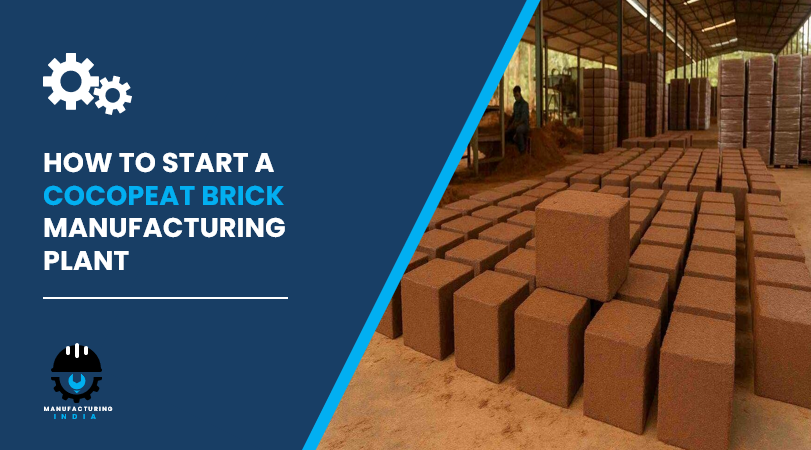
Cocopeat bricks are highly absorbent, natural growing mediums produced from coconut coir pith — a by-product of coconut fiber extraction. They are compressed into compact, dry blocks that expand significantly when soaked in water, providing an ideal medium for seed germination, plant propagation, and soil conditioning. Cocopeat bricks possess excellent water retention, aeration, and nutrient-holding capacity, making them suitable for horticulture, hydroponics, and greenhouse cultivation. They are lightweight, biodegradable, pH-neutral, and eco-friendly, positioning them as a sustainable alternative to traditional peat moss and synthetic growing media.
Notably, cocopeat bricks account for approximately 40% of the total cocopeat market, reflecting the segment’s dominant role in the broader coconut coir value chain. The process of producing these bricks involves fiber extraction, compression, and dehydration — a relatively straightforward manufacturing flow that lends itself well to small and medium-scale operations.
Cost of Setting Up a Cocopeat Brick Manufacturing Plant Cost in India
Setting up a cocopeat brick plant in India requires a structured understanding of both capital and operational expenditures. The proposed manufacturing facility is designed with an annual production capacity ranging between 10,000 and 15,000 metric tons, enabling economies of scale while maintaining operational flexibility. Below is a detailed breakdown of the cost components involved.
Capital Expenditure (CapEx) Breakdown
The total capital investment covers land acquisition and site preparation, civil works, machinery procurement, and other ancillary capital costs. Machinery costs account for the largest portion of the total CapEx. Key equipment required includes defibering machines, drying systems, hydraulic presses, and packaging stations. The cost of land and site development — including charges for land registration, boundary development, and associated expenses — forms a substantial part of the overall capital investment. The specific CapEx figures vary based on plant location, automation level, and chosen capacity, and are detailed in the IMARC Group project report linked at the end of this article.
Operational Expenditure (OpEx) Breakdown
The operating cost structure of a cocopeat brick manufacturing plant is primarily driven by raw material consumption. Raw cocopeat accounts for approximately 55–65% of total operating expenses. Utility costs — covering electricity and water — represent another 10–15% of OpEx. Additional operating cost components include transportation, packaging, salaries and wages, depreciation, taxes, and routine maintenance. By the fifth year of operations, total operational costs are expected to increase due to inflation, potential rises in raw material costs, and scale-related expenses.
Plant Capacity
The plant is designed for an annual production capacity of 10,000 to 15,000 metric tons. This range provides the flexibility to serve both domestic markets — nurseries, landscape companies, organic farms, and horticultural businesses — and export markets across Europe, North America, and the Middle East. Small and medium-scale setups at the lower end of this range are highly feasible with moderate capital investment.
Profit Margins & Financial Projections
The project demonstrates healthy profitability under normal operating conditions. Gross profit margins typically range between 25% and 40%, supported by stable demand across horticulture, floriculture, and soilless cultivation sectors. Net profit margins are projected between 8% and 15%, making this one of the more financially viable agro-processing ventures. Financial projections are based on realistic assumptions related to capital investment, operating costs, production capacity, pricing trends, and demand outlook. The payback period, NPV, and IRR figures are detailed in the full IMARC report.
Why Set Up a Cocopeat Brick Plant in India?
- Abundant Raw Material Availability: India is among the world’s largest coconut-producing nations, ensuring a consistent and low-cost supply of raw cocopeat — the primary input material — especially in southern states like Tamil Nadu, Kerala, and Karnataka.
- Make in India Policy Support: The Indian government actively promotes agro-processing industries through subsidies, infrastructure incentives, and export promotion schemes. The Tamil Nadu Coir Business Development Corporation (Tancoir) announced a subsidy of ₹25 lakh (or 25% of cost) in January 2024 to encourage coir processing units to build dedicated drying yards.
- Low-Cost Manufacturing Infrastructure: India offers competitive land, labor, and utility costs compared to other manufacturing destinations, significantly improving margins for plant operators and making the business viable at smaller scales.
- Agriculture’s Central Role in India’s Economy: As per the Economic Survey 2024–25, agriculture and allied sectors contribute nearly 16% to India’s GDP and support over 46% of the population, creating a strong institutional bias toward supporting agro-input industries like cocopeat brick manufacturing.
- Growing FMCG, Horticulture & Pharmaceutical Demand: The rise of organic farming, urban gardening, and pharmaceutical-grade plant cultivation is driving demand for clean, pH-neutral growing media such as cocopeat bricks, directly benefiting Indian manufacturers.
- Export Market Access: India is well-positioned to supply Europe, North America, and the Middle East with cocopeat bricks, given its raw material advantage and competitive production costs, providing additional revenue streams beyond the domestic market.
Request a Sample Report for In-Depth Market Insights: https://www.imarcgroup.com/cocopeat-brick-manufacturing-plant-project-report/requestsample
Manufacturing Process – Step by Step
The manufacturing of cocopeat bricks is a multi-step operation involving careful processing of coconut coir pith through the following stages:
- Step 1 – Raw Cocopeat Collection & Grading: Raw cocopeat (coir pith) is sourced from coconut fiber extraction units and graded for quality, moisture content, and impurity levels before entering the production line.
- Step 2 – Washing & Buffering: Raw cocopeat is washed with fresh water to remove excess salts and dust. Buffering agents such as calcium nitrate are applied to adjust EC (electrical conductivity) levels, improving the product’s suitability for premium horticulture applications.
- Step 3 – Defibering: Defibering machines break down coir pith clusters into a uniform, fine-textured growing medium. This step ensures consistent product quality and compression behavior in later stages.
- Step 4 – Drying: The processed cocopeat is fed into drying systems to reduce moisture to the required level. Proper moisture control is critical for achieving the desired compression ratio and product weight.
- Step 5 – Compression & Brick Forming: Hydraulic presses compress the dried cocopeat into compact brick form. Binding aids may be used to maintain structural integrity. Compression pressure and dwell time determine the final density and expansion ratio of each brick.
- Step 6 – Quality Control & Testing: Each batch undergoes technical testing for pH, EC, water retention, expansion ratio, and physical uniformity. Only bricks meeting quality criteria proceed to the packaging stage.
- Step 7 – Packaging & Dispatch: Finished cocopeat bricks are packed using appropriate packaging materials — typically shrink wrap or polythene — and labeled for domestic or export dispatch. Packaging stations handle both manual and automated packing based on plant configuration.
Key Applications of Cocopeat Bricks
Cocopeat bricks find application across a diverse range of industries and use cases, making the product versatile and recession-resilient:
- Soil conditioning and organic amendment for agricultural land
- Seedling germination trays and nursery propagation beds
- Potting mix substrate for containerized and indoor plants
- Moisture retention beds in landscaping and turf management
- Soilless cultivation systems including hydroponics and vertical farming
- Floriculture growing media for cut flower and ornamental plant production
- Pharmaceutical-grade plant cultivation requiring sterile, pH-neutral substrates
Timeline to Start the Plant
The establishment of a cocopeat brick manufacturing plant in India typically follows a phased development timeline. Site selection and land acquisition generally takes 1–2 months, factoring in proximity to raw material zones in Tamil Nadu, Kerala, or Karnataka. Civil construction and plant layout development spans approximately 3–5 months depending on the scale of infrastructure required. Machinery procurement, installation, and testing — covering defibering machines, drying systems, hydraulic presses, and packaging stations — requires another 2–3 months. Regulatory approvals, quality certifications, and trial production runs take an additional 1–2 months. The entire process from planning to commercial production typically takes 8–12 months for a medium-scale facility.
Licenses & Regulatory Requirements (India-Specific)
Establishing a cocopeat brick manufacturing plant in India requires compliance with several regulatory frameworks:
- Udyam Registration: Mandatory for MSME classification, which unlocks access to government subsidies, credit guarantees, and priority sector lending.
- Factory License: Required under the Factories Act from the State Department of Labour and Employment.
- Pollution Control Certificate: NOC from the State Pollution Control Board (SPCB) is required, particularly for operations with water treatment and effluent management components.
- FSSAI / Organic Certification (If Applicable): Plants producing cocopeat for food or pharmaceutical crop cultivation may need relevant organic input certifications.
- GST Registration: Required for all commercial manufacturing and trading operations.
- Export Licenses (For Export-Oriented Units): RCMC (Registration cum Membership Certificate) from the Coir Board of India and relevant APEDA registration for agri-export shipments.
- BIS Certification (Optional): Bureau of Indian Standards certification may be sought for product standardization, particularly for institutional buyers.
Key Challenges
- Raw Material Quality Variability: The quality of raw cocopeat varies by season, source region, and processing method. Inconsistent feedstock quality can affect final product uniformity, which is critical for premium horticulture buyers.
- Moisture Management: Achieving precise moisture levels during drying is technically demanding. Over- or under-drying affects brick compression quality, expansion ratio, and shelf life.
- Price Volatility of Key Inputs: Raw cocopeat prices fluctuate based on coconut harvest cycles and coir fiber demand. Long-term supplier contracts are essential to stabilize input costs.
- Export Compliance & Phytosanitary Requirements: Accessing European and North American markets requires compliance with strict phytosanitary standards, adding testing and certification costs for export-focused plants.
- Competition from Established Processors: Key players such as VIKAS Coir Products Pvt. Ltd., Mysore Coir Factory, Coirfit International, EcoCoir, and Ceylon Coir are established in the space, requiring new entrants to differentiate on quality, pricing, or geography.
Frequently Asked Questions
The following questions are answered in the report:
1. What is the total cost of setting up a cocopeat brick manufacturing plant in India?
2. What annual production capacity can a medium-scale cocopeat brick plant achieve in India?
3. What raw materials are required for cocopeat brick manufacturing?
4. What is the gross profit margin for a cocopeat brick plant?
5. What licenses and certifications are required to operate a cocopeat brick plant in India?
6. Which states in India are best suited for setting up a cocopeat brick plant?
7. What is the typical payback period for a cocopeat brick manufacturing investment?
8. Can cocopeat bricks manufactured in India be exported, and to which markets?
9. What government subsidies are available for coir-based manufacturing units in India?
Key Takeaways for Investors
The Cocopeat Brick Manufacturing Plant Cost in India is justified by gross margins of 25–40% and net margins of 8–15%, with a production capacity of 10,000–15,000 metric tons per annum at a commercially viable scale. India’s raw material abundance, Make in India subsidies, and expanding domestic and export demand make this a strong-margin, low-hazard agro-processing venture with a clear path to profitability.
About the Author