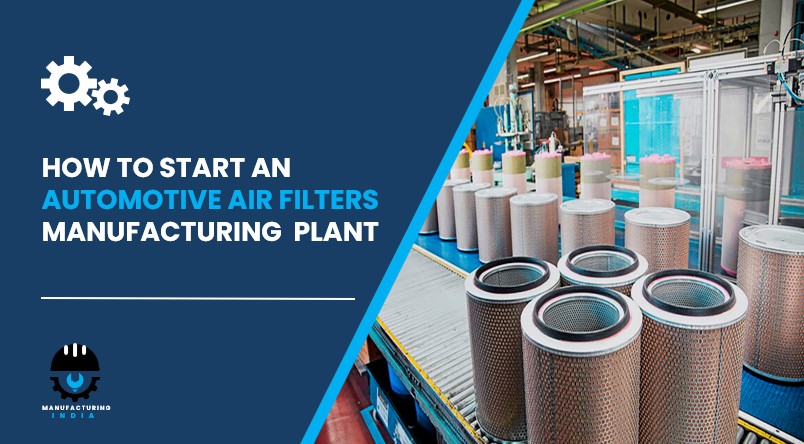
Setting up an automotive air filters manufacturing plant in India presents a compelling investment case, driven by the country’s rapidly expanding automotive sector and tightening vehicular emission norms. Automotive air filters are an essential component of an automobile’s intake system, designed to eliminate dust and contaminants from entering the engine, enabling clean oxygen flow for optimal engine efficiency and smooth running. Demand is surging across passenger vehicles, commercial vehicles, off-highway equipment, and the performance aftermarket — all segments experiencing strong volume growth in India’s evolving mobility landscape.
India’s strategic advantages for this investment are substantial. The country’s urbanisation wave, expanding road infrastructure, and growing fleet of passenger and commercial vehicles create a deep, sustained domestic market. The Make in India initiative continues to attract automotive component manufacturers, while industrial states such as Gujarat, Maharashtra, Rajasthan, and Uttar Pradesh offer competitive land costs, established automotive supply chains, and skilled labour pools. Setting up an automotive air filters manufacturing plant in India allows investors to serve both OEM customers and the large aftermarket replacement segment from a single, cost-efficient base.
India’s automotive growth trajectory, combined with policy support for domestic component manufacturing, positions an automotive air filters plant as a financially sound investment. With gross profit margins ranging between 30–40% and stable demand from vehicle OEMs and aftermarket buyers, this is a viable, scalable manufacturing opportunity with strong break-even fundamentals.
What are Automotive Air Filters?
Automotive air filters are a critical element of a vehicle’s intake system, purpose-built to prevent dust, debris, and airborne contaminants from reaching the engine. By ensuring that only clean air enters the combustion chamber, these filters play a direct role in enhancing engine efficiency, extending engine life, and enabling compliance with environmental emission regulations. Fresh air and clean oxygen are essential elements required for the proper optimisation of an automobile engine for effective efficiency and smooth running.
The primary production method involves cutting, folding, stitching, and assembling of filter media into finished units. Raw materials central to production include filter media (paper/non-woven fabric) and rubber/plastic housing components. End-use industries served include automotive OEMs, vehicle manufacturing facilities, and aftermarket replacement parts distributors. Applications span passenger vehicles such as sedans, SUVs, and hatchbacks; commercial vehicles including trucks and buses; off-highway and industrial vehicles used in construction, agriculture, and mining; and the performance and aftermarket segment for high-efficiency upgrades.
Cost of Setting Up an Automotive Air Filters Manufacturing Plant in India
The total cost of establishing an automotive air filters manufacturing plant depends on several interconnected variables including plant capacity, technology level, degree of automation, geographic location, and regulatory compliance requirements. Investors should plan for both capital expenditure at project inception and ongoing operational expenditure throughout the plant lifecycle.
1. Capital Expenditure (CapEx)
Land and Site Development: Land acquisition costs vary significantly by state and proximity to automotive hubs. Investors may consider locating within a Special Economic Zone (SEZ) or a dedicated automotive industrial estate in Gujarat or Maharashtra for infrastructure benefits and potential fiscal incentives. Site preparation includes boundary development, land levelling, drainage, and registration charges.
Civil Works and Construction: Civil investment covers the construction of the main production shed, raw material storage area, quality control laboratory, finished goods warehouse, and an administrative block. Adequate space must be allocated for an Effluent Treatment Plant (ETP) and safety infrastructure.
Machinery and Equipment: Equipment costs represent the largest single component of total capital expenditure. Key machinery required includes:
- Media slitters and creasers
- Moulding presses
- Curing ovens
- Automated assembly stations
- Robotic sealant applicators
- Leak testing chambers
- Quality inspection systems
- Packaging lines
Other Capital Costs: Additional CapEx items include the Effluent Treatment Plant, pre-operative expenses, trial production costs, import duties on specialised equipment where applicable, and commissioning charges.
Request a Sample Report for In-Depth Market Insights: https://www.imarcgroup.com/automotive-air-filters-manufacturing-plant-project-report/requestsample
2. Operational Expenditure (OpEx)
Raw Material Cost: The operating cost structure of this facility is primarily driven by raw material consumption, particularly filter media (paper/non-woven), which accounts for approximately 50–60% of total operating expenses. Rubber and plastic housing components form the other significant raw material input. Investors should negotiate long-term supplier contracts to stabilise pricing and protect against supply chain disruption.
Utility Cost: Electricity, water, and steam together account for approximately 10–15% of total OpEx, covering press operation, curing oven heating, assembly line power, and HVAC requirements within the production area.
Other Operating Costs: Remaining expenditure covers transportation and logistics, packaging materials, salaries and wages, routine maintenance, depreciation on plant and machinery, and applicable taxes. By the fifth year of operations, total operational cost is projected to increase substantially due to inflation, market fluctuations, and potential rises in the cost of key materials, with supply chain shifts and rising consumer demand as contributing factors.
3. Plant Capacity
The proposed manufacturing facility is designed with an annual production capacity ranging between 1 and 5 million units, enabling economies of scale while maintaining operational flexibility. Capacity can be customised to match the investor’s target market, available capital, and phased expansion plans. Profitability improves meaningfully with higher capacity utilisation, making volume ramp-up a key financial priority in the initial operating years.
4. Profit Margins and Financial Projections
The project demonstrates healthy profitability under normal operating conditions. Gross profit margins typically range between 30–40%, supported by stable demand and value-added applications. Net profit margins average 10–15%, reflecting the cost efficiency achievable at scale. Full financial projections — including NPV, IRR, payback period, income and expenditure projections, and sensitivity analysis — are available through the detailed project report.
Why Set Up an Automotive Air Filters Plant in India?
Growing Automotive Production and Vehicle Fleet: India is one of the fastest-growing automotive markets in Asia-Pacific, with rising domestic production of passenger cars, commercial vehicles, and two-wheelers. Each new vehicle requires at least one air filter at assembly, and the vehicle parc generates sustained aftermarket demand for periodic replacement filters.
Stringent Emission Regulations Driving Filter Demand: Increasing regulatory pressure for vehicles to meet higher emission standards ensures sustained demand for high-performance automotive air filters. Government initiatives aimed at reducing vehicular pollution further boost the need for efficient filtration solutions, directly expanding the addressable market for domestic manufacturers.
Technological Advancement and Product Innovation: The trend toward more advanced and efficient air filtration systems — including cabin air filters and multi-stage filtration technologies — is driving innovation in the automotive air filter market. Ahlstrom’s April 2024 launch of a new dual-layer filtration technology, offering up to double dust holding capacity compared to single-layer designs, illustrates how product development continues to open new business opportunities for manufacturers focused on quality.
Policy and Regulatory Tailwinds: The Make in India initiative and the government’s push for domestic automotive component manufacturing reduce import dependence and create procurement preference for locally produced filters among Indian OEMs. This policy environment enhances revenue visibility for new entrants establishing production in India.
Cost-Competitive Manufacturing Base: India offers globally competitive land acquisition costs, a large skilled and semi-skilled workforce, and established supplier networks for filter media and plastic/rubber components across the western and northern manufacturing belts. These structural advantages translate into lower input and labour costs relative to production in developed markets.
Active Industry Investment and Market Expansion: In January 2025, Donaldson Company, Inc. announced its partnership with Daimler Truck North America on their hydrogen fuel cell project, with Donaldson’s advanced air filter technology set to feature in the next-generation Freightliner SuperTruck III. This confirms that global players are investing in next-generation filter platforms, validating long-term demand. The Asia-Pacific region, especially India, is specifically highlighted as offering strong growth opportunity for the automotive air filter market.
Manufacturing Process — Step by Step
The automotive air filters manufacturing process uses cutting, folding, stitching, and assembling as the primary production method. Each stage involves dedicated machinery, material handling, and quality checkpoint integration.
- Raw Material Inspection and Staging: Incoming filter media (paper/non-woven) and rubber/plastic housing components are inspected for quality conformance and staged at the material intake area.
- Media Slitting and Creasing: Filter media rolls are fed through media slitters and creasers to produce precisely dimensioned filter element blanks with consistent fold geometry.
- Folding and Pleating: Cut media is folded into pleated configurations to maximise surface area within the filter housing, improving dust-holding capacity and airflow efficiency.
- Moulding and Housing Formation: Rubber and plastic housing components are formed using moulding presses, producing end caps, sealing rings, and outer casings to the required dimensional specifications.
- Curing: Formed components pass through curing ovens to achieve full material strength, dimensional stability, and chemical resistance under thermal exposure.
- Automated Assembly: Pleated filter media is assembled into housing components using automated assembly stations, ensuring repeatable positioning and bond integrity.
- Sealant Application: Robotic sealant applicators apply adhesive or polymer seals at critical join interfaces to prevent bypass airflow and ensure filter integrity.
- Leak Testing and Quality Inspection: Each assembled unit passes through leak testing chambers and quality inspection systems to verify seal integrity, dimensional compliance, and filtration performance.
- Packaging and Dispatch: Finished filters are packaged on dedicated packaging lines and dispatched to automotive OEMs, vehicle manufacturers, and aftermarket distributors.
Key Applications
Automotive air filters serve a broad range of industries and vehicle segments across the Indian and global market:
- Passenger Vehicles: Engine air intake filtration for sedans, SUVs, and hatchbacks; one of the largest volume application segments
- Commercial Vehicles: Heavy-duty air filters for trucks, buses, and fleet vehicles operating in high-dust environments
- Off-Highway and Industrial Vehicles: Air filtration systems for construction, agricultural, and mining equipment requiring robust filtration under extreme conditions
- Performance and Aftermarket: High-efficiency and performance air filters for periodic replacement and upgrade applications in the existing vehicle parc
Leading Manufacturers
The global automotive air filters industry is served by several established multinational companies with extensive production capacities and diversified application portfolios. Key players include:
- MANN+HUMMEL
- Donaldson Company, Inc.
- Cummins Filtration
- Mahle GmbH
- Freudenberg Filtration Technologies
Timeline to Start the Plant
- Feasibility study and project report preparation
- Land acquisition and site development
- Regulatory approvals and environmental clearances
- Factory licence and fire safety compliance
- Machinery procurement and installation
- Raw material supplier agreements and supply chain setup
- Trial production and quality testing
- Commercial production launch
Licences and Regulatory Requirements
Starting an automotive air filters manufacturing unit in India requires several approvals:
- Business registration (Proprietorship, LLP, or Pvt Ltd) under the Companies Act or relevant statute
- Factory Licence under the Factories Act, 1948
- Environmental Clearance from the State Pollution Control Board
- GST Registration under central and state GST frameworks
- Fire Safety NOC from the local fire authority
- Hazardous and chemical material compliance for adhesives, sealants, and solvent-based materials used in production
- Effluent Treatment Plant (ETP) operational clearance before commencement of production
- Occupational Health and Safety compliance under relevant state and central labour regulations
Key Challenges to Consider
- High Capital Requirements: Machinery costs — covering media slitters, moulding presses, curing ovens, automated assembly stations, and robotic sealant applicators — represent the largest single CapEx component, requiring substantial upfront investment and financing planning.
- Raw Material Price Volatility: Filter media (paper/non-woven) accounts for 50–60% of total operating expenses; any fluctuation in pulp, polymer, or non-woven fabric prices directly impacts gross margins and requires proactive supplier contract management.
- Regulatory Compliance: Meeting evolving vehicular emission standards and factory environmental norms requires continuous investment in process upgrades, ETP maintenance, and documentation, adding to operational overhead.
- Technology and Innovation Pressure: The emergence of dual-layer filtration and multi-stage filtration technologies, as seen in Ahlstrom’s April 2024 product launch, requires manufacturers to invest in R&D and retool processes to stay competitive in a product-driven market.
- Competition from Established Players: Global manufacturers such as MANN+HUMMEL, Donaldson Company, Mahle GmbH, Cummins Filtration, and Freudenberg Filtration Technologies hold strong brand equity with OEMs, making market entry and account acquisition a strategic challenge for new Indian producers.
- Skilled Manpower: Operating automated assembly stations, robotic sealant applicators, and quality inspection systems requires a trained technical workforce; finding and retaining qualified personnel near the plant site is an ongoing operational consideration.
Frequently Asked Questions
1. How much does it cost to set up an automotive air filters manufacturing plant in India? The total setup cost depends on plant capacity (1–5 million units annually), technology level, location, and automation. Costs span land and site development, civil construction, machinery, and pre-operative expenses. A detailed financial breakdown is available in the project report.
2. Is automotive air filters manufacturing profitable in India in 2026? Yes. Gross profit margins typically range between 30–40% and net profit margins average 10–15%, making this a financially viable investment at standard operating conditions and capacity utilisation.
3. What machinery is required for an automotive air filters plant in India? Essential equipment includes media slitters and creasers, moulding presses, curing ovens, automated assembly stations, robotic sealant applicators, leak testing chambers, quality inspection systems, and packaging lines.
4. What licences and approvals are required to start an automotive air filters plant in India? Key approvals include business registration, Factory Licence, Environmental Clearance, GST registration, Fire Safety NOC, ETP operational clearance, and Occupational Health and Safety compliance.
5. What raw materials are needed for automotive air filters manufacturing? The primary raw materials are filter media (paper/non-woven fabric) and rubber/plastic housing components. Filter media alone accounts for 50–60% of total operating expenses.
6. What are the environmental compliance requirements for an automotive air filters plant in India? The unit must obtain Environmental Clearance from the State Pollution Control Board, operate a certified Effluent Treatment Plant, comply with emission norms for chemical processes, and adhere to hazardous material handling regulations applicable to adhesives and sealants.
7. What is the best location to set up an automotive air filters plant in India? States with established automotive manufacturing ecosystems — including Gujarat, Maharashtra, Rajasthan, and Uttar Pradesh — offer proximity to OEM customers, raw material suppliers, skilled labour, and robust logistics infrastructure.
8. What is the break-even period for this type of plant in India? Break-even timelines vary by capacity, pricing strategy, and utilisation ramp-up. The detailed project report provides a full payback period analysis, NPV, and IRR calculations under realistic operating assumptions.
9. What government incentives are available for manufacturers in India? Investors may benefit from Make in India incentives, state industrial policy subsidies, SEZ tax benefits, PLI scheme eligibility in the automotive components segment, and GST input tax credits on capital goods and raw materials.
Key Takeaways for Investors
The automotive air filters manufacturing plant opportunity in India is underpinned by durable demand from passenger vehicles, commercial vehicles, off-highway equipment, and a large, growing aftermarket replacement segment. The investment is financially viable across a range of plant capacities, with gross margins of 30–40% and net margins of 10–15% achievable under normal operating conditions. The global automotive air filters market was valued at USD 5.7 billion in 2025 and is projected to reach USD 7.9 billion by 2034, exhibiting a CAGR of 3.62% from 2026 to 2034, with Asia-Pacific — and India specifically — identified as a key growth engine. With tightening emission regulations, increasing vehicle production, and a policy environment that rewards domestic manufacturing, demand for high-quality, locally produced automotive air filters is set to remain strong and structurally supported for the foreseeable future.
About the Author