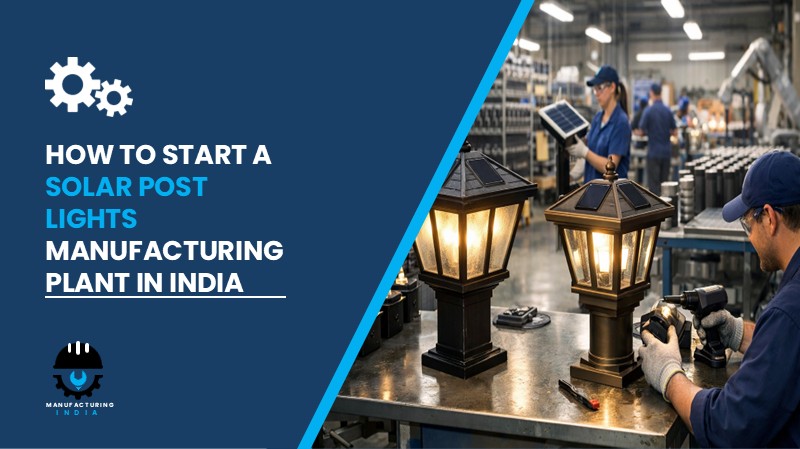
Setting up a solar post lights manufacturing plant in India presents a compelling investment case at a time when the country’s urbanisation momentum, smart city programmes, rural electrification drive, and a nationwide commitment to renewable energy are converging to create exceptional demand for eco-friendly, off-grid outdoor lighting solutions. Solar post lights — self-contained lighting fixtures that feature photovoltaic panels absorbing sunlight during the day and automatically illuminating pathways, gardens, driveways, parks, and perimeter areas at dusk — are among the most practically aligned products with India’s dual challenges of expanding infrastructure reach and reducing dependence on grid electricity. In a country where grid reliability and energy costs remain significant concerns across semi-urban and rural geographies, solar post lights offer an attractive alternative by eliminating wiring requirements, lowering long-term operating expenses, and delivering maintenance-free illumination to communities, campuses, and public spaces that need reliable outdoor lighting without the infrastructure burden of conventional grid-connected systems.
India’s structural advantages for solar post lights manufacturing are substantial and reinforcing. The Asia-Pacific region dominates the global solar post lights market, holding the largest revenue share of 43.8% — and within that region, India’s combination of high solar irradiance, rapidly expanding residential and commercial construction, active smart city and green infrastructure programmes, and strong government policy support positions the country as both one of the world’s most attractive solar post lights markets and one of the most competitive manufacturing bases. The Uttar Pradesh government’s MoU signings to boost solar deployment toward a 500 GW green energy target by 2030 represent just one of many state-level policy signals accelerating solar product adoption across India’s cities and towns. Electronics and solar product manufacturing clusters in Noida, Pune, Hyderabad, and Bengaluru offer the component supply chain access, skilled assembly workforce, and logistics infrastructure that a solar post lights manufacturing facility requires to serve both domestic market demand and export opportunities across Asia and beyond.
Investing in a solar post lights manufacturing plant in India today aligns India’s powerful solar energy policy momentum, expanding smart city and green infrastructure programmes, and rapidly growing residential and commercial construction with Asia-Pacific’s dominant global market position. With gross profit margins of 30–40% and net profit margins of 15–22%, the unit economics are among the most attractive in the solar product manufacturing segment, and the facility’s scalable production model — designed for 500,000 to 2 million units annually — supports commercially robust returns across a well-defined investment horizon.
What are Solar Post Lights?
Solar post lights are eco-friendly, self-contained lighting fixtures designed to illuminate outdoor spaces including pathways, gardens, driveways, and fences without relying on grid electricity. They feature photovoltaic panels that absorb sunlight during the day, converting it into energy stored in rechargeable batteries. Equipped with sensors, they automatically turn on at dusk and switch off at dawn, utilising energy-efficient LEDs for illumination that delivers reliable, consistent outdoor lighting without manual intervention or electricity connection.
These lights are generally crafted from durable, weather-resistant materials including aluminium or stainless steel, offering a maintenance-free, cost-effective, and easy-to-install solution for enhancing security and adding aesthetic appeal to a property’s exterior. Advancements in LED efficiency, lithium battery storage, motion sensing, and smart lighting controls are significantly improving illumination performance and durability, expanding the addressable market from basic residential applications into commercial, hospitality, municipal, and smart city deployments. Solar post lights are a preferred choice for sustainable, off-grid lighting needs where running grid power cabling would be impractical, expensive, or disruptive to existing landscapes and infrastructure.
The primary production process covers injection moulding, LED assembly, soldering, and battery integration. End-use industries served include residential landscaping, commercial outdoor lighting, hospitality, municipal parks, and smart home technology. Applications span garden path illumination, driveway accent lighting, patio and deck ambiance, security floodlighting, and off-grid area lighting solutions.
Cost of Setting Up a Solar Post Lights Manufacturing Plant in India
The cost of establishing a solar post lights manufacturing plant in India depends on plant capacity, product range across residential decorative and commercial or municipal-grade variants, level of in-house photovoltaic cell processing versus solar panel procurement, geographic location, degree of assembly automation, and the BIS and quality certification requirements applicable to solar-powered lighting products sold in the Indian market.
1. Capital Expenditure (CapEx)
Land and Site Development forms a foundational component of total capital investment, covering land acquisition charges, site registration, boundary development, drainage infrastructure, and site utilities. Investors may explore electronics manufacturing clusters, solar product industrial estates, or Special Economic Zones (SEZs) in states such as Uttar Pradesh, Gujarat, Rajasthan, and Tamil Nadu, where proximity to solar panel and LED component suppliers, established logistics infrastructure, and government renewable energy policy support create a commercially advantaged operating environment for solar product manufacturers.
Civil Works and Construction cover the main production hall housing injection moulding machines, LED assembly and soldering stations, battery integration workstations, and solar simulator testing areas, raw material storage for solar panels, LED modules, batteries, and plastic housing components, a quality control laboratory equipped for photovoltaic performance testing, battery charge-discharge cycle testing, and weatherproofing validation, finished goods warehousing, an administrative block, and utilities infrastructure.
Machinery and Equipment represent the largest single component of total CapEx for a solar post lights manufacturing plant. Key machinery required includes:
- Cell tabbers
- Stringers
- Laminators
- Frame crimpers
- Junction box attaching machines
- Solar simulator testers
- Automated assembly lines
Other Capital Costs include an effluent treatment plant (ETP) for managing process water and any battery material handling waste streams, ESD and static control infrastructure for LED and electronics assembly areas, BIS certification and solar product quality testing costs, pre-operative expenses, commissioning charges, and import duties on specialised solar simulator testing equipment not available domestically at the required specification level.
Request a Sample Report for In-Depth Market Insights: https://www.imarcgroup.com/solar-post-lights-manufacturing-plant-project-report/requestsample
2. Operational Expenditure (OpEx)
Raw Material Cost is the dominant operational expense, accounting for approximately 70–80% of total OpEx. The primary raw materials are solar panels, LEDs, batteries, and plastic housing. Solar panels — the photovoltaic cells and modules that convert sunlight into electrical energy — are the highest-value and most technically critical component, driving the majority of raw material cost. Battery storage — increasingly lithium-based for higher energy density, longer cycle life, and better low-temperature performance — is the second most significant input cost. LED modules, charge controllers, and plastic housing components complete the primary material requirement. Long-term procurement contracts with reliable suppliers for all major components are essential for production cost stability and supply continuity.
Utility Cost is the second-largest OpEx component, representing only 5–10% of total operating expenses, reflecting the assembly-intensive rather than energy-intensive nature of solar post lights production. Electricity for injection moulding machines, soldering stations, automated assembly lines, and solar simulator testing equipment constitutes the primary utility input.
Other Operating Costs include transportation and distribution to residential developers, commercial real estate companies, hospitality businesses, municipal procurement agencies, EPC contractors, and retail channels, protective packaging materials for finished products, salaries and wages for assembly operators and quality control technicians, routine machinery maintenance including injection mould servicing and assembly line upkeep, depreciation on production equipment, and applicable taxes. By the fifth year of operations, total operational costs are projected to increase substantially due to inflation, market fluctuations, potential rises in battery and solar panel prices, supply chain disruptions, rising consumer demand, and shifts in the global renewable energy materials economy — all variables requiring careful multi-year financial planning.
3. Plant Capacity
The proposed manufacturing facility for a solar post lights plant is designed with an annual production capacity ranging between 500,000 and 2 million units, enabling economies of scale while maintaining the operational flexibility to serve residential, commercial, hospitality, and municipal customer segments across a range of product specifications and price points. Plant capacity can be customised per investor requirements and scaled through additional assembly lines and injection moulding machines as customer volumes and market penetration grow. Profitability improves with higher capacity utilisation, making supply agreements with large residential developers, government smart city project implementers, or national retail chains a strategic commercial foundation for the investment.
4. Profit Margins and Financial Projections
The financial projections for a solar post lights manufacturing plant demonstrate attractive profitability potential under normal operating conditions. Gross profit margins typically range between 30–40%, supported by the value-added integration of solar, LED, battery, and electronic control systems into a complete, installation-ready product that commands a meaningful premium over its component input cost. Net profit margins are projected at 15–22% — among the strongest in the renewable energy product manufacturing category. A comprehensive financial analysis covering NPV (net present value), IRR (internal rate of return), payback period, gross margin progression, and net margin development across a five-year horizon is essential before committing capital. The project’s ROI profile and long-term sustainability are assessed against realistic assumptions on capital investment, production capacity utilisation, solar panel and battery pricing trends, and demand outlook from the residential, commercial, hospitality, and municipal end-use sectors.
Why Set Up a Solar Post Lights Plant in India?
Asia-Pacific Market Leadership and India’s Strategic Position. The Asia-Pacific region dominates the global solar post lights market, holding the largest revenue share of 43.8%, with India positioned as one of the region’s most rapidly growing solar product markets. India’s combination of high solar irradiance, expanding construction activity, and strong renewable energy policy support makes it simultaneously one of the world’s most attractive markets for solar post lights products and one of the most cost-competitive manufacturing bases for export-oriented production targeting the broader Asia-Pacific region.
Accelerating Urbanisation and Smart City Infrastructure Demand. According to UN-Habitat, by 2030, nearly 60% of the world’s population will live in urban areas. India’s urban expansion is particularly rapid, with hundreds of new residential townships, commercial developments, and institutional campuses being developed annually — each requiring outdoor pathway, perimeter, and landscape lighting that solar post lights can deliver at lower total cost of ownership and without the grid infrastructure complexity of conventional wired systems. Expanding smart city initiatives and green infrastructure programmes are specifically supporting the deployment of solar-based outdoor lighting across public spaces.
Growing Emphasis on Reducing Electricity Consumption and Carbon Footprints. The accelerating shift toward renewable energy adoption, smart cities, energy-efficient buildings, and off-grid lighting solutions is driving steady demand for autonomous solar lighting systems. Urban planners, residential communities, and commercial developers are increasingly prioritising sustainable outdoor lighting solutions that align with green building norms, corporate ESG commitments, and municipal sustainability targets — all of which create sustained institutional demand for solar post lights from buyers who prioritise lifecycle cost and environmental credentials alongside initial price.
India-Specific Grid Reliability and Energy Cost Drivers. In emerging markets such as India, where grid reliability and energy costs remain key concerns across semi-urban and rural geographies, solar post lights offer an attractive alternative by eliminating wiring requirements and lowering long-term operating expenses. This India-specific demand driver — particularly relevant for tier-2 and tier-3 cities, peri-urban townships, agricultural estates, and rural electrification projects — provides a domestic demand foundation that goes beyond the aesthetic and sustainability motivations dominant in developed markets.
Policy Support and Government Solar Targets. Government initiatives promoting renewable energy deployment, energy conservation, rural infrastructure development, public park upgrades, and smart city programmes indirectly strengthen demand for solar lighting solutions. The Uttar Pradesh government’s MoU signings to boost solar push, targeting 500 GW green energy by 2030, represents the scale of policy commitment at the state level that is translating into procurement programmes and infrastructure investments directly benefiting solar post lights manufacturers. National rooftop solar subsidies, green building norms, and domestic manufacturing incentives further strengthen the investment environment.
Product Innovation Driving Market Expansion. In January 2026, Festive Lights announced the formal introduction of its “More Solar, More Power, More Choices” initiative, marking a transition in product engineering toward higher-efficiency photovoltaic cells and high-capacity energy storage systems — a development that signals the direction of product innovation across the solar post lights category. Advancements in LED efficiency, lithium battery storage, motion sensing, and smart lighting controls are significantly improving illumination performance and durability, broadening the solar post lights market from basic residential applications into commercial, hospitality, and institutional deployments that command premium price points and higher margins.
Manufacturing Process — Step by Step
The solar post lights manufacturing process uses injection moulding, LED assembly, soldering, and battery integration as the primary production method. Each stage requires controlled process parameters and quality verification to deliver solar post lights that consistently meet photovoltaic performance, battery capacity, LED luminous output, weatherproofing, and operational cycle specifications required by residential, commercial, and municipal customers.
- Plastic Housing Injection Moulding: Post bodies, lamp heads, solar panel housing frames, and mounting bases are produced from weather-resistant polymer compounds using injection moulding machines, with controlled mould temperature, injection pressure, and cooling time parameters to achieve the dimensional accuracy and surface quality required for weatherproof outdoor product assembly.
- Solar Panel Assembly — Cell Tabbing and Stringing: Photovoltaic cells are connected in series and parallel configurations using cell tabbers and stringers to build solar panel assemblies of the specified voltage and current output capacity for the target product specification.
- Lamination: Assembled solar cell strings are encapsulated with EVA film and protective back sheet material using laminators operating at controlled temperature and pressure to produce weatherproof, UV-resistant solar panel modules that maintain photovoltaic performance throughout the product’s outdoor service life.
- Frame Crimping: Laminated solar panel modules are framed using frame crimpers that apply aluminium or polymer frames to protect panel edges, provide structural rigidity, and create the mounting interface for integration into the solar post light housing.
- Junction Box Attachment: Electrical junction boxes are attached to the back of framed solar panels using junction box attaching machines, with soldered connections to the cell string output leads providing the sealed, weatherproof electrical interface between the solar panel and the charge controller and battery circuit.
- LED Assembly and Soldering: LED modules are assembled onto circuit boards and soldered at soldering stations, with charge controllers, motion sensors, and battery management electronics integrated into the complete light head assembly that controls energy flow between solar panel, battery, and LED output.
- Battery Integration: Rechargeable battery packs — increasingly lithium-based for superior performance — are integrated into the post light body with appropriate electrical connections to the charge controller and battery management system, ensuring safe charging, discharging, and thermal management across outdoor operating temperature ranges.
- Solar Simulator Testing: Assembled solar post lights are evaluated at solar simulator testers that expose products to calibrated artificial sunlight to verify photovoltaic output, charge controller function, battery charging performance, LED luminous output, and automatic dusk-to-dawn sensor operation against specification before packaging.
- Automated Assembly and Packaging: Inspected and approved solar post lights are assembled with mounting hardware and completed packaging using automated assembly lines, then packed for dispatch to residential landscaping, commercial outdoor lighting, hospitality, municipal parks, and smart home technology customers.
Key Applications
Solar post lights manufactured in India serve a broad and commercially growing range of outdoor lighting applications across residential, commercial, and public infrastructure sectors:
- Solar Post Lights Core Application: Internal battery wiring, LED module connections, and charge controller links across all product variants from residential decorative to commercial-grade security lighting systems.
- Outdoor Landscape Lighting: Low-voltage, self-contained lighting assemblies and weather-resistant fixtures for garden paths, ornamental landscaping, and outdoor recreational areas in residential and commercial properties.
- Residential and Commercial Perimeter Lighting: Grounding-integrated post lights and pole-top lighting solutions for boundary demarcation, perimeter security, and building entrance illumination across apartments, villas, commercial campuses, and institutional properties.
- Renewable Energy Systems: Solar panel leads, DC power transmission, and integrated energy storage configurations enabling off-grid lighting deployment in rural areas, agricultural estates, and locations without reliable grid connectivity.
Leading Manufacturers
The global solar post lights industry is served by a group of established consumer and commercial outdoor lighting specialists and dedicated solar lighting producers. Key players in the global market include:
- Gama Sonic
- Classy Caps
- Hardoll
- HeiSolar
- Philips
Timeline to Start the Plant
Establishing a solar post lights manufacturing plant in India involves a structured multi-phase development sequence. Investors should plan for the following phases:
- Feasibility study and project report preparation
- Land acquisition and site development
- Regulatory approvals and environmental clearances
- Factory licence and fire safety compliance
- Machinery procurement and installation
- Raw material supplier agreements and supply chain setup
- Trial production and quality testing
- Commercial production launch
Licences and Regulatory Requirements
Starting a solar post lights manufacturing unit in India requires several approvals spanning business registration, renewable energy product certification, environmental, and industrial safety compliance domains:
- Business registration (Proprietorship, LLP, or Pvt Ltd)
- Factory Licence under the Factories Act
- Environmental Clearance from the State Pollution Control Board
- GST Registration
- Fire Safety NOC
- BIS (Bureau of Indian Standards) certification applicable to LED luminaires and solar-powered lighting products under applicable IS standards and the Electronics and Information Technology Goods Compulsory Registration framework
- Battery handling and disposal compliance under the Battery Waste Management Rules applicable to lithium battery-integrated products
- Effluent Treatment Plant (ETP) operational clearance
- Occupational Health and Safety compliance
Key Challenges to Consider
Solar Panel and Battery Cost Volatility. Solar panels and batteries together account for the dominant share of the 70–80% raw material OpEx proportion, with solar panel pricing tied to global polysilicon and module manufacturing economics and battery pricing linked to lithium carbonate and lithium hydroxide commodity markets — both subject to significant price fluctuations driven by global supply-demand dynamics and geopolitical factors. Active procurement risk management, long-term supplier contracts, and strategic inventory positioning are essential for margin protection.
Component Import Dependence. India’s domestic manufacturing capacity for high-efficiency photovoltaic cells and lithium battery cells remains limited, creating a structural import dependence for these highest-value components from primarily Chinese and Taiwanese manufacturers. Currency exposure, import duty policy changes, and global supply chain disruptions can all affect component availability and cost, requiring diversified sourcing strategies and domestic alternative development as part of the long-term supply chain plan.
Weatherproofing and Product Durability Standards. Solar post lights must withstand outdoor operating conditions including heavy monsoon rainfall, high humidity, temperature extremes, dust, and UV exposure across a product service life that customers expect to extend several years. Achieving and consistently maintaining the IP rating, corrosion resistance, and battery cycle life specifications required for institutional and municipal customer segments demands rigorous weatherproofing design, materials quality control, and accelerated weathering testing as integral parts of the manufacturing quality system.
BIS Certification and Regulatory Compliance. Solar-powered LED lighting products sold in India require BIS certification under applicable IS standards, and battery-integrated products must comply with Battery Waste Management Rules for end-of-life disposal and producer responsibility requirements. Managing these certification obligations alongside ongoing product development adds regulatory complexity and compliance cost that must be planned from the outset.
Competition from Established Players and Imported Products. The solar post lights market is served by established global brands including Gama Sonic, HeiSolar, and Philips alongside a substantial volume of imported products from Chinese manufacturers at competitive price points. New Indian producers must differentiate through after-sales service reliability, product quality consistency, customisation for Indian climatic conditions, and competitive pricing to win and retain accounts with large residential developers and municipal procurement agencies.
Skilled Manpower for Solar Electronics Assembly. Maintaining the LED soldering quality, battery integration accuracy, and electrical performance consistency required for solar post lights that meet outdoor durability and photovoltaic efficiency specifications demands trained electronics assembly technicians and product testing engineers — a specialised workforce requiring ongoing investment in training, workplace quality culture, and competitive retention programmes.
Frequently Asked Questions
1. How much does it cost to set up a solar post lights manufacturing plant in India?
The total setup cost depends on plant capacity, product range across residential and commercial grades, level of in-house solar panel processing versus module procurement, location, and assembly automation level. CapEx covers land and site development, solar product assembly facility construction, core machinery including cell tabbers, stringers, laminators, frame crimpers, junction box attaching machines, solar simulator testers, and automated assembly lines, along with BIS certification, ETP, and other capital costs. A detailed project report with full CapEx and OpEx breakdowns is available on request.
2. Is solar post lights manufacturing profitable in India in 2026?
Yes. The project demonstrates gross profit margins of 30–40% and net profit margins of 15–22% under normal operating conditions — among the strongest financial performance profiles in the renewable energy product manufacturing segment. These margins are supported by value-added integration of photovoltaic, battery, LED, and smart control systems, combined with strong and growing demand from residential, commercial, hospitality, and municipal customers across India’s expanding outdoor lighting market.
3. What machinery is required for a solar post lights plant in India?
Key machinery includes cell tabbers, stringers, laminators, frame crimpers, junction box attaching machines, solar simulator testers, and automated assembly lines. The scale and automation level of the assembly configuration determine total production capacity and machinery capital investment.
4. What licences and approvals are required to start a solar post lights plant in India?
Required approvals include business registration, a Factory Licence under the Factories Act, Environmental Clearance from the State Pollution Control Board, GST registration, a Fire Safety NOC, BIS certification for LED and solar-powered lighting products, battery waste management compliance under the Battery Waste Management Rules, ETP operational clearance, and Occupational Health and Safety compliance.
5. What raw materials are needed for solar post lights manufacturing?
The primary raw materials are solar panels, LEDs, batteries, and plastic housing. Solar panels and batteries account for the dominant share of the 70–80% raw material OpEx proportion, making photovoltaic component and battery procurement strategy, supplier contracts, and commodity price risk management the most critical cost management levers for the investment.
6. What are the environmental compliance requirements for a solar post lights plant in India?
The unit must obtain Environmental Clearance from the State Pollution Control Board, operate a certified ETP for process water management, comply with Battery Waste Management Rules for lithium battery handling and end-of-life responsibility, and implement monitoring systems for wastewater discharge and air emissions from injection moulding and soldering operations in line with applicable state pollution control standards.
7. What is the best location to set up a solar post lights plant in India?
Optimal locations offer proximity to solar panel, LED, and battery component supply chains, reliable utilities, skilled electronics assembly workforce availability, and logistics connectivity to large residential, commercial, and municipal outdoor lighting markets. Electronics and renewable energy product manufacturing clusters in Noida, Pune, Hyderabad, Bengaluru, and Ahmedabad are among the most strategically relevant options for this investment.
8. What is the break-even period for this type of plant in India?
The break-even period depends on plant capacity, product mix across residential and commercial grades, capacity utilisation rate, solar panel and battery pricing trends, and demand conditions across the residential, commercial, and municipal customer segments. A detailed financial analysis including payback period, NPV, and IRR projections is included in the full project report, available via the sample request link.
9. What government incentives are available for manufacturers in India?
The Make in India initiative, PLI scheme for solar PV manufacturing and related products, rooftop solar subsidies, smart city programme procurement preferences, and state-level renewable energy manufacturing incentives provide financial and regulatory support for solar post lights production investments. State governments in Uttar Pradesh, Gujarat, and Rajasthan — each with active solar energy targets — may offer additional capital subsidies, power tariff concessions, and land cost benefits for solar product manufacturers.
Key Takeaways for Investors
A solar post lights manufacturing plant in India represents a commercially well-timed and financially attractive investment opportunity at the intersection of India’s renewable energy transition, smart city ambitions, urbanisation growth, and rural infrastructure development — sectors that collectively create one of the most diverse and policy-supported outdoor solar lighting demand environments in the world. The project demonstrates compelling financial viability across annual production capacities of 500,000 to 2 million units, with gross profit margins of 30–40% and net profit margins of 15–22% confirming strong unit economics that reflect the meaningful value-added integration of solar, battery, LED, and smart control systems into a complete, installation-ready product. With Asia-Pacific dominating the global solar post lights market at 43.8% revenue share, India’s domestic market growing rapidly under the impetus of smart city programmes, 500 GW renewable energy targets, and urbanisation driven by a projected 60% urban population share by 2030, the demand sustainability for India-based solar post lights production is structurally robust and commercially compelling across the full investment horizon. Advancements in LED efficiency, lithium battery storage, motion sensing, and smart lighting controls are continuously expanding the addressable market and improving product value propositions — ensuring that this investment remains at the leading edge of India’s outdoor lighting transformation for years to come.
About the Author