Supplier selection is a multi-year commitment, yet many manufacturers feel its weaknesses within the first twelve months. RapidRatings’ 2026 Annual Risk Survey found that 82% of enterprises reported a material supplier disruption in the past 12 months.
India’s supplier base is wide and fragmented. The Udyam portals listed 9.16 crore registered MSMEs by 31 July 2026, including 1.83 crore manufacturing enterprises, so structured criteria matter far more than directory listings.
Specialist supplier evaluation services help businesses shortlist and assess potential vendors against consistent criteria covering technical capabilities, product quality, regulatory compliance, financial stability, production capacity, delivery reliability and commercial terms. On-site audits and supporting documentation can help verify supplier claims, while post-qualification performance monitoring helps businesses maintain quality standards and reduce supply chain risks. The sections below explain the key criteria for evaluating and selecting reliable suppliers.
Why Does Supplier Evaluation Matter More in 2026?
Supplier failures are now expensive, frequent and often invisible until the damage is done.
- Cost: direct procurement disruptions cost organisations an average of US$16 million a year, according to Coupa’s 2026 findings.
- Causes: in a 2026 survey of 2,805 organisations, about 31% named supplier financial distress, and a similar share named quality failures, as their most common disruption.
- Tooling: nearly 58% of those organisations manage supplier risk without any dedicated software platform.
- Risk perception: 66% of enterprises rate supply chain risk as high or very high in 2026.
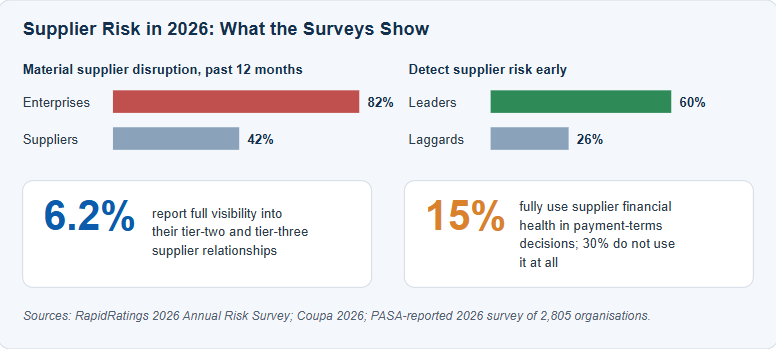
The gap is visibility. Suppliers report disruption at about half the rate their buyers do, so buyers need independent evidence rather than self-reported performance.
What Are the Key Criteria for Evaluating a Supplier?
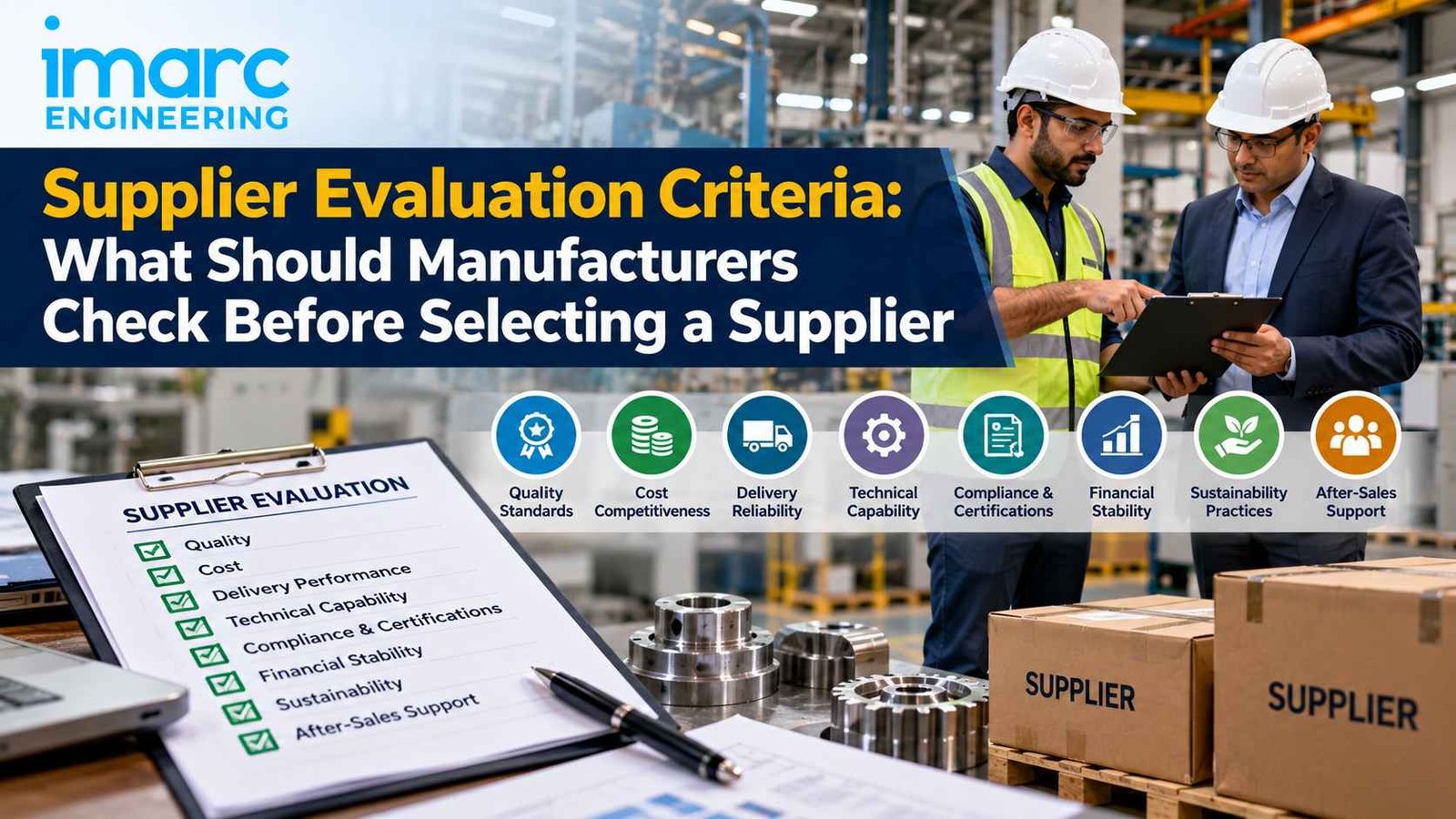
Manufacturers should evaluate suppliers on eight dimensions: technical capability, quality systems, capacity, financial stability, compliance and ESG, commercial terms, delivery reliability and communication fit, each weighted by category risk.
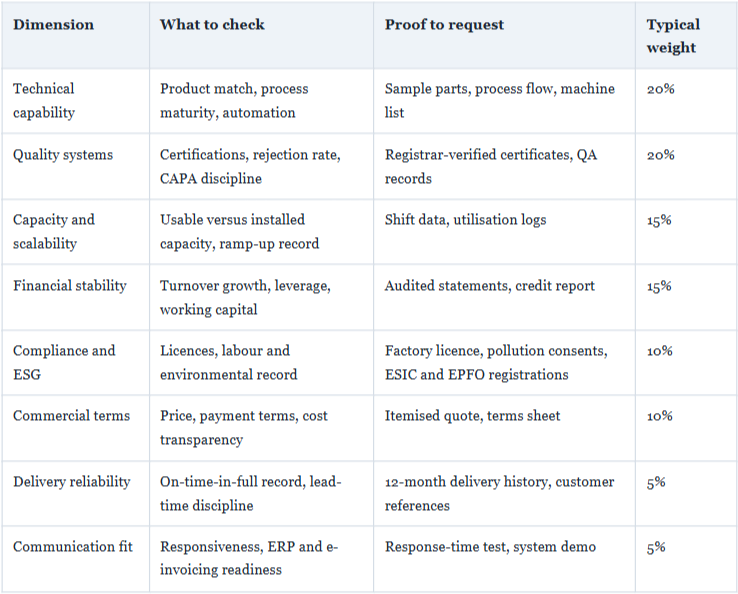
Weights should shift with category risk. A regulated pharma intermediate needs heavier quality and compliance weights than a packaging consumable. Applying one rubric to every candidate also keeps the final recommendation defensible with audit committees and lenders.
Price alone misleads. A supplier quoting below the shortlist benchmark but running 3 times the rejection rate and twice the on-time-in-full miss rate usually costs more once rework, expediting and safety stock are loaded.
Which Compliance and Certification Checks Should Come First?
A reliable verification process layers four checks, because each catches a different failure mode:
- Documentary: GSTIN, PAN, Import-Export Code, Udyam registration, factory licence and audited financials.
- Digital database: MCA21 filings, GST portal status, credit reports, NCLT and court records, plus sanctions and adverse-media screening.
- Registrar: confirm ISO 9001 and sector certificates such as IATF 16949, ISO 13485, WHO-GMP and FSSC 22000 directly with the issuing body.
- References: speak to three current customers, ideally one international.
ZED certification adds a useful quality signal. As of May 2026, 6.68 lakh of the 93.61 lakh MSMEs registered for ZED were certified, about 7%.
What Should a Supplier Audit Verify On Site?
Desk research can cut 20 candidates to five, but it cannot choose between them. In IMARC’s audit experience, 20% to 35% of supplier claims fail at least one ground-truth check, and usable capacity can run 30% to 50% below brochure claims.
- Machine count and age that differ from the published profile.
- Expired or missing calibration certificates on measuring instruments.
- A workforce much smaller than the claimed headcount.
- Incomplete or back-dated QA rejection and CAPA registers.
- Another brand’s labels or orders on the shop floor, which can signal undisclosed sub-contracting.
What India-Specific Risks Should Manufacturers Check?
- Size mix: about 99.4% of registered MSMEs are micro enterprises, and only about 5.8 lakh are small or medium. Quality depth and scale must be checked, not assumed.
- Output share: MSMEs account for 35.4% of manufacturing output and 48.58% of exports as of January 2026, so most buyers will source from them.
- Payment discipline: the MSME Samadhaan portal had received 2,56,892 delayed-payment applications worth ₹55,244 crore by June 2026. Supplier cash stress often traces back to buyer terms, so review both sides.
- Sub-contracting: ask for a written list of job-work vendors and audit the critical ones.
How Should Manufacturers Score and Select the Final Supplier?
A staged funnel keeps the process objective:
- Long-list: 20 to 30 candidates from directories, trade bodies and referrals.
- Shortlist: 6 to 8 candidates through weighted scoring.
- Audit: on-site inspection of every shortlisted supplier.
- Due diligence: financial, legal and ESG checks on the top 3 or 4.
- Pilot: a multi-lot trial before the full contract.
Structured long-listing helps buyers reach the right supplier 40% to 60% faster. In a three-supplier illustration, the lowest-priced bidder scored 7.15 out of 10, a financially strong one 7.25, and the most balanced candidate 7.45, which shows why even performance across criteria beats a single standout metric.
Read our detailed analysis here: https://www.imarcengineering.com/blog/how-to-identify-reliable-industrial-suppliers-in-india
How IMARC Engineering’s Expertise Can Help in Supplier Evaluation
- Long-list and shortlist development: cluster-level mapping by tier, sector credentials and compliance maturity.
- Weighted scoring models: criteria tuned to category risk and tested for sensitivity.
- On-site audits and verification: factory inspection, registrar checks and reference calls.
- Due diligence and onboarding: financial, legal and ESG screening, pilot monitoring and surveillance audits.
Consult With Our Experts: https://www.imarcengineering.com/contact?service=supplier-identification-and-evaluation
Conclusion
Supplier evaluation works when it is systematic. Weighted criteria, independent verification and on-site proof turn claims into evidence, while continuous monitoring catches drift after award. With disruption now routine, manufacturers that invest in evaluation before the first purchase order protect cost, quality and continuity, and build a supplier base that improves with every review cycle.
Contact Us:
IMARC Engineering
Phone: +91-120-433-0800
Email: sales@imarcengineering.com
India: C-130, Sector 2, Noida, Uttar Pradesh 201301
LinkedIn: https://www.linkedin.com/showcase/imarc-engineering/
About the Author