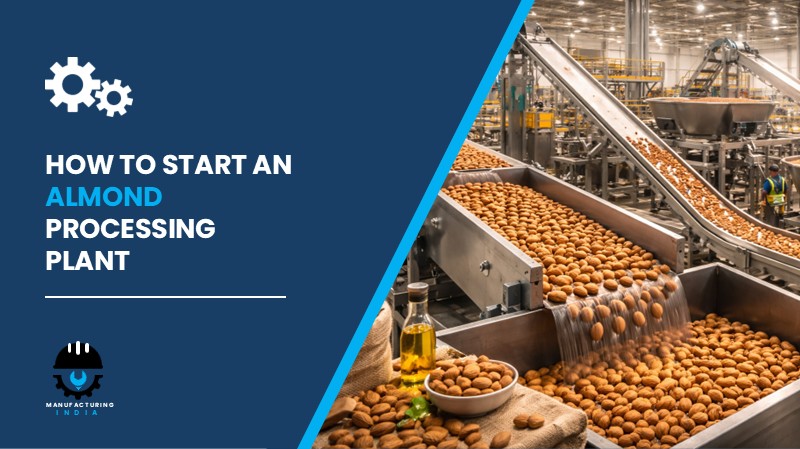
Setting up an almond processing plant in India presents a compelling investment case for entrepreneurs and institutional investors seeking long-term returns in the agri-food processing sector. The demand for almonds and almond-derived products is accelerating across India’s food processing industry, confectionery and bakery sector, dairy alternatives market, nutraceuticals segment, and the health and wellness segment. As Indian consumers increasingly shift toward nutrient-dense snacking and plant-based diets, the commercial case for domestic almond processing has never been stronger.
India’s strategic advantages make it an ideal location for setting up an almond processing facility. The country’s rapidly expanding urban population, growing modern retail infrastructure, and government-backed programmes such as the Make in India initiative offer a favourable operating environment. Key manufacturing states such as Gujarat, Maharashtra, and Uttar Pradesh provide access to robust transportation networks, industrial estates, and skilled labour pools. With rising import demand for processed almonds and value-added almond products, establishing a domestic processing unit offers a direct route to capturing margin across the supply chain.
India stands at the intersection of surging domestic demand, policy support under Make in India, and a cost-competitive manufacturing environment. An almond processing facility targeting the food processing industry, dairy alternatives, and nutraceuticals markets can deliver gross profit margins of 20–30% and a net margin of 8–12%, making the investment case both credible and commercially viable.
What is Almond?
Almonds are the edible seeds derived from the fruit of the almond tree (Prunus dulcis), a plant belonging to the Rosaceae family. Classified botanically as drupes or stone fruits due to their hard outer shell, almonds are consumed as the inner kernel, which is dense with nutrition. They carry a mild, slightly sweet taste and an extremely crunchy texture, and are consumed raw, roasted, or processed into a wide range of derived products including almond flour, almond butter, almond milk, and almond oil.
From a nutritional standpoint, almonds are an excellent source of healthy monounsaturated fats, plant-based proteins, dietary fibres, vitamins – particularly Vitamin E and B-complex – and minerals including magnesium, calcium, and potassium, as well as antioxidants. These properties support heart health, weight management, and brain function, which has contributed significantly to their global commercial appeal.
The production process for an almond processing unit involves a multi-step operation: cleaning, grading, shelling, blanching, roasting, slicing or grinding, almond oil extraction, quality inspection, and packaging. The end-use industries served by a processed almond facility include the food processing industry, confectionery and bakery sector, dairy alternatives, nutraceuticals, the health and wellness segment, and retail grocery distribution. Applications span household consumption, commercial bakery products, almond milk and dairy substitutes, confectionery production, snack foods, and cosmetic-grade almond oil.
Cost of Setting Up an Almond Processing Plant in India
The total cost of establishing an almond processing plant in India depends on several interrelated variables: plant capacity, technology selection, geographic location, level of automation, and regulatory compliance requirements. A systematic cost assessment – covering both capital and operational expenditure – is essential before committing to the investment.
1. Capital Expenditure (CapEx)
Land and Site Development: forms a substantial part of the overall investment. This includes charges for land registration, boundary development, and associated preparatory expenses. Investors may consider locating the facility within a Special Economic Zone (SEZ) or notified industrial estate to access infrastructure support, tax incentives, and lower land acquisition costs in states such as Gujarat or Maharashtra.
Civil Works and Construction: cost cover the construction of the processing shed, quality control laboratory, raw material storage area, finished goods warehouse, and administrative block. The layout must incorporate separate zones for raw material handling, production, and dispatch to ensure operational safety and efficiency.
Machinery and Equipment: represent the single largest component of capital expenditure. Key machinery required includes:
- Cleaners
- Shellers
- Blanchers
- Roasters
- Grinders
- Oil extractors
- Conveyors
- Packaging machines
Other Capital Cost: include installation of an Effluent Treatment Plant (ETP), pre-operative expenses, plant commissioning charges, and any applicable import duties on specialised processing equipment.
Request a Sample Report for In-Depth Market Insights: https://www.imarcgroup.com/almond-processing-plant-project-report/requestsample
2. Operational Expenditure (OpEx)
Raw Material Cost – is the dominant driver of operating expenditure. Raw almonds, the core input material, account for approximately 80–85% of total OpEx. Given this concentration, securing long-term procurement contracts with reliable suppliers is critical to managing price volatility and ensuring continuity of production. Investors should evaluate supplier proximity to minimise inbound transportation costs and build supply chain resilience.
Utility Cost – covering electricity, water, and steam – accounts for approximately 5–10% of total operating expenditure. Facilities should assess local utility tariffs at the time of site selection to optimise this cost component.
Other Operating Cost – include transportation and logistics, packaging materials, salaries and wages, ongoing maintenance, depreciation on fixed assets, and applicable taxes. By the fifth year of operations, total operational costs are projected to increase substantially relative to Year 1, driven by inflation, market fluctuations, and potential rises in the cost of key raw materials. Factors including supply chain disruptions, rising consumer demand, and shifts in the global economy are expected to contribute to this escalation, and financial planning should account for a conservative 5-year cost increase projection.
3. Plant Capacity
The proposed processing facility is designed with an annual production capacity ranging between 10,000 and 20,000 MT of almonds, enabling economies of scale while maintaining operational flexibility. Capacity can be customised according to investor requirements, and profitability improves with higher capacity utilisation as fixed costs are spread across a larger production volume. Investors with phased capital deployment strategies may opt to commission at the lower end of this range and expand as market demand is validated.
4. Profit Margins and Financial Projections
The financial viability of this investment is supported by healthy projected margins. Gross profit margins typically range between 20–30%, while net profit margins range between 8–12% under normal operating conditions. The detailed financial model covers NPV (Net Present Value), IRR (Internal Rate of Return), payback period, liquidity analysis, profitability analysis, uncertainty analysis, and sensitivity analysis. These projections are based on realistic assumptions related to capital investment, operating costs, production capacity utilisation, pricing trends, and demand outlook, providing a comprehensive view of the project’s long-term financial sustainability.
Why Set Up an Almond Processing Plant in India?
Rising Health Awareness Among Indian Consumers: Almonds are globally recognised as nutrient-dense foods that support heart health and overall wellness. According to industry data, 56% of consumers enjoy a healthy snack at least once daily, compared to 49% for indulgent snacks. India’s health-conscious urban middle class represents a large and rapidly growing addressable market for processed almond products.
Growing Demand in the Confectionery and Bakery Sector: Almonds are critical ingredients in premium chocolates, pastries, and snack foods. The expansion of organised food retail and premium bakery chains in India is driving sustained institutional demand for blanched, sliced, and roasted almonds at scale.
Expanding Plant-Based and Dairy Alternative Markets: The growing popularity of almond milk and almond-based dairy substitutes – including almond-based yogurts – is expanding the addressable market for processed almonds significantly. Almond milk and almond butter cater to India’s growing vegan and lactose-intolerant population segments.
Policy and Regulatory Tailwinds: India’s Make in India initiative and food processing sector schemes support investment in agri-processing infrastructure. Setting up production within an SEZ or industrial estate can provide access to capital subsidies, concessional power tariffs, and simplified regulatory processes for eligible investors.
Cost-Competitive Manufacturing Environment: India offers access to competitively priced industrial land, lower construction costs relative to Western markets, and a large skilled and semi-skilled labour pool. These structural cost advantages support stronger operating margins compared to processing facilities in higher-cost geographies.
Active Industry Investment and Latest Developments: In September 2025, EAT and the Almond Board of California formed a strategic partnership to promote sustainable, healthy diets and responsible almond production, launched at the Stockholm Food Forum 2025. In February 2025, Blue Diamond Almonds partnered with Mike’s Hot Honey to launch Hot Honey Almonds, a product combining honey and chili flavors with almonds, available in select Walmart stores. These developments demonstrate active innovation and cross-sector investment interest in the almond category globally.
Manufacturing Process – Step by Step
The almond processing manufacturing process uses cleaning, grading, shelling, blanching, roasting, slicing or grinding, almond oil extraction, quality inspection, and packaging as the primary production method. The following steps outline the full unit operation sequence:
- Cleaning: Raw almonds are passed through industrial cleaners to remove dust, debris, foreign matter, and undersized kernels.
- Grading: Cleaned almonds are sorted by size and quality using grading equipment to ensure uniformity for downstream processing.
- Shelling: Almonds pass through shellers to separate the hard outer shell from the edible kernel.
- Blanching: Kernels are subjected to a blanching process using hot water or steam to remove the skin and prepare the almond for further processing.
- Roasting: Blanched or unblanched almonds are roasted at controlled temperatures to develop flavour profiles required for snack and confectionery applications.
- Slicing or Grinding: Roasted or blanched almonds are passed through slicers or grinders to produce almond slices, flakes, or almond flour depending on the end-use application.
- Almond Oil Extraction: A portion of production may be directed toward oil extraction equipment to produce edible, cosmetic, or pharmaceutical-grade almond oil.
- Quality Inspection: Each batch undergoes technical tests and quality assurance checks covering concentration, purity, and stability parameters before dispatch clearance is issued.
- Packaging and Dispatch: Finished products – raw almonds, roasted almonds, blanched almonds, almond flour, almond oil – are packaged per retail, institutional, or industrial specifications and dispatched to end-use industries including the food processing industry, confectionery and bakery sector, dairy alternatives manufacturers, nutraceuticals producers, and retail grocery distribution channels.
Key Applications
An almond processing plant in India serves a broad and diversified base of end-use industries across the food, health, and personal care segments:
- Food Processing Industry: Almonds and almond-derived products are essential ingredients for bakery, confectionery, and snack production at industrial scale.
- Dairy Alternatives: Almond milk and almond-based dairy substitutes are growing rapidly among health-conscious consumers and lactose-intolerant populations.
- Retail and Household Consumption: Raw, roasted, blanched, and sliced almonds are widely sold through modern retail and e-commerce channels as snacks and cooking ingredients.
- Almond Oil Production: Almond oil finds application in edible, cosmetic, and pharmaceutical markets, broadening the revenue profile of the processing unit.
- Nutraceuticals and Health and Wellness Segment: Almond-based health supplements and functional food ingredients are experiencing rising demand across India’s premium health and wellness retail segment.
Leading Manufacturers
The global almond processing market is served by several large-scale multinational companies with diversified product portfolios and established supply chains. Key players operating in this sector include:
- Blue Diamond Growers
- Wonderful Pistachios & Almonds
- Panoche Creek Packing
- Spycher Brothers
- Select Harvest
- Mariani Nut Company
- Waterford Nut Co.
Timeline to Start the Plant
- Feasibility study and project report preparation
- Land acquisition and site development
- Regulatory approvals and environmental clearances
- Factory licence and fire safety compliance
- Machinery procurement and installation
- Raw material supplier agreements and supply chain setup
- Trial production and quality testing
- Commercial production launch
Licences and Regulatory Requirements
Starting an almond processing unit in India requires several approvals:
- Business registration (Proprietorship, LLP, or Private Limited Company)
- Factory Licence under the Factories Act
- Environmental Clearance from the State Pollution Control Board
- GST Registration
- Fire Safety NOC
- Effluent Treatment Plant (ETP) operational clearance
- Food Safety and Standards Authority of India (FSSAI) licence for food processing operations
- Occupational Health and Safety compliance
Key Challenges to Consider
High Capital Requirements: Establishing an almond processing plant with a capacity of 10,000–20,000 MT per annum requires significant upfront capital across land, civil works, and equipment, necessitating thorough financial planning and phased investment strategies.
Raw Material Price Volatility: Raw almonds account for approximately 80–85% of total OpEx, making the plant highly sensitive to fluctuations in almond procurement prices. Long-term supplier contracts and diversified sourcing strategies are essential risk mitigation tools.
Regulatory Compliance: Food processing operations in India are subject to FSSAI licensing, environmental clearances, factory act compliance, and ETP operational requirements. Navigating these approvals requires dedicated regulatory management and timeline planning.
Technology and Innovation Pressure: The global almond market is evolving rapidly with increasing demand for value-added products such as blanched almonds, almond flour, almond butter, and cosmetic-grade almond oil. Facilities must invest in equipment that supports product diversification to remain competitive.
Competition from Established Global Players: The market is served by large global processors including Blue Diamond Growers, Select Harvest, and Mariani Nut Company. Domestic producers must differentiate on speed-to-market, localisation, and cost competitiveness to capture market share.
Skilled Manpower: Operating blanchers, roasters, oil extractors, and quality assurance systems requires a trained technical workforce. Sourcing and retaining skilled operators and quality control personnel in target manufacturing states requires structured HR planning.
Frequently Asked Questions
1. How much does it cost to set up an almond processing plant in India?
The total investment depends on plant capacity, location, machinery selection, and automation level. The proposed facility is designed for a capacity of 10,000–20,000 MT per annum.
2. Is almond processing manufacturing profitable in India in 2026?
Yes. Gross profit margins for an almond processing plant typically range between 20–30%, with net profit margins of 8–12%, supported by stable demand across the food processing, dairy alternatives, and nutraceuticals sectors.
3. What machinery is required for an almond processing plant in India?
Key machinery includes cleaners, shellers, blanchers, roasters, grinders, oil extractors, conveyors, and packaging machines.
4. What licences and approvals are required to start an almond processing plant in India?
Required approvals include business registration, Factory Licence, FSSAI licence, Environmental Clearance from the State Pollution Control Board, GST Registration, Fire Safety NOC, ETP clearance, and Occupational Health and Safety compliance.
5. What raw materials are needed for almond processing manufacturing?
The primary raw material is raw almonds, which constitute approximately 80–85% of total operating costs. Long-term supplier contracts are recommended to manage price volatility.
6. What are the environmental compliance requirements for an almond processing plant in India?
The facility must obtain Environmental Clearance from the State Pollution Control Board and operate a compliant Effluent Treatment Plant (ETP) to manage wastewater and ensure adherence to emission standards.
7. What is the best location to set up an almond processing plant in India?
Industrial estates or SEZs in Gujarat, Maharashtra, and Uttar Pradesh offer strong infrastructure, transportation connectivity, and proximity to distribution markets. Site selection should also account for access to raw almonds, labour availability, and utility costs.
8. What is the break-even period for this type of plant in India?
The break-even period is detailed in the full financial analysis, which covers payback period, NPV, and IRR projections based on capacity utilisation and pricing assumptions. Request the sample for specific data.
9. What government incentives are available for manufacturers in India?
Investors may access incentives under the Make in India initiative, food processing sector schemes, and state industrial policies including capital subsidies, power tariff concessions, and simplified approvals within SEZs and notified industrial estates.
Key Takeaways for Investors
An almond processing plant in India represents a commercially sound and strategically well-timed investment, driven by accelerating demand across the food processing industry, confectionery and bakery sector, dairy alternatives market, nutraceuticals segment, and retail grocery distribution channels. The financial projections demonstrate viability across the proposed capacity range of 10,000–20,000 MT per annum, with gross margins of 20–30% and net margins of 8–12% achievable under normal operating conditions. The global almond market was valued at 1.70 million tons in 2025 and is projected to reach 2.28 million tons by 2034 at a CAGR of 3.3%, providing a durable long-term demand runway for new capacity. With active industry investment, expanding plant-based food adoption, and India’s cost-competitive manufacturing environment, the demand outlook for domestically processed almonds remains robust and sustainable over the foreseeable horizon.
About the Author