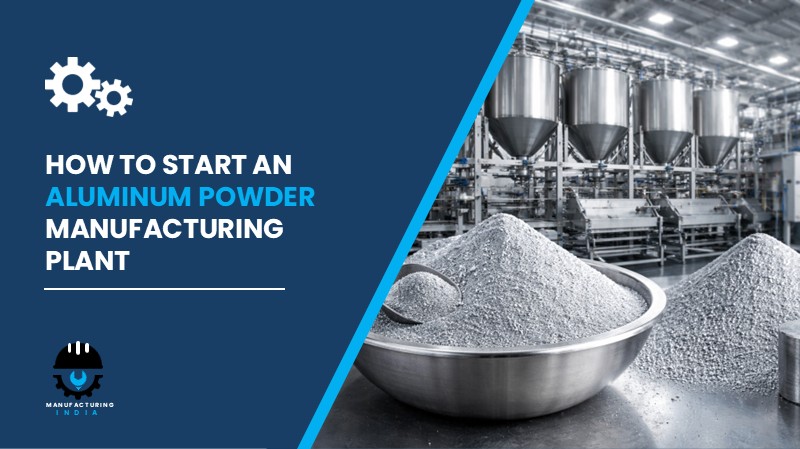
Setting up an aluminum powder manufacturing plant in India presents a compelling investment case backed by robust demand from construction materials, metallurgy, aerospace and defense, paints and coatings, pyrotechnics, and additive manufacturing industries. Aluminum powder is an indispensable industrial input used as a gas-forming agent in aerated concrete, a metallic pigment in protective coatings, a reducing agent in chemical synthesis, and a high-energy fuel component in fireworks and explosives. As India accelerates its infrastructure ambitions and expands its industrial base, the domestic appetite for this versatile powder continues to strengthen across multiple value chains.
India offers a strategically sound environment for aluminum powder production. The country’s rapid urbanisation, sustained infrastructure development as reflected in the construction of 5,853 km of National Highways between April and December 2024 per the National Economic Survey 2024–25 and the Make in India initiative collectively drive industrial demand while reducing import dependence. States such as Gujarat and Maharashtra provide well-developed industrial estates, strong logistics networks, access to utilities, and proximity to downstream users in construction, chemicals, and coatings. For investors seeking a scalable, export-capable manufacturing venture with healthy margins, the aluminum powder segment warrants serious consideration.
Setting up an aluminum powder manufacturing plant in India combines policy tailwinds, cost-competitive operations, and multi-sector demand into a financially viable investment. With gross profit margins of 25–35% and net margins of 10–15%, the plant demonstrates healthy profitability potential under normal operating conditions – with demand supported by infrastructure growth, lightweight material adoption, and expanding applications in 3D printing, aerated concrete, and conductive coatings.
What is Aluminum Powder?
Aluminum powder is a super-fine metal powder produced from primary aluminum or aluminum alloys through atomization, milling, or stamping methods. Its defining properties high conductivity, low density, high reactivity, and strong reflectivity make it a versatile industrial input across a wide range of applications. The powder functions as a pigment, fuel, reducing agent, and structural additive depending on the end-use sector.
Depending on particle size, morphology, and purity, aluminum powder is available in flake, granule, and sphere forms, each customized for a specific industrial application. It is used in the production of aerated concrete blocks, aluminum pastes, conductive coatings, fireworks, metal pigments, and powder metallurgy components. The production process – involving melting of aluminum, atomization or mechanical milling, particle size classification, drying, surface treatment, quality inspection, and packaging – ensures that output is precision-engineered for application-specific performance.
The end-use industries served by this manufacturing unit include construction materials, metallurgy, chemicals, aerospace and defense, paints and coatings, pyrotechnics, and additive manufacturing. Growing requirements for improved strength-to-weight ratios, thermal insulation, and energy efficiency have made aluminum powder a vital input in both the manufacturing and infrastructure sectors.
Cost of Setting Up an Aluminum Powder Manufacturing Plant in India
The cost of establishing an aluminum powder manufacturing plant depends on several interdependent variables: plant capacity, technology selection, degree of automation, site location, and regulatory compliance requirements. A structured understanding of both capital and operational expenditure is essential for sound investment planning.
1. Capital Expenditure (CapEx)
Land and Site Development represents a significant component of the total capital outlay, covering land acquisition charges, boundary development, registration costs, and site-levelling. Investors may consider locating within Special Economic Zones (SEZs) or state-designated industrial estates to benefit from land subsidies, tax exemptions, and superior utility infrastructure. Civil works costs cover the construction of the manufacturing shed, quality control laboratory, raw material storage areas, finished goods warehouse, effluent treatment plant (ETP) facility, and administrative block.
Machinery and Equipment constitute the largest share of capital expenditure. Key machinery required includes:
- Atomizers (for converting molten aluminum into fine powder)
- Ball mills (for mechanical milling and particle size reduction)
- Classifiers (for particle size separation and grading)
- Dryers (for moisture removal post-atomization)
- Dust collection systems (for safe containment of fine powder)
- Automated packaging units (for finished product packing)
Other capital costs include effluent treatment plant setup, pre-operative expenses (project report preparation, consultancy, regulatory approvals), commissioning costs, and import duties on specialized equipment where applicable.
Access the Detailed Feasibility Analysis, Request Sample: https://www.imarcgroup.com/aluminum-powder-manufacturing-plant-project-report/requestsample
2. Operational Expenditure (OpEx)
Raw Material Cost dominates the operating cost structure of this facility. The primary raw material aluminum ingots accounts for approximately 75–85% of total operating expenses. Investors are advised to negotiate long-term procurement contracts with reliable domestic and international suppliers to mitigate price volatility and ensure supply continuity.
Utility Cost covering electricity, process water, and steam requirements represents 10–15% of total OpEx. Aluminum powder production, particularly atomization and drying, is energy-intensive, making a reliable and cost-efficient power supply critical to profitability. Remaining operational costs include transportation, packaging, salaries and wages, equipment maintenance and repairs, depreciation, and applicable taxes. By the fifth year of operations, total operational costs are projected to increase substantially due to inflation, market fluctuations, supply chain shifts, and potential rises in the cost of aluminum ingots.
3. Plant Capacity
The proposed manufacturing facility is designed with an annual production capacity ranging between 5,000 and 10,000 metric tonnes, enabling economies of scale while maintaining operational flexibility. This capacity range can be customized based on investor requirements and target market demand. Profitability improves progressively with higher capacity utilisation, making it advisable for investors to plan for ramp-up phases aligned with demand growth in the target geographies.
4. Profit Margins and Financial Projections
The financial projections for this investment demonstrate healthy profitability potential under normal operating conditions. Gross profit margins typically range between 25–35%, supported by stable demand and the value-added nature of aluminum powder applications. Net profit margins are projected at 10–15% on average across the operating horizon. The project’s financial analysis encompasses NPV (Net Present Value), IRR (Internal Rate of Return), payback period assessment, liquidity analysis, sensitivity analysis, and uncertainty modelling — all developed on realistic assumptions related to capital investment, production capacity utilisation, pricing trends, and demand outlook.
Why Set Up an Aluminum Powder Plant in India?
Growing Demand for Lightweight and High-Performance Materials: Aluminum powder directly supports the global and domestic shift toward energy-efficient, lightweight construction and transportation materials. India’s infrastructure expansion including sustained highway construction momentum drives consistent demand for aerated concrete and construction chemicals where aluminum powder is a critical input.
Diverse and Resilient Industrial Applications: The product’s application across construction, paints and coatings, chemicals, metallurgy, aerospace and defense, pyrotechnics, and additive manufacturing ensures that demand is not concentrated in any single sector. This diversity provides revenue resilience against sector-specific slowdowns.
Policy and Regulatory Tailwinds: India’s Make in India initiative actively supports domestic manufacturing investment in chemicals and advanced materials. Regulatory focus on sustainability and recyclability further supports aluminum-based materials, given their low environmental footprint and high recyclability. The National Economic Survey 2024–25 reflects continued infrastructure momentum with 5,853 km of National Highways constructed between April and December 2024 directly strengthening demand for construction materials and coatings.
Cost-Competitive Manufacturing: India offers competitive land acquisition costs, affordable skilled and semi-skilled labour, and proximity to key raw material supply chains. Industrial clusters in Gujarat and Maharashtra provide access to reliable utilities, transport corridors, and a dense ecosystem of downstream buyers, reducing both production costs and distribution overheads.
Active Industry Investment and Innovation: The global aluminum powder industry continues to attract investment. In July 2025, AMPAL Inc., a subsidiary of United States Metal Powders Inc. (USMP), inaugurated a new production line for nodular and spherical aluminum powder at its Palmerton, Pennsylvania facility. In May 2025, CNPC Powder launched CNPC-Al0407 aluminum powder for additive manufacturing, featuring high thermal and electrical conductivity, strong mechanical performance, and consistent batch quality through its proprietary AMP automated metal production process. These developments signal expanding application boundaries and growing global demand that Indian manufacturers can service through export channels.
Local Supply Chain and Export Potential: Autoclaved aerated concrete producers, coating manufacturers, and chemical companies operating across India increasingly prefer local sourcing to reduce lead times and logistics costs. At the same time, continual worldwide demand for aluminum powder opens significant export possibilities, including long-term international supply contracts.
Manufacturing Process – Step by Step
The aluminum powder manufacturing process uses atomization or mechanical milling as the primary production method. The process is a multi-step operation involving several unit operations, material handling stages, and quality checkpoints.
- Aluminum Melting: Primary aluminum or aluminum alloys are melted in furnaces to achieve the molten state required for atomization.
- Atomization or Mechanical Milling: Molten aluminum is subjected to atomization (gas or water) or passed through ball mills for mechanical size reduction to produce fine powder particles.
- Particle Size Classification: Classifiers separate powder into defined particle size grades based on application requirements – flakes, granules, or spheres.
- Drying: Post-atomization moisture is removed through controlled drying to ensure product stability and prevent oxidation.
- Surface Treatment: Surface treatment processes are applied to enhance reactivity, conductivity, or stability based on end-use specifications.
- Quality Inspection: Analytical instruments are used to monitor product concentration, purity, particle morphology, and compliance with technical specifications.
- Packaging and Dispatch: Finished aluminum powder is packed using automated packaging units and dispatched to end-use industries including construction materials, coatings, chemicals, aerospace, pyrotechnics, and additive manufacturing.
Key Applications
Aluminum powder serves a wide range of industries, each leveraging its distinct physical and chemical properties:
- Construction Industry: Acts as a gas-forming agent in autoclaved aerated concrete, enabling lighter blocks with strong thermal insulation.
- Paints and Coatings Industry: Used as a metallic pigment to enhance corrosion resistance, reflectivity, and durability of protective coatings.
- Metallurgy and Chemicals: Functions as a reducing agent and alloying material in metallurgical reactions and chemical manufacturing processes.
- Pyrotechnics and Explosives: Fine aluminum powder improves energy output, brightness, and combustion efficiency in fireworks and industrial blasting agents.
- Aerospace and Defense: Supports the production of lightweight, high-strength structural components and energetic materials.
- Additive Manufacturing: Spherical aluminum powder is used as feedstock in 3D printing, enabling precision manufacture of complex components.
Leading Manufacturers
The global aluminum powder market is served by several multinational companies with extensive production capacities and diverse application portfolios. Key players in the industry include:
- AMG Advanced Metallurgical Group NV
- Ampal Inc.
- Valimet Inc.
- AVL Metal Powders N.V.
- Henan Yuanyang Powder Technology Co., Ltd.
- Angang Group Aluminium Powder Co., Ltd.
These companies serve end-use sectors including construction, coatings, chemicals, metallurgy, aerospace, and pyrotechnics worldwide.
Timeline to Start the Plant
- Feasibility study and project report preparation
- Land acquisition and site development
- Regulatory approvals and environmental clearances
- Factory licence and fire safety compliance
- Machinery procurement and installation
- Raw material supplier agreements and supply chain setup
- Trial production and quality testing
- Commercial production launch
Licences and Regulatory Requirements
Starting an aluminum powder manufacturing unit in India requires several approvals:
- Business registration (Proprietorship, LLP, or Pvt Ltd)
- Factory Licence under the Factories Act
- Environmental Clearance from State Pollution Control Board
- GST Registration
- Fire Safety NOC
- Hazardous and chemical material compliance (applicable given aluminum powder’s reactive and combustible properties)
- Effluent Treatment Plant (ETP) operational clearance
- Occupational Health and Safety compliance
Key Challenges to Consider
High Capital Requirements: Establishing a facility with annual capacity of 5,000–10,000 MT requires significant capital outlay, particularly for atomization equipment, classifiers, and dust collection systems, alongside land and civil works.
Raw Material Price Volatility: Aluminum ingots account for 75–85% of total operating expenses. Fluctuations in global aluminum prices directly impact production costs and margin sustainability, making long-term supplier contracts essential.
Regulatory Compliance: Aluminum powder is a reactive and combustible material requiring stringent adherence to fire safety, hazardous materials handling, and effluent management regulations across central and state regulatory bodies in India.
Technology and Innovation Pressure: The industry is advancing rapidly, with companies like CNPC Powder launching application-specific powder grades using proprietary automated production processes. Indian manufacturers must invest in process upgrades to remain competitive.
Competition from Global Players: Established players – including AMG Advanced Metallurgical Group NV, Valimet Inc., and AVL Metal Powders N.V. – have scale, technology, and supply network advantages that domestic entrants must strategically counter through niche focus and cost efficiency.
Skilled Manpower: Operating atomization equipment, classifiers, and quality control instruments demands trained technical personnel. Recruiting and retaining skilled engineers and production staff in competitive industrial clusters requires structured HR investment.
Frequently Asked Questions
How much does it cost to set up an aluminum powder manufacturing plant in India?
The total setup cost depends on plant capacity, technology selection, degree of automation, site location, and regulatory compliance costs. The capital expenditure structure covers land and site development, civil construction, machinery (atomizers, ball mills, classifiers, dryers, dust collection systems, and packaging units), and other pre-operative costs.
Is aluminum powder manufacturing profitable in India in 2026?
Yes. The project demonstrates gross profit margins of 25–35% and net profit margins of 10–15%, supported by multi-sector demand, infrastructure growth, and the expanding adoption of aluminum powder in additive manufacturing and construction chemicals.
What machinery is required for an aluminum powder plant in India?
Key machinery includes atomizers, ball mills, classifiers, dryers, dust collection systems, and automated packaging units.
What licences and approvals are required to start an aluminum powder plant in India?
Required approvals include business registration, Factory Licence, Environmental Clearance, GST registration, Fire Safety NOC, hazardous material compliance certification, ETP operational clearance, and occupational health and safety compliance.
What raw materials are needed for aluminum powder manufacturing?
The primary raw material is aluminum ingots, which account for 75–85% of total operating expenses. These may be sourced from primary aluminum producers or aluminum alloy suppliers.
What is the break-even period for this type of plant in India?
The break-even period depends on capacity utilisation, product pricing, and operating cost management. A detailed financial analysis – including NPV, IRR, and payback period is provided in the IMARC Group feasibility report for this manufacturing plant.
What government incentives are available for manufacturers in India?
Indian manufacturers can benefit from the Make in India initiative, state-level industrial policy incentives, SEZ tax benefits, capital subsidy schemes for MSME manufacturers, and export promotion incentives under applicable schemes of the Ministry of Commerce and Industry.
Key Takeaways for Investors
Aluminum powder manufacturing in India presents a well-structured investment opportunity driven by demand from construction materials, paints and coatings, metallurgy, pyrotechnics, aerospace and defense, and additive manufacturing — sectors that are all expanding rapidly within the Indian economy. The project demonstrates financial viability across a range of plant capacities, with gross margins of 25–35% and net margins of 10–15% achievable under normal operating conditions. The global aluminum powder market, valued at 669,800 tons in 2025, is projected to reach 772,200 tons by 2034 at a CAGR of 1.6% between 2026 and 2034, reflecting steady and sustained demand growth. With India’s infrastructure push, its cost-competitive manufacturing environment, and growing domestic end-use industries, the long-term demand outlook for domestically produced aluminum powder remains firmly positive.
About the Author