Setting up a banana powder manufacturing plant in India presents a compelling investment case driven by surging demand from food processing, infant nutrition, dietary supplements, and pharmaceutical formulations. As Indian consumers increasingly shift toward clean-label, plant-based, and natural ingredient products, banana powder has emerged as a strategic raw material for bakery goods, beverages, baby food blends, nutraceuticals, and cosmetic formulations. The product’s extended shelf life, nutritional richness – including carbohydrates, dietary fiber, potassium, and sugars – and versatility across industrial applications make this a high-demand commodity with stable offtake across multiple sectors.
India’s advantages as a manufacturing destination align strongly with the requirements of banana powder production. The country offers a cost-competitive environment for land, labour, and agro-processing infrastructure, alongside robust government support through the Make in India initiative and food processing incentives. States such as Gujarat, Maharashtra, Tamil Nadu, and Andhra Pradesh offer proximity to banana cultivation belts, logistics networks, and established food-grade industrial estates. With growing urbanisation, rising disposable incomes, and expanding modern retail and e-commerce channels, domestic demand for functional and natural food ingredients is accelerating – making this an optimal time to invest in banana powder production in India.
Establishing a banana powder manufacturing plant in India offers a financially viable entry point into the fast-growing natural ingredients market. With gross margins ranging between 35–45% and net margins of 15–20%, the project combines cost-competitive production with strong domestic and export demand. Policy support, a scalable production model, and multi-industry application across food, nutrition, and pharma sectors make this investment both resilient and high-return.
What is Banana Powder?
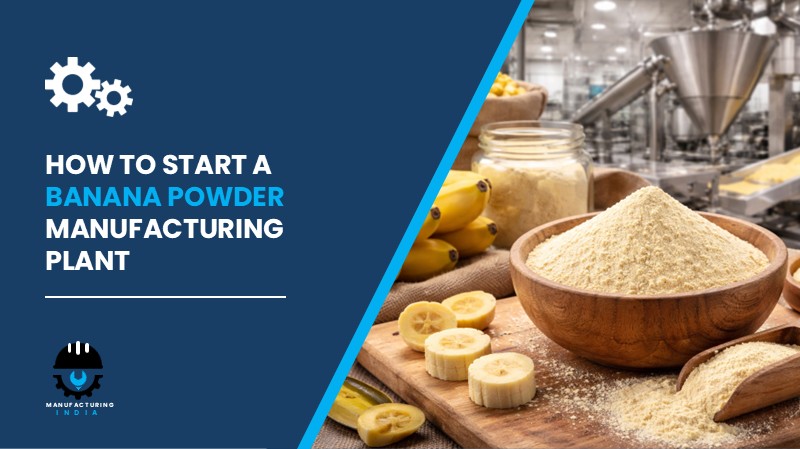
Banana powder is a product made from bananas that have been dehydrated and milled into a very fine powder. Depending on the intended application, it is produced from either ripe or green bananas. One of its greatest advantages is a long shelf life and easy handling, without losing vital nutrients such as carbohydrates, dietary fiber, potassium, and sugars during the production process. This makes banana powder a widely used ingredient in natural flavoring and nutritional applications spanning baby foods, bakery products, smoothies, confections, dairy products, and health supplements.
Green banana powder is particularly sought after for its resistant starch content – a plant-derived component that supports proper digestive function. Ripe banana powder, made from yellow bananas, takes the form of a sweet and fragrant powder well-suited to broader food applications. The product is available in several types, including conventional, organic, and spray-dried variants, enabling it to satisfy diverse industrial requirements. Its stability, versatility, and natural origin have positioned it as a valued substitute for artificial flavorings and fruit concentrates. The production process involves selecting and washing bananas, peeling and slicing, blanching or pretreatment, drying, grinding and pulverization, sieving, quality inspection, and packaging. End-use industries include the food and beverage sector, infant nutrition and baby food sector, dietary supplements and nutraceuticals, pharmaceutical industry, and cosmetics industry.
Cost of Setting Up a Banana Powder Manufacturing Plant in India
The total cost of establishing a banana powder manufacturing plant depends on multiple variables including plant capacity, technology selection, geographic location, level of automation, and regulatory compliance requirements.
1. Capital Expenditure (CapEx)
Capital investment forms the backbone of project planning and covers several major heads. Land and site development involves acquisition costs, registration charges, boundary development, and preliminary infrastructure – with options ranging from SEZ zones and food processing industrial parks to state government-allocated industrial estates, particularly in agro-processing hubs across southern and western India. Civil works and construction costs cover factory shed construction, a quality control laboratory, raw material and finished goods storage areas, administrative block, and utilities infrastructure.
Machinery and equipment costs account for the largest portion of total capital expenditure. Key machinery required includes:
- Washing systems
- Slicers
- Dryers
- Pulverizers
- Sieving machines
- Packaging units
- Laboratory instruments
Other capital costs include the effluent treatment plant (ETP), pre-operative and commissioning expenses, and any import duties applicable to specialized processing equipment.
Request a Sample Report for In-Depth Market Insights: https://www.imarcgroup.com/banana-powder-manufacturing-plant-project-report/requestsample
2. Operational Expenditure (OpEx)
The operating cost structure of this facility is primarily driven by raw material consumption. Raw material cost – principally bananas – accounts for approximately 65–75% of total operational expenditure, making supplier contract strategy and proximity to banana-growing regions a critical cost management lever. Long-term agreements with reliable suppliers help mitigate price volatility and ensure consistent production quality.
Utility costs including electricity, water, and steam constitute 15–20% of OpEx, reflecting the energy intensity of drying and milling processes. Additional operating costs encompass transportation and distribution, packaging materials, salaries and wages, equipment maintenance, depreciation, and applicable taxes. By the fifth year of operations, the total operational cost is expected to increase substantially due to inflationary pressures, market fluctuations, supply chain disruptions, and potential rises in the cost of key materials.
3. Plant Capacity
The proposed manufacturing facility is designed with an annual production capacity ranging between 2,000 and 5,000 MT, enabling economies of scale while maintaining operational flexibility. Capacity can be customized per investor requirements and business growth plans. Profitability improves progressively with higher capacity utilisation, as fixed costs are distributed across greater production volume, improving per-unit economics and margin realization.
4. Profit Margins and Financial Projections
The banana powder manufacturing plant project demonstrates healthy profitability potential under normal operating conditions. Gross profit margins typically range between 35–45%, supported by stable demand across value-added applications. Net profit margins stand at 15–20% on an average basis over the project period. Financial projections encompass NPV (net present value), IRR (internal rate of return), payback period analysis, income and expenditure projections, fixed versus variable cost breakdowns, and sensitivity analysis – all developed based on realistic assumptions related to capital investment, operating costs, capacity utilisation, pricing trends, and demand outlook.
Why Set Up a Banana Powder Plant in India?
Growing Demand for Natural Ingredients: The increasing consumer preference for clean-label and plant-based products directly drives higher usage of banana powder. Data from ATLAS 2023 statistics indicates that around 78% of consumers expressed willingness to pay more for products labelled natural or all-natural, while 68% preferred products with simple, recognizable ingredients. This powerful shift underpins the sustained demand expansion for banana powder across food and nutrition sectors.
Extended Shelf Life and Reduced Post-Harvest Waste: Converting fresh bananas into powder results in significantly fewer post-harvest losses and more stable pricing across the supply chain. India’s status as one of the world’s largest banana-producing nations gives domestic processors a key feedstock advantage – securing raw material at competitive costs while reducing agricultural waste.
Wide Industrial Applications Across Multiple Sectors: Banana powder’s diverse use across food processing, infant nutrition, nutraceuticals, pharmaceuticals, and cosmetics guarantees steady, multi-channel demand. This breadth of application reduces concentration risk and supports stable revenue generation across market cycles.
Export Potential and Global Market Demand: The worldwide market for tropical fruit derivatives offers an attractive opportunity for Indian manufacturers. The global banana powder market was valued at USD 1,304.7 Million in 2025 and is expected to reach USD 2,195.2 Million by 2034, exhibiting a CAGR of 5.95% from 2026 to 2034. Indian producers are well-positioned to capture export market share given their raw material access and cost-efficient manufacturing base.
Active Industry Investment and Innovation: In June 2025, Symrise completed a major upgrade at its Pasaje site in Ecuador, enhancing production of banana powder with new drum dryers and modernized infrastructure. In February 2025, Dole entered a partnership with Givaudan to supply green banana powder through Dole Specialty Ingredients (DSI), strengthening Givaudan’s Sense Texture range with emulsifier and texturizer solutions. These developments signal continued global capital commitment to this product category.
Scalable and Energy-Efficient Processing Technology: Advanced drying and milling technologies ensure cost-efficient, large-scale production operations. The unit’s scalability from 2,000 to 5,000 MT per annum allows phased capacity expansion aligned with demand growth and investor capital deployment timelines.
Manufacturing Process – Step by Step
The banana powder manufacturing process uses a multi-step dehydration and milling operation as the primary production method, incorporating several unit operations, material handling stages, and quality checks.
- Selection and Washing: Raw bananas are inspected for quality and thoroughly washed to remove surface contaminants before processing begins.
- Peeling and Slicing: Bananas are peeled and uniformly sliced to prepare them for the drying stage and ensure consistent moisture removal.
- Blanching or Pretreatment: Sliced banana pieces undergo blanching or chemical pretreatment to prevent enzymatic browning and preserve color, flavor, and nutritional integrity.
- Drying: The pretreated slices are passed through drying systems – the most energy-intensive stage – which reduce moisture content to levels suitable for powder production.
- Grinding and Pulverization: Dried banana pieces are fed into pulverizers that mill them into a fine, uniform powder.
- Sieving: The ground powder is sieved to ensure consistent particle size and remove any oversized particles, improving product quality and texture.
- Quality Inspection: Finished powder undergoes technical testing for concentration, purity, moisture content, microbial compliance, and stability parameters.
- Packaging and Dispatch: Approved powder is packaged in food-grade materials and dispatched to end-use industries including food and beverage manufacturers, infant nutrition brands, nutraceutical companies, pharmaceutical formulators, and cosmetic producers.
Key Applications
Banana powder serves a broad range of industries, each leveraging the product’s natural properties for distinct formulation purposes:
- Food and Beverage Industry: Used to enhance flavor, texture, and nutritional value in bakery items, beverages, and processed foods, replacing artificial additives.
- Infant Nutrition Sector: Serves as a natural carbohydrate and mineral source in baby food formulations due to its high digestibility and mild taste profile.
- Nutraceuticals and Dietary Supplements: High potassium and fiber content make it an effective ingredient in energy supplements, gut health products, and sports nutrition formulations.
- Pharmaceutical and Cosmetic Applications: Used as a natural excipient, binder, and skin-conditioning agent in select pharmaceutical and cosmetic formulations.
Leading Manufacturers
The global banana powder industry is served by several manufacturers with established production capacities and diverse application portfolios. Key players in this market include:
- Nutryttiva
- Manna Foods
- Babyvita India Food Products
- Banatone Food Industries Kochuveli
- Saipro Biotech Private Limited
These companies serve end-use sectors including food processing, nutrition, pharmaceutical, and cosmetic industries.
Timeline to Start the Plant
Investors should plan for a structured pre-production and commissioning timeline that covers all critical phases:
- Feasibility study and project report preparation
- Land acquisition and site development
- Regulatory approvals and environmental clearances
- Factory licence and fire safety compliance
- Machinery procurement and installation
- Raw material supplier agreements and supply chain setup
- Trial production and quality testing
- Commercial production launch
Licences and Regulatory Requirements
Starting a banana powder manufacturing unit in India requires several approvals across business registration, factory operations, and environmental compliance:
- Business registration (Proprietorship, LLP, or Pvt Ltd)
- Factory Licence under the Factories Act
- Environmental Clearance from the State Pollution Control Board
- GST Registration
- Fire Safety NOC
- Food Safety and Standards Authority of India (FSSAI) licence for food-grade production
- Effluent Treatment Plant (ETP) operational clearance
- Occupational Health and Safety compliance
Key Challenges to Consider
High Capital Requirements: Establishing a banana powder manufacturing plant involves significant upfront investment in land, civil works, machinery (washing systems, slicers, dryers, pulverizers, sieving machines, packaging units, and laboratory instruments), and utilities infrastructure, requiring careful financial planning and phased funding.
Raw Material Price Volatility: Bananas, the primary input accounting for 65–75% of OpEx, are subject to seasonal and climate-driven price fluctuations. Establishing long-term supplier contracts and maintaining buffer inventory are essential risk mitigation strategies.
Regulatory Compliance: Meeting food-grade manufacturing standards, FSSAI requirements, environmental clearances, and ETP operational norms requires dedicated compliance management and ongoing monitoring investment.
Technology and Innovation Pressure: Global players such as Symrise are continuously upgrading production infrastructure with advanced drum dryers and modern equipment, raising the bar for quality and efficiency that Indian producers must meet to remain competitive in export markets.
Competition from Established Players: Key players including Nutryttiva, Manna Foods, Babyvita India Food Products, Banatone Food Industries Kochuveli, and Saipro Biotech Private Limited are already active in this market, requiring new entrants to differentiate on price, quality, or niche application focus.
Skilled Manpower: Operating advanced drying, milling, and quality control systems requires trained technical personnel and food science professionals, making workforce development and retention a strategic priority.
Frequently Asked Questions
1. How much does it cost to set up a banana powder manufacturing plant in India?
The total cost depends on plant capacity (2,000–5,000 MT per annum), location, technology selection, and automation level. Key cost components include land and site development, civil construction, machinery (washing systems, slicers, dryers, pulverizers, sieving machines, packaging units, and laboratory instruments), and pre-operative expenses. A detailed breakdown is available in the IMARC feasibility report.
2. Is banana powder manufacturing profitable in India in 2026?
Yes. The project demonstrates gross profit margins of 35–45% and net profit margins of 15–20% under normal operating conditions, supported by stable multi-sector demand and India’s cost-competitive production environment.
3. What machinery is required for a banana powder plant in India?
Key equipment includes washing systems, slicers, dryers, pulverizers, sieving machines, packaging units, and laboratory instruments.
4. What licences and approvals are required to start a banana powder plant in India?
Required approvals include business registration, Factory Licence under the Factories Act, Environmental Clearance, FSSAI licence, GST Registration, Fire Safety NOC, ETP operational clearance, and Occupational Health and Safety compliance.
5. What raw materials are needed for banana powder manufacturing?
The primary raw material is bananas – either ripe (yellow) or green – depending on the application, along with packaging materials. Raw material cost accounts for 65–75% of total operational expenditure.
6. What are the environmental compliance requirements for a banana powder plant in India? Compliance requirements include obtaining Environmental Clearance from the State Pollution Control Board, operating a functional Effluent Treatment Plant (ETP), and adhering to applicable emission and waste management standards.
7. What is the best location to set up a banana powder plant in India?
Ideal locations combine proximity to banana cultivation regions, access to reliable transportation and utilities infrastructure, and availability within food processing industrial estates or SEZ zones. States with strong agro-processing ecosystems offer additional advantages.
8. What is the break-even period for this type of plant in India?
The break-even period is determined through detailed financial analysis including NPV, IRR, and payback period calculations based on capacity utilization, pricing trends, and operating cost projections – covered comprehensively in the project report.
9. What government incentives are available for manufacturers in India?
Food processing manufacturers in India may benefit from schemes under the Make in India initiative, Production Linked Incentive (PLI) schemes for food processing, state-level industrial subsidies, and capital subsidy programmes under the Ministry of Food Processing Industries (MoFPI).
Key Takeaways for Investors
Banana powder manufacturing in India presents a well-rounded investment opportunity anchored by multi-sector demand from food and beverage processing, infant nutrition, nutraceuticals, pharmaceutical, and cosmetic industries – all of which are expanding rapidly within India’s domestic economy and in global export markets. The project demonstrates financial viability across plant capacities ranging from 2,000 to 5,000 MT per annum, with gross margins of 35–45% and net margins of 15–20% providing a strong return profile at varying scales. The global banana powder market, valued at USD 1,304.7 Million in 2025 and projected to reach USD 2,195.2 Million by 2034 at a CAGR of 5.95%, signals sustained long-term demand growth. With clean-label consumer trends, active global industry investment, and India’s inherent cost and feedstock advantages, this manufacturing segment offers durable, forward-looking commercial viability for serious investors.
About the Author