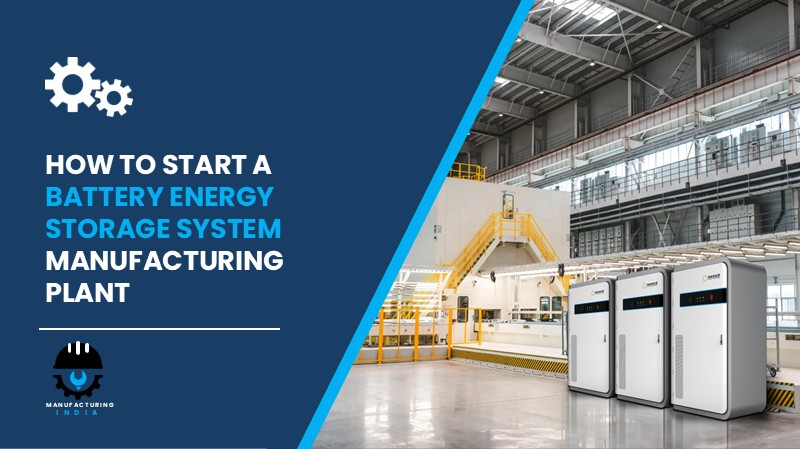
Setting up a battery energy storage system manufacturing plant in India presents a compelling investment case driven by the country’s accelerating transition toward renewable energy, rapid growth of the electric vehicle sector, and the urgent need for grid stabilisation across utilities and commercial infrastructure. Battery energy storage systems are critical enablers for utilities, renewable energy developers, electric vehicle charging networks, and commercial and residential users – all sectors experiencing significant expansion within India’s evolving energy economy. As India targets 500 GW of non-fossil power capacity by 2030, the demand for reliable, scalable energy storage solutions has never been stronger.
India’s strategic advantages make it an ideal base for this type of manufacturing investment. The country’s cost-competitive land and labour environment, combined with robust policy frameworks such as the Make in India initiative, government subsidies, and regulatory incentives for clean energy manufacturing, create favourable conditions for establishing a battery energy storage system plant. Industrial corridors in states such as Uttar Pradesh – where India’s largest commissioned battery energy storage facility is already operational in Noida – alongside Gujarat and Maharashtra, offer proximity to raw material supply chains, growing EV infrastructure demand, and established export logistics. For investors seeking long-term viability in clean energy manufacturing, India represents a strategically sound and financially attractive location.
India’s battery energy storage system manufacturing opportunity is underpinned by strong policy support, cost-competitive production conditions, and surging demand from utilities, renewable energy, and electric vehicles. With gross profit margins ranging between 20–30% and a break-even window of 4–6 years, this investment offers robust financial viability for capacity-oriented operators.
What is a Battery Energy Storage System?
A battery energy storage system is a device used to store energy for later use, typically in the form of electrical power. These systems are composed of batteries, power conversion systems (PCS), and associated control systems that manage the flow of energy. The batteries used in storage systems can vary in chemistry; lithium-ion (Li-ion) batteries are the most widely used due to their high energy density, long lifespan, and decreasing cost. Other battery types used in these systems include lead-acid, sodium-sulfur, and flow batteries.
Battery energy storage systems are primarily used for applications such as load levelling, grid stabilisation, renewable energy integration, backup power, and energy arbitrage, enabling efficient energy use and improving grid reliability. The production process encompasses raw material sourcing, battery cell manufacturing, battery module and pack assembly, power conversion and control systems integration, testing and quality assurance, and packaging. End-use industries served include utilities, renewable energy, electric vehicles, and commercial and residential segments.
Cost of Setting Up a Battery Energy Storage System Manufacturing Plant in India
The cost of establishing a battery energy storage system manufacturing plant in India depends on several variables, including plant capacity, technology selection, site location, level of automation, and regulatory compliance requirements.
1. Capital Expenditure (CapEx)
The capital investment for this type of plant covers multiple major cost heads.
Land and site development: includes land acquisition costs, boundary development, registration charges, and preparatory site work. Proximity to raw material suppliers and target markets is a key criterion, and locating the facility within an SEZ or established industrial estate can reduce land costs and provide fiscal benefits. Civil works and construction costs cover the main production shed, laboratory, quality control area, raw material storage, finished goods warehouse, and administrative block – all of which must comply with industrial safety norms and environmental standards.
Machinery and equipment: represent the single largest component of capital expenditure for a battery energy storage system manufacturing plant. Key machinery required includes:
- Battery assembly machines for cell stacking and packaging
- Battery management system (BMS) testing equipment
- Soldering machines for connecting cells and electronics
- Welding machines for battery packs
- Power control systems for testing charging and discharging efficiency
- Encapsulation and sealing machines
- Packaging machines
Other capital cost: include effluent treatment plant (ETP) installation, pre-operative and commissioning expenses, and import duties applicable to specialised equipment components.
Request a Sample Report for In-Depth Market Insights: https://www.imarcgroup.com/battery-storage-system-manufacturing-plant-project-report/requestsample
2. Operational Expenditure (OpEx)
The operating cost structure of a battery energy storage system manufacturing plant is primarily driven by raw material consumption. Raw material costs – covering Li-ion battery packs or cells, battery management system (BMS) components, power conversion systems (PCS), thermal management components, and steel enclosures – account for approximately 80–85% of total operating expenses. Securing long-term supplier contracts for these core inputs is essential to mitigate price volatility and maintain production continuity. Utility costs, comprising electricity, water, and process energy, account for a further 5–10% of OpEx. Remaining operating costs include transportation, packaging, salaries and wages, maintenance, depreciation, and taxes. By the fifth year of operations, total operational expenditure is expected to increase substantially due to inflation, market fluctuations, supply chain pressures, and potential rises in the cost of key materials.
3. Plant Capacity
The proposed manufacturing facility is designed with an annual production capacity ranging between 1–2 GWh, enabling economies of scale while maintaining operational flexibility. Capacity can be customized to align with investor requirements, market access, and capital availability. As with most capital-intensive manufacturing operations, profitability improves materially with higher capacity utilisation, making early demand pipeline development a strategic priority.
4. Profit Margins and Financial Projections
The project demonstrates healthy profitability potential under normal operating conditions. Gross profit margins typically range between 20–30%, supported by stable demand and value-added applications across the utilities, renewable energy, and EV sectors. Net profit margins range between 12–18%. Financial projections covering NPV, IRR, payback period, and sensitivity analysis are developed based on realistic assumptions regarding capital investment, production capacity utilisation, and demand outlook. The break-even period for a battery energy storage system manufacturing business typically ranges from 4 to 6 years, depending on production volume, technology costs, and operational efficiency.
Why Set Up a Battery Energy Storage System Plant in India?
Growing Demand for Renewable Energy: As India accelerates its transition to cleaner energy, demand for energy storage solutions has grown significantly. The International Energy Agency projects that renewable power capacity will increase by nearly 4,600 GW between 2025 and 2030, doubling the rate seen in the 2019–2024 period. This surge in renewable generation directly drives demand for battery energy storage systems capable of smoothing intermittent supply from solar and wind sources.
Electric Vehicle Growth: The rise of electric vehicles has created substantial demand for energy storage systems, both for EV batteries and for supporting fast-charging infrastructure. With rapid growth in India’s EV market, battery energy storage systems are increasingly deployed at charging stations to provide the infrastructure needed for electric vehicle fleets and individual users.
Grid Modernisation: The need for more reliable and flexible energy grids is driving demand for storage solutions across India. Battery energy storage systems provide critical support for grid stabilisation and resilience, especially in regions with aging infrastructure or frequent power outages – a persistent challenge in several Indian states.
Cost Reduction and Technological Advancements: Continuous advancements in battery technologies, including lithium-ion and solid-state batteries, are leading to improvements in energy density, cycle life, and cost-effectiveness, making these systems more affordable and commercially viable at scale.
Active Industry Investment: In January 2026, India’s GoodEnough Energy commissioned the country’s largest 7 GWh battery energy storage system in Noida, Uttar Pradesh, with plans to expand capacity to 25 GWh over the next three years. The facility aims to reduce reliance on imported storage solutions and support India’s 500 GW non-fossil power target by 2030. In May 2025, ABB launched a battery energy storage system-as-a-service (BESS-as-a-Service) model enabling companies to adopt energy storage without large upfront capital commitments.
Policy and Regulatory Tailwinds: Government initiatives in the form of subsidies, regulatory incentives, and industrial schemes under Make in India are projected to further drive product demand. Governments may offer capital subsidies, tax exemptions, reduced utility tariffs, export benefits, or interest subsidies to promote manufacturing under national and regional industrial policies.
Manufacturing Process – Step by Step
The battery energy storage system manufacturing process uses raw material sourcing, battery cell manufacturing, battery module and pack assembly, power conversion and control systems integration, testing and quality assurance, and packaging as the primary production method.
- Raw Material Sourcing: Li-ion battery packs or cells, BMS components, PCS, thermal management materials, and steel enclosures are procured from qualified suppliers under long-term contracts.
- Battery Cell Manufacturing: Individual battery cells are produced or sourced and prepared for module assembly, with quality verification of chemistry and electrochemical performance.
- Battery Module and Pack Assembly: Cells are stacked and interconnected using battery assembly machines, soldering machines for connecting cells and electronics, and welding machines for battery packs.
- BMS Integration and Testing: Battery management system components are installed and tested using BMS testing equipment to ensure accurate cell monitoring, balancing, and protection.
- Power Conversion and Control Systems Integration: Power conversion systems (PCS) are installed and connected, with power control systems used to test charging and discharging efficiency.
- Thermal Management Installation: Thermal management components are fitted to ensure safe operating temperatures across the battery pack assembly.
- Encapsulation and Sealing: Encapsulation and sealing machines are used to protect the battery packs from environmental exposure, moisture, and physical damage.
- Testing and Quality Assurance: Complete quality checks are performed for performance, safety, and rated capacity before units are cleared for dispatch.
- Packaging and Dispatch: Packaging machines are used to prepare finished battery energy storage systems for distribution to utilities, renewable energy developers, EV charging operators, and commercial and residential end-users.
Key Applications
Battery energy storage systems serve a broad range of industries across the energy, transportation, and built environment sectors:
- Utilities: Used for load levelling – storing excess energy during low-demand periods and discharging during peak demand to reduce dependence on additional power plants and improve grid stability.
- Renewable Energy: Critical enabler for solar and wind integration, storing energy during periods of excess generation and releasing it during low-generation periods to smooth supply intermittency.
- Electric Vehicles: Deployed at fast-charging stations to support EV fleet operators and individual users by providing reliable charging infrastructure backed by stored energy.
- Commercial and Residential: Adopted by businesses and homeowners for energy management, backup power during outages, and lowering energy costs by utilising stored energy during high-tariff periods.
Leading Manufacturers
The global battery energy storage system market is served by several multinational companies with extensive production capacities and diverse application portfolios. Key players include:
- Tesla, Inc.
- LG Energy Solution
- Samsung SDI Co., Ltd.
- Contemporary Amperex Technology Co., Ltd. (CATL)
- BYD Company Ltd.
- Fluence Energy, Inc.
Timeline to Start the Plant
- Feasibility study and project report preparation
- Land acquisition and site development
- Regulatory approvals and environmental clearances
- Factory licence and fire safety compliance
- Machinery procurement and installation
- Raw material supplier agreements and supply chain setup
- Trial production and quality testing
- Commercial production launch
Based on plant scale, battery chemistry, supply chain readiness, and compliance requirements, the overall timeline typically ranges from 18 to 24 months.
Licences and Regulatory Requirements
Starting a battery energy storage system manufacturing unit in India requires several approvals:
- Business registration (Proprietorship, LLP, or Private Limited Company)
- Factory Licence under the Factories Act
- Environmental Clearance from State Pollution Control Board
- GST Registration
- Fire Safety NOC
- Hazardous and chemical storage compliance (applicable given lithium-ion cell handling requirements)
- Effluent Treatment Plant (ETP) operational clearance
- Occupational Health and Safety compliance
Key Challenges to Consider
High Capital Requirements: Establishing a battery energy storage system manufacturing plant involves significant upfront investment in land, civil works, specialised machinery, and working capital, requiring careful financial planning and funding strategy.
Raw Material Price Volatility: The operating cost structure is heavily dependent on Li-ion battery packs or cells, BMS components, PCS, thermal management materials, and steel enclosures, which account for 80–85% of OpEx. Price fluctuations in these inputs can materially affect margins.
Regulatory Compliance: Meeting environmental clearances, hazardous material handling requirements, ETP standards, and factory safety norms involves sustained management effort and ongoing operational cost.
Technology and Innovation Pressure: Continuous advancements in lithium-ion and solid-state battery technologies require manufacturers to stay current with evolving production standards and energy density benchmarks to remain competitive.
Competition: The global market is served by well-capitalised players including Tesla, LG Energy Solution, Samsung SDI, CATL, BYD, and Fluence Energy, creating competitive pressure on pricing, technology, and supply chain efficiency.
Skilled Manpower: Operating battery assembly, BMS testing, PCS integration, and quality assurance systems requires a trained technical workforce, which may need to be developed through structured recruitment and training programmes.
Frequently Asked Questions
1. How much does it cost to set up a battery energy storage system manufacturing plant in India?
Capital requirements vary based on plant capacity, technology, and location, covering land acquisition, civil construction, machinery procurement, installation, pre-operative expenses, and working capital. The total investment is influenced by whether the facility is positioned at 1 GWh or 2 GWh annual production capacity.
2. Is battery energy storage system manufacturing profitable in India in 2026?
Yes. The project demonstrates healthy profitability potential with gross profit margins of 20–30% and net profit margins of 12–18% under normal operating conditions, supported by stable and growing demand from utilities, renewable energy, and EV sectors.
3. What machinery is required for a battery energy storage system plant in India?
Key machinery includes battery assembly machines, BMS testing equipment, soldering machines, welding machines, power control systems, encapsulation and sealing machines, and packaging machines.
4. What licences and approvals are required to start a battery energy storage system plant in India?
Required approvals include business registration, Factory Licence, Environmental Clearance from the State Pollution Control Board, GST Registration, Fire Safety NOC, hazardous material compliance, ETP clearance, and Occupational Health and Safety compliance.
5. What raw materials are needed for battery energy storage system manufacturing?
Core raw materials include Li-ion battery packs or cells, battery management system (BMS) components, power conversion systems (PCS), thermal management components, and steel enclosures.
6. What are the environmental compliance requirements for a battery energy storage system plant in India?
Plants must obtain Environmental Clearance from the State Pollution Control Board, operate a compliant Effluent Treatment Plant, meet hazardous chemical storage norms applicable to lithium-ion materials, and maintain Occupational Health and Safety standards.
7. What is the best location to set up a battery energy storage system plant in India?
Locations should offer access to key raw materials, proximity to target markets, robust transport and utility infrastructure, and compliance with local zoning laws. Uttar Pradesh, where India’s largest 7 GWh battery energy storage facility was commissioned in Noida in January 2026, represents a proven location for this type of investment.
8. What government incentives are available for manufacturers in India?
Governments may offer capital subsidies, tax exemptions, reduced utility tariffs, export benefits, or interest subsidies under national and regional industrial policies promoting clean energy and advanced manufacturing.
Key Takeaways for Investors
A battery energy storage system manufacturing plant in India offers a compelling opportunity driven by sustained demand from utilities, renewable energy developers, the electric vehicle sector, and commercial and residential energy users. The project demonstrates financial viability across a range of plant capacities, with gross profit margins of 20–30%, net margins of 12–18%, and a break-even period of 4 to 6 years. The global battery energy storage system market was valued at 273.22 GW in 2025 and is projected to reach 513.82 GW by 2034 at a CAGR of 7.3% from 2026 to 2034, providing a long-term demand horizon that supports sustained capacity utilisation and margin expansion. With India’s 500 GW non-fossil power target, active domestic investment exemplified by GoodEnough Energy’s 7 GWh Noida facility, and government policy reinforcing clean energy manufacturing, demand sustainability for this production category is structurally well-supported through the decade ahead.
About the Author