Setting up a catheter manufacturing plant in India presents a compelling investment case backed by one of the fastest-growing healthcare sectors in the world. The demand for catheters is being driven by rising incidences of chronic diseases such as cardiovascular conditions, diabetes, and urinary disorders, alongside a significant surge in minimally invasive surgical procedures across hospitals, diagnostic laboratories, and long-term care facilities. As India continues to scale its healthcare infrastructure, the need for domestically manufactured medical devices – particularly precision-grade catheters – has never been more urgent or commercially promising.
India’s structural advantages make it an ideal manufacturing destination for catheter production. The country’s expanding urban population, rapidly developing hospital and healthcare network, and supportive policy environment under the Make in India initiative create a strong platform for new manufacturing entrants. States such as Gujarat and Maharashtra, with their established medical device industrial clusters, offer superior logistics, reliable utility infrastructure, and access to skilled manufacturing workforces. For investors looking to participate in India’s medical device growth story, catheter manufacturing represents a financially viable, strategically timed, and policy-supported production opportunity.
Setting up a catheter manufacturing plant in India combines high gross margins of 55–65%, robust demand from healthcare facilities and home care sectors, and strong government policy tailwinds – making it one of the most defensible and scalable medical device manufacturing investments available to Indian and global entrepreneurs today.
What is a Catheter?
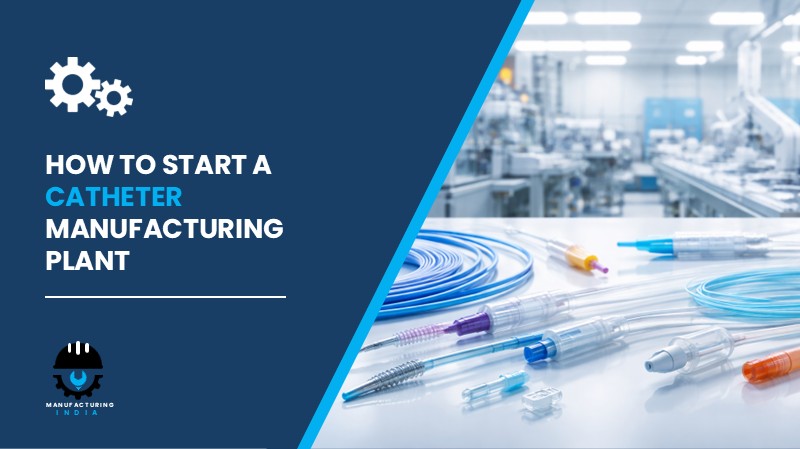
A catheter is a thin, flexible tube inserted into the body to treat urinary incontinence or to perform diagnostic procedures. Used across a wide range of medical applications – including draining fluids, delivering medication, and monitoring body functions – catheters are manufactured from biocompatible materials such as medical-grade silicone, polyurethane, and PVC, and are specifically designed to withstand body conditions while preventing infection and irritation.
Depending on their application, catheters are available in various forms. These include urinary catheters, cardiovascular catheters, intravenous catheters, neurovascular catheters, and surgical catheters, each optimised for specific medical procedures. The production process combines raw material sourcing, extrusion and moulding, coating, cutting and sterilisation, packaging, and rigorous quality control. End-use industries served by catheter manufacturers include healthcare facilities, medical device companies, home care and rehabilitation providers, diagnostic laboratories, and long-term care facilities.
Cost of Setting Up a Catheter Manufacturing Plant in India
The cost of establishing a catheter manufacturing plant in India depends on several interdependent variables including production capacity, technology selection, degree of automation, geographic location, and the level of regulatory compliance infrastructure built into the facility.
1. Capital Expenditure (CapEx)
Land and Site Development: represents one of the most substantial components of initial capital outlay. Investors may consider setting up within a Special Economic Zone (SEZ) or a notified industrial estate to benefit from tax incentives, better utility connectivity, and streamlined regulatory approvals. Costs cover land registration, boundary development, and site preparation.
Civil Works and Construction: encompass the manufacturing shed, quality control laboratory, raw material and finished goods warehouses, and administrative block. For a catheter plant, cleanroom-compliant construction is essential given biocompatibility and sterility requirements.
Machinery and Equipment: form the largest single component of CapEx. Key machinery required includes:
- Extruders
- Injection moulding machines
- Coating machines
- Sterilisation equipment
- Quality testing equipment
Other Capital Cost: include effluent treatment plant (ETP) installation, pre-operative expenses, commissioning charges, and applicable import duties on specialised medical manufacturing equipment.
Request a Sample Report for In-Depth Market Insights: https://www.imarcgroup.com/catheter-manufacturing-plant-project-report/requestsample
2. Operational Expenditure (OpEx)
Raw Material Cost: is the dominant operating expense for a catheter manufacturing plant, accounting for approximately 40–50% of total OpEx. The primary raw materials required are medical-grade PVC/polyurethane, luer locks, and sterile packaging materials. Long-term supplier contracts are strongly recommended to mitigate price volatility and ensure supply chain continuity.
Utility Cost: covering electricity, water, and steam – accounts for a further 15–20% of total operating expenditure. Catheter manufacturing demands consistent, uninterrupted utility supply given the precision requirements of extrusion, moulding, and sterilisation processes.
Other Operating Cost: include transportation, packaging, salaries and wages, maintenance, depreciation, and taxes. By the fifth year of operations, total operational costs are projected to increase substantially due to inflation, market fluctuations, rising material costs, supply chain pressures, and growing consumer demand.
3. Plant Capacity
The proposed catheter manufacturing facility is designed with an annual production capacity ranging between 10 and 50 million units, enabling meaningful economies of scale while maintaining operational flexibility. Capacity can be customized based on individual investor requirements, available capital, and projected market penetration. Profitability improves significantly with higher capacity utilisation, making early ramp-up strategy a critical financial planning consideration.
4. Profit Margins and Financial Projections
The catheter manufacturing plant project demonstrates healthy profitability potential under normal operating conditions. Gross profit margins typically range between 55–65%, supported by stable demand and value-added medical applications. Net profit margins average between 25–30%, reflecting well-controlled operating cost structures. A comprehensive financial analysis covering NPV, IRR, payback period, gross margin, net margin, and break-even timelines is integral to the detailed project report.
Why Set Up a Catheter Plant in India?
Growing Demand from Chronic Disease Prevalence: The rising incidence of chronic diseases including diabetes, cardiovascular conditions, and urinary tract disorders is driving consistent demand for various catheter types across acute and long-term care settings in India. As India’s diabetic and cardiac patient populations continue to expand, domestic catheter production becomes increasingly economically compelling.
Accelerating Adoption of Minimally Invasive Procedures: The increasing shift toward minimally invasive surgeries and diagnostic procedures – which offer less pain and faster recovery times – has amplified demand for specialised catheter devices. Indian hospitals and surgical centres are progressively adopting these techniques, creating a growing and captive domestic market.
Technological Advancements Driving Product Value: Advances in catheter technology – including antimicrobial coatings, hydrophilic coatings, and innovations such as flexible self-lubricating catheter designs – are enhancing patient outcomes and commanding premium pricing. Manufacturers that invest in these value-added technologies gain a measurable competitive advantage.
Cost-Competitive Manufacturing Base: India offers a cost-competitive manufacturing environment relative to global alternatives, combining affordable land acquisition, competitive labour costs, and an expanding domestic supply chain for medical-grade polymers and packaging materials. These structural cost advantages strengthen export viability alongside domestic market supply.
Active Industry Investment and Innovation: In January 2026, Wellspect HealthCare launched the Surity Female External Catheter in the United States – a non-invasive device targeting severe urinary incontinence in women. In November 2025, MicroPort EP launched PulseMagic TrueForce, a pressure-sensing pulsed field ablation catheter approved by China’s NMPA. These developments confirm sustained global R&D investment and product innovation momentum in the catheter space.
Aging Population and Long-Term Care Demand: The global aging population – and India’s own growing elderly demographic – is increasing the number of surgical and clinical procedures requiring catheterisation. Long-term care facilities and home care rehabilitation providers represent a rapidly expanding customer base that increasingly sources catheters from domestic manufacturers to reduce procurement lead times.
Manufacturing Process – Step by Step
The catheter manufacturing process uses raw material sourcing, extrusion/moulding, coating, cutting and sterilisation, packaging, and quality control as the primary production method. Each stage involves dedicated equipment and strict quality monitoring:
- Raw Material Sourcing: Medical-grade PVC/polyurethane, luer locks, and sterile packaging materials are procured from qualified suppliers under long-term contracts to ensure consistency.
- Extrusion/Moulding: Extruders and injection moulding machines shape the raw polymer materials into catheter tube forms of precise diameter, wall thickness, and flexibility specifications.
- Coating: Coating machines apply antimicrobial, hydrophilic, or biocompatible surface treatments to enhance performance and patient safety.
- Cutting and Sterilisation: Tubes are precision-cut to required lengths, followed by sterilisation using validated equipment to meet medical device sterility standards.
- Quality Control: Analytical instruments and quality testing equipment are used throughout production to monitor product concentration, purity, dimensional accuracy, and stability. Documentation for traceability and regulatory compliance is maintained at every stage.
- Packaging and Dispatch: Finished catheters are packaged in sterile packaging and dispatched to healthcare facilities, medical device companies, home care providers, diagnostic laboratories, and long-term care facilities.
Key Applications
Catheters serve a broad and growing range of clinical and institutional end-users across the healthcare value chain:
- Healthcare Facilities: Used in hospitals and clinics for urinary catheterisation, vascular access for medications and fluids, and cardiovascular catheterisation for cardiac procedures.
- Medical Device Companies: Integral components in medical devices including angioplasty balloons, stents, and pacemakers.
- Home Care and Rehabilitation: Increasingly used for long-term urinary and vascular management in elderly patients requiring home-based care.
- Diagnostic Laboratories: Specialised catheters used for angiograms and electrophysiological mapping procedures.
- Long-Term Care Facilities: Used in nursing homes and extended care settings for managing urinary or cardiovascular conditions in patients with mobility limitations.
Leading Manufacturers
The global catheter market is served by several multinational companies with extensive production capacities and diverse application portfolios. Key players include:
- Hollister Incorporated
- Medtronic
- Boston Scientific Corporation
- Edward Lifesciences
- Smith Medical Inc.
- Teleflex Incorporated
These players serve end-use sectors including healthcare facilities, medical device companies, home care and rehabilitation providers, diagnostic laboratories, and long-term care facilities.
Timeline to Start the Plant
- Feasibility study and project report preparation
- Land acquisition and site development
- Regulatory approvals and environmental clearances
- Factory licence and fire safety compliance
- Machinery procurement and installation
- Raw material supplier agreements and supply chain setup
- Trial production and quality testing
- Commercial production launch
Licences and Regulatory Requirements
Starting a catheter manufacturing unit in India requires several approvals:
- Business registration (Proprietorship, LLP, or Pvt Ltd)
- Factory Licence under the Factories Act
- Environmental Clearance from State Pollution Control Board
- GST Registration
- Fire Safety NOC
- Hazardous/Chemical compliance (applicable to PVC and polyurethane handling)
- Effluent Treatment Plant (ETP) operational clearance
- Occupational Health and Safety compliance
Key Challenges to Consider
High Capital Requirements: Establishing a cleanroom-compliant, sterilisation-equipped catheter facility demands substantial upfront investment in civil works, specialised machinery, and quality infrastructure – creating a significant entry barrier that rewards well-capitalised investors.
Raw Material Price Volatility: Medical-grade PVC/polyurethane, luer locks, and sterile packaging materials are subject to global commodity price fluctuations. Since raw materials account for 40–50% of total OpEx, price volatility in these inputs can materially impact operating margins without hedging strategies.
Regulatory Compliance: Global and domestic standards for medical devices are increasingly stringent. Meeting quality control, sterility, and biocompatibility requirements demands ongoing investment in certified processes, documentation systems, and quality assurance personnel.
Technology and Innovation Pressure: Advances in antimicrobial coatings, hydrophilic coatings, and flexible catheter design require manufacturers to invest continuously in R&D or licensed technology partnerships to remain competitive with global innovators such as Medtronic and Boston Scientific Corporation.
Competition from Established Players: Key global players including Hollister Incorporated, Teleflex Incorporated, and Smith Medical Inc. command strong brand loyalty and distribution networks. New entrants must differentiate on price, delivery speed, or product customisation to gain market share.
Skilled Manpower: Catheter manufacturing requires trained operators for precision extrusion, sterile packaging, and quality testing processes. Recruiting, training, and retaining technically competent manufacturing personnel in India remains an ongoing operational challenge.
Frequently Asked Questions
1. How much does it cost to set up a catheter manufacturing plant in India?
Setup costs vary based on capacity, technology, location, and automation. The detailed CapEx breakdown – covering land, civil works, machinery (extruders, injection moulding machines, coating machines, sterilisation equipment), and other capital costs – is available in the full project report.
2. Is catheter manufacturing profitable in India in 2026?
Yes. Gross profit margins range between 55–65% and net profit margins between 25–30%, supported by stable healthcare demand across multiple end-use segments.
3. What machinery is required for a catheter plant in India?
Key equipment includes extruders, injection moulding machines, coating machines, sterilisation equipment, and quality testing equipment.
4. What licences and approvals are required to start a catheter plant in India?
Required approvals include business registration, Factory Licence, Environmental Clearance, GST Registration, Fire Safety NOC, ETP operational clearance, chemical compliance, and Occupational Health and Safety certification.
5. What raw materials are needed for catheter manufacturing?
Primary raw materials are medical-grade PVC/polyurethane, luer locks, and sterile packaging materials.
6. What are the environmental compliance requirements for a catheter plant in India?
An operational Effluent Treatment Plant is mandatory, along with State Pollution Control Board clearance and ongoing monitoring of chemical handling, effluent discharge, and occupational health standards.
7. What is the best location to set up a catheter plant in India?
Locations offering access to key raw material suppliers, reliable transportation, utilities, and waste management infrastructure are preferred. States with developed medical device industrial estates – such as Gujarat and Maharashtra – provide strong location advantages.
8. What is the break-even period for this type of plant in India?
Break-even timelines depend on plant capacity utilisation, pricing strategy, and operating cost management. Full payback period analysis is covered in the project’s financial projections section.
9. What government incentives are available for manufacturers in India?
The Make in India initiative, SEZ benefits, state-level industrial subsidies, and Production Linked Incentive (PLI) schemes for medical devices offer meaningful fiscal support to catheter manufacturing investors.
Key Takeaways for Investors
A catheter manufacturing plant in India offers a high-margin, demand-resilient investment opportunity with strong end-user diversification across healthcare facilities, medical device companies, home care providers, diagnostic laboratories, and long-term care facilities. The facility is financially viable across a broad capacity range of 10 to 50 million units annually, with gross margins of 55–65% and net margins of 25–30% providing durable return profiles at scale. The global catheter market was valued at USD 25.44 Billion in 2025 and is projected to reach USD 46.30 Billion by 2034 at a CAGR of 6.9%, confirming a long and well-supported demand runway. With India’s chronic disease burden rising, minimally invasive surgery adoption accelerating, and domestic medical device manufacturing receiving active policy support, demand sustainability for this investment is structurally secured well beyond the current decade.
About the Author