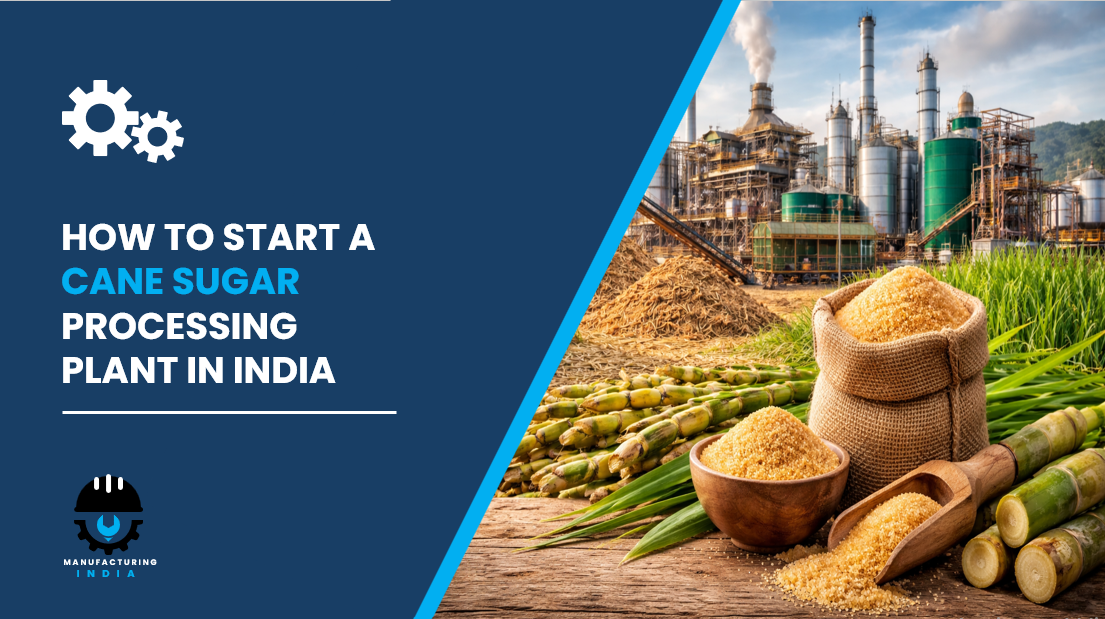
Setting up a cane sugar processing plant in India presents a compelling investment case rooted in the country’s position as the world’s second-largest sugarcane producer and one of its largest sugar consumers. Cane sugar — chemically known as sucrose and derived from Saccharum officinarum through mechanical extraction and refining — is a fundamental ingredient across food and beverage, confectionery, bakery, pharmaceutical, dairy, and ethanol production industries. India’s vast sugarcane cultivation belt, spanning Uttar Pradesh, Maharashtra, Karnataka, Tamil Nadu, and Andhra Pradesh, provides an unmatched raw material base at competitive procurement costs, giving domestic processors a structural advantage over import-dependent geographies. With rising food and beverage consumption, growing urbanisation, and one of the world’s most ambitious ethanol blending programmes, the demand tailwinds for cane sugar processing in India are both broad and durable.
What makes this investment particularly compelling in 2026 is India’s landmark achievement of 20% ethanol blending in petrol by mid-2025 — up from just 1.53% in 2014 — driven by a massive expansion of ethanol production capacity from 380 million litres to over 6,610 million litres. This programme, supported by government subsidies to distilleries and the use of sugarcane-based feedstocks, directly strengthens the demand for molasses — a key cane sugar processing byproduct — while improving the overall viability and integration economics of sugar mills. Alongside India’s Make in India initiative, agro-processing investment incentives, and state-level industrial estate development in the sugarcane belt, the cane sugar processing plant opportunity is backed by policy momentum that few other food processing segments can match.
A cane sugar processing plant in India combines a world-class agricultural feedstock base, accelerating ethanol blending policy support, and multi-sector demand from food and beverage, confectionery, pharmaceutical, and dairy industries to deliver a financially sound investment. With gross margins of 20–30%, net margins of 10–20%, and by-product revenues from molasses and bagasse cogeneration enhancing overall plant economics, this facility represents a strategically well-timed and commercially proven manufacturing opportunity.
What is Cane Sugar?
Cane sugar is a natural sweetener derived from sugarcane (Saccharum officinarum) through mechanical extraction and refining processes. Chemically known as sucrose, it is a crystalline carbohydrate composed of glucose and fructose units. Cane sugar is typically available in raw, white refined, brown, and specialty forms depending on the level of processing applied. It is characterised by high purity, high solubility, a stable sweetness profile, and a long shelf life.
Beyond its sweetening function, cane sugar contributes to texture, preservation, fermentation, and browning reactions in food applications. Importantly, by-products such as molasses and bagasse add significant value — molasses supports ethanol production and alcoholic beverage manufacturing, while bagasse can be used for cogeneration of electricity — enhancing overall plant profitability and resource efficiency. The primary production method spans sugarcane harvesting, cane crushing and juice extraction, juice clarification and purification, evaporation and concentration, crystallisation, centrifugation, drying and cooling, and packaging. The product serves end-use industries including food and beverage, confectionery, bakery, pharmaceutical, alcohol and ethanol production, and dairy processing.
Cost of Setting Up a Cane Sugar Processing Plant in India
The total cost of establishing a cane sugar processing plant in India depends on production capacity, chosen technology, plant location, degree of automation, and regulatory compliance requirements.
1. Capital Expenditure (CapEx)
The capital investment required to set up this facility covers several major cost heads. Land and site development — including land registration, boundary development, cane yard construction, internal road networks, and related infrastructure — forms a substantial portion of total CapEx. Investors should consider locating the unit within or adjacent to India’s primary sugarcane cultivation zones in Uttar Pradesh (the country’s largest sugar-producing state), Maharashtra, Karnataka, or Tamil Nadu. Proximity to farmgate sugarcane supply is critical given the perishable nature of harvested cane and the need to minimise the time between harvest and crushing to preserve sucrose content.
Civil works and construction costs cover the main processing shed, cane receiving and weighing yard, juice extraction building, clarification and evaporation hall, crystallisation and centrifugation area, drying and packing section, molasses storage tanks, bagasse handling area, boiler house for cogeneration, quality control laboratory, effluent treatment zone, and administrative block. The scale of civil infrastructure required for a 100,000–500,000 MT annual capacity facility is substantial, necessitating careful layout planning and civil engineering design.
Machinery and equipment represent the largest component of total capital expenditure for this cane sugar processing plant. Key machinery required includes:
- Cane cutters and shredders
- Juice heaters and clarifiers
- Evaporators
- Vacuum pans
- Crystallisers
- Centrifuges
- Rotary dryers
- Packaging systems
Other capital costs include effluent treatment plant (ETP) installation, bagasse-fired boiler and steam turbine cogeneration system, molasses storage and handling infrastructure, pre-operative and commissioning expenses, and any applicable import duties on specialised evaporation and crystallisation equipment.
Request a Sample Report for In-Depth Market Insights: https://www.imarcgroup.com/cane-sugar-processing-plant-project-report/requestsample
2. Operational Expenditure (OpEx)
The operating cost structure of a cane sugar processing plant is overwhelmingly dominated by raw material procurement. Raw material cost — covering sugarcane as the primary input along with lime, sulfur, and packaging bags — accounts for approximately 75–80% of total OpEx, making sugarcane procurement the single most critical cost management lever in the business. Investors must establish long-term agreements with sugarcane farmers and cooperatives in the surrounding agricultural zone, ensuring minimum guaranteed offtake pricing arrangements that align with government-notified Fair and Remunerative Price (FRP) levels applicable to cane procurement in India.
Utility costs, covering electricity, water, and steam — which are central to juice evaporation, vacuum crystallisation, and rotary drying operations — account for 10–15% of OpEx, a proportion that can be significantly reduced by operating a bagasse-fired cogeneration system that converts processing byproduct into plant electricity, improving energy self-sufficiency and reducing net utility expenditure. Other operating costs include transportation of finished sugar and molasses to buyers, packaging materials, salaries and wages, maintenance and repairs of heavy processing equipment, depreciation of fixed assets, and applicable taxes. By the fifth year of operations, total operational costs are projected to increase substantially due to inflation, sugarcane price escalation, market fluctuations, and rising consumer demand dynamics.
3. Plant Capacity
The proposed processing facility is designed with an annual production capacity ranging between 100,000–500,000 MT, enabling economies of scale while maintaining operational flexibility. Capacity can be customised based on specific investor requirements, available sugarcane catchment area, and capital availability. Profitability and unit economics improve meaningfully with higher capacity utilisation, and the large-scale nature of cane sugar processing means that fixed cost absorption improves significantly as throughput increases toward nameplate capacity.
4. Profit Margins and Financial Projections
The cane sugar processing plant demonstrates solid profitability potential under normal operating conditions, further strengthened by molasses and bagasse by-product revenues. Gross profit margins typically range between 20–30%, supported by stable multi-sector demand and the value-added by-product revenue streams from molasses sales to ethanol distilleries and bagasse-derived cogeneration income. Net profit margins are projected in the range of 10–20%. Key financial indicators including NPV, IRR, payback period, liquidity analysis, and sensitivity analysis are covered comprehensively in the full project report. Financial viability is further supported by India’s government-backed ethanol blending programme, which provides a guaranteed and policy-supported revenue channel for molasses-derived ethanol output.
Why Set Up a Cane Sugar Processing Plant in India?
Essential Food Ingredient with Stable Baseline Demand. Cane sugar remains a fundamental ingredient across global food systems, ensuring steady baseline demand across food and beverage, confectionery, bakery, pharmaceutical, dairy, and household consumption categories. India’s large and growing population, rising packaged food consumption, and expanding food and beverage industry make domestic demand both deep and predictable.
By-Product Utilisation Enhancing Plant Profitability. Bagasse can be used for cogeneration of electricity, reducing plant energy costs and generating surplus power for grid sale, while molasses supports ethanol production and alcoholic beverage manufacturing — improving overall plant profitability and resource efficiency well beyond what sugar revenues alone would provide. This integrated by-product economics is a defining feature of the Indian sugar mill business model.
India’s Landmark Ethanol Blending Programme. India achieved 20% ethanol blending in petrol by mid-2025, up from 1.53% in 2014, driven by an expansion of ethanol production capacity from 380 million litres to over 6,610 million litres. Government subsidies to distilleries and the use of sugarcane-based feedstocks have directly tightened ethanol supply chains and strengthened the revenue value of molasses as a fermentation substrate, making the integrated sugar-ethanol mill model increasingly attractive for Indian investors.
Active Global Industry Investment. In September 2025, Sucro Limited and Santander Sugar Group formed a joint venture — Caribbean Sugar Refinery Limited (CSR) — to build a modern cane sugar refinery expected to supply more than 75% of the CARICOM region’s refined sugar demand. In July 2025, Coca-Cola planned to introduce a new cane sugar-sweetened version of its classic soda in the U.S., signalling growing consumer preference for cane sugar as a natural sweetener and creating new premium positioning opportunities for cane sugar producers globally.
Large-Scale Agricultural Linkages and Rural Economic Development. Sugar manufacturing supports rural economies and agro-industrial development, strengthening supply chain integration between farming communities and industrial processing. This positions cane sugar investment in India as both commercially viable and socially significant — attributes that attract state government support, concessional financing, and farmer supply partnerships.
Export Potential and Foreign Exchange Earnings. India is a major global sugar exporter, and cane sugar processing plants positioned in high-productivity agricultural zones can benefit from export opportunities that supplement domestic sales, contributing to foreign exchange earnings and providing revenue diversification beyond domestic pricing cycles.
Manufacturing Process — Step by Step
The cane sugar processing plant uses sugarcane harvesting, cane crushing and juice extraction, juice clarification and purification, evaporation and concentration, crystallisation, centrifugation, drying and cooling, and packaging as the primary production method. The process involves multiple unit operations, material handling stages, and quality verification checkpoints throughout.
- Sugarcane Harvesting and Receipt: Freshly harvested sugarcane from contracted farmers is received at the cane yard, weighed, and inspected for quality before entering the crushing line. Speed of processing is critical as sucrose content degrades after cutting.
- Cane Cutting and Shredding: Harvested cane is fed through cane cutters and shredders to break it down into a fibrous material that maximises juice extraction efficiency in the milling train.
- Juice Extraction (Crushing): Shredded cane passes through a series of roller mills that crush the cane fibre and extract raw juice. Bagasse — the fibrous residue — is collected for boiler fuel and cogeneration.
- Juice Clarification and Purification: Extracted juice is heated in juice heaters and treated with lime and sulfur dioxide to precipitate impurities. The treated juice passes through clarifiers to remove sludge and produce clear juice suitable for evaporation.
- Evaporation and Concentration: Clear juice is fed into multi-effect evaporators where water is progressively removed under vacuum, concentrating the juice into a thick syrup — known as massecuite — with high sucrose content.
- Crystallisation (Vacuum Pans): Concentrated syrup enters vacuum pans where controlled crystallisation produces sugar crystals of the desired size and purity. This is the core value-creation step of the cane sugar processing procedure.
- Centrifugation: Massecuite containing sugar crystals and mother liquor (molasses) is fed into high-speed centrifuges that separate the crystals from the residual molasses by centrifugal force.
- Drying and Cooling: Separated sugar crystals are passed through rotary dryers to reduce moisture content to specification and then cooled before packaging.
- Quality Control and Testing: Finished sugar is tested for purity, colour (ICUMSA), moisture, grain size, and ash content against applicable FSSAI and export quality specifications.
- Packaging and Dispatch: Approved sugar is packaged in bags of various sizes and dispatched to food and beverage manufacturers, confectionery and bakery companies, pharmaceutical producers, dairy processors, retail channels, ethanol distilleries (molasses), and export markets.
Key Applications
The cane sugar processing plant serves multiple high-volume industries with sustained and recurring demand for consistent-quality sucrose:
- Food and Beverage Industry: Primary sweetener in soft drinks, juices, sauces, processed foods, and ready-to-eat products due to its consistent taste and preservation properties.
- Confectionery Industry: Used in candies, chocolates, chewing gums, and sweets where crystallisation properties are critical for texture and structure.
- Bakery Industry: Enhances browning through Maillard reactions, improves moisture retention, and contributes to product volume and flavour stability in breads, cakes, and biscuits.
- Pharmaceutical Industry: Serves as a base for syrups, medicinal suspensions, and coating agents due to its high solubility and stability.
- Ethanol and Alcohol Industry: Molasses, the by-product of cane sugar processing, is utilised in ethanol fermentation for India’s national blending programme and in alcoholic beverage production.
- Dairy Industry: Applied in flavoured milk, condensed milk, ice cream, and yogurt products for sweetness and consistency.
Leading Processors
The global cane sugar industry is served by several major processors and agri-industrial groups with extensive production capacities and diversified application portfolios. Key players include:
- Florida Crystals Corporation
- Anthony’s Goods, LLC
- Global Organics Ltd.
- Nanning Sugar Industry Co., Ltd.
- Wilmar Sugar Australia Limited
- Shree Renuka Sugars Limited
- Tereos Group
- SRB S.p.A.
Timeline to Start the Plant
- Feasibility study and project report preparation
- Land acquisition and site development
- Regulatory approvals and environmental clearances
- Factory licence and fire safety compliance
- Machinery procurement and installation
- Raw material supplier agreements and supply chain setup
- Trial production and quality testing
- Commercial production launch
Licences and Regulatory Requirements
Starting a cane sugar processing unit in India requires several approvals:
- Business registration (Proprietorship, LLP, or Pvt Ltd)
- Factory Licence under the Factories Act
- Environmental Clearance from State Pollution Control Board
- GST Registration
- Fire Safety NOC
- FSSAI (Food Safety and Standards Authority of India) licence — mandatory for all food processing operations
- Sugar factory licence under the Sugar (Control) Order applicable to regulated sugar manufacturing
- Effluent Treatment Plant (ETP) operational clearance for press mud and wastewater management
- Occupational Health and Safety compliance
Key Challenges to Consider
High Capital Requirements. The scale of infrastructure required for a 100,000–500,000 MT annual capacity cane sugar processing facility — covering heavy crushing, evaporation, crystallisation, centrifugation, and cogeneration equipment — constitutes a very large CapEx commitment, requiring careful structuring of institutional debt, equity, and government-backed financing.
Raw Material Price Volatility. Sugarcane — accounting for 75–80% of total OpEx — is subject to seasonal availability, yield variability influenced by monsoon performance, and government-regulated Fair and Remunerative Price (FRP) revisions that can escalate procurement costs. Securing long-term agreements with farming cooperatives and building a diversified farmer supply base are essential risk management strategies.
Regulatory Compliance. The Indian sugar sector operates under significant regulatory oversight including the Sugar (Control) Order, FSSAI food safety norms, State Pollution Control Board requirements for effluent and press mud management, and government intervention in cane pricing — all of which require dedicated compliance management and proactive engagement with regulatory bodies.
Technology and Innovation Pressure. Regulatory scrutiny over sugar consumption and health implications in some regions may continue to impact demand and spur new product offerings toward specialty and refined sugar grades. Processors that invest in value-added product capabilities — including raw, organic, and specialty sugar variants — can command price premiums and diversify revenue.
Competition. Global players such as Shree Renuka Sugars Limited, Tereos Group, Wilmar Sugar Australia Limited, and Florida Crystals Corporation maintain strong market positions. Domestic Indian processors must leverage feedstock proximity, integrated ethanol-cogeneration economics, and scale efficiencies to maintain competitive cost structures.
Skilled Manpower. Operating large-scale multi-effect evaporators, vacuum pans, high-speed centrifuges, and cogeneration systems requires technically trained engineers and process operators — a challenge in rural sugarcane-belt locations that may have limited industrial operator training infrastructure.
Frequently Asked Questions
1. How much does it cost to set up a cane sugar processing plant in India? Total investment depends on production capacity (100,000–500,000 MT annually), technology selection, location within the sugarcane belt, and automation level. Key cost components include land and cane yard development, civil construction, machinery (cane cutters and shredders, juice heaters and clarifiers, evaporators, vacuum pans, crystallisers, centrifuges, rotary dryers, packaging systems), cogeneration boiler infrastructure, utilities, and working capital. A detailed project report provides capacity-specific CapEx and OpEx estimates.
2. Is cane sugar processing profitable in India in 2026? Yes. The facility demonstrates gross profit margins of 20–30% and net profit margins of 10–20% under normal operating conditions. Profitability is further enhanced by molasses revenue from ethanol distillery sales under India’s 20% ethanol blending programme and bagasse-derived cogeneration income.
3. What machinery is required for a cane sugar processing plant in India? Key equipment includes cane cutters and shredders, juice heaters and clarifiers, evaporators, vacuum pans, crystallisers, centrifuges, and rotary dryers, along with packaging systems, molasses storage tanks, and bagasse-fired boilers for cogeneration.
4. What licences and approvals are required to start a cane sugar processing plant in India? Required approvals include business registration, Factory Licence under the Factories Act, Environmental Clearance from the State Pollution Control Board, GST registration, FSSAI food safety licence, sugar factory licence under the Sugar (Control) Order, ETP operational clearance, Fire Safety NOC, and Occupational Health and Safety certification.
5. What raw materials are needed for cane sugar processing? The primary raw material is sugarcane (Saccharum officinarum). Supporting process materials include lime and sulfur used in juice clarification and purification, along with packaging bags for finished sugar dispatch.
6. What are the environmental compliance requirements for a cane sugar processing plant in India? Operators must obtain Environmental Clearance, maintain an operational Effluent Treatment Plant to manage press mud and wastewater from juice processing, comply with State Pollution Control Board guidelines on effluent discharge and boiler emission standards, and implement solid waste management for filter cake and press mud disposal in line with applicable regulations.
7. What is the best location to set up a cane sugar processing plant in India? Ideal locations offer maximum proximity to high-productivity sugarcane cultivation areas to minimise cane transportation costs and preserve sucrose content. Uttar Pradesh — India’s largest sugar-producing state — along with Maharashtra (Kolhapur, Ahmednagar), Karnataka (Belgaum, Mandya), and Tamil Nadu (Thanjavur, Vellore) represent the strongest location options, each offering established farmer supply networks, agro-industrial infrastructure, and state government support for sugar industry investment.
8. What is the break-even period for this type of plant in India? Break-even depends on production scale, sugarcane procurement costs, capacity utilisation, and prevailing domestic and export sugar pricing. The integrated revenue from by-product molasses sold to ethanol distilleries and bagasse cogeneration income meaningfully improves the payback timeline relative to sugar revenue alone. A detailed feasibility study provides project-specific break-even and NPV projections.
9. What government incentives are available for manufacturers in India? Cane sugar processors in India can benefit from government subsidies for integrated ethanol distillery additions under the ethanol blending programme, capital subsidies under state agricultural processing investment schemes, interest subvention on term loans for sugar mills, tax incentives for cogeneration infrastructure investment, and state-level industrial promotion incentives in major sugarcane belt states. Central schemes supporting agro-processing investment may provide additional funding support.
Key Takeaways for Investors
The cane sugar processing plant opportunity in India is underpinned by a powerful combination of structural domestic demand from food and beverage, confectionery, bakery, pharmaceutical, dairy, and ethanol industries, India’s world-leading ethanol blending achievement of 20% by mid-2025, and a vast, cost-competitive sugarcane agricultural base that gives domestic processors a feedstock cost advantage unavailable in most other geographies. The financial profile is robust across plant capacities, with gross margins of 20–30% and net margins of 10–20%, further strengthened by molasses and bagasse by-product revenues that improve overall mill economics materially. The Brazil cane sugar market alone was valued at USD 4.11 billion in 2025 and is projected to reach USD 5.25 billion by 2034 at a CAGR of 2.8%, while India’s domestic market scale and ethanol demand trajectory offer an even larger and more immediate growth opportunity. As global brands like Coca-Cola move toward cane sugar-sweetened product formulations and the integrated sugar-ethanol-cogeneration model matures in India, this production facility is positioned for multi-decade demand sustainability across its core revenue streams and by-product channels.
About the Author