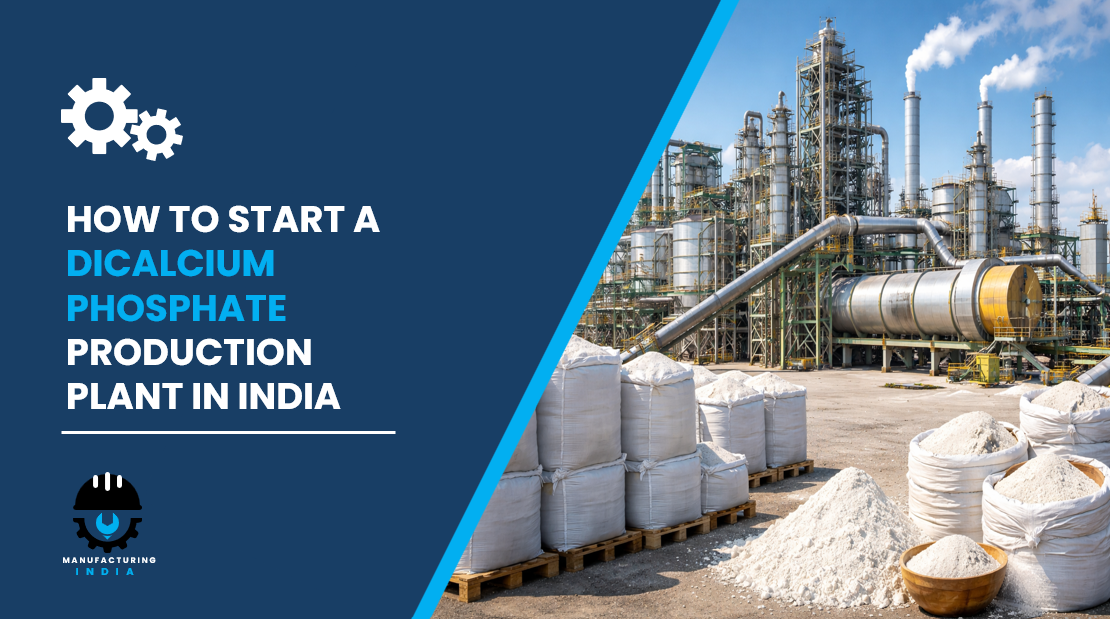
Setting up a dicalcium phosphate manufacturing plant in India presents a compelling investment case driven by the country’s rapidly expanding livestock and poultry industry, a growing pharmaceutical and nutraceutical sector, increasing government-backed food fortification programmes, and rising consumer awareness of calcium and mineral nutritional deficiencies. Dicalcium phosphate (DCP) – a white crystalline compound that delivers essential calcium and phosphorus for bone development, growth, and general health in both humans and animals – is an indispensable feed additive, pharmaceutical excipient, and food fortifier whose demand is structurally tied to some of India’s fastest-growing industries. With the country’s poultry, swine, and cattle feed industries expanding in response to rising protein consumption, and pharmaceutical companies increasingly incorporating DCP into supplement and tablet formulations, the domestic demand base for a locally produced supply of high-purity dicalcium phosphate has never been stronger.
India’s strategic position for this investment is reinforced by the availability of phosphate rock from domestic and regional sources, a cost-competitive manufacturing environment, well-developed chemical industry infrastructure in states such as Gujarat, Andhra Pradesh, Rajasthan, and Tamil Nadu, and a strong regulatory and policy framework supporting animal nutrition, pharmaceutical manufacturing, and food fortification. The Make in India initiative and chemical sector investment incentives further strengthen the case for establishing a dicalcium phosphate manufacturing plant in India, particularly for investors targeting the large and growing domestic animal feed and pharmaceutical buyer base while retaining optionality on export markets in Southeast Asia and the Middle East.
A dicalcium phosphate manufacturing plant in India combines multi-sector demand from animal feed, pharmaceuticals, nutraceuticals, and food fortification with a scalable dry chemical production process, gross margins of 25–35%, and net margins of 10–15%. With the global DCP market projected to reach USD 1.66 billion by 2034 at a CAGR of 5.6%, this investment offers stable financial returns and long-term demand visibility for technically capable producers serving India’s agriculture and health sectors.
What is Dicalcium Phosphate?
Dicalcium phosphate (DCP) is a white crystalline substance that functions primarily as a dietary supplement and feed additive. The compound provides essential calcium and phosphorus – nutrients that both humans and animals need to develop bones, attain full growth potential, and maintain good health. The poultry industry, livestock sector, and pet food manufacturers use DCP to enhance their feed formulations and improve nutritional value. In the pharmaceutical and nutraceutical sector, the substance functions as a mineral supplement and tablet manufacturing excipient, while in the food sector it acts as a component for baking powders and fortified food products.
Dicalcium phosphate is available in both powder and granule forms, which enable industrial-scale production and small-scale usage because of their superior solubility, stability, and convenient handling properties. The material achieves predictable performance across different applications because of its high purity and consistent composition. The primary production method spans calcination, precipitation, filtration, drying, grinding, sieving, quality testing, and packaging. The product serves end-use industries including the animal feed industry, pharmaceutical and nutraceutical industry, food fortification sector, and industrial chemical applications.
Cost of Setting Up a Dicalcium Phosphate Manufacturing Plant in India
The total cost of establishing a dicalcium phosphate manufacturing plant in India depends on production capacity, chosen production route (wet chemical precipitation vs. direct reaction), plant location, automation level, and regulatory compliance requirements.
1. Capital Expenditure (CapEx)
The capital investment required to set up this facility covers several major cost heads. Land and site development — including land registration, boundary development, chemical-resistant flooring, drainage infrastructure, and related site works — forms a substantial portion of total CapEx. Investors should consider locating the unit within chemical or agro-chemical industrial estates in Gujarat (Ankleshwar, Dahej), Andhra Pradesh, or Rajasthan, where proximity to phosphate rock sources, established chemical supplier networks, and state government industrial incentives can meaningfully reduce both input procurement and infrastructure costs.
Civil works and construction costs cover the main reaction and precipitation hall, raw material storage area for phosphate rock, hydrochloric acid or sulfuric acid, and lime or calcium carbonate, the quality control laboratory, drying and grinding zone, finished goods warehouse, effluent treatment area, and administrative block. Corrosion-resistant construction materials must be specified throughout the facility given the acid-handling requirements of the production process.
Machinery and equipment represent the largest component of total capital expenditure for this dicalcium phosphate manufacturing plant. Key machinery required — all of which must be high-quality and corrosion-resistant — includes:
- Reactors
- Filters
- Dryers (rotary or spray dryers)
- Grinders
- Sieves
- Packaging machines
- Reaction tanks
- Mixers
- Filtration units
- Crushers
- Storage silos
- Conveyors
- Dust collectors
- Laboratory testing tools
Other capital costs include effluent treatment plant (ETP) installation for acid and process wastewater management, pre-operative and commissioning expenses, acid-resistant piping and vessel lining throughout the plant, and any applicable import duties on specialised reactor and filtration equipment not manufactured domestically.
Request a Sample Report for In-Depth Market Insights: https://www.imarcgroup.com/dicalcium-phosphate-manufacturing-plant-project-report/requestsample
2. Operational Expenditure (OpEx)
The operating cost structure of a dicalcium phosphate manufacturing plant is primarily driven by raw material procurement. Raw material cost – covering phosphate rock as the primary input, along with hydrochloric acid or sulfuric acid, and lime or calcium carbonate as process reagents – accounts for approximately 60–70% of total OpEx. Given the pricing sensitivity of phosphate rock – subject to global phosphate market cycles – investors should establish long-term supply contracts with reliable domestic and regional suppliers to stabilise input costs. Sourcing phosphate rock from Rajasthan, which holds India’s primary phosphate rock deposits, can reduce freight costs relative to import-dependent procurement.
Utility costs, covering electricity, water, and steam required for reaction heating, drying, and grinding operations, account for 20–25% of OpEx – a moderately high share reflecting the thermal energy demands of the multi-stage drying process. Other operating costs include transportation and logistics for finished DCP dispatch to animal feed manufacturers, pharmaceutical companies, and food processors, packaging materials, salaries and wages, maintenance and repairs of corrosion-sensitive process equipment, depreciation of fixed assets, and applicable taxes. By the fifth year of operations, total operational costs are projected to increase substantially due to inflation, phosphate rock price escalation, market fluctuations, and growing demand from expanding livestock and pharmaceutical end-use sectors.
3. Plant Capacity
The proposed production facility is designed with an annual production capacity ranging between 20,000–50,000 MT, enabling economies of scale while maintaining operational flexibility. Capacity can be customised based on specific investor requirements, target market segment mix across animal feed, pharmaceutical, and food fortification buyers, and capital availability. The dry chemical process provides a production method that companies can use to create products in both smaller and larger production facilities while utilising resources efficiently.
4. Profit Margins and Financial Projections
The dicalcium phosphate manufacturing plant demonstrates healthy and consistent profitability potential under normal operating conditions. Gross profit margins typically range between 25–35%, supported by stable multi-sector demand, moderate production process complexity, and the premium pricing achievable in pharmaceutical-grade and food-grade DCP segments relative to feed-grade output. Net profit margins are projected in the range of 10–15%. Key financial indicators including NPV, IRR, payback period, liquidity analysis, and sensitivity analysis are covered comprehensively in the full project report. Break-even for this type of plant typically ranges from three to five years, depending on production scale, raw material pricing, capacity utilisation, and the mix of high-margin pharmaceutical versus commodity feed-grade DCP output.
Why Set Up a Dicalcium Phosphate Manufacturing Plant in India?
Rising Demand in India’s Expanding Livestock Feed Sector. The livestock feed market in India shows accelerating demand for calcium and phosphorus supplements as poultry, swine, and cattle producers scale their operations to meet rising protein consumption across India’s growing and increasingly affluent population. Dicalcium phosphate is a non-substitutable mineral supplement in commercial livestock and poultry feed formulations, creating a stable and structurally growing domestic buyer base for Indian DCP producers.
Pharmaceutical and Nutraceutical Growth Driving High-Value Demand. The demand for calcium and mineral-rich dietary supplements has increased as consumers become more aware of health and wellness. As per CDC data reported in 2025, 1 out of 8 U.S. women of reproductive age and nearly 1 in 4 pregnant women face iron deficiency, while over half of children under 5 globally lack essential micronutrients – trends that directly drive mineral supplement demand, including DCP, across both developed and developing markets including India.
Food Fortification Trend Creating Institutional Demand. The trend of food fortification leads to increased DCP consumption as governments and health organisations promote the fortification of staple food products. India’s own national food fortification programmes covering wheat flour, rice, and milk create a sustained institutional demand channel for food-grade DCP producers operating in compliance with FSSAI standards.
High Profit Potential with Scalable Production Process. The business generates attractive gross margins of 25–35% because it maintains consistent demand while producing goods through a moderate-complexity dry chemical process. The scalability of DCP production – from smaller facilities targeting specialty pharmaceutical-grade output to larger plants serving commodity animal feed markets – gives investors flexibility to match production economics to available capital and target markets.
Active Industry Innovation Expanding Applications. In October 2025, Chatham Rock Phosphate Limited advanced the Korella North Mine with plans to supply rock phosphate to a manufacturing plant in Cloncurry targeting DCP and monocalcium phosphate for cattle lick blocks in phosphorus-deficient Northern Queensland — demonstrating continued global investment in DCP supply chain development. In May 2025, researchers from Bangladesh and China published findings on nano-sized dicalcium phosphate dihydrate (DCPD) synthesised from marine mollusk shells, highlighting its potential for advanced biomedical and material science applications — signalling an expanding future value-added product horizon beyond conventional DCP grades.
Local Supply Chain Preference from Animal Feed and Pharma Buyers. Animal feed manufacturers, pharmaceutical companies, and food fortification processors in India are increasingly favouring domestic DCP suppliers to reduce import dependence, ensure product traceability, and maintain consistent supply. This preference for localised sourcing creates strong commercial relationships for India-based DCP producers who can consistently meet purity, particle size, and regulatory compliance specifications.
Manufacturing Process – Step by Step
The dicalcium phosphate manufacturing process uses calcination, precipitation, filtration, drying, grinding, sieving, quality testing, and packaging as the primary production method. The process involves multiple unit operations, material handling stages, and quality verification checkpoints throughout.
- Raw Material Receipt and Inspection: Phosphate rock, hydrochloric acid or sulfuric acid, and lime or calcium carbonate are received, inspected for purity and specification compliance, and stored in designated corrosion-resistant storage areas.
- Phosphate Rock Treatment (Acid Digestion): Phosphate rock is treated with hydrochloric acid or sulfuric acid in reaction tanks to release phosphoric acid and dissolve the calcium phosphate matrix, forming a reactive intermediate solution.
- Precipitation Reaction: Lime or calcium carbonate is added to the acidic phosphate solution in controlled-pH reactors to precipitate dicalcium phosphate through a neutralisation reaction. Reaction parameters – temperature, pH, and reagent ratios – are carefully controlled to achieve the desired DCP crystal structure, particle size, and purity.
- Filtration and Washing: The DCP precipitate is separated from the mother liquor using filtration units. The filter cake is washed with water to remove residual acid, soluble impurities, and process contaminants.
- Drying: Washed DCP filter cake is fed into rotary or spray dryers to reduce moisture content to specification, producing a free-flowing dry powder or granule depending on the target product grade.
- Grinding and Size Reduction: Dried DCP is processed through grinders and crushers to achieve the required particle size distribution for feed-grade, food-grade, or pharmaceutical-grade applications.
- Sieving and Classification: Ground material is passed through sieves to separate particle size fractions and ensure product conformity with grade-specific particle size specifications.
- Quality Control and Testing: Finished DCP is tested for calcium content, phosphorus content, heavy metals, fluoride levels, moisture, particle size distribution, and microbiological parameters against applicable BIS, FSSAI, USP, and feed-grade quality standards.
- Packaging and Dispatch: Approved DCP – in powder or granule form – is packaged in bags or bulk containers and dispatched to animal feed manufacturers, pharmaceutical and nutraceutical companies, food fortification processors, and industrial chemical users.
Key Applications
The dicalcium phosphate manufacturing plant serves multiple industries with high-volume, specification-driven demand for consistent-purity mineral inputs:
- Animal Feed Industry: Supplement for calcium and phosphorus in poultry, swine, and cattle feed formulations, improving bone development, growth performance, and general livestock health.
- Pharmaceutical and Nutraceutical Sector: Functions as a calcium and phosphorus dietary supplement and as a binding agent and excipient in tablet and capsule manufacturing.
- Food Fortification: Adds nutritional value to bakery, dairy, and other processed food products, supporting government-mandated and voluntary fortification programmes.
- Industrial Chemical Applications: Serves as a primary substance that manufacturers use in specialised production methods and chemical product formulations.
Leading Manufacturers
The global dicalcium phosphate industry is served by several major producers with extensive production capacities and diversified application portfolios. Key players include:
- Guizhou Zerophos Chemical Co., Ltd.
- ICL
- Bamni Proteins Limited
- Gujarat Narmada Valley Fertilizers & Chemicals Ltd.
- Aarti Industries Limited
Timeline to Start the Plant
- Feasibility study and project report preparation
- Land acquisition and site development
- Regulatory approvals and environmental clearances
- Factory licence and fire safety compliance
- Machinery procurement and installation
- Raw material supplier agreements and supply chain setup
- Trial production and quality testing
- Commercial production launch
The overall timeline from project initiation to commercial production typically ranges from 12 to 36 months, depending on plant capacity, equipment availability, construction speed, technology used, and regulatory approvals.
Licences and Regulatory Requirements
Starting a dicalcium phosphate manufacturing unit in India requires several approvals:
- Business registration (Proprietorship, LLP, or Pvt Ltd)
- Factory Licence under the Factories Act
- Environmental Clearance from State Pollution Control Board
- GST Registration
- Fire Safety NOC
- Hazardous chemical compliance for acid storage and handling (hydrochloric acid or sulfuric acid) under applicable rules
- FSSAI licence for food-grade DCP production — mandatory for food fortification applications
- Effluent Treatment Plant (ETP) operational clearance for acid and process wastewater management
- Occupational Health and Safety compliance
Key Challenges to Consider
High Capital Requirements. Corrosion-resistant reactors, filtration systems, drying equipment, and grinding and sieving lines — along with acid-resistant civil construction throughout the plant — constitute substantial CapEx commitments requiring careful financial planning and access to institutional funding or government-backed chemical sector investment schemes.
Raw Material Price Volatility. Phosphate rock – accounting for 60–70% of total OpEx – is subject to global phosphate commodity price cycles. Hydrochloric acid or sulfuric acid prices are also tied to chemical industry supply-demand dynamics. Long-term supply agreements with domestic phosphate rock suppliers and acid producers are essential cost risk management tools.
Regulatory Compliance. Meeting FSSAI food safety standards for food-grade DCP, BIS and pharmacopoeial purity specifications for pharmaceutical-grade output, hazardous chemical handling norms for acid storage, and State Pollution Control Board environmental clearance requirements involves multi-layered compliance obligations that require dedicated management and documentation investment.
Technology and Innovation Pressure. Emerging research into nano-sized dicalcium phosphate dihydrate (DCPD) for advanced biomedical and material science applications — as highlighted in May 2025 published findings — and innovations in renewable-electricity-based phosphoric acid generation represent potential technology shifts that forward-looking producers should monitor for future product portfolio expansion.
Competition. Indian players such as Gujarat Narmada Valley Fertilizers & Chemicals Ltd. and Aarti Industries Limited, alongside global producers such as ICL and Guizhou Zerophos Chemical Co., Ltd., maintain established market positions. New entrants must differentiate on product purity, grade versatility across feed, food, and pharmaceutical applications, and supply reliability to win and retain institutional buyers.
Skilled Manpower. Operating acid-handling reactors, controlled-pH precipitation systems, and multi-stage quality testing laboratories to pharmacopoeial and feed certification standards requires technically trained chemical engineers and process operators – a challenge in locations outside established chemical manufacturing clusters.
Frequently Asked Questions
1. How much does it cost to set up a dicalcium phosphate manufacturing plant in India? Total investment depends on production capacity (20,000–50,000 MT annually), production route, location, and automation level. Key cost components include land and site development with acid-resistant construction, corrosion-resistant machinery (reactors, filters, dryers, grinders, sieves, packaging machines), utilities, ETP infrastructure, and working capital. A detailed project report provides capacity-specific CapEx and OpEx estimates.
2. Is dicalcium phosphate manufacturing profitable in India in 2026? Yes. The facility demonstrates gross profit margins of 25–35% and net profit margins of 10–15% under normal operating conditions. Profitability improves with higher capacity utilisation, pharmaceutical-grade output premiums, and effective phosphate rock procurement cost management.
3. What machinery is required for a dicalcium phosphate plant in India? Key equipment includes reactors, filters, dryers (rotary or spray), grinders, sieves, packaging machines, reaction tanks, mixers, filtration units, crushers, storage silos, conveyors, dust collectors, and laboratory testing tools – all specified in corrosion-resistant materials.
4. What licences and approvals are required to start a dicalcium phosphate plant in India? Required approvals include business registration, Factory Licence under the Factories Act, Environmental Clearance from the State Pollution Control Board, GST registration, Fire Safety NOC, hazardous chemical compliance for acid handling, FSSAI food safety licence (for food-grade DCP), ETP operational clearance, and Occupational Health and Safety certification.
5. What raw materials are needed for dicalcium phosphate manufacturing? Key raw materials are phosphate rock as the primary input, hydrochloric acid or sulfuric acid used for phosphate rock digestion, and lime or calcium carbonate used as the precipitation reagent to form dicalcium phosphate.
6. What are the environmental compliance requirements for a dicalcium phosphate plant in India? Operators must obtain Environmental Clearance, maintain an operational Effluent Treatment Plant for acid process wastewater and wash water streams, comply with hazardous chemical storage regulations for acid handling, and meet State Pollution Control Board guidelines on effluent quality, dust emissions from grinding operations, and fluoride management from phosphate rock processing.
7. What is the best location to set up a dicalcium phosphate plant in India? Ideal locations offer proximity to phosphate rock supply sources, established chemical supplier networks for acids and lime, reliable power and water infrastructure, and access to chemical or agro-chemical industrial estates. Gujarat – particularly the Dahej and Ankleshwar chemical zones – Rajasthan (for phosphate rock proximity), and Andhra Pradesh are well-suited given their chemical industry infrastructure, state investment incentives, and connectivity to major animal feed and pharmaceutical buyer clusters.
8. What is the break-even period for this type of plant in India? Break-even typically ranges from three to five years, depending on production scale, phosphate rock procurement costs, capacity utilisation, and the revenue mix between higher-margin pharmaceutical-grade and commodity feed-grade DCP output. Operating at scale and securing stable long-term buyers in animal feed and pharmaceutical sectors can reduce the payback period meaningfully.
9. What government incentives are available for manufacturers in India? DCP manufacturers in India can benefit from capital subsidies under chemical sector industrial promotion schemes in Gujarat and Rajasthan, tax exemptions under state investment policies, reduced utility tariffs in chemical industrial estates, MSME development scheme funding for smaller plants, and export-linked benefits for pharmaceutical-grade DCP exports. Make in India and animal nutrition sector development initiatives may provide additional support.
Key Takeaways for Investors
The dicalcium phosphate manufacturing plant opportunity in India is underpinned by structurally growing demand from the livestock and poultry feed industry, the pharmaceutical and nutraceutical sector, government-backed food fortification programmes, and emerging industrial chemical applications – all of which are expanding in parallel with India’s population, income growth, and nutritional awareness. The financial profile is attractive across the 20,000-50,000 MT annual capacity range, with gross margins of 25–35% and net margins of 10–15%, supported by a scalable dry chemical production process and the premium pricing achievable in pharmaceutical-grade output segments. The global dicalcium phosphate market, valued at USD 1.01 billion in 2025, is projected to reach USD 1.66 billion by 2034 at a CAGR of 5.6%, confirming a sustained and broad-based demand growth trajectory. As micronutrient deficiency awareness deepens globally – with over half of children under 5 lacking essential micronutrients according to 2025 CDC data – and as livestock intensification and pharmaceutical supplement consumption accelerate in India, this production facility is positioned for durable, multi-decade demand across its core application segments.
About the Author