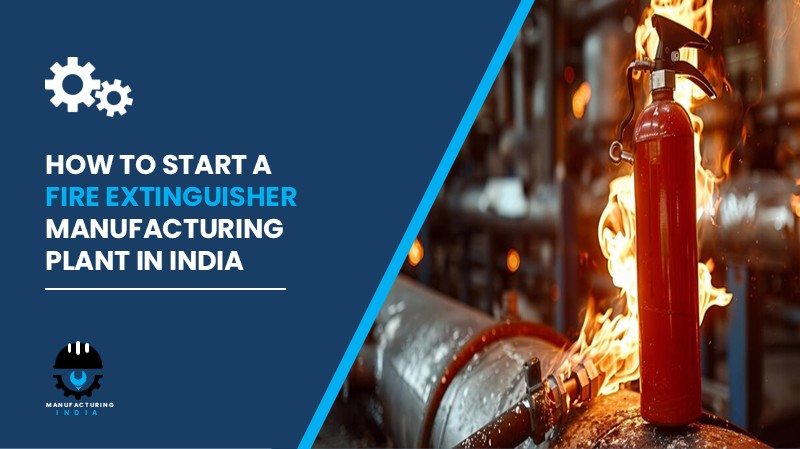
Setting up a fire extinguisher manufacturing plant in India presents a compelling investment case as the country rapidly emerges as one of the most cost-competitive and high-demand destinations for safety equipment manufacturing. Driven by booming demand from the construction, industrial facilities, transportation, and residential building sectors, fire extinguishers have become an indispensable part of India’s safety infrastructure.
“With over billion consumers, rapidly increasing safety regulations, growing infrastructure investments, and a booming construction sector, India offers one of the most financially attractive environments for fire extinguisher manufacturing with gross margins of 35–45% and a break-even window of 3–5 years.”
What is a Fire Extinguisher?
A fire extinguisher is a portable device used to extinguish small fires or control them in emergency situations. These devices are commonly filled with fire-suppressing agents such as water, foam, dry chemical powder, CO₂, or wet chemical agents, depending on the class of fire. Fire extinguishers are designed to quickly suppress fires by targeting the fire’s heat, fuel, or oxygen, effectively preventing the fire from escalating. Common types include water-based, CO₂-based, powder-based, and foam-based fire extinguishers. They are widely used in homes, offices, industrial facilities, and vehicles as an essential fire safety tool
Key Investment Highlights
- Process Used: Powder coating, assembly, filling, testing, and inspection.
- End-use Industries: Construction, industrial facilities, transportation, and residential buildings.
- Applications: Residential buildings, commercial properties, industrial plants, vehicles, aircraft, and marine environments.
Cost of Setting Up a Fire Extinguisher Manufacturing Plant in India
The fire extinguisher manufacturing plant cost in India depends on several parameters including production capacity, technology used, plant location, level of automation, and regulatory compliance. Here is a structured breakdown of all major cost components:
Request for a Sample Report: https://www.imarcgroup.com/fire-extinguisher-manufacturing-plant-project-report/requestsample
- Capital Expenditure (CapEx)
The total capital investment in a fire extinguisher manufacturing plant typically covers the following:
Land and Site Development
This includes land acquisition, boundary development, land registration charges, and basic site preparation. Cost varies significantly depending on whether the land is in an industrial estate, Special Economic Zone (SEZ), or a privately purchased plot.
Civil Works and Construction
Building costs cover the main manufacturing shed, utility area, raw material storage, quality control laboratory, administrative block, and worker amenities. Construction specifications depend on plant scale and local compliance norms.
Machinery and Equipment
This is the single largest component of CapEx. Essential equipment required for a fire extinguisher manufacturing plant includes:
- Metal Forming Presses (deep drawing machines)
- Welding Systems (MIG/TIG welding machines)
- Hydrostatic Test Chambers
- Shot Blasting Machines
- Powder Coating Lines
- Automated Filling Lines (for ABC powder, CO₂, foam agents)
- Valve Calibration Units and Pressure Gauges
- Air Compressors and Gas Filling Units
- Assembly Lines and Labeling Machines
Machinery costs represent the largest share of overall capital expenditure, reflecting the high degree of precision engineering involved in fire extinguisher production.
Other Capital Costs
These include pre-operative expenses, commissioning charges, import duties (if machinery is sourced internationally), utilities installation, safety systems, and Effluent Treatment Plant (ETP) setup.
| Particulars | Cost (in US$) |
| Land and Site Development Costs | XX |
| Civil Works Costs | XX |
| Machinery Costs | XX |
| Other Capital Costs | XX |
- Operational Expenditure (OpEx)
Once the plant is commissioned, the ongoing cost structure is dominated by a few key components:
Raw Material Cost (Steel Cylinders & Agents): 60–70% of Total OpEx
Steel cylinders are the primary raw material and account for the majority of operating expenses. Additional materials include valves, ABC powder/CO₂/foam agents, pressure gauges, hoses, and painting/powder coating materials. Long-term contracts with reliable suppliers help mitigate price volatility and ensure a consistent supply.
Utility Cost: 10–15% of Total OpEx
Utilities include electricity (consumed by forming presses, welding systems, hydrostatic test chambers, and filling lines), water (used in pressure testing), and compressed air supply.
Other Operating Costs
The remaining budget covers transportation, secondary packaging, salaries and wages, maintenance, depreciation, taxes, and miscellaneous overhead. By the fifth year of operations, total operational costs are expected to increase due to inflation, market fluctuations, and rising material costs.
| Particulars | In % |
| Raw Material Cost | 60–70% |
| Utility Cost | 10–15% |
| Transportation Cost | XX |
| Packaging Cost | XX |
| Salaries and Wages | XX |
| Depreciation | XX |
| Taxes | XX |
| Other Expenses | XX |
- Plant Capacity
The proposed manufacturing facility is designed with an annual production capacity ranging between 500,000 to 1 million units. This range allows the plant to achieve economies of scale while maintaining flexibility to serve multiple end-use segments including construction, industrial facilities, transportation, and residential buildings.
Smaller pilot setups with limited automation may start at a lower capacity, but profitability significantly improves with higher capacity utilization.
- Profit Margins and Financial Projections
- Gross Profit Margin: 35–45%
- Net Profit Margin: 15–20%
- Break-Even Period: 3 to 5 years, depending on production scale, market demand, raw material cost management, and sales efficiency.
Financial projections must account for capital investment, operating costs, capacity utilization rates, pricing trends, and demand outlook. A thorough analysis should also include sensitivity analysis, Net Present Value (NPV), Internal Rate of Return (IRR), and Payback Period.
Profitability Analysis
| Particulars | Unit | Year 1 | Year 2 | Year 3 | Year 4 | Year 5 | Average |
| Total Income | US$ | XX | XX | XX | XX | XX | XX |
| Total Expenditure | US$ | XX | XX | XX | XX | XX | XX |
| Gross Profit | US$ | XX | XX | XX | XX | XX | XX |
| Gross Margin | % | XX | XX | XX | XX | XX | 35–45% |
| Net Profit | US$ | XX | XX | XX | XX | XX | XX |
| Net Margin | % | XX | XX | XX | XX | XX | 15–20% |
Why Set Up a Fire Extinguisher Plant in India?
India presents a uniquely favorable environment for establishing a fire extinguisher manufacturing plant:
- Essential Fire Safety Equipment: Fire extinguishers are a fundamental part of fire safety systems across residential, commercial, and industrial sectors, positioning them as an indispensable safety tool.
- Regulatory Compliance Drive: Increasing safety regulations across industries — such as fire safety standards in buildings and workplaces — are driving the demand for fire extinguishers, particularly in commercial and industrial sectors.
- Growth in Infrastructure and Construction: As construction activities ramp up globally, the need for fire extinguishers in both residential and commercial buildings is rising. The residential construction industry is poised to reach USD 350 billion by 2030, according to industrial reports.
- Focus on Safety and Awareness: Growing awareness about fire safety, especially in developing economies, is fostering the adoption of fire extinguishers and driving market expansion.
- Technological Advancements: Ongoing innovations in fire extinguisher technology — such as the development of more efficient, eco-friendly, and easy-to-use extinguishers — are boosting market prospects.
- Cost-Competitive Manufacturing: India offers competitive land costs, a large pool of trained labor, and a well-established metals and chemicals supply chain, making it one of the most cost-effective locations for fire extinguisher production in Asia.
- Export Opportunities: India-based manufacturers can tap into growing export demand from Southeast Asia, the Middle East, and Africa, where local fire safety equipment capacity remains limited.
Manufacturing Process Overview
The fire extinguisher manufacturing process is a multi-step operation that involves several unit operations, material handling, and quality checks. The main stages include:
Process Used: Powder coating, assembly, filling, testing, and inspection.
The complete process flow involves:
- Designing and creating specifications for the extinguisher
- Material selection (steel/aluminum cylinders, plastic, valves)
- Cylinder shaping using deep drawing machines and welding
- Shot blasting and surface treatment for corrosion protection
- Powder coating for finish and rust resistance
- Valve assembly — installing valves and pressure components
- Filling with fire-suppressing agent (ABC powder, CO₂, foam, or water)
- Pressurizing the cylinder with gas
- Hydrostatic testing to ensure pressure integrity and zero leaks
- Labeling with safety instructions and product information
- Packaging, storage, and dispatch
Major Applications of Fire Extinguishers
Fire extinguishers manufactured in India serve a wide variety of end-use industries:
- Fire extinguisher bodies and cylinders (durable pressure vessels for stored agents)
- Valve and discharge assemblies (handles, levers, and control mechanisms)
- Internal components (siphon tubes, dip tubes, and seals)
- Mounting and safety hardware (brackets, straps, and wall mounts)
- Inspection and maintenance accessories (pressure gauges, hoses, and nozzles)
End-Use Sectors:
- Residential Buildings: Homes, apartments, and housing complexes
- Commercial Properties: Offices, malls, hotels, and restaurants
- Industrial Plants: Factories, warehouses, and manufacturing facilities
- Vehicles: Automobiles, heavy vehicles, aircraft, and marine environments
- Infrastructure Projects: Construction sites and public utilities
Fire Extinguisher Industry Outlook 2026
The global fire extinguisher market size was valued at USD 5.98 Billion in 2025. According to IMARC Group estimates, the market is expected to reach USD 9.20 Billion by 2034, exhibiting a CAGR of 4.9% from 2026 to 2034.
The fire extinguisher market is expected to grow at a steady pace, driven by the global push for fire safety in residential, commercial, and industrial sectors. The increasing construction of high-rise buildings, infrastructure projects, and industrial facilities, coupled with stricter fire safety regulations, is driving demand. North America and Europe are expected to maintain steady demand, particularly due to stringent fire safety regulations in commercial and industrial applications.
Recent industry developments include:
- January 2026: Full Circle Lithium Corp. announced the launch of six new lithium-ion fire extinguisher sizes — four retail-focused models and two industrial-size units — designed to address growing risks associated with lithium-ion battery use.
- November 2025: Amerex Corporation announced that its vehicle fire suppression systems are now fully compliant with FM Approvals’ 5970 Standard, the industry’s latest benchmark for heavy-duty mobile equipment fire protection.
Leading Fire Extinguisher Manufacturers
Leading manufacturers in the global fire extinguisher industry include:
- Kidde Fire Safety
- Tyco Fire Protection Products
- Siemens Building Technologies
- Minimax Viking
- Britannia Fire
How to Setup a Fire Extinguisher Manufacturing Plant?
Setting up a fire extinguisher manufacturing plant requires evaluating several key factors, including technological requirements and quality assurance. Some of the critical considerations include:
- Detailed Process Flow: The manufacturing process involves several unit operations, material handling, and quality checks, including mass balance and raw material requirements, quality assurance criteria, and technical tests.
- Site Selection: The location must offer easy access to key raw materials such as steel cylinders, valves, ABC powder/CO₂/foam agents, pressure gauges, hoses, and painting/powder coating materials. Proximity to target markets minimizes distribution costs. The site must have robust infrastructure including reliable transportation, utilities, and waste management systems.
- Plant Layout Optimization: The layout should be optimized to enhance workflow efficiency, safety, and minimize material handling. Separate areas for raw material storage, production, quality control, and finished goods storage must be designated, with space incorporated for future expansion.
- Equipment Selection: High-quality, corrosion-resistant machinery tailored for fire extinguisher production must be selected. Essential equipment includes metal forming presses, welding systems, hydrostatic test chambers, filling stations for agents and propellants, valve calibration units, pressure gauges, assembly lines, and labeling machines.
- Raw Material Sourcing: Reliable suppliers must be secured for steel cylinders, valves, ABC powder/CO₂/foam agents, pressure gauges, hoses, and powder coating. Long-term contracts help stabilize pricing and ensure a steady supply.
- Safety and Environmental Compliance: Safety protocols must be implemented throughout the manufacturing process. Advanced monitoring systems should be installed to detect leaks or deviations. Effluent treatment systems are necessary to minimize environmental impact and ensure compliance with emission standards.
- Quality Assurance Systems: A comprehensive quality control system should be established throughout production, with analytical instruments to monitor product concentration, purity, and stability. Documentation for traceability and regulatory compliance must be maintained.
Timeline to Start a Fire Extinguisher Plant
Setting up a fire extinguisher manufacturing plant from ideation to commissioning typically requires 12 to 24 months. This covers:
- Feasibility study and project report preparation
- Land acquisition and site development
- Regulatory approvals and environmental clearances
- Factory license and fire safety compliance
- Machinery procurement and installation
- Trial production and quality testing
- Commercial production launch
Licenses and Regulatory Requirements
Starting a fire extinguisher manufacturing unit in India requires several approvals, including:
- Business registration (Proprietorship, LLP, or Private Limited Company)
- Factory License under the Factories Act
- Environmental Clearance from the State Pollution Control Board
- GST Registration
- Fire Safety NOC
- BIS Certification (mandatory for fire extinguishers sold in India)
- Industry-specific permits as required by local/state/national regulations
Key Challenges to Consider
Before investing, entrepreneurs should be aware of the common challenges in this business:
- High Capital Requirements: Initial CapEx for machinery and infrastructure is significant, especially for mid to large-scale plants.
- Securing Regulatory Approvals: Navigating fire safety certifications and environmental clearances requires time and expertise.
- Raw Material Price Volatility: Steel prices are linked to global commodity markets and can fluctuate, directly impacting margins.
- Regulatory Compliance: Meeting BIS standards, fire safety, and environmental norms requires continuous investment in quality systems.
- Competition: The market has both organized large players and unorganized local manufacturers, requiring a clear differentiation strategy.
- Skilled Manpower: Operating precision welding, hydrostatic testing, and filling equipment requires trained technical staff.
Frequently Asked Questions
The following questions are answered in the IMARC report:
- How much does it cost to set up a fire extinguisher manufacturing plant in India?
- Is fire extinguisher manufacturing profitable in India in 2026?
- What machinery and equipment are required for a fire extinguisher plant in India?
- What licences and approvals are required to start a fire extinguisher plant in India?
- How long does it take to commission a fire extinguisher manufacturing plant in India?
- What is the best state or location to set up a fire extinguisher plant in India?
- What government incentives are available for fire extinguisher manufacturers in India?
- What is the break-even period for a fire extinguisher plant in India?
- What are the BIS compliance requirements for fire extinguisher manufacturing in India?
- Who are the top fire extinguisher manufacturers in the world?
Key Takeaways for Investors
The fire extinguisher manufacturing industry in India represents a strong and scalable investment opportunity backed by growing domestic demand, increasingly stringent safety regulations, rapid infrastructure expansion, and a supportive government policy environment. With gross margins of 35–45% and a break-even window of 3–5 years, a well-planned fire extinguisher manufacturing plant cost in India remains competitive and financially viable across plant capacities.
IMARC Group’s comprehensive DPR report, titled “Fire Extinguisher Manufacturing Plant Project Report 2026: Industry Trends, Plant Setup, Machinery, Raw Materials, Investment Opportunities, Cost and Revenue,” provides a complete roadmap for setting up a fire extinguisher manufacturing unit, covering everything from project economics and CapEx/OpEx analysis to regulatory compliance and financial projections.
How IMARC Can Help?
IMARC Group is a global management consulting firm that helps the world’s most ambitious changemakers to create a lasting impact. The company provides a comprehensive suite of market entry and expansion services. IMARC offerings include thorough market assessment, feasibility studies, company incorporation assistance, factory setup support, regulatory approvals and licensing navigation, branding, marketing and sales strategies, competitive landscape and benchmarking analyses, pricing and cost research, and procurement research.
With a client base of over 3,000 organizations — including prominent corporations, governments, and institutions — and an extensive network of consultants across 100+ countries, IMARC Group is a trusted partner for entrepreneurs and investors looking to establish world-class manufacturing facilities.
About the Author