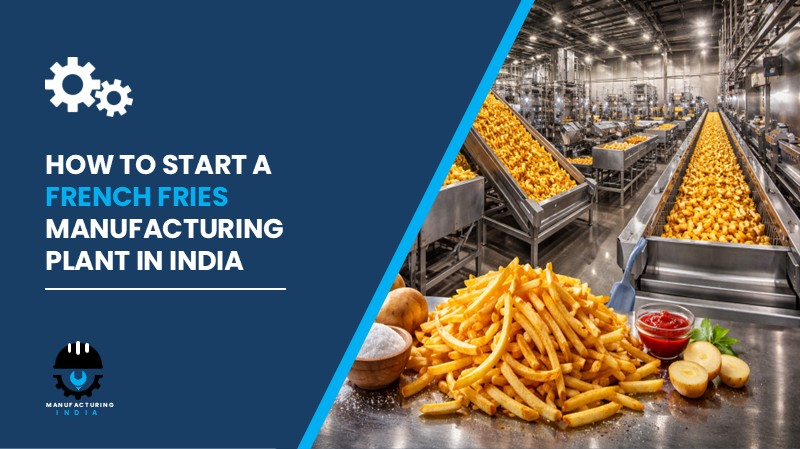
Setting up a french fries manufacturing plant in india presents a compelling investment case driven by converging demand from quick-service restaurants (QSRs), casual dining chains, frozen food retail, and food service distribution networks. As India’s organised food service sector continues to expand rapidly, domestic demand for consistently produced, ready-to-cook potato products has grown significantly. The product processed by slicing peeled potatoes into thin strips, partially or fully frying them, and storing through freezing or chilled storage sits at the heart of this growth. Its role in the global frozen food value chain makes it a strategically important commodity for any investor evaluating India’s food processing opportunity.
India offers a uniquely favourable environment for this investment. The country’s accelerating urbanisation, expanding cold-chain infrastructure, growing organised retail footprint, and the government’s Make in India initiative for food processing collectively reduce entry barriers and improve long-term unit economics. States such as Gujarat and Maharashtra offer well-developed industrial estates, agri-processing zones, and proximity to potato-growing belts making them natural anchors for new capacity. The recent inauguration of Falcon Agrifriz Foods Private Limited’s fully automated frozen potato products facility in Mehsana, Gujarat in May 2025 validates India’s readiness as a production hub. ITC a diversified conglomerate is targeting up to 20% of the ₹7,400 crore (USD 1.06 billion) frozen food market in India over the next three years, signalling aggressive domestic demand capture.
India’s frozen potato processing opportunity is underpinned by strong policy support, a cost-competitive supply chain, and multi-sector demand from QSRs, frozen food retail, and food service distributors. With gross profit margins of 25–35% and a payback period of 3 to 6 years, the facility delivers both financial viability and long-term demand sustainability.
What are French Fries?
French fries are potato products processed by slicing peeled potatoes into thin strips, partially or completely frying them, and then storing the resulting product through either freezing or chilled storage. High-starch potatoes particularly Russet varieties with moderate starch content and regular shape are preferred in production because they deliver better texture and appearance after frying, resulting in superior consumer satisfaction.
The product can be retailed as frozen foods or chilled food items and is classified and marketed based on form: straight-cut, crinkle-cut, shoestring-cut, and wedge-cut variants. Each form caters to different channel requirements, from QSR standardisation to premium pub-style and retail offerings. The core production method cutting, blanching, and frying transforms raw potato inputs into a value-added, shelf-stable product. The unit serves end-use industries including quick-service restaurants, casual dining establishments, frozen food retail, food service distribution, and convenience stores.
Cost of Setting Up a French Fries Manufacturing Plant in India
The total investment for establishing this production facility in India depends on capacity, technology selection, site location, automation level, and regulatory compliance. Investors should evaluate both capital expenditure and ongoing operational costs to build a realistic financial plan.
1. Capital Expenditure (CapEx)
The CapEx for this facility covers several major components. Land and site development which includes land acquisition, boundary development, land registration charges, and site grading forms a substantial portion of initial investment. Locating the facility within a Special Economic Zone (SEZ) or state-designated industrial estate can reduce land costs and provide access to fiscal incentives. Civil works encompass the construction of the production shed, cold storage rooms, raw material storage, quality control laboratory, utility block, and administrative offices all designed to comply with food-grade hygiene and safety standards.
Machinery and equipment represent the largest single capital outlay. Key machinery required includes:
- Washers
- Peelers
- Cutters (slicing machines)
- Blanchers
- Dryers
- Industrial fryers
- De-oiling shakers
- Flash freezers
- Seasoning applicators
- Automated weighing and packaging lines
- Cooling tunnels
- Conveyors
- Refrigeration units and cold rooms
- Inspection systems, sensors, and testing equipment
Other capital costs include the Effluent Treatment Plant (ETP), pre-operative expenditures such as feasibility studies and licencing fees, commissioning charges, and applicable import duties on specialised equipment not manufactured domestically.
Request a Sample Report for In-Depth Market Insights: https://www.imarcgroup.com/french-fries-manufacturing-plant-project-report/requestsample
2. Operational Expenditure (OpEx)
Raw material cost is the dominant operational driver, accounting for 60–70% of total OpEx. Key inputs include potatoes (Russet varieties with moderate starch content), palm oil, salt, dextrose, sodium acid pyrophosphate, citric acid, and packaging materials including PE bags and cartons. Securing long-term supplier contracts with potato farmers in agri-rich states and palm oil importers will help stabilise input costs and reduce price volatility exposure. Utility costs — covering electricity for refrigeration, blanching, frying, and freezing systems, water, and steam — account for 15–20% of OpEx, making energy management a critical efficiency lever. Additional operational costs include transportation of raw materials and finished goods, packaging procurement, employee salaries and wages, equipment maintenance, depreciation, and applicable taxes. By the fifth year, total operational cost is expected to increase substantially due to inflation, market fluctuations, and potential rises in the cost of key materials.
3. Plant Capacity
The proposed facility is designed with an annual production capacity of 10,000–20,000 MT, enabling economies of scale while maintaining operational flexibility. Capacity can be customised to align with investor requirements, market entry strategy, and available funding. Profitability improves meaningfully as capacity utilisation increases, with higher throughput enabling better absorption of fixed costs.
4. Profit Margins and Financial Projections
The financial projections for this investment demonstrate strong viability under normal operating conditions. Gross profit margins typically range between 25–35%, supported by stable demand and value-added applications across food service and retail channels. Net profit margins range between 10–15% through the income projection years. A comprehensive model covering NPV (Net Present Value), IRR (Internal Rate of Return), payback period, liquidity analysis, sensitivity analysis, and profit and loss projections is essential for securing financing and managing investor expectations. The break-even period typically ranges from 3 to 6 years, depending on plant scale, raw material cost management, and market penetration speed.
Why Set Up a French Fries Plant in India?
Rising Demand from Quick-Service Restaurants and Casual Dining. The global expansion of QSR chains has been a primary demand driver, with these establishments integrating the product as a staple menu item. In India, the rapid growth of organised food service — including both international and domestic QSR brands — creates a consistent, large-volume off-take opportunity for domestic producers guaranteeing supply consistency and food safety compliance.
Growing Frozen Food Retail and Cold-Chain Infrastructure. Increasing frozen food consumption and the expansion of cold-chain infrastructure across Indian cities have opened new distribution channels for producers. Organised retail chains and modern trade are expanding their frozen food sections, and rising consumer preference for convenient, ready-to-cook meals has broadened the addressable market significantly.
Policy and Regulatory Tailwinds. Government initiatives — including Make in India for food processing and support for cold chain infrastructure and rural agricultural development programmes — create a supportive policy environment. These initiatives stimulate demand for domestic production and support investments in local manufacturing through potential access to capital subsidies, tax exemptions, and reduced utility tariffs.
Cost-Competitive Manufacturing. India’s advantage in land, labour, and agri-supply chain management makes the economics of domestic production structurally attractive. Proximity to potato-growing regions in states like Gujarat, Uttar Pradesh, and Maharashtra reduces raw material logistics costs and supports supply chain reliability — critical given that potatoes account for 60–70% of total OpEx.
Active Industry Investment Signals. The May 2025 inauguration of Falcon Agrifriz Foods Private Limited’s fully automated facility in Mehsana, Gujarat confirms growing investor confidence in India’s frozen potato sector. Simultaneously, ITC’s target to capture up to 20% of the ₹7,400 crore (USD 1.06 billion) frozen food market in India over the next three years signals aggressive market expansion, validating the scale of domestic opportunity.
Local Supply Chain Preference. QSR chains, frozen food retailers, and food service distributors consistently prefer local, reliable manufacturers to ensure shorter lead times, stable supply, and consistent product quality — creating durable off-take relationships for well-positioned domestic producers.
Manufacturing Process — Step by Step
The french fries manufacturing process uses cutting, blanching, and frying as the primary production method. The operation involves multiple unit operations, material handling stages, and quality checks throughout the line.
- Potato Selection: Sourcing high-quality, high-starch potatoes — preferably Russet varieties — with regular shape and suitable dry matter content for optimal texture
- Washing: Thorough washing of raw potatoes using industrial washers to remove soil, debris, and surface contaminants
- Peeling: Mechanical peeling to remove potato skins uniformly while minimising waste
- Slicing/Cutting: Precision cutting into the desired form — straight-cut, crinkle-cut, shoestring-cut, or wedge-cut — using slicing machines calibrated to consistent dimensions
- Blanching: Immersion in hot water using blanchers to partially cook the product, deactivate enzymes, reduce sugar content, and achieve the desired texture after frying
- Drying: Removal of excess surface moisture using industrial dryers to ensure uniform frying
- Deep Frying: Cooking in palm oil using industrial fryers until the product achieves a golden, crispy exterior and fluffy interior
- De-oiling: Removal of excess oil using de-oiling shakers to meet target fat content specifications
- Seasoning: Application of salt and optional flavourings using seasoning applicators
- Cooling: Rapid cooling through cooling tunnels to bring product temperature down before packaging
- Flash Freezing: Freezing using flash freezers to lock in quality, texture, and freshness for cold-chain distribution
- Packaging, Storage, and Dispatch: Automated weighing and sealing into PE bags or cartons, followed by cold room storage and distribution to QSRs, retailers, food service distributors, and convenience stores
Key Applications
The product serves a wide range of end-use industries across the food service and retail ecosystem:
- Quick-Service Restaurants (QSRs): Core menu item used in drive-thru orders, value meal components, and side dish offerings
- Casual Dining: Served as side dishes and loaded fry platters in casual and family dining restaurants
- Frozen Food Retail: Sold through supermarkets and modern trade as frozen supermarket brands and private-label products
- Food Service Distribution: Supplied in bulk to institutional food service operators, catering companies, and hospitality establishments
- Convenience Stores: Retailed as ready-to-cook or ready-to-heat snack products for impulse purchase segments
- Pub-Style Offerings: Premium crinkle-cut and wedge-cut variants used in pub menus and casual bar food formats
Leading Manufacturers
The global industry is served by several multinational companies with extensive production capacities and diversified portfolios across food service and retail channels. Key players include:
- McCain Foods
- Lamb Weston
- J.R. Simplot Company
- Aviko
- Farm Frites
- Cavendish Farms
Timeline to Start the Plant
- Feasibility study and project report preparation
- Land acquisition and site development
- Regulatory approvals and environmental clearances
- Factory licence and fire safety compliance
- Machinery procurement and installation
- Raw material supplier agreements and supply chain setup
- Trial production and quality testing
- Commercial production launch
Licences and Regulatory Requirements
Starting a french fries manufacturing unit in India requires several approvals:
- Business registration (Proprietorship, LLP, or Pvt Ltd)
- Factory Licence under the Factories Act
- Environmental Clearance from State Pollution Control Board
- GST Registration
- Fire Safety NOC
- FSSAI licence for food manufacturing
- Effluent Treatment Plant (ETP) operational clearance
- Occupational Health and Safety compliance
Key Challenges to Consider
High Capital Requirements. Establishing a fully automated facility with flash freezing and cold storage capability involves significant upfront capital investment in land, civil works, machinery, and utilities — requiring careful financial planning and structured funding.
Raw Material Price Volatility. Potatoes, palm oil, and packaging materials such as PE bags and cartons are subject to price fluctuations driven by seasonal harvests, crude oil prices, and supply chain disruptions. Long-term supplier contracts and hedging strategies are essential to protecting margins.
Regulatory Compliance. Compliance with food safety standards, ETP requirements, and environmental clearances adds time and cost to the commissioning process, requiring dedicated regulatory resources — particularly for first-time food processing investors.
Technology and Innovation Pressure. Advancements in freezing technology, oil management systems, and quality control automation continuously raise the bar for product consistency and shelf-life performance, requiring ongoing capital investment to remain competitive.
Competition from Established Players. The presence of globally scaled manufacturers — including McCain Foods, Lamb Weston, J.R. Simplot Company, Aviko, Farm Frites, and Cavendish Farms — alongside growing domestic investment by ITC intensifies competitive pressure on pricing, quality, and distribution.
Skilled Manpower. Operating food-grade processing lines, cold storage systems, and automated packaging equipment requires trained technical and quality assurance personnel, which can be challenging to recruit and retain in smaller industrial locations.
Frequently Asked Questions
- How much does it cost to set up a french fries manufacturing plant in India? The total setup cost varies with capacity, technology, automation level, and location, covering land, civil construction, machinery including washers, peelers, blanchers, fryers, flash freezers, and packaging lines, utilities, and pre-operative costs. A detailed CapEx breakdown is available in the IMARC project report.
- Is french fries manufacturing profitable in India in 2026? Yes. Gross profit margins of 25–35% and net profit margins of 10–15% indicate strong financial viability. Rising QSR expansion, frozen food consumption, and cold-chain growth continue to support sustainable demand and returns.
- What machinery is required for a french fries plant in India? Essential equipment includes washers, peelers, cutters, blanchers, dryers, industrial fryers, de-oiling shakers, flash freezers, seasoning applicators, cooling tunnels, conveyors, and automated weighing and packaging lines.
- What licences and approvals are required to start a french fries plant in India? Key requirements include business registration, Factory Licence, Environmental Clearance, FSSAI licence, GST Registration, Fire Safety NOC, ETP clearance, and Occupational Health and Safety compliance.
- What raw materials are needed for french fries manufacturing? Primary inputs include potatoes (Russet varieties), palm oil, salt, dextrose, sodium acid pyrophosphate, citric acid, PE bags, and cartons for packaging.
- What are the environmental compliance requirements for a french fries plant in India? The unit must install and operate an Effluent Treatment Plant, obtain Environmental Clearance from the State Pollution Control Board, and comply with emission standards and waste management norms under applicable environmental regulations.
- What is the best location to set up a french fries plant in India? States with proximity to potato-growing belts and developed cold-chain infrastructure — such as Gujarat, Maharashtra, and Uttar Pradesh — are well-suited. Gujarat’s agri-processing zones, including Mehsana where Falcon Agrifriz Foods launched its facility in May 2025, represent an active investment cluster.
- What is the break-even period for this type of plant in India? The break-even period typically ranges from 3 to 6 years, depending on production scale, capacity utilisation, raw material cost management, and market penetration speed.
- What government incentives are available for manufacturers in India? Governments may offer capital subsidies, tax exemptions, reduced utility tariffs, export benefits, and interest subsidies under national and state industrial policies, including Make in India and food processing development programmes.
Key Takeaways for Investors
A french fries manufacturing plant in India addresses multi-sector demand from quick-service restaurants, casual dining, frozen food retail, food service distribution, and convenience stores — making this a diversified, demand-resilient investment. The production economics are viable across a range of capacities, with gross margins of 25–35% and net margins of 10–15% supporting financial sustainability from the mid-term. The global market — valued at USD 17.94 Billion in 2025 — is projected to reach USD 29.80 Billion by 2034 at a CAGR of 5.8%, with India’s domestic market expanding in parallel, as confirmed by ITC’s aggressive frozen food strategy and Falcon Agrifriz Foods’ facility launch in Gujarat. With cold-chain infrastructure expanding, QSR networks deepening, and consumer preference for convenient, ready-to-cook products rising, demand fundamentals for this investment remain structurally sound for the foreseeable future.
About the Author