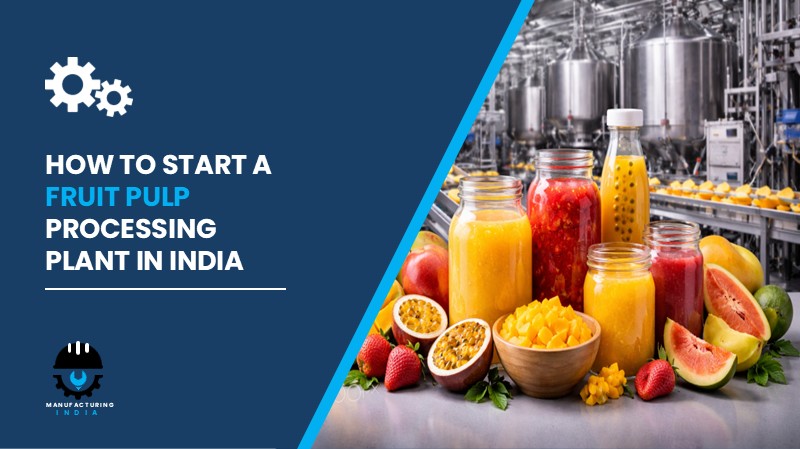
Setting up a fruit pulp processing plant in India presents a compelling investment case driven by accelerating demand across the beverages, dairy, confectionery, bakery, and frozen foods industries. As Indian consumers increasingly shift toward natural, preservative-free, and nutrition-rich food products, the requirement for high-quality fruit pulp derived from mangoes, guavas, strawberries, papayas, and berries has grown substantially. This demand is further amplified by the rapid expansion of the packaged food and ready-to-use ingredient sector, positioning fruit pulp as a critical input for India’s evolving food processing economy.
India’s inherent advantages make this investment particularly attractive. The country’s vast agricultural base ensures a reliable supply of tropical and exotic fresh fruits at competitive costs, while rapid urbanisation and changing consumer lifestyles are fuelling adoption of convenient, processed fruit ingredients across households and food service channels. Government initiatives such as the Make in India campaign and agro-processing promotion schemes provide direct policy support for food processing ventures. Manufacturing states such as Gujarat where Mother Dairy began construction of a new fruit and vegetable processing plant in March 2025 and Maharashtra offer strong infrastructure, cold chain connectivity, and proximity to both raw material sources and end-use markets, making them strategic hubs for new production facilities.
India’s fruit pulp processing sector offers investors a rare combination of cost-competitive manufacturing, strong government policy support, and sustained demand from beverages, dairy, confectionery, and export markets. With gross profit margins ranging between 30–40% and a payback period of 3 to 5 years, the investment case is financially sound across a wide range of plant capacities.
What is Fruit Pulp?
Fruit pulp is a concentrated form of fruit produced by extracting and removing the seeds, skin, and excess water, while retaining the taste, colour, and nutritional profile of the source fruit. A wide range of fruits including mango, guava, strawberry, papaya, and berries can be processed into pulp for commercial applications. The production process is a multi-step operation involving washing, sorting, and crushing the fruits, followed by de-seeding, pulping, pasteurisation, concentration, and aseptic packaging to deliver a high-quality, shelf-stable product.
Fruit pulp is widely used across several food and beverage categories. End-use industries include the beverages sector (juices, smoothies, and soft drinks), dairy and ice cream (for natural flavour, colour, and nutrition), confectionery and bakery (jams, fillings, and desserts), and the export market, where tropical fruit pulp is shipped to international food processing industries. Applications span fruit juices, smoothies, yogurts, jams, jellies, desserts, and flavourings, making this a versatile ingredient with strong cross-industry demand.
Cost of Setting Up a Fruit Pulp Processing Plant in India
The total cost of establishing a fruit pulp manufacturing plant depends on several variables, including production capacity, technology selection, plant location, level of automation, and regulatory compliance requirements. Investors should evaluate both capital expenditure and operational expenditure carefully before finalising their project blueprint.
1. Capital Expenditure (CapEx)
Capital investment in a fruit pulp processing plant covers land and site development, civil construction, machinery procurement, and other pre-operative costs. Land and site development costs include expenses related to land registration, boundary development, and foundational infrastructure this forms a substantial share of the total CapEx, particularly in industrial estates or Special Economic Zones (SEZs), where regulatory approvals may be streamlined and certain fiscal incentives are available. Civil works costs encompass the construction of the processing shed, quality control laboratory, raw material storage facility, finished goods warehouse, and administrative block.
Machinery and equipment constitute the single largest component of capital expenditure in a fruit pulp manufacturing plant. Key machinery required includes:
- Fruit washers
- Crushers
- Pulping machines
- De-seeders
- Pasteurizers
- Evaporators
- Homogenizers
- Automated packing lines
- Filling and sealing machines
- Sterilizers
- Cold storage units
Other capital costs include the installation of an Effluent Treatment Plant (ETP), pre-operative expenses, commissioning charges, and applicable import duties on specialised processing equipment.
Access the Detailed Feasibility Analysis, Request Sample: https://www.imarcgroup.com/fruit-pulp-processing-plant-project-report/requestsample
2. Operational Expenditure (OpEx)
The operating cost structure of a fruit pulp manufacturing plant is heavily weighted toward raw material consumption. Raw material costs covering fresh fruits, sugar, citric acid, ascorbic acid, and aseptic packaging account for approximately 65–75% of total OpEx. Securing long-term supplier contracts with regional fruit growers and ingredient distributors is essential to mitigate price volatility and ensure supply continuity. Utility costs, including electricity, water, and steam required for pasteurisation and concentration processes, represent a further 10–15% of operating expenditure. Additional operating costs include transportation, packaging materials, salaries and wages, maintenance, depreciation, and applicable taxes. By the fifth year of operations, total OpEx is projected to increase substantially, driven by inflation, market fluctuations, rising raw material costs, and supply chain pressures.
3. Plant Capacity
The proposed processing facility is designed with an annual production capacity ranging between 20,000 and 50,000 metric tonnes of pulp, enabling economies of scale while maintaining operational flexibility. Capacity can be customised to suit individual investor requirements, whether for a small regional unit or a large-scale export-oriented plant. Profitability improves significantly with higher capacity utilisation, as fixed costs are distributed across a greater volume of output.
4. Profit Margins and Financial Projections
The fruit pulp processing plant project demonstrates strong financial viability. Gross profit margins typically range between 30–40%, supported by stable demand and value-added applications. Net profit margins fall in the range of 12–18% under normal operating conditions. Comprehensive financial projections covering NPV, IRR, payback period, gross margin, and net margin are developed based on realistic assumptions related to capital investment, operating costs, capacity utilisation, and demand outlook. The break-even period for this type of plant is typically 3 to 5 years, depending on scale, market access, and operational efficiency.
Why Set Up a Fruit Pulp Plant in India?
Growing Convenience Food Demand. Rising consumer willingness to adopt natural food products is significantly driving demand for high-quality fruit pulp across India. The shift toward ready-to-use ingredients in households and food service operations is accelerating, creating a sustained offtake base for domestic producers.
Alignment with Health and Wellness Trends. The increasing preference for natural, preservative-free, and nutritious food products is directly supporting demand for fruit pulp across beverage, dairy, and bakery segments. Indian consumers, particularly in urban centres, are actively seeking clean-label ingredients, a trend that strengthens the long-term market case for this investment.
Policy and Regulatory Tailwinds. The Make in India campaign, combined with government promotion of agro-processing and export incentive schemes, provides indirect but meaningful support to the fruit pulp sector. Investors setting up units in designated food processing zones or SEZs may benefit from capital subsidies, tax exemptions, reduced utility tariffs, and interest subsidies under applicable national and regional industrial policies.
Cost-Competitive Manufacturing. India’s access to a large agricultural base, competitive land costs, and an extensive labour pool enables fruit pulp processors to operate at significantly lower input costs compared to many other geographies. Proximity to tropical fruit-growing regions in states such as Gujarat, Maharashtra, Andhra Pradesh, and Uttar Pradesh further reduces raw material procurement and transportation expenses.
Active Industry Investment. Recent developments underscore growing momentum in this sector. In March 2025, Mother Dairy commenced construction of a new fruit and vegetable processing plant in Gujarat, designed to handle five metric tonnes of fruit pulp per hour. In October 2025, UK-based flavor house I.T.S Taste launched a range of crossbreed fruit flavors for beverages, snacks, bakery, and dairy products, demonstrating expanding innovation in fruit-based applications. These developments signal active capital deployment and growing international demand.
Export Potential and Supply Chain Stability. Tropical and exotic fruit pulp products command strong demand in international food processing markets. India’s established export infrastructure and its position as a major tropical fruit producer enables processors to build direct partnerships with regional farmers, ensuring supply chain reliability while simultaneously accessing the global marketplace.
Manufacturing Process – Step by Step
The fruit pulp manufacturing process uses a multi-step unit operation flow as its primary production method, integrating material handling and quality checks at every stage.
- Fruit Washing and Sorting: Incoming fresh fruits are thoroughly washed to remove dirt, pesticides, and surface contaminants, then sorted to eliminate damaged or substandard produce.
- Peeling and De-Seeding: Fruits are peeled and de-seeded using mechanical peelers and de-seeder machines to prepare the clean fruit mass for pulping.
- Crushing and Pulping: The prepared fruit is passed through crushers and pulping machines to extract raw pulp, separating it from fibrous material.
- Pulp Refining and Filtering: The extracted pulp is refined and filtered to achieve the desired consistency and remove any residual fibre or seed fragments.
- Pasteurisation: The pulp is thermally treated using pasteurizers to eliminate microbial contamination, extending shelf life while preserving nutritional value.
- Concentration (Optional): Evaporators are used to concentrate the pulp by reducing moisture content, producing a shelf-stable, high-value intermediate product.
- Homogenisation: Homogenizers ensure uniform texture and consistency across the pulp batch, improving product quality for downstream food manufacturers.
- Aseptic Filling and Packaging: The finished pulp is filled and sealed using automated packing lines and filling and sealing machines into aseptic packaging for safe storage and distribution.
- Storage and Dispatch: Packaged pulp is stored in cold storage units and dispatched to end-use industries including beverage manufacturers, dairy processors, confectionery producers, and export buyers.
Key Applications
Fruit pulp serves as a critical ingredient across multiple food and beverage industries, enabling natural flavour, colour, and nutritional enrichment in a wide range of finished products.
- Beverage Industry: Used as one of the primary components in juices, smoothies, and soft drinks.
- Dairy and Ice Cream: Provides natural taste, colour, and nutritional enhancement to yogurts and ice cream products.
- Confectionery and Bakery: Used in the preparation of jams, fruit fillings, desserts, and baked goods.
- Export Market: Tropical fruit pulp is exported to international food processing industries, meeting demand for exotic ingredients across global markets.
Leading Manufacturers
The global fruit pulp industry is served by several multinational and regional processors with extensive production capacities and diversified application portfolios. Key players active in this sector include:
- ABC Fruits
- Döhler GmbH
- SunOpta, Inc.
- Tree Top, Inc.
- Citrosuco S.A.
- SVZ International B.V.
- Conagra Brands, Inc.
- Tropicana Products, Inc.
- AGRANA Beteiligungs-AG
- Capricorn Food Products India Ltd.
Timeline to Start the Plant
Investors planning a fruit pulp processing plant in India should plan for a project timeline of 12 to 18 months from inception to commercial launch. Key phases include:
- Feasibility study and project report preparation
- Land acquisition and site development
- Regulatory approvals and environmental clearances
- Factory licence and fire safety compliance
- Machinery procurement and installation
- Raw material supplier agreements and supply chain setup
- Trial production and quality testing
- Commercial production launch
Licences and Regulatory Requirements
Starting a fruit pulp manufacturing plant in India requires several approvals from central and state authorities:
- Business registration (Proprietorship, LLP, or Pvt Ltd)
- Factory Licence under the Factories Act
- Environmental Clearance from State Pollution Control Board
- GST Registration
- Fire Safety NOC
- Effluent Treatment Plant (ETP) operational clearance
- Food Safety and Standards Authority of India (FSSAI) licence (applicable for food processing units)
- Occupational Health and Safety compliance
Key Challenges to Consider
High Capital Requirements. Establishing a fruit pulp processing unit involves significant upfront investment in land, civil construction, and machinery particularly pasteurizers, evaporators, and automated packing lines — which may require structured financing through term loans or government-backed schemes.
Raw Material Price Volatility. Fresh fruits, citric acid, ascorbic acid, sugar, and aseptic packaging are subject to seasonal price fluctuations and supply disruptions. Establishing long-term procurement contracts with regional suppliers is essential to managing input cost risk.
Regulatory Compliance. Meeting environmental clearance, ETP, food safety, and factory licensing requirements demands dedicated time and resources. Non-compliance at any stage can delay commercial production and increase project costs.
Technology and Innovation Pressure. The global fruit pulp industry is experiencing accelerating product innovation, as evidenced by the October 2025 launch of crossbreed fruit flavours by I.T.S Taste and upcycled cocoa fruit pulp products by Altinmarka in April 2025. Indian processors will need to invest in quality systems and product development to remain competitive with international players.
Competition. The sector includes well-capitalised global players such as Döhler GmbH, Conagra Brands, Tropicana Products, and Citrosuco S.A., as well as established Indian processors like Capricorn Food Products India Ltd. New entrants must differentiate on quality, cost, or export specialisation to carve out sustainable market positions.
Skilled Manpower. Operating pasteurizers, evaporators, and automated packing lines requires trained food processing technicians and quality control personnel, which may be difficult to source in certain locations. Investing in staff training during the ramp-up phase is critical to maintaining production efficiency.
Frequently Asked Questions
1. How much does it cost to set up a fruit pulp processing plant in India? The total cost depends on plant capacity, technology, location, and automation level. It covers land, civil construction, machinery (including fruit washers, crushers, pasteurizers, and automated packing lines), utilities, and pre-operative expenses. Request the sample report for detailed CapEx figures.
2. Is fruit pulp manufacturing profitable in India in 2026? Yes. Gross profit margins typically range between 30–40% and net margins between 12–18%, supported by growing domestic consumption and strong export demand for tropical fruit pulp.
3. What machinery is required for a fruit pulp plant in India? Key equipment includes fruit washers, crushers, pulping machines, de-seeders, pasteurizers, evaporators, homogenizers, automated packing lines, filling and sealing machines, sterilizers, and cold storage units.
4. What licences and approvals are required to start a fruit pulp plant in India? Required approvals include business registration, Factory Licence, Environmental Clearance from the State Pollution Control Board, GST registration, Fire Safety NOC, FSSAI licence, ETP operational clearance, and Occupational Health and Safety compliance.
5. What raw materials are needed for fruit pulp manufacturing? Primary raw materials include fresh or frozen fruits (mango, guava, strawberry, papaya, berries), water, citric acid, ascorbic acid, sugar, and aseptic packaging materials.
6. What are the environmental compliance requirements for a fruit pulp plant in India? Producers must obtain Environmental Clearance from the State Pollution Control Board, operate a certified Effluent Treatment Plant (ETP), and comply with waste management and emission standards applicable under state and national regulations.
7. What is the best location to set up a fruit pulp plant in India? States with strong agro-processing infrastructure and proximity to tropical fruit-growing regions such as Gujarat, Maharashtra, Andhra Pradesh, and Uttar Pradesh are strategically advantageous. Gujarat has already attracted significant investment, including Mother Dairy’s new processing plant.
8. What is the break-even period for this type of plant in India? The break-even period typically ranges from 3 to 5 years, depending on plant capacity, production efficiency, market demand, and supply chain effectiveness.
9. What government incentives are available for manufacturers in India? Applicable incentives may include capital subsidies, tax exemptions, reduced utility tariffs, export benefits, and interest subsidies under the Make in India initiative and various state-level agro-processing promotion schemes.
Key Takeaways for Investors
A fruit pulp processing plant in India represents a well-grounded investment opportunity backed by strong and diversified demand across the beverages, dairy, confectionery, bakery, and export sectors. The facility demonstrates financial viability across a wide range of plant capacities, with gross margins of 30–40% and net margins of 12–18% achievable under normal operating conditions. The global fruit pulp market was valued at USD 1.571 billion in 2025 and is projected to reach USD 2.12 billion by 2034, growing at a CAGR of 3.4% from 2026 to 2034 – a trajectory that ensures sustained long-term demand for producers entering the market today. With India’s policy environment, agricultural abundance, export potential, and expanding food processing infrastructure all working in the investor’s favour, the demand outlook for high-quality fruit pulp remains robust well into the next decade.
About the Author