Introduction
Green NPK fertilizers have emerged as essential products in sustainable agriculture, combining the critical nutrients nitrogen, phosphorus, and potassium with environmentally responsible production methods. As the global agricultural sector increasingly embraces eco-friendly farming practices, the demand for green fertilizers continues to expand rapidly. This comprehensive guide provides entrepreneurs, investors, and agricultural businesses with a detailed roadmap for establishing a successful green NPK fertilizers manufacturing plant.
Understanding Green NPK Fertilizers and Market Potential
Green NPK fertilizers are balanced nutrient formulations manufactured using environmentally sustainable processes, often incorporating organic materials alongside mineral-based nutrients. Unlike conventional chemical fertilizers, these products emphasize reduced environmental impact through cleaner production technologies, integration of bio-based components, and responsible resource management.
The global shift toward sustainable agriculture, organic farming expansion, soil health awareness, and environmental regulations has created strong market demand. These fertilizers serve diverse applications including organic crop production, horticulture and floriculture, commercial farming operations, home gardening segments, and protected cultivation systems.
Market drivers include increasing consumer preference for organic produce, government incentives for sustainable agriculture, growing awareness of soil degradation issues, export opportunities in developed markets, and rising agricultural input prices favoring efficient nutrient management.
Step-by-Step Process to Start Green NPK Fertilizers Manufacturing Plant
Step 1: Conducting Comprehensive Market Research
Thorough market research forms the foundation of your business strategy. Begin by analyzing your target market segments, identifying potential customers such as organic farmers, agricultural cooperatives, retail garden centers, institutional buyers, and export markets.
Study demand patterns by examining regional crop types, farming practices, seasonal variations, and nutrient requirements. Evaluate competitor landscape including existing manufacturers, their product portfolios, pricing strategies, distribution channels, and market positioning.
Conduct customer surveys to understand specific NPK ratio preferences, organic certification requirements, packaging size preferences, delivery expectations, and technical support needs. This intelligence guides product development, pricing decisions, and market entry strategies.
Step 2: Developing a Detailed Business Plan
A comprehensive business plan serves as your strategic roadmap and essential tool for securing financing. Your business plan should articulate clear vision and mission statements, business objectives, and growth strategies.
Define your product range including various NPK formulations for different crops, organic and conventional variants, specialized formulations for specific applications, and value-added products with micronutrients or bio-stimulants.
Outline your operational strategy covering production capacity planning, manufacturing process selection, quality assurance frameworks, raw material sourcing strategies, and distribution network development. Include detailed financial projections encompassing capital investment requirements, working capital needs, operational cost structure, revenue forecasts, profitability analysis, and return on investment calculations.
Step 3: Site Selection and Infrastructure Planning
Strategic site selection significantly impacts operational efficiency and long-term success. Consider multiple location factors when evaluating potential sites.
Proximity to raw material sources reduces transportation costs and ensures reliable supply chains. Agricultural regions often provide better access to organic materials, mineral deposits, and agricultural by-products suitable for fertilizer production.
Evaluate infrastructure availability including reliable electricity supply, adequate water sources, proper drainage systems, and waste disposal facilities. Transportation connectivity remains crucial for both inbound raw materials and outbound product distribution.
Verify that your chosen location complies with industrial zoning regulations, environmental clearance requirements, and distance norms from residential areas. The site should accommodate production facilities, raw material warehouses, finished goods storage, quality control laboratories, administrative offices, and future expansion areas.
Request for a Sample Report: https://www.imarcgroup.com/green-npk-fertilizers-manufacturing-plant-project-report
Step 4: Obtaining Licenses, Permits, and Regulatory Approvals
Establishing a fertilizer manufacturing plant requires compliance with extensive regulatory frameworks. Begin with business registration, selecting appropriate legal structure such as proprietorship, partnership, limited liability company, or corporation. Complete essential tax registrations including goods and services tax, income tax, and other applicable levies.
Fertilizer-specific licenses include manufacturing licenses from fertilizer control authorities, product registration for each NPK formulation, and organic certification if marketing products as organic. Environmental clearances are mandatory, requiring consent to establish and consent to operate from pollution control boards, environmental impact assessments for larger facilities, and waste management authorizations.
Additional permits encompass factory licenses under state industrial regulations, fire safety certificates, explosives licenses if handling certain chemicals, boiler permits for steam generation equipment, and trade licenses from local authorities. Maintain detailed documentation and engage with regulatory agencies proactively to ensure smooth approval processes.
Step 5: Understanding the Manufacturing Process
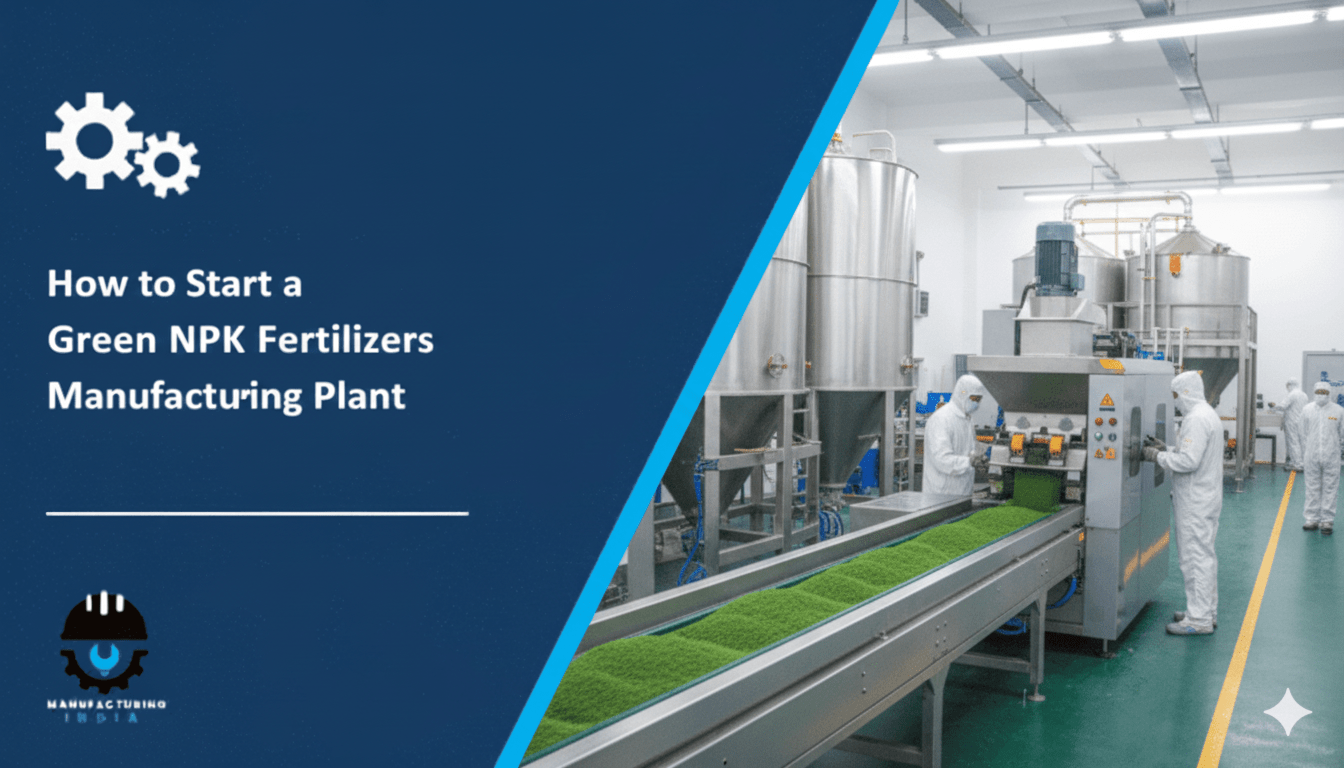
Green NPK fertilizer production involves multiple integrated operations transforming raw materials into finished products. The manufacturing process typically includes these key stages:
Raw Material Preparation: Organic materials undergo composting, fermentation, or mechanical processing. Mineral components are crushed, ground, and refined to required specifications. Bio-based additives are processed and standardized.
Formulation and Blending: Nitrogen sources from organic matter, processed animal waste, or controlled chemical inputs are combined with phosphorus sources including rock phosphate, bone meal, or processed phosphate rock, and potassium sources such as potassium sulfate, potassium chloride, or organic potassium carriers. Advanced mixing equipment ensures uniform nutrient distribution throughout the batch.
Granulation: The blended mixture transforms into uniform granules through specialized granulation equipment, improving handling characteristics, reducing dust generation, and enabling controlled nutrient release properties.
Drying: Rotary dryers or fluidized bed dryers remove excess moisture, achieving optimal moisture content for storage stability and preventing caking during transportation and storage.
Screening and Grading: Screening machines separate granules by size, ensuring product uniformity and customer specifications. Oversized or undersized materials return to the process for reprocessing.
Coating (Optional): Protective coatings may be applied to enhance moisture resistance, add slow-release properties, incorporate micronutrients, or improve physical appearance.
Packaging: Automated or semi-automated packaging systems fill products into bags ranging from small consumer packs to large bulk bags for commercial agriculture.
Step 6: Machinery and Equipment Requirements
Selecting appropriate machinery directly impacts production efficiency, product quality, and operational costs. Essential equipment for green NPK fertilizer manufacturing includes:
Primary Processing Equipment: Crushers and pulverizers for breaking down raw materials, screens and sieves for size separation, and mixers and blenders for homogeneous material mixing.
Granulation Systems: Pan granulators, drum granulators, or extrusion granulators depending on product specifications and production scale.
Drying and Cooling Equipment: Rotary dryers for moisture removal, cooling systems to reduce product temperature, and dust collection systems for environmental compliance.
Material Handling Systems: Conveyor belts for horizontal transport, bucket elevators for vertical movement, pneumatic conveying systems for powdered materials, and storage silos for bulk materials.
Packaging Equipment: Automatic weighing and bagging machines, bag sealing equipment, and palletizing systems for finished goods handling.
Quality Control Laboratory: Analytical balances, pH meters, nutrient analysis equipment, moisture analyzers, and testing apparatus for physical properties.
When selecting machinery suppliers, evaluate their industry experience, after-sales service capabilities, spare parts availability, technical training support, and energy efficiency of equipment.
Step 7: Raw Material Sourcing and Supply Chain Management
Establishing reliable raw material supply chains ensures uninterrupted production and consistent product quality. Key raw materials for green NPK fertilizer manufacturing include:
Organic Components: Agricultural waste materials, animal manure from livestock operations, plant residues and crop by-products, compost from organic waste, and bio-digester effluent.
Nitrogen Sources: Processed neem cake, blood meal or feather meal, controlled urea application, ammonium sulfate, and nitrogen-fixing bacterial cultures.
Phosphorus Sources: Rock phosphate deposits, bone meal from processing facilities, guano deposits, and processed phosphate rock.
Potassium Sources: Potassium sulfate, potassium chloride (muriate of potash), wood ash, and seaweed extracts.
Additives and Supplements: Micronutrients including zinc, iron, manganese, copper, and boron; bio-stimulants and growth promoters; humic and fulvic acids; and binding agents for granulation.
Develop relationships with multiple suppliers to mitigate supply risks, negotiate long-term contracts for price stability, implement stringent quality inspection protocols for incoming materials, and explore vertical integration opportunities for critical raw materials.
Step 8: Quality Control and Quality Assurance
Maintaining consistent product quality builds customer trust, ensures regulatory compliance, and supports premium market positioning. Establish a comprehensive quality management system covering all production stages.
Set up a dedicated quality control laboratory equipped with instruments for nutrient content analysis, moisture determination, particle size distribution measurement, pH testing, and physical property evaluation including hardness, bulk density, and appearance.
Implement quality checkpoints including incoming raw material testing and approval, in-process monitoring during blending, granulation, and drying, finished product testing for nutrient content, physical properties, and contaminant levels, and packaging verification for weight accuracy and seal integrity.
Develop and document standard operating procedures for all quality control activities, maintain comprehensive batch records and traceability systems, and conduct regular internal audits of quality systems. Pursue relevant quality certifications such as international quality management standards, organic certification programs, and eco-labels for environmental credentials.
Step 9: Manpower Planning and Human Resource Management
Building a skilled and motivated workforce drives operational excellence. Your staffing requirements depend on production scale but typically include:
Management Team: Plant manager overseeing overall operations, production manager managing manufacturing processes, quality assurance manager ensuring product standards, and procurement manager handling raw material sourcing.
Technical Personnel: Production supervisors coordinating shop floor activities, quality control analysts performing testing, maintenance technicians ensuring equipment reliability, and safety officers managing workplace safety.
Support Staff: Warehouse workers handling materials, packaging operators managing finished goods, administrative staff managing documentation, and sales personnel developing customer relationships.
Provide comprehensive training covering production processes and equipment operation, quality control procedures and testing methods, safety protocols and emergency response, and environmental compliance requirements. Foster continuous improvement culture encouraging process optimization suggestions, implement performance recognition programs, and provide competitive compensation packages to retain talent.
Step 10: Marketing and Distribution Strategy
Effective marketing connects your products with customers and builds brand recognition. Develop a multi-channel marketing approach combining various strategies.
Direct Sales Channels: Field sales team engaging farmers directly, participation in agricultural exhibitions and trade shows, demonstration plots showcasing product effectiveness, and farmer training programs on proper fertilizer application.
Distribution Partnerships: Agreements with agricultural input dealers, relationships with farming cooperatives, tie-ups with organic farming associations, and online agricultural marketplaces.
Promotional Activities: Educational content on benefits of green fertilizers, technical literature on crop-specific applications, success stories and testimonials from satisfied customers, and digital marketing through website, social media, and online advertising.
Provide value-added services including soil testing and nutrient recommendation services, agronomic advice and crop management guidance, application equipment demonstrations, and responsive customer support systems.
Step 11: Environmental Management and Sustainability Practices
Operating responsibly protects the environment and aligns with your green fertilizer positioning. Implement comprehensive environmental management systems covering all aspects of operations.
Waste Management: Treat and recycle production wastewater, implement dust control measures in production areas, manage solid waste through segregation and disposal, and minimize packaging waste through sustainable materials.
Resource Conservation: Optimize water usage through recycling and efficiency measures, implement energy-efficient equipment and processes, maximize raw material utilization with minimal waste, and explore renewable energy options for power needs.
Emissions Control: Install scrubbers and filters for air emissions control, monitor stack emissions regularly, implement odor control measures, and maintain noise levels within permissible limits.
Conduct regular environmental audits, maintain compliance with pollution control norms, pursue environmental certifications, and report environmental performance transparently.
Step 12: Financial Management and Scaling Operations
Sound financial management ensures business sustainability and enables growth. Implement robust financial systems tracking production costs, operational expenses, inventory valuation, and revenue realization.
Monitor key financial metrics including cost per unit produced, gross and net profit margins, working capital cycles, and return on investment. Implement cost optimization measures through efficient resource utilization, waste reduction initiatives, energy conservation programs, and process improvements.
Maintain adequate working capital for raw material procurement, maintaining production inventories, managing accounts receivable, and meeting operational expenses. Explore financing options including term loans for capital equipment, working capital facilities from banks, government schemes supporting green industries, and private equity or venture capital for expansion.
As your business stabilizes and grows, consider scaling strategies such as expanding production capacity through additional lines or equipment, developing new product variants for niche markets, entering new geographic regions domestically or internationally, and diversifying into complementary products like bio-pesticides or soil conditioners.
About the Author