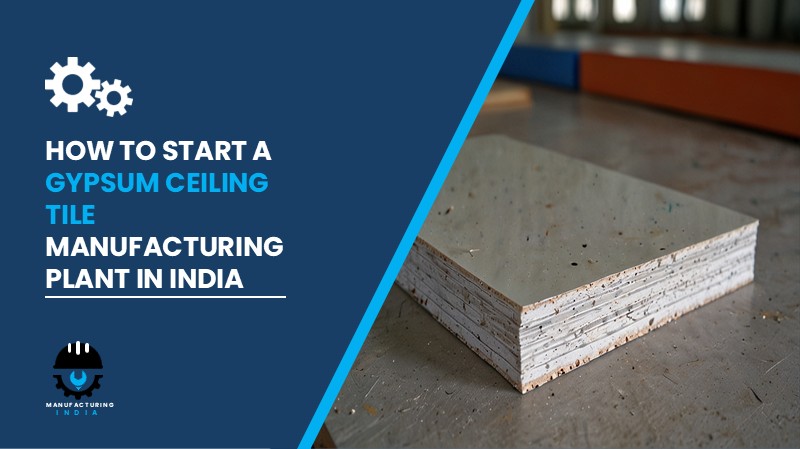
Setting up a gypsum ceiling tile manufacturing plant in India presents a compelling investment case as the country rapidly emerges as one of the most cost-competitive and high-demand destinations for building materials and interior construction product manufacturing. Driven by surging demand from the commercial real estate, residential housing, hospitality, healthcare, education, and retail infrastructure sectors, gypsum ceiling tiles have become an indispensable part of India’s booming construction and interior finishing industry.
“With over 1.4 billion consumers, a rapidly urbanizing population, a booming real estate and infrastructure sector, Smart Cities Mission support, and strong growth in commercial and institutional construction, India offers one of the most financially attractive environments for gypsum ceiling tile manufacturing — with gross margins of 25–40% and a break-even window of 3–5 years.”
What is a Gypsum Ceiling Tile?
A gypsum ceiling tile, also known as a gypsum board tile or false ceiling tile, is a prefabricated interior ceiling panel manufactured primarily from calcium sulfate dihydrate (gypsum) combined with additives such as glass fiber, perlite, starch, and surface-facing materials. Gypsum ceiling tiles are widely used in suspended false ceiling systems across commercial, institutional, and residential buildings for their excellent acoustic insulation, fire resistance, thermal comfort, aesthetic appeal, and ease of installation.
Gypsum ceiling tiles are available in standard sizes (typically 595×595 mm and 603×603 mm) and in a variety of surface textures, edge profiles, and specialty grades including standard, moisture-resistant, fire-rated, and acoustic performance variants. They are compatible with standard suspended grid ceiling systems (T-bar grids) and are a preferred choice for offices, hospitals, schools, shopping malls, hotels, airports, and industrial facilities across India and globally.
Cost of Setting Up a Gypsum Ceiling Tile Manufacturing Plant in India
The gypsum ceiling tile manufacturing plant cost in India depends on several parameters including production capacity, product mix (standard vs. specialty grades), level of automation, plant location, raw material sourcing strategy, and regulatory compliance. Here is a structured breakdown of all major cost components:
1. Capital Expenditure (CapEx)
The total capital investment in a gypsum ceiling tile manufacturing plant typically covers the following:
Land and Site Development
This includes land acquisition, boundary development, land registration charges, and basic site preparation. Cost varies significantly depending on whether the land is in an industrial estate, Special Economic Zone (SEZ), or a privately purchased plot. Proximity to gypsum raw material sources (natural gypsum mines or FGD gypsum from thermal power plants) and to major construction markets is a key site selection criterion to optimize logistics costs.
Civil Works and Construction
Building costs cover the main manufacturing shed (with humidity and temperature control provisions), raw material storage area (covered storage essential for gypsum to prevent moisture absorption), mixing and casting area, drying and curing section, finishing and cutting area, quality control laboratory, administrative block, and worker facilities. Adequate floor loading capacity is required for gypsum slurry casting equipment and heavy molds.
Machinery and Equipment
This is the single largest component of CapEx. Key machinery required for a gypsum ceiling tile manufacturing plant includes:
- Gypsum Calcination Kiln or Kettle (for conversion of raw gypsum to hemihydrate plaster — if processing natural gypsum on-site)
- Slurry Mixing Tanks and High-Speed Mixers
- Continuous Casting Line or Mold Filling Stations
- Conveyor Systems for tile movement through production stages
- Drying Ovens or Tunnel Dryers (for moisture removal and strength development)
- Surface Coating and Painting Line (for white facing paper or paint application)
- CNC Cutting and Edging Machines (for precise tile dimensioning and edge profiling)
- Surface Texturing Rollers or Embossing Equipment
- Quality Testing Equipment (hardness, moisture, fire resistance, acoustic performance)
- Dust Collection and Air Filtration Systems
- Packaging and Palletizing Machines
- Fork Lifts and Material Handling Equipment
Machinery costs represent the largest share of overall capital expenditure, reflecting the precision required in slurry formulation, casting uniformity, dimensional accuracy, and surface finish quality demanded by the construction industry.
Other Capital Costs
These include pre-operative expenses, commissioning charges, import duties (if specialized casting or drying equipment is sourced internationally), utilities installation (electricity, water, steam or gas for drying), dust control infrastructure, and any environmental compliance setup required under state pollution control norms for gypsum processing operations.
Request a Sample Report for In-Depth Market Insights: https://www.imarcgroup.com/gypsum-ceiling-tile-manufacturing-plant-project-report/requestsample
2. Operational Expenditure (OpEx)
Once the plant is commissioned, the ongoing cost structure is dominated by a few key components:
Raw Material Cost (Gypsum Plaster, Additives & Facing Materials): 60-70% of Total OpEx
Calcined gypsum (hemihydrate plaster or alpha/beta plaster), glass fiber, perlite, starch, foaming agents, and surface-facing materials (paper or non-woven fabric) are the primary raw materials and account for the majority of operating expenses. India has substantial natural gypsum reserves primarily in Rajasthan, as well as an abundant supply of FGD (Flue Gas Desulfurization) synthetic gypsum from thermal power plants, providing cost-competitive raw material options. Additive costs depend on the product grade and performance requirements.
Utility Cost: 15-20% of Total OpEx
Utilities include electricity (consumed by mixers, conveyors, cutting machines, and air handling systems), fuel or steam for drying ovens (a significant cost component given the energy-intensive nature of gypsum tile drying), and process water used in slurry preparation. Energy cost optimization through waste heat recovery and efficient kiln design is a key profitability lever.
Other Operating Costs
The remaining budget covers transportation of raw materials and finished tiles, secondary packaging (shrink wrap, cartons, pallets), salaries and wages, maintenance, quality control consumables, depreciation, taxes, and miscellaneous overhead.
3. Plant Capacity
The proposed manufacturing facility is designed with an annual production capacity ranging between 500,000 to 5,000,000 square metres of gypsum ceiling tiles. This range allows the plant to achieve economies of scale while maintaining flexibility to serve multiple end-use segments including commercial offices, healthcare facilities, educational institutions, retail spaces, and residential projects. Smaller manually operated setups may start at lower capacity, but profitability significantly improves with higher automation levels and capacity utilization rates.
4. Profit Margins and Financial Projections
- Gross Profit Margin: 35-45%
- Net Profit Margin: 18-25%
- Break-Even Period: 3 to 5 years, depending on production scale, product mix (standard vs. specialty grades), market demand, raw material cost management, and distribution reach.
Financial projections must account for capital investment, operating costs, capacity utilization rates, raw material price trends, product pricing strategy across grades, and demand outlook from the construction and real estate sector. A thorough analysis should also include sensitivity analysis, Net Present Value (NPV), Internal Rate of Return (IRR), and Payback Period.
Why Set Up a Gypsum Ceiling Tile Manufacturing Plant in India?
India presents a uniquely favorable environment for establishing a gypsum ceiling tile manufacturing plant:
Surging Construction and Real Estate Demand
India’s construction sector is one of the fastest-growing in the world, with massive investments in commercial real estate, affordable housing under PM Awas Yojana, Smart Cities Mission infrastructure, healthcare expansion, and educational institution development. All of these segments are significant consumers of gypsum false ceiling systems, driving sustained and growing demand for gypsum ceiling tiles across urban and semi-urban markets.
Policy and Regulatory Tailwinds
The Government of India’s emphasis on affordable housing, urban infrastructure development, green building standards, and fire safety compliance in public buildings is creating a policy-favorable environment for gypsum ceiling tile manufacturers. The Bureau of Indian Standards (BIS) certification framework and green building rating systems such as IGBC and GRIHA increasingly specify gypsum-based ceiling systems for their fire resistance and acoustic properties.
Abundant Domestic Raw Material Availability
India possesses the world’s fifth-largest natural gypsum reserves, concentrated primarily in Rajasthan (Bikaner, Barmer, Nagaur districts), with additional deposits in Jammu, Gujarat, and Tamil Nadu. Furthermore, India’s large fleet of thermal power plants generates millions of tonnes of FGD synthetic gypsum annually, providing a high-purity, cost-effective alternative raw material that is increasingly being utilized by building materials manufacturers.
Cost-Competitive Manufacturing
India offers competitive land costs, a large pool of trained construction materials production workers, low-cost access to domestic gypsum raw materials, and a well-developed distribution network reaching construction sites across the country, making it one of the most cost-effective locations for gypsum ceiling tile production in Asia.
Export Opportunities
India-based manufacturers can tap into growing export demand from the Middle East, Southeast Asia, East Africa, and neighboring South Asian countries, where construction activity is expanding rapidly and local gypsum ceiling tile manufacturing capacity is limited. India’s cost advantage and improving product quality standards are making Indian gypsum ceiling tiles increasingly competitive in export markets.
Shift from Traditional Ceilings to False Ceiling Systems
India is witnessing a significant long-term structural shift from conventional plaster-of-Paris (POP) and concrete ceiling finishes toward modern suspended false ceiling systems using gypsum tiles. This transition, driven by aesthetic preferences, acoustic requirements, energy efficiency, and ease of installation and maintenance, represents a multi-decade demand growth opportunity for gypsum ceiling tile manufacturers.
Manufacturing Process Overview
The gypsum ceiling tile manufacturing process involves a series of well-controlled production stages:
- Raw Gypsum Procurement and Testing — sourcing of natural or synthetic FGD gypsum and quality verification for purity and consistency
- Gypsum Calcination — heating of raw gypsum in a calcination kiln or kettle at 150–180°C to convert calcium sulfate dihydrate to hemihydrate (Plaster of Paris) — this step may be outsourced by purchasing pre-calcined plaster
- Slurry Formulation — precision mixing of calcined gypsum with water, glass fiber, perlite, foaming agents, starch binder, and other performance additives in high-speed mixers to produce a uniform casting slurry
- Casting and Forming — pouring of slurry onto a continuous casting belt or into molds fitted with facing paper or non-woven fabric on the tile surface
- Setting and Curing — controlled setting of gypsum slurry through the natural hydration reaction, forming a solid gypsum matrix
- Drying — passing of set tiles through tunnel dryers or drying ovens to remove free moisture and achieve specified density and strength
- Cutting and Edging — precision cutting of dried tile boards to standard dimensions (595×595 mm, 603×603 mm) and profiling of edges (square, tegular, or beveled) using CNC cutting equipment
- Surface Finishing — application of surface coatings, textures, or embossed patterns as per product specifications
- Quality Inspection — testing of tiles for dimensional accuracy, weight, moisture content, breaking load, fire resistance, and acoustic performance as per BIS IS 2095 or equivalent standards
- Packaging and Palletizing — wrapping, cartooning, and palletizing of finished tiles for storage and dispatch
Key Applications of Gypsum Ceiling Tiles
Gypsum ceiling tiles manufactured in India serve a wide variety of end-use sectors:
- Commercial Offices and IT Parks: Acoustic and aesthetic false ceiling systems in corporate offices, co-working spaces, and technology campuses
- Healthcare Facilities: Hygienic, moisture-resistant, and cleanable ceiling tiles for hospitals, clinics, diagnostic centers, and pharmaceutical facilities
- Educational Institutions: Acoustic ceiling tiles for classrooms, libraries, lecture halls, and auditoriums to improve speech intelligibility and learning environments
- Retail and Shopping Malls: Decorative and high-performance ceiling systems for retail stores, food courts, multiplexes, and shopping complexes
- Hospitality: Hotel lobbies, corridors, conference rooms, and banquet halls requiring aesthetically superior and acoustically comfortable ceiling finishes
- Industrial and Warehousing: Fire-rated ceiling systems in manufacturing plants, warehouses, and logistics facilities requiring fire protection compliance
- Residential: False ceiling systems in premium residential apartments, villas, and housing projects for aesthetic and acoustic improvement
Global Market Outlook
The global gypsum ceiling tile market was valued at approximately USD 5.8 billion in 2025 and is projected to reach USD 8.5–10.0 billion by 2034, growing at a CAGR of 4.5–6% from 2026 to 2034. This sustained growth is driven by rapid urbanization and construction activity in Asia and Africa, increasing adoption of green building standards, growing awareness of acoustic comfort in commercial spaces, and the shift from traditional ceiling finishes to modern suspended grid ceiling systems.
Leading global players in the gypsum ceiling tile industry include:
- Armstrong World Industries, Inc. (USA)
- Saint-Gobain S.A. (France)
- USG Corporation (Knauf Group, Germany)
- Rockwool International A/S (Denmark)
- Etex Group NV (Belgium)
- SAINT-GOBAIN Gyproc India Ltd.
- USG Boral Building Products (Asia-Pacific)
Timeline to Start a Gypsum Ceiling Tile Manufacturing Plant
Setting up a gypsum ceiling tile manufacturing plant from ideation to commissioning typically requires 12 to 18 months. This covers:
- Feasibility study and Detailed Project Report (DPR) preparation
- Land acquisition and site development
- Regulatory approvals and environmental clearances
- Factory license and fire safety compliance
- Machinery procurement and installation (casting line, drying ovens, cutting equipment)
- Raw material sourcing agreements (gypsum, additives, facing materials)
- Trial production and product quality testing and BIS certification
- Commercial production launch and market development
Licenses and Regulatory Requirements
Starting a gypsum ceiling tile manufacturing unit in India requires several approvals, including:
- Business registration (Proprietorship, LLP, or Private Limited Company)
- Factory License under the Factories Act
- Environmental Clearance from the State Pollution Control Board (SPCB)
- Consent to Establish (CTE) and Consent to Operate (CTO) under Air and Water Acts
- GST Registration
- Fire Safety NOC
- BIS Certification under IS 2095 (Gypsum Plaster Board) or relevant Indian Standards for gypsum ceiling products
- Mines and Minerals approval (if operating own gypsum quarry as a raw material source)
- MSME/Udyam Registration (for eligibility under government incentive schemes)
Key Challenges to Consider
Before investing, entrepreneurs should be aware of the common challenges in this business:
- Raw Material Quality Consistency: Natural gypsum purity and moisture content can vary by source, requiring robust incoming quality control to maintain consistent tile properties.
- Energy Cost Management: Drying is the most energy-intensive step in gypsum tile manufacturing; fluctuations in fuel and electricity costs directly impact margins and require investment in energy-efficient drying systems.
- Competition from Organized Players: The Indian gypsum ceiling tile market is served by large multinational brands (Saint-Gobain Gyproc, Armstrong, USG Boral) with established distribution networks, requiring new entrants to compete on price, service, or product differentiation.
- Product Standardization and BIS Compliance: Meeting BIS certification requirements for dimensional accuracy, breaking load, moisture resistance, and fire performance demands consistent process control and ongoing investment in quality systems.
- Logistics and Distribution: Gypsum ceiling tiles are fragile and bulky, making distribution logistics complex and expensive; breakage during transit is a significant concern that requires investment in robust packaging.
- Market Education: In smaller cities and semi-urban markets, architects, contractors, and end-users may still prefer traditional POP finishes, requiring investment in market development and product demonstration.
Frequently Asked Questions
The following questions are answered in the report:
- How much does it cost to set up a gypsum ceiling tile manufacturing plant in India?
- Is gypsum ceiling tile manufacturing profitable in India in 2026?
- What machinery is required for a gypsum ceiling tile plant in India?
- What licences and approvals are required to start a gypsum ceiling tile plant in India?
- How long does it take to commission a gypsum ceiling tile manufacturing plant in India?
- What is the best state or location to set up a gypsum ceiling tile plant in India?
- What government incentives are available for building materials manufacturers in India?
- What is the break-even period for a gypsum ceiling tile plant in India?
- What is the difference between standard, moisture-resistant, fire-rated, and acoustic gypsum ceiling tiles?
- What are the BIS certification requirements for gypsum ceiling tiles in India?
Key Takeaways for Investors
The gypsum ceiling tile manufacturing industry in India represents a strong and scalable investment opportunity backed by the country’s booming construction sector, rapid urbanization, abundant domestic gypsum raw material availability, and the long-term structural shift from traditional ceiling finishes to modern suspended false ceiling systems. With gross margins of 25–40% and a break-even window of 3–5 years, a well-planned gypsum ceiling tile manufacturing plant cost in India remains highly competitive and financially attractive — particularly for entrepreneurs who can secure BIS certification, develop a strong regional distribution network, and differentiate through specialty product grades such as moisture-resistant, fire-rated, or high-acoustic-performance tiles that command premium pricing in healthcare, education, and commercial construction segments.
About the Author