Setting up an LED panel manufacturing plant in India presents a compelling investment case at a time when the country’s urban infrastructure is expanding at an unprecedented scale, smart city programmes are rolling out across hundreds of cities, and both government policy and private sector energy efficiency mandates are driving the systematic replacement of conventional fluorescent lighting with LED panel solutions. LED panels — advanced lighting fixtures that use light-emitting diodes arranged in a flat, thin panel design to deliver uniform and glare-free illumination — are now the preferred lighting standard across residential, commercial, healthcare, retail, and industrial applications due to their higher energy efficiency, longer operational lifespan, and compatibility with smart lighting and IoT control systems. As India urbanises rapidly and its construction pipeline accelerates, the domestic requirement for domestically manufactured LED panels is growing into one of the most commercially attractive lighting sector investment opportunities in the Asia-Pacific region.
India’s structural advantages make it an exceptionally well-positioned country for establishing LED panel production. According to India’s Economic Survey 2023–24 and NITI Aayog assessments, over 40% of India’s population is projected to reside in urban areas by 2030 — a trajectory that is expected to significantly boost demand for LED panel solutions driven by expanding infrastructure, smart city initiatives, and energy-efficient lighting adoption across new residential, commercial, and institutional construction. The government’s active promotion of LED usage through subsidies, policies, and the landmark UJALA programme — which has already driven mass LED adoption at the household level — is creating a policy-supported demand environment for commercial LED panel products that complements the structural urbanisation trend. Electronics manufacturing clusters in Noida, Bengaluru, Pune, Hyderabad, and Chennai offer the component supply chain access, skilled workforce, and logistics infrastructure that an SMT-based LED panel assembly plant requires to operate efficiently and serve customers across India’s rapidly growing commercial and institutional construction market.
Investing in an LED panel manufacturing plant in India today aligns powerful urbanisation-driven infrastructure demand with government LED promotion policy, growing smart city and IoT lighting adoption, and a cost-competitive electronics assembly ecosystem under Make in India. With gross profit margins of 25–35% and net profit margins of 12–18%, the unit economics are commercially strong, and the facility’s scalable production model — designed for 1 to 5 million units annually — supports viable break-even outcomes across a well-defined investment horizon.
What is an LED Panel?
An LED panel is an advanced lighting solution that utilises light-emitting diodes arranged in a flat, thin panel design to deliver uniform and glare-free illumination. These panels are widely used as replacements for conventional fluorescent ceiling lights due to their significantly higher energy efficiency, longer service life, and improved lighting quality across all interior lighting applications. LED panels typically consist of components including LED chips, light guide plates, diffusers, and aluminium frames, which work together to distribute light evenly across the surface of the panel and into the illuminated space below.
LED panels are available in two primary optical configurations — edge-lit and back-lit — and in different shapes including square, rectangular, and circular formats to suit different architectural and ceiling grid requirements. Their low heat emission, minimal maintenance requirements, elimination of hazardous materials such as mercury found in fluorescent tubes, and compatibility with smart lighting systems and IoT controls make them highly suitable for residential, commercial, healthcare, retail, industrial, and smart city lighting applications. The production process covers LED chip mounting using the SMT (Surface Mount Technology) process, driver integration, panel assembly, testing and quality inspection, and packaging. End-use industries served include residential lighting, commercial buildings, retail spaces, healthcare facilities, industrial infrastructure, and smart city projects. Applications span office lighting, ceiling panel systems, hospitals and clean rooms, retail display lighting, and institutional infrastructure.
Cost of Setting Up an LED Panel Manufacturing Plant in India
The cost of establishing an LED panel manufacturing plant in India depends on plant capacity, SMT line configuration and automation level, product mix across edge-lit and back-lit variants, geographic location, and the quality compliance and BIS certification requirements applicable to LED lighting products sold in the Indian market.
1. Capital Expenditure (CapEx)
Land and Site Development forms a foundational component of total capital investment, covering land registration charges, boundary development, ESD-safe flooring infrastructure for electronics assembly, and site utilities. Investors may explore electronics manufacturing clusters, Special Economic Zones (SEZs), or the dedicated electronics manufacturing zones established under India’s PLI scheme for LED and lighting products in states such as Uttar Pradesh, Telangana, Karnataka, and Tamil Nadu, where proximity to component suppliers and large institutional customer markets reduces both procurement and distribution costs.
Civil Works and Construction cover the main SMT assembly production hall requiring ESD-controlled and temperature-regulated manufacturing environments, raw material storage for LED chips, aluminium frames, diffusers, driver ICs, and light guide plates, a quality control and testing laboratory equipped for lumen output, colour rendering index (CRI), colour temperature, and aging test measurements, finished goods warehousing, an administrative block, and utilities infrastructure.
Machinery and Equipment represent the largest single component of total CapEx for an LED panel manufacturing plant. Key machinery required includes:
- SMT machines
- Reflow ovens
- LED testing systems
- Assembly lines
- Soldering stations
- Packaging units
Other Capital Costs include an effluent treatment plant (ETP) for managing any process water, ESD protection infrastructure across the production floor, BIS testing and certification costs for LED products, pre-operative expenses, commissioning charges, and import duties on high-precision SMT placement machines or reflow ovens not available through domestic equipment suppliers at equivalent specification.
Request a Sample Report for In-Depth Market Insights: https://www.imarcgroup.com/led-panel-manufacturing-plant-project-report/requestsample
2. Operational Expenditure (OpEx)
Raw Material Cost is the dominant operational expense, accounting for approximately 70–80% of total OpEx. The primary raw materials are LED chips, aluminium frames, diffusers, and driver ICs. LED chips — as the most technically critical and highest-value component — drive the majority of raw material cost and are subject to global semiconductor supply conditions and technology-linked price trajectories. Aluminium frames provide structural housing and heat dissipation, diffusers ensure uniform light distribution, and driver ICs regulate the electrical supply to the LED array. Long-term procurement contracts with reliable suppliers for all four input categories are strongly advisable to stabilise production economics and protect margins against component price fluctuations.
Utility Cost is the second-largest OpEx component, representing only 5–10% of total operating expenses — one of the lowest utility cost proportions across manufacturing industries — reflecting the assembly-intensive rather than process-intensive nature of LED panel production. Electricity for SMT machines, reflow ovens, and testing equipment constitutes the primary utility input.
Other Operating Costs include transportation and distribution to commercial building contractors, institutional buyers, retail chains, government procurement programmes, and smart city project implementers, protective packaging materials for finished LED panel products, salaries and wages for SMT technicians and quality control engineers, routine machinery maintenance including SMT nozzle and feeder upkeep and reflow oven profile calibration, depreciation on production equipment, and applicable taxes. By the fifth year of operations, total operational costs are projected to increase substantially due to inflation, market fluctuations, potential rises in LED chip and driver IC prices, supply chain disruptions, rising demand, and shifts in the global electronics economy — all variables requiring careful incorporation into the multi-year financial model.
3. Plant Capacity
The proposed manufacturing facility for an LED panel plant is designed with an annual production capacity ranging between 1 million and 5 million units, enabling economies of scale while maintaining the operational flexibility to serve diverse customer segments across residential, commercial, healthcare, retail, and institutional lighting markets. Plant capacity can be customised per investor requirements and scaled through the addition of SMT lines as customer volumes and market penetration grow. As with all electronics assembly manufacturing, profitability improves significantly with higher capacity utilisation, making secured supply agreements with commercial real estate developers, government procurement channels, smart city project implementers, or large institutional buyers a strategic commercial foundation from the outset.
4. Profit Margins and Financial Projections
The financial projections for an LED panel manufacturing plant demonstrate healthy profitability under normal operating conditions. Gross profit margins typically range between 25–35%, supported by stable demand across residential, commercial, healthcare, retail, and smart infrastructure lighting segments and the value-added engineering assembly properties that finished LED panels command relative to their component input cost. Net profit margins are projected at 12–18%. A comprehensive financial analysis covering NPV (net present value), IRR (internal rate of return), payback period, gross margin progression, and net margin development across a five-year horizon is essential before committing capital. The project’s ROI profile and long-term sustainability are assessed against realistic assumptions on capital investment, production capacity utilisation, LED chip pricing trends, and demand outlook from the residential, commercial, healthcare, industrial, and smart city end-use sectors.
Why Set Up an LED Panel Plant in India?
Rapid Urbanisation Driving Infrastructure and Lighting Demand. India’s urbanisation trajectory is one of the most powerful structural demand drivers for LED panel solutions globally. With over 40% of India’s population projected to reside in urban areas by 2030 according to NITI Aayog assessments, the consequent expansion of residential, commercial, and institutional construction is generating sustained and growing procurement volumes for energy-efficient ceiling lighting systems — a category in which LED panels have become the technical and commercial standard.
Government LED Promotion Policy and Energy Efficiency Mandates. The government’s active promotion of LED usage through subsidies, regulatory mandates, and large-scale procurement programmes is a direct and policy-sustained demand driver. Supportive regulations promoting LED usage across public buildings, street lighting, and institutional facilities are accelerating the replacement of conventional fluorescent systems and creating consistent procurement cycles for domestic LED panel manufacturers at national, state, and municipal government levels.
Expansion of Smart City and IoT Lighting Systems. The increasing convergence of smart lighting solutions with IoT controls is transforming conventional lighting into intelligent, connected systems that can adjust intensity, colour temperature, and scheduling based on occupancy, daylight, and energy management parameters. Smart cities and intelligent buildings are increasing the demand for integrated LED panel lighting systems with smart control compatibility — a higher-specification product category where domestically manufactured panels offer local after-sales service and customisation advantages over imported alternatives.
Technological Advancements Driving Product Performance and Market Expansion. Continuous improvements in LED chips and driver technologies are enhancing product efficiency, lifespan, and performance, expanding the LED panel’s addressable market into higher-demanding applications. In January 2026, Aputure introduced two NOVA LED Panel fixtures featuring a hyper-narrow beam panel and the NOVA II 1×1, enabling high-intensity output capable of mimicking direct sunlight for professional lighting applications. In December 2025, Godox introduced the LiteWafer UP150R, an ultra-thin full-colour LED panel delivering 20,400 lux at 1 metre with a sub-inch profile, featuring full HSI, RGBW, and GEL control across a 1,800K to 10,000K CCT range — developments illustrating the rapid performance innovation frontier that LED panel technology continues to advance.
Sustainability and Environmental Benefits Accelerating Adoption. LED panels reduce carbon emissions significantly compared to conventional fluorescent alternatives and eliminate hazardous materials such as mercury used in traditional lighting. As India’s corporate sector, government bodies, and building developers adopt green building standards and sustainability commitments, the shift toward LED panel systems is being driven not only by energy cost economics but also by ESG compliance and environmental certification requirements.
Scalable, High-Growth Industry with Modular Production. The modular nature of LED panel production — based on standardised SMT assembly processes — supports scalable manufacturing with relatively moderate capital investment per unit of capacity added. The industry’s strong long-term demand trajectory, combined with India’s large and growing construction pipeline, provides a commercially supportive environment for phased capacity expansion as the business establishes customer relationships and market presence.
Manufacturing Process — Step by Step
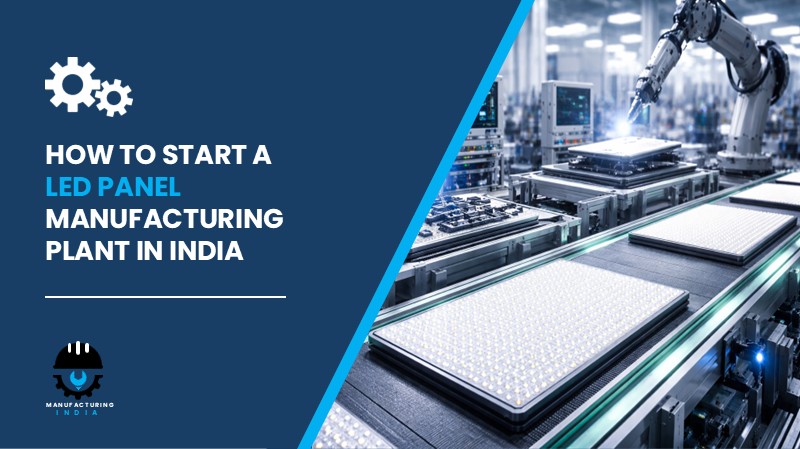
The LED panel manufacturing process uses LED chip mounting through the SMT process, driver integration, panel assembly, testing and quality inspection, and packaging as the primary production method. Each stage requires controlled process parameters, ESD protection, and quality verification to deliver LED panels that consistently meet lumen output, colour uniformity, CRI, and operational lifespan specifications.
- PCB Preparation and Printing: Printed circuit boards (PCBs) are inspected for dimensional accuracy and solder mask quality, then loaded into the SMT production line where solder paste is applied through precision stencil printing to the LED chip mounting pads.
- LED Chip Mounting (SMT Process): LED chips are placed onto the solder-pasted PCB pads with precision using SMT machines, which pick individual LED components from tape-and-reel packaging and place them at the specified coordinates with the positional accuracy required for consistent light output and array uniformity.
- Reflow Soldering: Loaded PCBs pass through reflow ovens where a controlled temperature profile melts the solder paste, flows it around the LED chip leads and pad surfaces, and then cools to form reliable solder joints between the LED chips and the PCB copper tracks.
- Driver IC Integration: Driver ICs — the electronic power conversion components that regulate the electrical supply to the LED array — are integrated onto the driver PCB using soldering stations, and the driver assembly is connected and tested for electrical compatibility with the LED array before panel assembly.
- Panel Assembly: The LED-populated PCB or light guide plate assembly, diffuser, aluminium frame, and driver unit are assembled together on assembly lines into the complete LED panel product, with all components secured and connected according to the panel design specification.
- Testing and Quality Inspection: Assembled panels are subjected to comprehensive testing at LED testing systems covering lumen output measurement, colour temperature verification, CRI testing, flicker analysis, power factor measurement, and aging tests on aging test racks to confirm operational stability and compliance with product standards before release for packaging.
- Packaging: Inspected and approved LED panels are individually packaged using packaging units with protective materials suited to prevent transit damage, then packed into outer cartons for dispatch to commercial building contractors, residential developers, retail chains, healthcare facilities, industrial customers, and government and smart city procurement channels.
Key Applications
LED panels manufactured in India serve a commercially broad and rapidly expanding range of lighting applications across public, commercial, and residential infrastructure:
- Commercial Buildings and Offices: Widely used in office ceilings to provide uniform, glare-free lighting that enhances workplace productivity and significantly reduces energy consumption relative to conventional fluorescent ceiling systems.
- Healthcare and Clean Rooms: These panels ensure hygienic, flicker-free illumination suitable for hospitals, medical laboratories, and sterile environments requiring consistent, high-CRI lighting quality without UV or mercury content.
- Retail and Showrooms: LED panels improve product visibility and aesthetic appeal through bright, evenly distributed illumination across retail floor spaces, merchandise displays, and showroom environments.
- Residential Lighting: Increasingly used in modern homes due to their sleek flat-panel design, high energy efficiency, long operational lifespan, and compatibility with smart home dimming and scene control systems.
Leading Manufacturers
The global LED panel industry is served by a group of large multinational corporations with extensive production capacities and diversified product portfolios across residential, commercial, industrial, and smart infrastructure lighting applications. Key players in the global market include:
- Nichia
- Osram
- Samsung Electronics
- Everlight Electronics
- LG Innotek
Timeline to Start the Plant
Establishing an LED panel manufacturing plant in India involves a structured multi-phase development sequence. Investors should plan for the following phases:
- Feasibility study and project report preparation
- Land acquisition and site development
- Regulatory approvals and environmental clearances
- Factory licence and fire safety compliance
- Machinery procurement and installation
- Raw material supplier agreements and supply chain setup
- Trial production and quality testing
- Commercial production launch
Licences and Regulatory Requirements
Starting an LED panel manufacturing unit in India requires several approvals spanning business registration, electronics product safety, environmental, and industrial compliance domains:
- Business registration (Proprietorship, LLP, or Pvt Ltd)
- Factory Licence under the Factories Act
- Environmental Clearance from the State Pollution Control Board
- GST Registration
- Fire Safety NOC
- BIS (Bureau of Indian Standards) certification under the Compulsory Registration Scheme (CRS) applicable to LED lighting products sold in India
- Effluent Treatment Plant (ETP) operational clearance
- Occupational Health and Safety compliance
Key Challenges to Consider
LED Chip Cost Concentration and Supply Chain Exposure. LED chips and driver ICs together account for the dominant share of the 70–80% raw material OpEx proportion, with LED chip pricing tied to global semiconductor supply conditions, technology generation cycles, and concentrated production in Taiwan, South Korea, Japan, and China. Supply chain disruptions or rapid technology transitions — such as the shift to higher-efficacy LED chip generations — can create both sourcing challenges and inventory obsolescence risk that require active procurement risk management.
BIS Certification and Product Compliance Requirements. LED panels sold in India must carry BIS certification under the Compulsory Registration Scheme, which requires product testing at BIS-accredited laboratories and adherence to relevant IS standards for LED luminaires. Achieving and maintaining BIS certification across the product range adds upfront compliance costs and ongoing audit obligations that must be planned into the operational cost structure from the beginning.
Competitive Market with Established Global Players. The competitive landscape includes large multinationals such as Nichia, Osram, Samsung Electronics, Everlight Electronics, and LG Innotek, alongside a substantial presence of Chinese LED panel manufacturers supplying the Indian market at competitive price points. New Indian producers must compete on price, after-sales service reliability, localisation benefits, and product customisation responsiveness to win and retain commercial and government procurement accounts.
Technology and Innovation Pressure. Continuous improvements in LED chip efficacy, driver efficiency, and smart control integration — as evidenced by the rapid product innovation from Aputure in January 2026 and Godox in December 2025 — create pressure on producers to regularly update product specifications and production configurations to remain competitive. Staying current with LED chip generations and smart lighting integration standards requires ongoing investment in engineering capability and product development.
Skilled Manpower for SMT Electronics Assembly. Maintaining consistent SMT placement accuracy, solder joint quality, and functional testing performance across high-speed LED panel assembly requires trained SMT technicians, reflow oven process engineers, and quality control specialists — a technically skilled electronics manufacturing workforce requiring ongoing investment in recruitment, training, and retention.
Import Dependence for LED Chips and Driver ICs. India currently relies significantly on imports for LED chips and driver ICs from semiconductor manufacturers in Taiwan, South Korea, Japan, and China. Managing this import dependence through dual-source procurement strategies, strategic inventory management, and long-term supplier contracts is essential for production continuity and cost stability.
Frequently Asked Questions
1. How much does it cost to set up an LED panel manufacturing plant in India?
The total setup cost depends on plant capacity, SMT line configuration, product mix, location, and automation level. CapEx covers land and site development, ESD-controlled production facility construction, core machinery including SMT machines, reflow ovens, LED testing systems, assembly lines, soldering stations, and packaging units, along with BIS certification, ETP, and other capital costs. A detailed project report with full CapEx and OpEx breakdowns is available on request.
2. Is LED panel manufacturing profitable in India in 2026?
Yes. The project demonstrates gross profit margins of 25–35% and net profit margins of 12–18% under normal operating conditions, supported by growing demand from commercial buildings, residential construction, healthcare facilities, retail spaces, and smart city infrastructure programmes that together constitute one of India’s fastest-expanding lighting market segments.
3. What machinery is required for an LED panel plant in India?
Key machinery includes SMT machines, reflow ovens, LED testing systems, assembly lines, soldering stations, and packaging units. The number of SMT lines and their speed and accuracy specifications determine the total production capacity and capital investment required.
4. What licences and approvals are required to start an LED panel plant in India?
Required approvals include business registration, a Factory Licence under the Factories Act, Environmental Clearance from the State Pollution Control Board, GST registration, a Fire Safety NOC, BIS certification under the Compulsory Registration Scheme for LED lighting products, ETP operational clearance, and Occupational Health and Safety compliance.
5. What raw materials are needed for LED panel manufacturing?
The primary raw materials are LED chips, aluminium frames, diffusers, and driver ICs. LED chips account for approximately 70–80% of total operating expenses as the dominant and highest-value input, making LED chip procurement strategy and supplier contract discipline the most critical cost management lever for the investment.
6. What are the environmental compliance requirements for an LED panel plant in India?
The unit must obtain Environmental Clearance from the State Pollution Control Board, operate an ETP for process water management, maintain ESD waste management procedures for failed LED components and PCB assemblies, and adhere to e-waste management regulations applicable to electronic manufacturing facilities under India’s E-Waste Management Rules.
7. What is the best location to set up an LED panel plant in India?
Optimal locations offer proximity to LED chip and electronics component supply chains, reliable utilities, skilled electronics assembly workforce availability, and access to large commercial construction and government procurement markets. Electronics manufacturing zones and industrial estates in Noida, Bengaluru, Hyderabad, Pune, and Chennai are among the most strategically relevant options for this investment.
8. What is the break-even period for this type of plant in India?
The break-even period depends on plant capacity, capacity utilisation rate, LED chip pricing trends, and demand conditions. A detailed financial analysis including payback period, NPV, and IRR projections is included in the full project report, available via the sample request link.
9. What government incentives are available for manufacturers in India?
The Make in India initiative, PLI schemes for electronics and LED lighting manufacturing, and state-level electronics manufacturing zone incentives provide financial and regulatory support for LED panel production investments. Capital subsidies, interest subvention schemes, power tariff concessions, and export promotion benefits may be applicable depending on the chosen plant location and production scale.
Key Takeaways for Investors
An LED panel manufacturing plant in India represents a commercially well-timed investment opportunity underpinned by powerful and converging demand drivers — rapid urbanisation, government LED promotion policies, smart city infrastructure expansion, and a structural shift across commercial, healthcare, retail, and residential sectors from conventional fluorescent lighting to energy-efficient LED panel systems — that collectively constitute one of the most consistently growing lighting market environments in the Asia-Pacific region. The project demonstrates financial viability across annual production capacities of 1 to 5 million units, with gross profit margins of 25–35% and net profit margins of 12–18% confirming strong unit economics under normal operating conditions. With North America alone accounting for 32% of the global LED panel market, and India’s urbanisation and smart infrastructure programmes creating substantial additional demand within the Asia-Pacific growth region, the market opportunity for domestically manufactured LED panels is significant and expanding. With product innovation accelerating — as demonstrated by Aputure’s January 2026 NOVA LED Panel launch and Godox’s December 2025 LiteWafer UP150R introduction — and India’s construction pipeline sustaining high commercial and institutional lighting procurement volumes, demand sustainability for India-based LED panel production is structurally robust across the full investment horizon.
About the Author