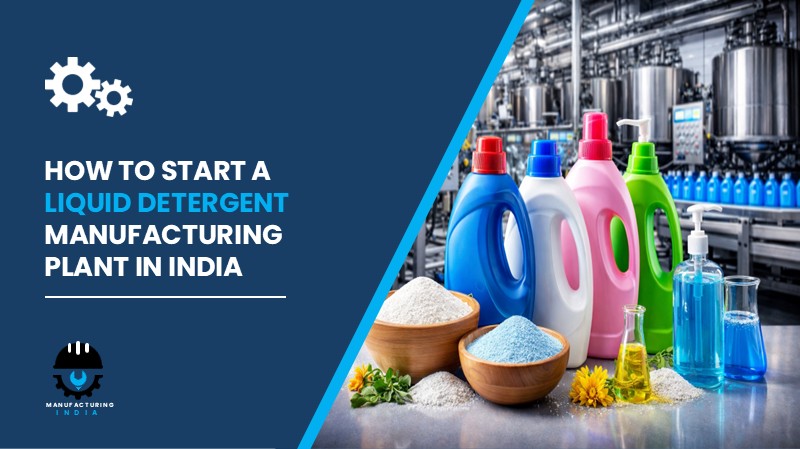
Setting up a liquid detergent manufacturing plant in India presents a compelling investment case driven by sustained demand across household care, hospitality, healthcare, institutional cleaning, and commercial laundries. As urbanisation accelerates and hygiene awareness deepens among Indian consumers, demand for liquid-based laundry solutions continues to outpace traditional powder segments. The rapid penetration of automatic washing machines in Tier 1 and Tier 2 cities is reinforcing this shift, since liquid formulations deliver measurably better performance in high-efficiency wash cycles. Understanding the liquid detergent manufacturing process from raw material blending through to filling and dispatch is essential for investors evaluating this opportunity.
India’s structural advantages make the country a strategically sound base for this production. The Make in India initiative provides policy-level support for FMCG and chemical manufacturing, while industrial states such as Gujarat, Maharashtra, and Uttar Pradesh offer established chemical clusters, logistics connectivity, and cost-competitive labour. Rising disposable incomes, expanding organised retail, and high-growth e-commerce channels create scalable distribution pathways for manufacturers entering this space today.
India’s liquid detergent sector sits at the intersection of policy support, cost-competitive production, and structural consumer demand. With gross profit margins of 30–40% and a typical break-even of 2–4 years, this investment offers strong ROI across a range of plant capacities — from institutional supply to full-scale FMCG production.
What is Liquid Detergent?
Liquid detergent is a concentrated, water-based mixture consisting primarily of surfactants, builders, solvents, stabilizers, enzymes, fragrances, and preservatives. Its core purpose is to lift dirt, oil, and stains from fabrics and surfaces, dissolving immediately in water for even distribution and minimal residue. Unlike powder detergents, liquid variants deliver superior performance in cold-water cycles, making them ideal for contemporary eco-friendly washing machines.
Key properties include controlled viscosity, high solubility, and stable foam generation. The primary production method is surfactant blending, neutralization, homogenization, filtration, and liquid filling. Product variants span laundry care, dishwashing, and industrial cleaning, each formulated to preserve fabric softness and colour. End-use industries served include household and consumer care, commercial laundries, hospitality and institutional cleaning, and healthcare facilities.
Request for a Sample Report: https://www.imarcgroup.com/liquid-detergent-manufacturing-plant-project-report/requestsample
Cost of Setting Up a Liquid Detergent Manufacturing Plant in India
The total cost of a liquid detergent manufacturing plant depends on capacity, technology, location, automation level, and regulatory compliance.
1. Capital Expenditure (CapEx)
Land and site development — covering registration charges, boundary work, and related civil costs — forms a substantial portion of total investment. Locating within a Special Economic Zone (SEZ) or state-designated industrial estate can reduce land costs and simplify utility connections significantly. Civil works cover the production shed, quality control laboratory, raw material and finished goods storage, and the administrative block.
Machinery and equipment represent the largest single CapEx component. Key machinery required includes:
- Stainless steel mixing tanks (reactors)
- Agitators and homogenizers
- Dosing and metering pumps
- Filtration units
- Automatic filling and packaging machines
- Water treatment units
- Quality control and testing tools
- Packaging and batching systems
- Labeling equipment
- Storage tanks
Other capital costs include effluent treatment plant (ETP) setup, pre-operative expenses, and import duties on specialised equipment.
Request a Sample Report for In-Depth Market Insights: https://www.imarcgroup.com/liquid-detergent-manufacturing-plant-project-report/requestsample
2. Operational Expenditure (OpEx)
Raw material cost dominates operating expenditure, accounting for approximately 70–80% of total OpEx. Key inputs are linear alkyl benzene (LAB), sulfuric acid, caustic soda, soda ash, perfumes, water, and HDPE bottles. Long-term contracts with domestic suppliers — particularly for LAB and caustic soda — are advisable to stabilise pricing and manage commodity risk. Utility costs covering electricity, water, and steam represent approximately 5–10% of OpEx. Other operating costs include transportation, packaging, salaries, maintenance, depreciation, and taxes. Total operational costs are projected to increase substantially by Year 5 due to inflation, market fluctuations, and potential rises in key material costs.
3. Plant Capacity
The proposed facility design supports annual production of 50,000–100,000 kiloliters, enabling economies of scale while maintaining operational flexibility. Capacity can be customised to match specific investor requirements, and profitability improves directly with higher capacity utilisation as fixed overheads are spread across a larger output volume.
4. Profit Margins and Financial Projections
The project demonstrates strong profitability under normal operating conditions. Gross profit margins range between 30–40% and net profit margins between 12–18% over a five-year horizon. Investors should evaluate Net Present Value (NPV), Internal Rate of Return (IRR), payback period, sensitivity analysis, and liquidity analysis in a detailed feasibility study. The payback window typically runs 2–4 years, improving as capacity utilisation rises through Years 2 and 3.
Why Set Up a Liquid Detergent Plant in India?
Consistent Consumer Demand. Liquid detergents are daily-use FMCG products with stable, recession-resistant demand. Population growth, urbanising lifestyles, and rising hygiene consciousness among Indian consumers create a reliable and expanding customer base across retail and institutional markets.
Shift from Powders to Liquids. Indian consumers are progressively choosing liquid over powder detergents for ease of dissolution, superior stain removal, and compatibility with high-efficiency washing machines. This structural shift creates sustained growth for new manufacturing entrants.
Scalable Model and Private-Label Opportunity. The manufacturing model supports flexible capacity expansion and private-label production for supermarket chains, hospitality groups, and institutional buyers — providing an additional revenue stream alongside branded FMCG production.
Alignment with Sustainability Trends. Concentrated formulas, low-temperature wash compatibility, and reduced packaging waste align with eco-conscious consumption patterns. Advances in surfactant chemistry and enzyme efficiency are further improving performance while lowering the environmental footprint.
Active Industry Investment. In August 2025, Hindustan Unilever Limited launched Surf Excel Matic Express with Pro-S Technology for fast-cycle washing machines in India. In June 2024, Whirlpool India partnered with Hindustan Unilever to integrate washing machine technology with its detergent portfolio. In April 2025, Henkel introduced concentrated laundry formulas for its all®, Persil®, and Snuggle® brands using 50% recycled-plastic bottles — all confirming active investment in this segment.
Strong Retail and E-Commerce Distribution. Expanding organised retail, D2C brands, and online marketplaces are accelerating product accessibility across India’s diverse geographic markets.
Manufacturing Process — Step by Step
The liquid detergent manufacturing process uses surfactant blending, neutralization, homogenization, filtration, and liquid filling as the primary production method:
- Raw Material Preparation: LAB, sulfuric acid, caustic soda, soda ash, perfumes, water, and HDPE bottles are received and quality-checked.
- Mixing of Surfactants and Builders: Combined in stainless steel mixing tanks in controlled proportions to form the detergent base.
- Blending of Fragrances, Enzymes, and Colorants: Added via dosing tanks to achieve the target formulation.
- Neutralization: Acid-base reactions are carried out under controlled temperature using caustic soda.
- Homogenization and Filtration: Passed through homogenizers and filtration units for uniform consistency and foam stability.
- Quality Control and Testing: Tested for concentration, viscosity, pH, and stability against defined quality criteria.
- Automatic Filling and Packaging: Filled into HDPE bottles, sealed, and labeled using automated equipment.
- Finished Goods Dispatch: Packed units dispatched to household retailers, commercial laundries, hospitality accounts, and healthcare facilities.
Key Applications
Liquid detergent serves a broad range of industries and end-use segments:
- Household and Consumer Care: Daily laundry, stain removal, delicate fabric care, and cold-water washing for modern appliances.
- Commercial Laundries: Bulk textile cleaning for hotels, hospitals, and industrial uniform services.
- Hospitality and Institutional Cleaning: Linen and upholstery washing and hygiene maintenance across large facilities.
- Healthcare Facilities: Cleaning of reusable medical textiles requiring gentle foam and residue-free performance.
Leading Manufacturers
The global liquid detergent market includes a range of multinational and regional manufacturers with extensive production capacities. Key players include:
- Ecover
- Persan S.A.
- McBride plc
- Unilever PLC
- Kao Corporation
- Lion Corporation
- Method Products
- LG Household & Health Care Ltd.
- Nirma Limited
- Seventh Generation, Inc.
- Church & Dwight Co., Inc.
- Henkel AG & Co. KGaA
- Amway Corporation
- Reckitt Benckiser Group PLC
Timeline to Start the Plant
Establishing a liquid detergent manufacturing plant typically requires 12–18 months from initiation to commercial production:
- Feasibility study and project report preparation
- Land acquisition and site development
- Regulatory approvals and environmental clearances
- Factory licence and fire safety compliance
- Machinery procurement and installation
- Raw material supplier agreements and supply chain setup
- Trial production and quality testing
- Commercial production launch
Licences and Regulatory Requirements
Starting a liquid detergent manufacturing unit in India requires several approvals:
- Business registration (Proprietorship, LLP, or Pvt Ltd)
- Factory Licence under the Factories Act
- Environmental Clearance from State Pollution Control Board
- GST Registration
- Fire Safety NOC
- Chemical and Hazardous Materials Handling compliance (applicable for sulfuric acid and caustic soda)
- Effluent Treatment Plant (ETP) operational clearance
- Occupational Health and Safety compliance
Key Challenges to Consider
High Capital Requirements. Significant upfront investment in land, construction, stainless steel processing equipment, and an ETP requires a structured mix of equity and debt financing.
Raw Material Price Volatility. Inputs such as linear alkyl benzene (LAB), sulfuric acid, and caustic soda are subject to global commodity fluctuations; long-term supplier contracts are essential to manage input cost risk.
Regulatory Compliance. Chemical manufacturing involves multi-layered environmental and factory regulations — securing ETP approvals, pollution control clearances, and chemical handling NOCs requires dedicated compliance management.
Technology and Innovation Pressure. Active product development — concentrated formats, enzyme formulas, eco-friendly packaging — creates ongoing pressure to invest in process and formulation upgrades.
Competition from Established Players. Multinational firms such as Unilever PLC, Henkel AG & Co. KGaA, and Reckitt Benckiser Group PLC, alongside domestic players like Nirma Limited, compete on scale and brand equity.
Skilled Manpower. Operating reactors, automated filling lines, and QC laboratories requires trained chemical engineers and process technicians that can be challenging to source outside major industrial clusters.
Frequently Asked Questions
1. How much does it cost to set up a liquid detergent manufacturing plant in India? Total capital investment varies by capacity, location, technology, and automation. It covers land, civil works, machinery, utilities, and pre-operative expenses. A detailed project feasibility report is recommended for location-specific estimates.
2. Is liquid detergent manufacturing profitable in India in 2026? Yes. Gross margins of 30–40% and net margins of 12–18% reflect stable FMCG demand, rising urbanisation, and growing washing machine penetration across Indian households.
3. What machinery is required for a liquid detergent plant in India? Essential machinery includes stainless steel mixing tanks, agitators and homogenizers, dosing and metering pumps, filtration units, automatic filling and packaging machines, water treatment units, labeling equipment, and storage tanks.
4. What licences and approvals are required to start a liquid detergent plant in India? Required approvals include business registration, Factory Licence, Environmental Clearance, GST registration, Fire Safety NOC, chemical handling compliance, ETP clearance, and occupational health and safety certification.
5. What raw materials are needed for liquid detergent manufacturing? Key raw materials are linear alkyl benzene (LAB), sulfuric acid, caustic soda, soda ash, perfumes, water, and HDPE bottles. Optional inputs include enzymes, antibacterial agents, and colorants.
6. What are the environmental compliance requirements for a liquid detergent plant in India? Compliance requires clearance from the State Pollution Control Board, a functional ETP, adherence to emission standards, and compliance with hazardous chemical storage norms for sulfuric acid and caustic soda.
7. What is the best location to set up a liquid detergent plant in India? Ideal locations offer proximity to raw material suppliers (LAB, caustic soda, soda ash), reliable utilities, strong logistics access, and supportive state industrial policies. Gujarat, Maharashtra, and Uttar Pradesh offer established chemical industry infrastructure.
8. What is the break-even period for this type of plant in India? The break-even period typically ranges from 2 to 4 years, depending on production scale, market penetration, and capacity utilisation. Strong distribution and brand positioning can accelerate this timeline.
9. What government incentives are available for manufacturers in India? Central and state governments may offer capital subsidies, tax exemptions, reduced utility tariffs, export benefits, and interest subsidies under national and state industrial promotion schemes, including Make in India and MSME support programmes.
Key Takeaways for Investors
This type of production facility in India represents a well-grounded opportunity anchored by durable demand across household care, commercial laundries, hospitality, and healthcare. The financial profile is viable across production scales, with gross margins of 30–40% and net margins of 12–18% achievable under normal conditions. The global liquid detergent market was valued at USD 36.879 billion in 2025 and is projected to reach USD 57.26 billion by 2034 at a CAGR of 5.0% from 2026 to 2034 — a trajectory that signals sustained and expanding global and domestic demand. For Indian investors, a large consumer base, cost-competitive inputs, improving retail infrastructure, and active policy support through Make in India combine to create a demand outlook that is both immediate and durable over the long term.
About the Author