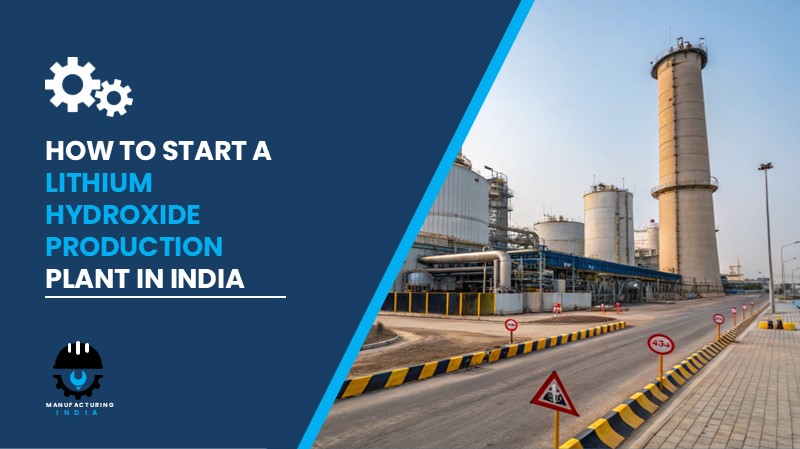
Setting up a lithium hydroxide production plant in India presents a compelling investment case as the country rapidly emerges as one of the most strategically important destinations for battery-grade chemical manufacturing. Driven by accelerating demand from the electric vehicle sector, lithium-ion battery manufacturing, renewable energy storage, aerospace, ceramics, and pharmaceuticals, lithium hydroxide has become an indispensable part of India’s rapidly evolving clean-energy supply chain.
“With over 1.4 billion consumers, a rapidly expanding EV market, India’s renewable energy capacity crossing 200 GW, and strong government support for domestic battery manufacturing, India offers one of the most financially attractive environments for lithium hydroxide production — with a break-even window of 3–6 years and growing demand directly tied to the global shift toward clean energy and electric mobility.”
What is Lithium Hydroxide?
Lithium hydroxide is an inorganic compound with the molecular formula LiOH. It appears as a white solid that is hygroscopic, meaning it readily absorbs moisture from the air. It is most prominently used as a key starting material in producing cathodes for lithium-ion batteries, particularly in nickel-rich battery chemistries preferred for high-energy-density EV applications. Lithium hydroxide is also widely used in ceramics and glassmaking, as a lubricant additive, in air scrubbers to remove carbon dioxide in aerospace and breathing apparatus applications, and increasingly in pharmaceuticals. As lithium hydroxide produces a strongly alkaline solution, it requires careful handling under strict safety protocols throughout the production and storage process. This commodity is becoming increasingly critical due to the rapid acceleration of the electric vehicle market and global growth in energy storage systems.
Cost of Setting Up a Lithium Hydroxide Production Plant in India
The lithium hydroxide production plant cost in India depends on several parameters including production capacity, technology used, plant location, level of automation, raw material sourcing strategy, and regulatory compliance requirements. Here is a structured breakdown of all major cost components:
1. Capital Expenditure (CapEx)
The total capital investment in a lithium hydroxide production plant typically covers the following:
Land and Site Development
This includes land acquisition, boundary development, land registration charges, and basic site preparation. Cost varies significantly depending on whether the land is located in a chemical manufacturing zone, Special Economic Zone (SEZ), Industrial Development Corporation estate, or a privately purchased plot. Proximity to lithium mineral processing hubs, port infrastructure for spodumene concentrate imports, and water availability are critical site selection factors for a lithium hydroxide production facility.
Civil Works and Construction
Building costs cover the main chemical processing facility, acid-resistant flooring and containment systems, raw material and chemical storage areas, quality control and analytical laboratory, effluent treatment plant, administrative block, and worker safety amenities. Construction specifications must comply with chemical industry safety standards, corrosion-resistant materials requirements, and environmental protection norms applicable to hazardous chemical manufacturing in India.
Machinery and Equipment
This is the single largest component of CapEx. Key machinery and equipment required for a lithium hydroxide production plant includes:
- Crushing and Grinding Mills
- Calcination Kilns
- Acid Roasting Units
- Leaching Reactors and Tanks
- Filtration Systems
- Crystallizers
- Centrifuges
- Dryers and Drying Systems
- Evaporators
- Storage Tanks (Acid-Resistant)
- Water Treatment and Effluent Management Systems
- Packaging Units
- Material Handling and Conveying Equipment
Machinery costs represent the largest share of overall capital expenditure, reflecting the high degree of chemical engineering precision, corrosion-resistant construction, and safety infrastructure required in lithium hydroxide production.
Other Capital Costs
These include pre-operative expenses, commissioning charges, import duties on specialised chemical processing equipment, acid handling and containment infrastructure, utilities installation, fire safety systems, hazardous waste management setup, and Effluent Treatment Plant (ETP) construction. Environmental impact assessment and regulatory compliance infrastructure also form part of the initial capital outlay.
2. Operational Expenditure (OpEx)
Once the plant is commissioned, the ongoing cost structure is dominated by a few key components:
Raw Material Cost (Spodumene Concentrate, Sulfuric Acid, Lime): Major Share of OpEx
Spodumene concentrate is the primary lithium-bearing raw material and represents the dominant cost in the operating expense structure. Other essential inputs include sulfuric acid, lime or limestone, soda ash, water, and chemical reagents for purification and pH control. Securing long-term offtake agreements with spodumene concentrate suppliers and negotiating stable sulfuric acid supply contracts are critical levers for managing raw material cost volatility over the plant lifecycle.
Utility Cost: Significant Share of OpEx
Utilities include electricity (heavily consumed by calcination kilns, grinding mills, dryers, and effluent treatment systems), process water, steam, and fuel for high-temperature operations. Energy efficiency in kiln and drying operations is a key operational optimisation lever given the energy-intensive nature of lithium hydroxide production.
Other Operating Costs
The remaining budget covers transportation and logistics, secondary packaging, salaries and wages for chemical engineers, process technicians, and quality analysts, maintenance of corrosion-resistant equipment, environmental compliance, depreciation, taxes, regulatory audit costs, and miscellaneous overhead.
3. Plant Capacity
The proposed production facility is designed with a capacity scalable to serve both domestic and export demand across the battery-grade and technical-grade lithium hydroxide market. Capacity can be customised based on downstream offtake commitments, capital availability, and strategic positioning. Smaller pilot setups may serve niche domestic applications initially, while larger integrated facilities targeting battery manufacturers and EV supply chain customers benefit significantly from economies of scale, higher throughput, and improved per-unit production economics.
4. Profit Margins and Financial Projections
- Gross Profit Margin: Varies with lithium market pricing cycles, plant scale, and raw material sourcing efficiency
- Net Profit Margin: Improves substantially with long-term offtake contracts with battery manufacturers and higher-purity product premiums
- Break-Even Period: 3 to 6 years, depending on plant scale, lithium market prices, raw material sourcing strategy, and strength of downstream customer contracts
Financial projections must account for capital investment, operating costs, capacity utilisation rates, lithium hydroxide pricing trends, and demand outlook. A thorough analysis should also include sensitivity analysis, Net Present Value (NPV), Internal Rate of Return (IRR), and Payback Period, with particular attention to lithium commodity price scenarios.
Request a Sample Report for In-Depth Market Insights: https://www.imarcgroup.com/lithium-hydroxide-manufacturing-plant-project-report/requestsample
Why Set Up a Lithium Hydroxide Production Plant in India?
India presents a uniquely favourable environment for establishing a lithium hydroxide production plant:
Surging Domestic Demand from EV and Battery Manufacturing
India’s rapidly growing EV market across two-wheelers, three-wheelers, passenger vehicles, and commercial vehicles is creating strong domestic demand for battery-grade lithium hydroxide. The government’s Production Linked Incentive (PLI) schemes for Advanced Chemistry Cell (ACC) battery manufacturing are catalysing the establishment of gigafactories in India, creating a direct and high-volume demand pipeline for domestic lithium hydroxide producers.
Policy and Regulatory Tailwinds
The Government of India’s National Critical Minerals Mission, focus on reducing import dependence for battery materials, and support for domestic lithium processing infrastructure under Make in India and Atmanirbhar Bharat create a strongly policy-favourable environment for lithium hydroxide producers. India’s discovery of significant lithium reserves in Jammu and Kashmir further strengthens the long-term domestic raw material outlook for the sector.
Renewable Energy Growth Driving Storage Demand
India’s renewable energy capacity has crossed 200 GW, and the country is targeting 500 GW of non-fossil fuel capacity by 2030. This massive build-out of solar and wind power is driving parallel demand for grid-scale and distributed energy storage, directly increasing consumption of lithium hydroxide for battery cathode production across stationary storage applications.
Cost-Competitive Manufacturing
India offers competitive land costs, a large pool of trained chemical engineers and process technicians, and a well-established industrial chemicals supply chain for inputs such as sulfuric acid and lime. Strategic location near ports facilitates cost-effective import of spodumene concentrate, while proximity to domestic battery manufacturers reduces finished product logistics costs.
Export Opportunities
India-based producers can leverage competitive manufacturing costs to serve export demand from Southeast Asia, the Middle East, and Europe, where battery supply chains are actively seeking to diversify away from single-geography concentration in lithium chemical processing. India’s chemical export infrastructure and established trade routes support international market entry at competitive price points.
Manufacturing Process Overview
The lithium hydroxide production process uses chemical synthesis and purification technology. The complete process flow involves:
- Raw Material Procurement and Quality Inspection — sourcing and IQC of spodumene concentrate, sulfuric acid, lime, limestone, and process chemicals
- Crushing and Grinding — size reduction of spodumene ore to the required particle size for calcination
- Calcination — high-temperature roasting of spodumene in calcination kilns to convert alpha-spodumene to the more reactive beta-spodumene form
- Acid Roasting — reaction of calcined spodumene with sulfuric acid to produce lithium sulfate
- Water Leaching — dissolution of lithium sulfate from the roasted mass using water in leaching reactors
- Purification and Filtration — removal of impurities including iron, aluminium, calcium, and magnesium through pH adjustment, precipitation, and filtration
- Conversion to Lithium Hydroxide — reaction of purified lithium sulfate solution with lime or caustic soda to produce lithium hydroxide solution
- Evaporation and Crystallisation — concentration of lithium hydroxide solution followed by crystallisation to produce lithium hydroxide monohydrate crystals
- Centrifugation and Washing — separation and washing of crystals to achieve battery-grade purity
- Drying — removal of moisture to produce dry lithium hydroxide monohydrate powder
- Quality Testing and Analysis — purity verification, particle size analysis, and heavy metals testing to battery-grade specifications
- Packaging and Dispatch — sealed packaging in moisture-proof bags or drums for safe storage and transport
Key Applications of Lithium Hydroxide
Lithium hydroxide produced in India serves a wide variety of end-use industries and applications:
- Battery Manufacturing: Primary cathode precursor material for nickel-rich NMC and NCA lithium-ion batteries used in electric vehicles and energy storage systems — the largest and fastest-growing end-use segment
- Electric Vehicles: Used in producing high-energy-density battery cathodes for two-wheelers, three-wheelers, passenger EVs, and commercial electric vehicles across India’s rapidly expanding EV ecosystem
- Aerospace and Breathing Apparatus: Carbon dioxide absorbent in air purification and life support systems for spacecraft, submarines, and mining breathing equipment
- Ceramics and Glass: Used as a flux and glazing agent in technical ceramics, specialty glass, and porcelain enamel manufacturing
- Lubricant Additives and Pharmaceuticals: Lithium-based greases for high-temperature industrial lubrication applications and as a reagent in pharmaceutical synthesis
Global Market Outlook
The global lithium hydroxide market is witnessing robust growth driven by the accelerating transition to electric mobility, expanding energy storage deployment, and the increasing preference for nickel-rich lithium-ion battery chemistries that specifically require lithium hydroxide over lithium carbonate. According to the International Energy Agency, electric car sales are expected to exceed 20 million units in 2025, representing more than a quarter of all cars sold globally — a direct and powerful demand driver for battery-grade lithium hydroxide worldwide.
Leading global players in the lithium hydroxide industry include:
- SQM S.A.
- Albemarle Corporation
- Ganfeng Lithium Co., Ltd.
- Livent Corporation
- Arcadium Lithium
- LevertonHELM Limited
- Tianqi Lithium Corporation
- Pilbara Minerals Ltd.
- Nemaska Lithium
- American Elements
Timeline to Start a Lithium Hydroxide Production Plant
Setting up a lithium hydroxide production plant from ideation to commissioning typically requires 18 to 24 months. This covers:
- Feasibility study and detailed project report (DPR) preparation
- Land acquisition and site development
- Environmental Impact Assessment (EIA) and regulatory approvals
- Factory licence and fire and hazardous chemicals safety compliance
- Machinery procurement, installation, and acid handling infrastructure setup
- Effluent treatment plant and waste management system commissioning
- Trial production, quality testing, and battery-grade purity certification
- Commercial production launch and customer supply commencement
Licenses and Regulatory Requirements
Starting a lithium hydroxide production unit in India requires several approvals, including:
- Business registration (Proprietorship, LLP, or Private Limited Company)
- Factory Licence under the Factories Act
- Environmental Clearance from the Ministry of Environment, Forest and Climate Change (MoEFCC) and State Pollution Control Board
- Consent to Establish and Consent to Operate under the Water and Air (Prevention and Control of Pollution) Acts
- Hazardous Chemicals Licence under the Manufacture, Storage and Import of Hazardous Chemical Rules
- GST Registration
- Fire Safety NOC
- Chemical Weapons Convention (CWC) compliance declaration where applicable
- BIS / REACH / export quality certification for battery-grade product supply
- Udyam Registration (for MSME benefits and government scheme eligibility)
Key Challenges to Consider
Before investing, entrepreneurs should be aware of the common challenges in this business:
- High Capital Requirements: Initial CapEx for calcination kilns, acid handling systems, leaching reactors, crystallisers, and effluent treatment infrastructure is significant, particularly for battery-grade production facilities requiring high-purity output.
- Raw Material Import Dependency: India currently lacks large-scale domestic spodumene concentrate production, making plants dependent on imports from Australia, Chile, and other producing countries. Currency fluctuations and shipping disruptions can impact input costs substantially.
- Lithium Price Volatility: Lithium hydroxide prices are subject to significant commodity price cycles linked to EV demand forecasts, new supply coming online, and macroeconomic conditions, requiring robust financial modelling and hedging strategies.
- Stringent Environmental and Safety Compliance: Handling corrosive chemicals including sulfuric acid, lime, and lithium hydroxide requires continuous investment in safety infrastructure, monitoring systems, effluent treatment, and regulatory compliance documentation.
- Battery-Grade Purity Requirements: Achieving and consistently maintaining battery-grade purity specifications demanded by lithium-ion battery cathode manufacturers requires sophisticated analytical capability and tightly controlled process chemistry.
- Skilled Manpower: Operating calcination kilns, leaching reactors, crystallisers, and analytical quality control systems requires trained chemical engineers and process chemists, who are in growing demand across India’s expanding battery materials and specialty chemicals sector.
Frequently Asked Questions
The following questions are answered in the report:
- How much does it cost to set up a lithium hydroxide production plant in India?
- Is lithium hydroxide manufacturing profitable in India in 2026?
- What machinery is required for a lithium hydroxide production plant in India?
- What raw materials are required for lithium hydroxide production?
- What licences and approvals are required to start a lithium hydroxide plant in India?
- How long does it take to commission a lithium hydroxide production plant in India?
- What is the best state or location to set up a lithium hydroxide plant in India?
- What government incentives are available for lithium hydroxide manufacturers in India?
- What is the break-even period for a lithium hydroxide production plant in India?
- What are the environmental and hazardous chemical compliance requirements for lithium hydroxide manufacturing in India?
Key Takeaways for Investors
The lithium hydroxide production industry in India represents a strong and strategically critical investment opportunity backed by India’s rapidly growing EV market, accelerating battery manufacturing ecosystem, and supportive government policy for domestic critical mineral processing. With a break-even window of 3–6 years, a well-planned lithium hydroxide production plant cost in India remains competitive and financially viable across plant capacities. Investors who combine battery-grade quality systems, strategic raw material sourcing partnerships, and long-term offtake agreements with domestic and export battery manufacturers stand to benefit significantly from one of India’s most critical and fast-growing segments of clean-energy and specialty chemical manufacturing.
About the Author