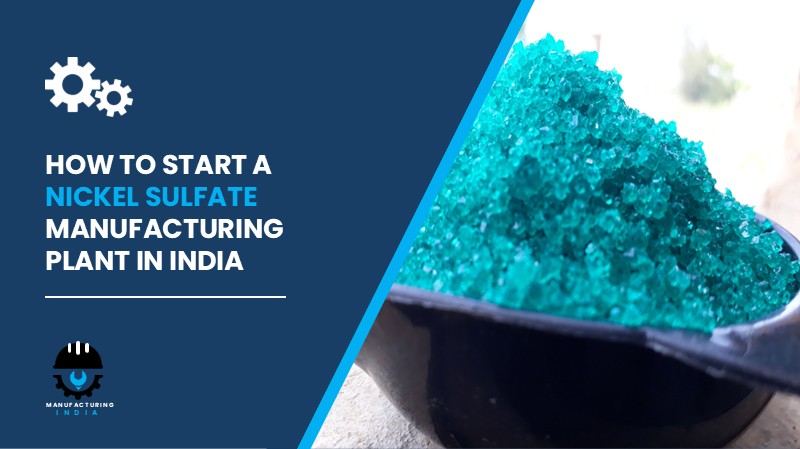
Setting up a nickel sulfate manufacturing plant in India presents a compelling investment case as the country rapidly emerges as one of the most cost-competitive and high-demand destinations for specialty chemical and battery material manufacturing. Driven by surging demand from the electric vehicle (EV) battery, electroplating, catalyst, and ceramics industries, nickel sulfate has become an indispensable industrial chemical in India’s growing advanced materials economy.
“With over 1.4 billion consumers, a rapidly expanding EV and electronics sector, Make in India policy support, and a booming battery materials supply chain, India offers one of the most financially attractive environments for nickel sulfate manufacturing — with gross margins of 20–30% and a break-even window of 4–6 years.”
What is Nickel Sulfate?
Nickel sulfate (NiSO₄) is an inorganic compound available as a green crystalline hexahydrate or anhydrous powder. It is produced through the dissolution of nickel or nickel oxide in sulfuric acid and subsequent crystallization. Nickel sulfate is a critical precursor material in the production of nickel-manganese-cobalt (NMC) and nickel-cobalt-aluminum (NCA) cathode active materials for lithium-ion batteries, making it a cornerstone of the global electric vehicle supply chain.
Beyond batteries, nickel sulfate is widely used in electroplating and surface finishing to provide corrosion-resistant nickel coatings on metals, as a catalyst in chemical synthesis, and in the manufacture of ceramics, pigments, and electronic components. As India aggressively pursues EV adoption and electronics manufacturing, domestic demand for high-purity nickel sulfate continues to accelerate.
Cost of Setting Up a Nickel Sulfate Manufacturing Plant in India
The nickel sulfate manufacturing plant cost in India depends on several parameters including production capacity, purity grade (battery-grade vs. electroplating-grade), technology used, plant location, level of automation, and regulatory compliance. Here is a structured breakdown of all major cost components:
1. Capital Expenditure (CapEx)
The total capital investment in a nickel sulfate manufacturing plant typically covers the following:
Land and Site Development
This includes land acquisition, boundary development, land registration charges, and basic site preparation. Cost varies significantly depending on whether the land is in an industrial estate, Special Economic Zone (SEZ), or a privately purchased plot. Given the chemical nature of the process, proximity to effluent treatment infrastructure and water sources is critical.
Civil Works and Construction
Building costs cover the main manufacturing shed with chemical-resistant flooring, acid storage area, utility zone, raw material storage, quality control laboratory, administrative block, and worker safety facilities. Construction specifications must comply with chemical plant safety standards and local SPCB requirements.
Machinery and Equipment
This is the single largest component of CapEx. Key machinery required for a nickel sulfate plant includes:
- Dissolution and Reaction Vessels (nickel/NiO dissolution in H₂SO₄)
- Filtration and Clarification Units
- Crystallization Reactors
- Centrifuges and Drying Systems
- Ion Exchange and Solvent Extraction Units (for battery-grade purification)
- pH Control and Dosing Systems
- Storage Tanks (acid-resistant)
- Effluent Treatment Plant (ETP)
- Quality Analysis Equipment (ICP-OES, AAS)
Machinery costs represent the largest share of overall capital expenditure, reflecting the high degree of chemical process engineering and corrosion-resistant construction materials involved in nickel sulfate production.
Other Capital Costs
These include pre-operative expenses, commissioning charges, import duties (if specialized purification equipment is sourced internationally), utilities installation, fire safety systems, chemical storage infrastructure, and Effluent Treatment Plant (ETP) setup, which is mandatory for nickel-bearing wastewater.
2. Operational Expenditure (OpEx)
Once the plant is commissioned, the ongoing cost structure is dominated by a few key components:
Raw Material Cost (Nickel Feedstock & Sulfuric Acid): 80-85% of Total OpEx
Nickel feedstock (nickel metal, nickel oxide, or nickel hydroxide) and sulfuric acid are the primary raw materials and account for the majority of operating expenses. Nickel prices are subject to global commodity market fluctuations linked to stainless steel and EV battery demand cycles. Additional materials may include chemical reagents for purification, pH adjustment chemicals, and filtration media.
Utility Cost: 10–15% of Total OpEx
Utilities include electricity (consumed by reactors, centrifuges, and drying systems), process water (used in dissolution and washing operations), steam for crystallization, and effluent treatment operations.
Other Operating Costs
The remaining budget covers transportation, secondary packaging (drums, big bags, IBC containers), salaries and wages (including chemical safety-trained staff), maintenance, depreciation, environmental compliance, ETP operations, taxes, and miscellaneous overhead.
3. Plant Capacity
The proposed manufacturing facility is designed with an annual production capacity ranging between 30,000 metric tons of nickel sulfate hexahydrate. This range allows the plant to achieve economies of scale while maintaining flexibility to serve multiple end-use segments including battery materials, electroplating, and specialty chemicals. Smaller pilot setups may start at lower capacity, but profitability significantly improves with higher capacity utilization and battery-grade product premiums.
4. Profit Margins and Financial Projections
- Gross Profit Margin: 15–25%
- Net Profit Margin: 8–15%
- Break-Even Period: 4 to 6 years, depending on production scale, product grade (battery vs. electroplating), market demand, raw material cost management, and sales efficiency.
Financial projections must account for capital investment, operating costs, capacity utilization rates, pricing trends across product grades, and demand outlook. A thorough analysis should also include sensitivity analysis, Net Present Value (NPV), Internal Rate of Return (IRR), and Payback Period.
Request a Sample Report for In-Depth Market Insights: https://www.imarcgroup.com/nickel-sulfate-manufacturing-plant-project-report/requestsample
Why Set Up a Nickel Sulfate Plant in India?
India presents a uniquely favorable environment for establishing a nickel sulfate manufacturing plant:
Surging EV and Battery Demand
India’s EV market is growing at a rapid pace, with government targets to achieve 30% EV penetration by 2030. This is creating massive upstream demand for battery-grade nickel sulfate as domestic cell and battery manufacturing capacity scales up under the PLI (Production Linked Incentive) scheme for Advanced Chemistry Cell (ACC) batteries.
Policy and Regulatory Tailwinds
The Government of India’s emphasis on domestic battery manufacturing, the National Mission on Transformative Mobility, Make in India initiative, and PLI schemes for specialty chemicals and advanced materials is creating a policy-friendly environment for nickel sulfate manufacturers serving the EV and electronics sectors.
Cost-Competitive Manufacturing
India offers competitive land costs, a large pool of trained chemical engineers and process technicians, and an improving specialty chemical raw material supply chain, making it one of the most cost-effective locations for nickel sulfate production in Asia.
Export Opportunities
India-based manufacturers can tap into growing export demand from Southeast Asia, the Middle East, and Africa where local nickel sulfate production capacity remains limited, and from global battery manufacturers seeking supply chain diversification away from China.
Local Supply Chain Preference
Battery cell manufacturers, EV OEMs, and electroplating industries increasingly prefer sourcing critical materials locally to reduce logistics costs, improve supply security, and maintain better quality control — a direct opportunity for domestic nickel sulfate manufacturers.
Manufacturing Process Overview
The nickel sulfate manufacturing process primarily uses two technology routes:
- Acid Dissolution Route — dissolution of nickel metal, nickel oxide, or nickel hydroxide in sulfuric acid to form crude nickel sulfate solution
- Refinery By-product Route — processing of nickel-bearing intermediates (e.g., nickel matte, mixed hydroxide precipitate) via leaching and purification
The complete process flow involves raw material sourcing and preparation, dissolution and leaching, filtration and impurity removal, solvent extraction or ion exchange for battery-grade purification, crystallization, centrifugation and drying, quality inspection and purity testing, and final packaging for dispatch.
Key Applications of Nickel Sulfate
Nickel sulfate manufactured in India serves a wide variety of end-use industries:
- EV Battery Materials: Precursor to NMC and NCA cathode active materials for lithium-ion batteries in electric vehicles
- Electroplating and Surface Finishing: Nickel plating baths for corrosion protection and decorative finishing of metals and electronics
- Catalyst Manufacturing: Nickel-based catalysts used in hydrogenation, petroleum refining, and specialty chemical synthesis
- Ceramics and Pigments: Green colorants and specialty glazes for ceramic and glass applications
- Electronics: Printed circuit board manufacturing and electronic component surface treatment
Global Market Outlook
The global nickel sulfate market was valued at approximately USD 3.60 billion in 2025 and is projected to reach USD 4.99 billion by 2034, growing at a CAGR of 3.7% from 2026 to 2034. This strong growth is driven by the exponential scale-up of EV battery production, increasing electroplating demand from automotive and electronics sectors, and supply chain localization trends in battery materials.
Leading global players in this industry include:
- Norilsk Nickel (Nornickel)
- Sumitomo Metal Mining Co., Ltd.
- Umicore S.A.
- Jiangxi Ganfeng Lithium Co., Ltd.
- GEM Co., Ltd.
- Jinchuan Group Co., Ltd.
Timeline to Start a Nickel Sulfate Plant
Setting up a nickel sulfate manufacturing plant from ideation to commissioning typically requires 18 to 24 months. This covers:
- Feasibility study and project report preparation
- Land acquisition and site development
- Regulatory approvals and environmental clearances (including hazardous chemical handling NOC)
- Factory license and fire safety compliance
- Machinery procurement and installation
- Trial production and purity testing
- Commercial production launch
Licenses and Regulatory Requirements
Starting a nickel sulfate manufacturing unit in India requires several approvals, including:
- Business registration (Proprietorship, LLP, or Private Limited Company)
- Factory License under the Factories Act
- Environmental Clearance from the State Pollution Control Board (SPCB)
- Consent to Establish (CTE) and Consent to Operate (CTO) under Water and Air Acts
- Hazardous Chemicals License under the Manufacture, Storage and Import of Hazardous Chemical Rules
- GST Registration
- Fire Safety NOC
- BIS/ISO Certification for product quality standards
- Import Export Code (IEC) for export-oriented units
Key Challenges to Consider
Before investing, entrepreneurs should be aware of the common challenges in this business:
- High Capital Requirements: Initial CapEx for chemical-grade equipment, corrosion-resistant infrastructure, and ETP is significant, especially for battery-grade production.
- Raw Material Price Volatility: Nickel prices are linked to global commodity markets and can fluctuate significantly, directly impacting margins.
- Regulatory Compliance: Handling nickel salts (classified as hazardous and potentially carcinogenic substances) requires stringent environmental and occupational safety compliance.
- Competition: The battery-grade market is dominated by large global players with established supply chains, requiring significant investment in purity capabilities to compete.
- Skilled Manpower: Operating chemical purification and crystallization processes requires trained chemical engineers and process technicians.
- Wastewater Management: Nickel-bearing effluent must be treated to very low levels before discharge, requiring robust ETP infrastructure.
Frequently Asked Questions
The following questions are answered in the report:
- How much does it cost to set up a nickel sulfate manufacturing plant in India?
- Is nickel sulfate manufacturing profitable in India in 2026?
- What machinery is required for a nickel sulfate plant in India?
- What licences and approvals are required to start a nickel sulfate plant in India?
- How long does it take to commission a nickel sulfate manufacturing plant in India?
- What is the best state or location to set up a nickel sulfate plant in India?
- What government incentives are available for nickel sulfate manufacturers in India?
- What is the break-even period for a nickel sulfate plant in India?
- What is the difference between battery-grade and electroplating-grade nickel sulfate?
- What are the environmental compliance requirements for nickel sulfate manufacturing in India?
Key Takeaways for Investors
The nickel sulfate manufacturing industry in India represents a strong and scalable investment opportunity backed by the global EV revolution, growing domestic battery manufacturing ambitions, and supportive government policy. With gross margins of 20–30% and a break-even window of 4–6 years, a well-planned nickel sulfate manufacturing plant cost in India remains competitive and financially viable across plant capacities — particularly for operators who can achieve battery-grade purity and capitalize on the significant premium this commands over standard electroplating-grade product.
About the Author