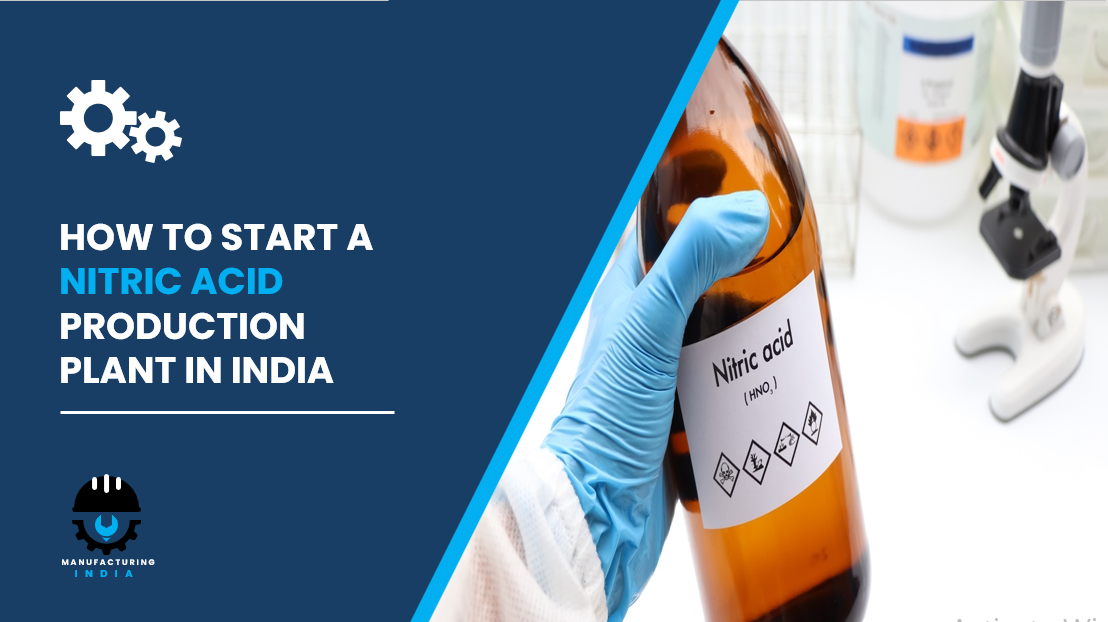
Setting up a nitric acid production plant in India presents a compelling investment case as demand for this strategically vital inorganic acid continues to grow steadily across fertilizer manufacturing, explosives, chemical intermediates, metal processing, and specialty chemicals. Nitric acid is an essential chemical building block that multiple industries depend on and cannot easily replace, making it one of the most structurally stable commodity chemicals for long-term investment. India’s expanding agricultural sector, growing mining and infrastructure industries, and rapidly developing chemicals manufacturing base collectively create a highly favorable environment for establishing a commercially viable nitric acid production facility. India’s mining and quarrying sector recorded an Index of Mineral Production of 156.8 in March 2025, reflecting a 0.4% annual rise, further strengthening demand for nitric acid as a key input in mineral processing and metal extraction.
“The global nitric acid market was valued at USD 32.00 Billion in 2025 and is projected to reach USD 42.80 Billion by 2034, exhibiting a CAGR of 3.3% — driven by strong and sustained demand from fertilizer manufacturers, mining operators, chemical producers, and metal processors who depend on nitric acid as a critical, non-substitutable industrial input.”
What is Nitric Acid?
Nitric acid is a highly corrosive inorganic acid that industrial facilities produce through the Ostwald process method. The compound exists as a colorless to pale yellow liquid that exhibits strong oxidizing properties. Nitric acid serves as an essential chemical building block that various industrial applications depend on for their operations. The primary use of this substance involves producing nitrogen-based fertilizers, which include ammonium nitrate and calcium ammonium nitrate. The manufacturing process for explosives, metal surface treatment, stainless steel pickling and etching, dye production, and pharmaceutical and specialty chemical production all utilize nitric acid.
The production of nitric acid needs controlled operational procedures because of its dangerous nature, which requires specialized equipment and strict adherence to safety and environmental regulations to maintain secure and compliant operations. Despite these operational complexities, the strategic importance of nitric acid across multiple industries — and the high barrier to substitution — make it one of the most defensible commodity chemical investments available to industrial manufacturers.
Cost of Setting Up a Nitric Acid Production Plant in India
The nitric acid production plant cost in India depends on several parameters including production capacity, technology used, plant location, level of automation, and regulatory compliance. Here is a structured breakdown of all major cost components:
- Capital Expenditure (CapEx)
The total capital investment in a nitric acid production plant typically covers the following:
Land and Site Development This includes land acquisition, boundary development, land registration charges, and basic site preparation. The location must offer easy access to key raw materials such as ammonia, air, and platinum-rhodium catalyst gauze. Sites within established chemical industrial estates in Gujarat, Maharashtra, or Andhra Pradesh are strategically preferred due to proximity to ammonia supply, existing chemical infrastructure, and regulatory frameworks for hazardous chemical manufacturing.
Civil Works and Construction Building costs cover the main production complex including the ammonia oxidation reactor building, absorption tower structure, acid storage tank farm, heat exchanger area, utilities block, quality control laboratory, emission control systems, administrative block, and worker amenities. Construction specifications for a hazardous chemical plant must meet stringent safety and environmental compliance standards.
Machinery and Equipment This is the single largest component of CapEx. Essential machinery required for a nitric acid production plant includes:
- Ammonia Converters (Catalytic Oxidation Reactors with Platinum-Rhodium Gauze)
- Absorption Towers
- Heat Exchangers
- Compressors (Air and Gas Compression Systems)
- Storage Tanks (Acid-resistant stainless steel or glass-lined)
- Emission Control Systems (EnviNOx or equivalent NOx abatement units)
- Cooling Systems
- Instrumentation and Process Control Systems
- Safety and Leak Detection Equipment
Other Capital Costs These include pre-operative expenses, commissioning charges, import duties (if equipment is sourced internationally), utilities installation, fire safety systems, hazardous chemical handling infrastructure, and Effluent Treatment Plant (ETP) setup.
Request a Sample Report for In-Depth Market Insights: https://www.imarcgroup.com/nitric-acid-manufacturing-plant-project-report/requestsample
- Operational Expenditure (OpEx)
Once the plant is commissioned, the ongoing cost structure is dominated by a few key components:
Raw Material Cost (Ammonia): 75–80% of Total OpEx Ammonia is the primary raw material and accounts for the overwhelming majority of operating expenses. Additional inputs include air (for oxidation), platinum-rhodium catalyst gauze (periodic replacement), process water, and chemicals for emission control systems.
Utility Cost: 15–20% of Total OpEx Utilities include electricity (for compressors, instrumentation, and auxiliary systems), steam (for process heating), cooling water, and instrument air. The Ostwald process involves significant heat integration opportunities, and well-designed plants can recover substantial energy from the exothermic reactions to reduce net utility costs.
Other Operating Costs The remaining budget covers transportation, packaging (acid-resistant drums and tankers), salaries and wages, catalyst replacement costs, maintenance, depreciation, taxes, and miscellaneous overhead.
- Plant Capacity
The proposed production facility is designed with an annual production capacity of approximately 300,000 MT, enabling economies of scale while maintaining operational flexibility to serve multiple end-use segments including fertilizer manufacturers, explosives producers, chemical intermediates industry, pharmaceuticals, and metal processing operations.
The fertilizer and chemical companies typically sign bulk contracts which ensure consistent revenue streams for producers. The established production methods of the Ostwald process enable manufacturers to increase production capacity and enhance operational performance through proven engineering scale-up pathways, making capacity expansion a relatively predictable investment.
- Profit Margins and Financial Projections
- Gross Profit Margin: 15–25%
- Net Profit Margin: 8–12%
- Break-Even Period: Depends on production scale, capacity utilization, ammonia feedstock cost management, long-term offtake contract terms with fertilizer and chemical customers, and efficiency of heat recovery from the Ostwald process.
Financial projections must account for capital investment, operating costs, capacity utilization rates, pricing trends, and demand outlook. A thorough analysis should also include sensitivity analysis, Net Present Value (NPV), Internal Rate of Return (IRR), and Payback Period.
Why Set Up a Nitric Acid Production Plant in India?
India presents a uniquely favorable environment for establishing a nitric acid production plant:
Strong Fertilizer Demand
The agricultural production increase creates continual demand for fertilizers which contain nitric acid. India’s massive and growing agricultural sector, government subsidies for fertilizer production, and the strategic priority placed on food security and crop yield improvement all ensure sustained domestic demand for nitric acid as the key feedstock for ammonium nitrate and calcium ammonium nitrate fertilizers.
Industrial Growth Driving Stable Demand
The industrial sectors of mining, construction, and chemical manufacturing achieve stable production rates that generate consistent nitric acid consumption. India’s mining and quarrying sector recorded an Index of Mineral Production of 156.8 in March 2025, reflecting continued growth in iron ore, manganese ore, and zinc concentrate output — all of which strengthen demand for nitric acid as a key input in mineral processing and metal extraction.
Strategic Chemical Importance
Multiple industries depend on nitric acid as an essential chemical that they cannot easily replace. This non-substitutability across fertilizers, explosives, metal pickling, chemical synthesis, and pharmaceutical manufacturing creates a structurally stable demand base that is resilient to economic cycles and technology substitution — a rare characteristic in the commodity chemicals sector.
Scalable Production Technology
The established Ostwald process production methods enable manufacturers to increase production capacity and enhance operational performance through proven engineering pathways. Advanced emission control technologies such as thyssenKrupp Uhde’s EnviNOx system — as deployed in the 600 MTPD plant commissioned for Gujarat Narmada Valley Fertilizers & Chemicals Ltd. in Bharuch, Gujarat (March 2025) — are making Indian nitric acid plants cleaner and more competitive.
Long-term Offtake Potential
Fertilizer and chemical companies sign bulk contracts which ensure consistent revenue for nitric acid producers. Long-term supply agreements with fertilizer manufacturers, explosives producers, and chemical intermediates companies provide revenue visibility and reduce commercial risk, making nitric acid production a highly bankable investment with predictable cash flow generation.
Manufacturing Process Overview
The nitric acid production process involves the following key unit operations via the Ostwald process:
- Ammonia Oxidation — ammonia gas is mixed with filtered air and passed over a platinum-rhodium catalyst gauze at high temperature (800–900°C), oxidizing ammonia to nitric oxide (NO) in a highly exothermic reaction; the heat generated is recovered through waste heat boilers to generate steam for process use
- Nitrogen Oxide Cooling — the hot reaction gases containing nitric oxide (NO) are cooled through a series of heat exchangers, recovering energy and preparing the gas stream for oxidation to nitrogen dioxide (NO₂) in the subsequent stage
- Oxidation of NO to NO₂ — the cooled nitric oxide is further oxidized to nitrogen dioxide (NO₂) by combining with excess oxygen from the air; this oxidation is promoted by cooling the gas stream and allowing sufficient residence time in the absorption system
- Nitrogen Oxide Absorption — nitrogen dioxide (NO₂) is absorbed into water in a series of absorption towers to produce dilute nitric acid (HNO₃) of approximately 55–65% concentration; countercurrent flow of water and gas ensures efficient absorption
- Nitric Acid Concentration — dilute nitric acid is concentrated to the required product grade (typically 60–68% weak acid or 98–99% concentrated acid) through distillation with a dehydrating agent such as sulfuric acid or magnesium nitrate, depending on the product specification required
- Emission Control (NOx Abatement) — tail gases from the absorption towers containing residual nitrogen oxides are treated through catalytic reduction (using systems such as EnviNOx) to destroy NOx and N₂O before atmospheric discharge, ensuring compliance with environmental emission standards
- Cooling and Storage — finished nitric acid is cooled and transferred to acid-resistant stainless steel storage tanks; strict temperature and containment protocols are maintained given the corrosive and oxidizing nature of the product
- Controlled Dispatch — nitric acid is loaded into acid-resistant tankers or drums for dispatch to customers under controlled conditions with appropriate safety documentation, hazard labeling, and transport compliance requirements
Key Applications of Nitric Acid
Nitric acid serves a wide variety of critical end-use industries and applications:
- Fertilizer Industry: Nitric acid is extensively used for producing ammonium nitrate and calcium ammonium nitrate fertilizers that support high-yield agricultural practices — the largest single application globally and the primary driver of nitric acid demand growth in emerging markets including India
- Explosives and Mining Sector: Functions as a fundamental component that industrial explosives manufacturers use to create explosives for mining, quarrying, and construction operations; rising infrastructure development and mining activity directly drives this demand segment
- Chemical Manufacturing: The chemical industry uses nitric acid as a chemical building block to create adipic acid (for nylon production), nitrobenzene, and different specialized chemicals used across plastics, synthetic fibers, and industrial chemical value chains
- Metal Processing Industry: Metal pickling, surface cleaning, and passivation processes use nitric acid to enhance both corrosion resistance and finish quality on stainless steel, aluminum, copper, and other non-ferrous metals processed in India’s growing manufacturing sector
- Pharmaceuticals and Specialty Chemicals: Used in the synthesis of pharmaceutical intermediates and specialty chemicals requiring nitration reactions; demand from India’s growing pharmaceutical manufacturing sector provides an additional high-value application channel
- Laboratory Reagents: High-purity nitric acid is used as an analytical reagent in laboratories, quality control facilities, and research institutions across India’s expanding industrial and academic research infrastructure
Global Market Outlook
The global nitric acid market was valued at USD 32.00 Billion in 2025 and is projected to reach USD 42.80 Billion by 2034, exhibiting a CAGR of 3.3% from 2026 to 2034. Emerging economies experiencing agricultural development drive nitrogen-based fertilizer use, resulting in increased nitric acid consumption. The demand for explosives is rising due to infrastructure development and mining operations, creating additional market growth. Environmental regulations now require manufacturers to implement advanced emission control technologies, which is resulting in production facility upgrades and investments in modern NOx abatement systems across established producers.
Leading global players in this industry include:
- BASF SE
- DuPont
- Nutrien Ltd.
- Omnia Holding Limited
- Apache Nitrogen Products Inc.
Timeline to Start a Nitric Acid Production Plant
Setting up a nitric acid production plant from ideation to commissioning typically requires 18 to 24 months given the complexity of hazardous chemical plant design and regulatory requirements. This covers:
- Feasibility study and detailed project report preparation
- Land acquisition and site development within a designated chemical industrial zone
- Regulatory approvals and environmental clearances
- Factory license and hazardous chemical handling compliance
- Machinery and equipment procurement, including catalyst sourcing
- Plant construction, installation, and commissioning
- Trial production runs, quality testing, and safety validation
- Commercial production launch and customer offtake activation
Licenses and Regulatory Requirements
Starting a nitric acid production unit in India requires several approvals, including:
- Business registration (Proprietorship, LLP, or Private Limited Company)
- Factory License under the Factories Act, 1948
- Environmental Clearance from the Ministry of Environment, Forest and Climate Change (MoEFCC)
- Consent to Establish and Consent to Operate from the State Pollution Control Board (SPCB)
- License under the Manufacture, Storage and Import of Hazardous Chemical Rules (MSIHC Rules)
- Explosives Act compliance (for facilities proximate to or supplying explosives manufacturers)
- GST Registration
- Fire Safety NOC from local fire authority
- BIS Certification for applicable chemical product standards
- MSME/Udyam Registration for government incentives and schemes
- Import Export Code (IEC) for businesses targeting export markets
Key Challenges to Consider
Before investing, entrepreneurs should be aware of the common challenges in this business:
- High Capital Requirements: Initial CapEx for ammonia converters, absorption towers, heat exchangers, compressors, acid-resistant storage tanks, and NOx emission control systems is significant. The specialized nature of nitric acid plant equipment and the need for hazardous chemical compliance add to the total investment requirement compared with less hazardous chemical manufacturing.
- Ammonia Feedstock Price Volatility: Ammonia accounts for 75–80% of operating expenses, making nitric acid production margins highly sensitive to ammonia price fluctuations. Ammonia prices are linked to natural gas markets and can be significantly volatile, requiring effective procurement strategies, long-term supply contracts, and consideration of backward integration into ammonia production.
- Stringent Safety and Environmental Compliance: Nitric acid production involves highly corrosive and oxidizing chemicals, high-temperature catalytic reactions, and generation of nitrogen oxide (NOx) emissions. Meeting SPCB emission standards, MSIHC Rules compliance, and workplace safety requirements demands continuous investment in monitoring systems, safety training, emergency response infrastructure, and NOx abatement technology.
- Regulatory Complexity: The hazardous nature of both the raw materials (ammonia) and the product (nitric acid) subjects the facility to multiple layers of central and state regulatory oversight, including environmental, industrial safety, explosives, and chemical hazard regulations, which require dedicated legal and compliance resources to manage continuously.
- Skilled Manpower: Operating ammonia converters, absorption towers, compressors, and emission control systems requires highly trained chemical engineers and process technicians with specific experience in hazardous inorganic acid manufacturing. Attracting and retaining qualified personnel with the required safety certifications is an ongoing operational challenge.
Frequently Asked Questions
The following questions are answered in the report:
- How has the nitric acid market performed so far and how will it perform in the coming years?
- What is the market segmentation of the global nitric acid market?
- What is the regional breakup of the global nitric acid market?
- What are the price trends of various feedstocks in the nitric acid industry?
- What is the structure of the nitric acid industry and who are the key players?
- What are the various unit operations involved in a nitric acid production plant?
- What is the total size of land required for setting up a nitric acid production plant?
- What is the layout of a nitric acid production plant?
- What are the machinery requirements for setting up a nitric acid production plant?
- What are the raw material requirements for setting up a nitric acid production plant?
- What are the packaging requirements for setting up a nitric acid production plant?
- What are the transportation requirements for setting up a nitric acid production plant?
- What are the utility requirements for setting up a nitric acid production plant?
- What are the human resource requirements for setting up a nitric acid production plant?
- What are the capital costs for setting up a nitric acid production plant?
- What are the operating costs for setting up a nitric acid production plant?
- What should be the pricing mechanism of the final product?
- What will be the income and expenditures for a nitric acid production plant?
- What is the time required to break even?
- What are the profit projections for setting up a nitric acid production plant?
- What are the key success and risk factors in the nitric acid industry?
- What are the key regulatory procedures and requirements for setting up a nitric acid production plant?
- What are the key certifications required for setting up a nitric acid production plant?
Key Takeaways for Investors
The nitric acid production industry in India represents a strategically sound and financially viable investment opportunity backed by strong and structurally stable demand from fertilizer manufacturers, explosives producers, chemical intermediates companies, and metal processors. With the global market projected to grow from USD 32.00 Billion in 2025 to USD 42.80 Billion by 2034 at a CAGR of 3.3%, and with gross profit margins of 15–25% and net margins of 8–12%, a well-planned nitric acid production plant in India offers reliable and defensible returns driven by long-term bulk offtake contracts. India’s own investment momentum is clear: Deepak Chem Tech commissioned its INR 515 crore nitric acid plant in Nandesari, Gujarat (December 2025), and thyssenKrupp Uhde secured a contract for a 600 MTPD nitric acid facility for GNFC in Bharuch, Gujarat (March 2025). Investors who establish technically capable, safety-certified production facilities with strong ammonia procurement strategies and long-term customer supply agreements are well-positioned to generate consistent returns as India’s agricultural, mining, and chemicals industries continue their robust growth.
About the Author