
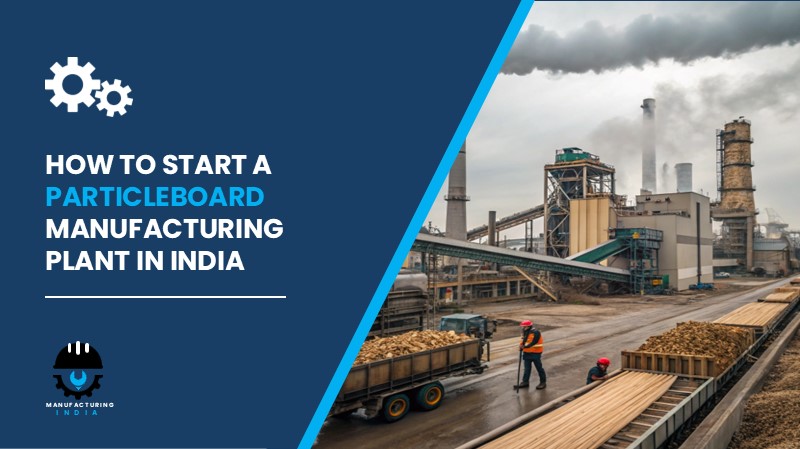
Setting up a particleboard manufacturing plant in India presents a compelling investment case as the country rapidly emerges as one of the most cost-competitive and high-demand destinations for engineered wood panel manufacturing. Driven by booming demand from the furniture manufacturing industry, residential and commercial construction sector, interior design and fit-out industry, and the ready-to-assemble furniture segment, particleboard has become an indispensable material in India’s rapidly expanding housing, real estate, and organised furniture economy.
“With over 1.4 billion consumers, a middle class projected to expand from 300–400 million to nearly 600 million by 2030, rapidly urbanising population, and Make in India policy support, India offers one of the most financially attractive environments for particleboard manufacturing — with gross margins of 30–40% and a break-even window of 3–5 years.”
What is Particleboard?
Particleboard is an engineered wood product manufactured by compressing wood particles such as sawdust, wood chips, and shavings with synthetic resin adhesives under heat and pressure. It is characterised by uniform density, smooth surface finish, and dimensional stability, making it highly suitable for laminating and veneering applications. Particleboard offers significant cost advantages over solid wood and plywood while utilising wood waste and by-products from sawmills, contributing to resource efficiency and sustainable forest management. It is available in various grades, including standard, moisture-resistant, and fire-retardant variants, catering to diverse performance requirements. Particleboard is widely used in furniture, cabinetry, flooring underlayment, and interior construction due to its affordability, machinability, and compatibility with a wide range of surface finishes and edge treatments.
Cost of Setting Up a Particleboard Manufacturing Plant in India
The particleboard manufacturing plant cost in India depends on several parameters including production capacity, technology used, plant location, level of automation, raw material sourcing strategy, and regulatory compliance requirements. Here is a structured breakdown of all major cost components:
1. Capital Expenditure (CapEx)
The total capital investment in a particleboard manufacturing plant typically covers the following:
Land and Site Development
This includes land acquisition, boundary development, land registration charges, and basic site preparation. Cost varies significantly depending on whether the land is in an industrial estate, Special Economic Zone (SEZ), or a privately purchased plot. Proximity to sawmill clusters and timber processing zones — such as those in Andhra Pradesh, Telangana, Uttarakhand, and Punjab — ensures a reliable and cost-effective supply of wood chips, sawdust, and shavings, while proximity to furniture manufacturing hubs reduces finished goods logistics costs.
Civil Works and Construction
Building costs cover the main pressing and panel production shed, wood chip and raw material storage yard, resin blending and dosing area, quality control laboratory, finished panel storage and dispatch area, administrative block, and worker amenities. Construction specifications depend on plant scale, heavy press foundation requirements, fire safety infrastructure for wood dust environments, and local regulatory compliance norms.
Machinery and Equipment
This is the single largest component of CapEx. Key machinery required for a particleboard manufacturing plant includes:
- Wood Chippers and Hammer Mills
- Rotary Drum Dryers
- Screening and Classification Systems
- Resin Blending and Glue Application Systems
- Wax Dosing Systems
- Mat-Forming Machines (Mechanical or Air-Forming)
- Pre-Press Units
- Continuous or Multi-Daylight Hot Presses
- Panel Cooling Systems
- Edge Trimming and Cross-Cutting Saws
- Wide-Belt Sanding Machines
- Surface Calibration Equipment
- Lamination and Foil Pressing Lines (for value-added grades)
- Automated Stacking and Material Handling Systems
- Dust Collection and Emission Control Systems
Machinery costs represent the largest share of overall capital expenditure, reflecting the high degree of engineering precision and automation involved in continuous particleboard panel production. Hot press systems, whether continuous or multi-daylight, represent the single largest machinery investment in a particleboard facility.
Other Capital Costs
These include pre-operative expenses, commissioning charges, import duties on specialised pressing and forming equipment sourced internationally, utilities installation, fire safety systems, dust explosion prevention infrastructure, and Effluent Treatment Plant (ETP) setup. Formaldehyde emission monitoring systems and continuous stack emission monitoring equipment also form part of the capital outlay for regulatory compliance.
2. Operational Expenditure (OpEx)
Once the plant is commissioned, the ongoing cost structure is dominated by a few key components:
Raw Material Cost (Wood Chips, Sawdust, Resin, and Wax): 65–75% of Total OpEx
Wood chips and sawdust are the primary raw materials and together account for the majority of operating expenses. Urea-formaldehyde (UF) resin and melamine-urea-formaldehyde (MUF) resin are the primary binders, while wax emulsion is used to improve moisture resistance. Securing long-term supply agreements with local sawmills, timber yards, and agricultural residue suppliers helps ensure consistent raw material availability and cost stability. The trend toward low-formaldehyde and eco-friendly resin formulations may add moderate cost premiums but opens premium product segment opportunities.
Utility Cost: 15–20% of Total OpEx
Utilities include electricity (consumed by rotary dryers, hot presses, sanding machines, and dust collection systems), thermal energy for drying operations, process water, and compressed air. Given the energy-intensive nature of drying and pressing operations, investments in biomass-fired energy systems — using wood dust and trim waste as fuel — can substantially reduce utility costs and improve overall plant energy economics.
Other Operating Costs
The remaining budget covers transportation and logistics, secondary packaging, salaries and wages for production operators and quality engineers, maintenance of pressing and sanding equipment, resin and wax procurement, depreciation, taxes, BIS certification audit costs, formaldehyde emission testing, and miscellaneous overhead.
3. Plant Capacity
The proposed manufacturing facility is designed with an annual production capacity ranging between 100,000 to 500,000 cubic metres. This range allows the plant to achieve economies of scale while maintaining flexibility to serve multiple end-use segments including modular furniture manufacturers, kitchen cabinet producers, residential construction developers, interior fit-out contractors, and ready-to-assemble furniture exporters. Smaller setups may start at lower capacity, but profitability and press utilisation improve significantly with higher throughput and longer continuous production runs.
4. Profit Margins and Financial Projections
- Gross Profit Margin: 30–40%, supported by stable demand from the furniture and construction sectors and growing modular furniture adoption
- Net Profit Margin: 15–25%, improving with higher capacity utilisation, energy self-sufficiency through biomass use, and premium product mix
- Break-Even Period: 3 to 5 years, depending on production scale, raw material procurement efficiency, product grade mix, and depth of customer relationships in the furniture and construction sectors
Financial projections must account for capital investment, operating costs, capacity utilisation rates, pricing trends, and demand outlook. A thorough analysis should also include sensitivity analysis, Net Present Value (NPV), Internal Rate of Return (IRR), and Payback Period.
Request a Sample Report for In-Depth Market Insights: https://www.imarcgroup.com/particleboard-manufacturing-plant-project-report/requestsample
Why Set Up a Particleboard Plant in India?
India presents a uniquely favourable environment for establishing a particleboard manufacturing plant:
Surging Domestic Demand from Furniture and Construction Sectors
India’s middle class, estimated at 300–400 million people in 2025 and projected to expand to nearly 600 million by 2030, is driving strong and sustained demand for modular furniture, kitchen systems, wardrobes, and office furniture — all of which are primary applications for particleboard. Rapid urbanisation and the growth of organised housing are creating large and recurring demand for cost-effective interior panel materials across both residential and commercial construction segments.
Policy and Regulatory Tailwinds
The Government of India’s focus on affordable housing under PM Awas Yojana, infrastructure expansion, growth of the organised furniture retail sector, and the Make in India initiative for wood-based panel industries creates a policy-supportive environment for domestic particleboard manufacturers. Growing environmental awareness is also driving preference for engineered wood products that utilise wood waste efficiently, aligning with India’s circular economy objectives.
Cost-Competitive Manufacturing
India offers competitive land costs, a large pool of trained machine operators and production supervisors, and access to a well-established wood residue supply chain from sawmills, plywood manufacturers, and timber processing units across several states. The availability of agricultural residues such as rice husk, sugarcane bagasse, and cotton stalk as supplementary raw materials further reduces input costs and supports year-round production continuity.
Export Opportunities
India-based manufacturers can tap into growing export demand from the Middle East, Southeast Asia, and Africa, where furniture manufacturing and construction activities are expanding rapidly and local engineered wood panel production capacity remains limited. India’s competitive manufacturing costs, established furniture export ecosystem, and improving port infrastructure support international market entry across standard and value-added particleboard grades.
Sustainability and Resource Efficiency Advantage
Particleboard production utilises sawmill residues and wood waste that would otherwise be discarded or burned, promoting sustainable resource management and circular economy practices. Manufacturers adopting low-formaldehyde resin systems, recycled wood fibre inputs, and biomass energy recovery are increasingly preferred by furniture brands and construction companies seeking to meet sustainability commitments and green building certification requirements.
Manufacturing Process Overview
The particleboard manufacturing process uses raw material sourcing, wood chipping, drying, blending with resin, mat forming, hot pressing, cooling and trimming, and sanding and finishing technologies. The complete process flow involves:
- Raw Material Procurement and Incoming Inspection — sourcing and quality verification of wood chips, sawdust, shavings, UF/MUF resin, wax emulsion, and other additives
- Wood Chipping and Size Reduction — processing of wood logs, offcuts, and residues through chippers and hammer mills to achieve the required particle size distribution
- Drying — reduction of wood particle moisture content to the target level using rotary drum dryers to ensure proper resin bonding during pressing
- Screening and Classification — separation of particles by size for core and surface layer differentiation to achieve desired board density and surface quality
- Resin and Wax Blending — uniform application of urea-formaldehyde resin and wax emulsion to wood particles in blending systems
- Mat Forming — layered deposition of resin-coated particles into a uniform mat using mechanical or air-forming mat-forming machines
- Pre-Pressing — initial compression of the mat to reduce thickness and improve handleability before the hot press
- Hot Pressing — consolidation of the mat under controlled temperature and pressure in hot presses to cure the resin and form the finished panel
- Panel Cooling — controlled cooling of pressed panels to relieve internal stresses and stabilise dimensions
- Edge Trimming and Cross-Cutting — precision sawing of panels to required dimensions
- Sanding and Surface Calibration — wide-belt sanding to achieve uniform thickness, smooth surface finish, and required surface quality
- Quality Inspection and Testing — density, internal bond, modulus of rupture, formaldehyde emission, and moisture content testing against BIS and customer specifications
- Lamination (Optional) — application of decorative paper foil, melamine laminate, or wood veneer for value-added product grades
- Stacking, Packaging, and Dispatch — automated stacking, protective wrapping, and palletising for safe storage and delivery to furniture and construction customers
Key Applications of Particleboard
Particleboard manufactured in India serves a wide variety of end-use industries and applications:
- Furniture Manufacturing: Modular kitchen systems, wardrobes, bedroom furniture, office desks, cabinets, and shelving units — the largest and most important end-use segment for particleboard in India
- Residential Construction: Interior paneling, subflooring underlayment, built-in storage units, partition walls, and false ceiling frameworks in housing and apartment projects
- Commercial Construction: Office partitions, retail store fixtures, hospitality fit-outs, and decorative paneling in commercial and institutional buildings
- Interior Design and Fit-Out: Cost-effective customised interior solutions, display units, reception counters, and decorative feature walls for residential and commercial projects
- Packaging: Protective packaging crates, pallets, and industrial packaging applications requiring rigid, flat panel construction
Global Market Outlook
The global particleboard market was valued at USD 24.60 Billion in 2025 and is projected to reach USD 32.20 Billion by 2034, growing at a CAGR of 3.0% from 2026 to 2034. This sustained growth is driven by rising demand for cost-effective engineered wood products in furniture manufacturing, expanding residential and commercial construction activities, growing urbanisation in emerging economies, and increasing preference for sustainable wood-based panel solutions that utilise wood residues efficiently.
Leading global players in the particleboard industry include:
- Kastamonu Entegre
- Roseburg Forest Products Co.
- Norbord Inc.
- Boise Cascade Company
- Columbia Forest Products, Inc.
- Uniboard Canada
- Century Plyboards (India) Ltd.
- Greenply Industries Limited
- Action Tesa
- Sonae Industria
Timeline to Start a Particleboard Plant
Setting up a particleboard manufacturing plant from ideation to commissioning typically requires 12 to 18 months. This covers:
- Feasibility study and detailed project report (DPR) preparation
- Land acquisition and site development
- Regulatory approvals and environmental clearances
- Factory licence and fire safety compliance
- Machinery procurement, installation, and press commissioning
- Raw material supply chain establishment and resin supplier qualification
- Trial production, board grade testing, and BIS certification
- Commercial production launch and customer supply commencement
Licenses and Regulatory Requirements
Starting a particleboard manufacturing unit in India requires several approvals, including:
- Business registration (Proprietorship, LLP, or Private Limited Company)
- Factory Licence under the Factories Act
- Environmental Clearance from the State Pollution Control Board
- Consent to Establish and Consent to Operate under the Water and Air (Prevention and Control of Pollution) Acts
- GST Registration
- Fire Safety NOC (particularly important given wood dust fire and explosion risks)
- BIS Certification under IS 12823 (Prelaminated Particle Board) and IS 3087 (Particle Board) for products supplied to furniture and construction markets
- Formaldehyde Emission Compliance certification for furniture-grade and interior-use boards (E0, E1, or E2 emission class)
- Pollution Control Board Stack Emission Monitoring for dryers and hot press operations
- Udyam Registration (for MSME benefits and government scheme eligibility)
Key Challenges to Consider
Before investing, entrepreneurs should be aware of the common challenges in this business:
- High Capital Requirements: Initial CapEx for hot presses, continuous forming lines, wide-belt sanding machines, and dust collection infrastructure is significant, particularly for mid to large-scale plants targeting furniture OEM and construction supply customers.
- Raw Material Availability and Quality Consistency: Securing a consistent supply of wood chips and sawdust of the right species mix, moisture content, and particle size requires active supply chain management across multiple sawmill and agricultural residue sources, especially in regions with seasonal availability variations.
- Formaldehyde Emission Regulations: Increasingly stringent domestic and export market requirements for low-formaldehyde emission products (E0 and E1 class) require investment in premium resin systems, emission monitoring equipment, and product certification, adding cost and compliance complexity.
- Energy Intensity: Rotary dryers and hot presses are major energy consumers. Managing energy costs through biomass fuel recovery from production waste and optimising press cycle times are critical to maintaining cost competitiveness.
- Competition from Established Players: The market includes large integrated wood panel manufacturers with captive raw material supply, established dealer networks, and brand recognition, requiring new entrants to compete on product quality, delivery responsiveness, or regional proximity to key customer clusters.
- Skilled Manpower: Operating hot presses, continuous forming lines, wide-belt sanders, and resin dosing systems requires trained production technicians and quality engineers, who are in growing demand across India’s expanding wood panel and engineered materials manufacturing sector.
Frequently Asked Questions
The following questions are answered in the report:
- How much does it cost to set up a particleboard manufacturing plant in India?
- Is particleboard manufacturing profitable in India in 2026?
- What machinery is required for a particleboard plant in India?
- What raw materials are required for particleboard production?
- What licences and approvals are required to start a particleboard plant in India?
- How long does it take to commission a particleboard manufacturing plant in India?
- What is the best state or location to set up a particleboard plant in India?
- What government incentives are available for particleboard manufacturers in India?
- What is the break-even period for a particleboard plant in India?
- What are the BIS and formaldehyde emission compliance requirements for particleboard manufacturing in India?
Key Takeaways for Investors
The particleboard manufacturing industry in India represents a strong and scalable investment opportunity backed by the country’s rapidly expanding middle class, booming modular furniture sector, accelerating residential construction, and supportive domestic manufacturing policies. With gross margins of 30–40%, a well-planned particleboard manufacturing plant cost in India remains competitive and financially viable across plant capacities. Investors who combine BIS-compliant product quality, efficient wood residue sourcing, biomass energy recovery, and strong relationships with furniture manufacturers and construction developers stand to benefit significantly from one of India’s fastest-growing segments of the engineered wood and building materials industry.
About the Author