Setting up a pistachios processing plant in India presents a compelling investment case grounded in the country’s rapidly expanding food processing, bakery and confectionery, and premium snack industries. As Indian consumers shift decisively away from highly processed, high-sugar snacks toward natural, protein-rich, and heart-healthy alternatives, pistachios have emerged as a preferred premium nut category across retail, gifting, and foodservice channels. The combination of rising disposable incomes, urbanisation-driven dietary change, and growing demand from industrial buyers in ice cream, bakery, and plant-based food segments creates a robust and multi-layered demand environment for this processing unit type.
India’s strategic strengths make the country a sound base for establishing a pistachios processing facility. Growing infrastructure in food processing zones across Maharashtra, Gujarat, Rajasthan, and Uttar Pradesh, combined with the government’s active push under the Make in India initiative and the Production-Linked Incentive (PLI) scheme for food processing, offers investors cost-competitive land, skilled labour, and regulatory support. India’s geographic position also enables access to both large domestic consumption markets and export corridors reaching the Middle East, Southeast Asia, and Europe — markets with demonstrated and rising appetite for premium pistachio products.
Investing in a pistachios processing plant in India offers access to a high-margin premium nut segment backed by a global market expanding at a 4.5% CAGR toward 1.74 million tons by 2034, strong policy support under Make in India, and gross profit margins typically ranging between 30–40%. With applications spanning snacking, bakery, confectionery, dairy, and functional foods, the investment delivers both domestic and export-oriented revenue pathways with a financially viable break-even trajectory.
What are Pistachios?
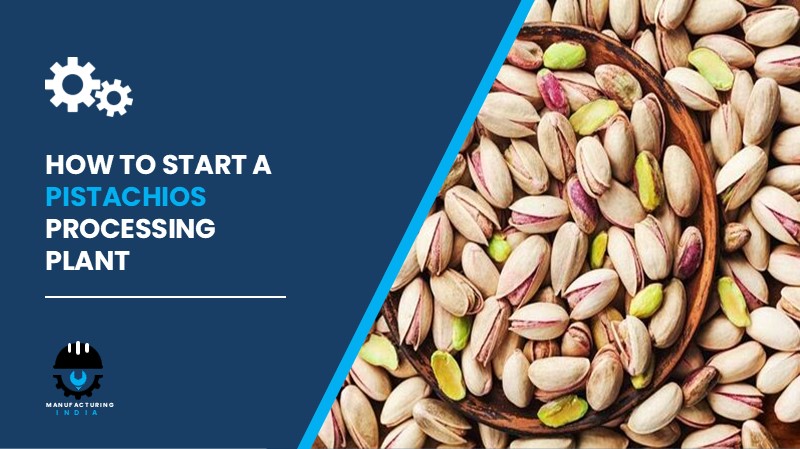
Pistachios are edible seeds obtained from the fruit of the pistachio tree, scientifically known as Pistacia vera. The nuts have a green kernel which the tree produces inside a beige shell that opens automatically when it reaches full development. Pistachios contain plant-based protein along with monounsaturated and polyunsaturated fats, dietary fibre, antioxidants, and vitamins including vitamin B6, as well as essential minerals such as potassium and phosphorus. They are favoured by health-conscious consumers worldwide for their superior nutritional profile, slightly sweet nutty taste, and bright visual appeal, making them suitable for snacking and for use in desserts, bakery products, ice creams, candies, and savoury recipes.
A pistachios processing plant is a value-added facility designed to clean, grade, shell, roast, season, and package raw pistachios into market-ready consumer and industrial products. The primary production process involves cleaning, grading, shelling, roasting, salting or flavouring, and packaging — a multi-step operation integrating material handling, quality control checkpoints, and food-grade hygiene standards throughout. The facility serves the food processing, bakery and confectionery, and snack industries, producing outputs including flavoured snack nuts, bakery fillings, confectionery ingredients, pistachio paste, chopped kernels, and powdered pistachios.
Cost of Setting Up a Pistachios Processing Plant in India
The total investment required to establish a pistachios processing plant in India depends on plant capacity, technology selection, geographic location, automation level, and compliance with food safety and environmental regulations. Investors evaluating the financial feasibility of this unit must plan for both one-time capital expenditure and recurring operational costs across a multi-year projection horizon.
1. Capital Expenditure (CapEx)
Land and Site Development constitutes a foundational and substantial part of the upfront investment. Costs associated with land registration, boundary development, internal road construction, drainage infrastructure, and site levelling vary based on whether the facility is established within a government-notified food processing industrial estate, a Special Economic Zone (SEZ), or on privately acquired land. Locations in food processing clusters across Maharashtra, Gujarat, and Punjab typically offer infrastructure-ready plots at competitive costs.
Civil Works and Construction encompasses the construction of the main processing shed, raw material receiving and storage area, quality control laboratory, roasting and seasoning production zone, finished goods warehouse, and the administrative block. Food-grade facility requirements — including pest-proof construction, food-safe flooring, and controlled-environment storage for raw and processed nuts — add to civil works expenditure.
Machinery and Equipment represent the largest single component of capital expenditure. Key machinery required includes:
- Cleaning and grading machines
- Shelling units
- Roasting ovens
- Seasoning drums
- Conveyors
- Automated packaging systems
Other Capital Costs include pre-operative expenses such as feasibility study preparation, regulatory filing fees, utility connection charges, effluent treatment plant (ETP) setup, plant commissioning, and import duties applicable to specialised food processing or automated packaging equipment sourced from overseas suppliers.
Request a Sample Report for In-Depth Market Insights: https://www.imarcgroup.com/pistachios-processing-plant-project-report/requestsample
2. Operational Expenditure (OpEx)
Raw Material Cost is the dominant driver of operating expenditure, accounting for approximately 75–85% of total OpEx. The primary inputs are raw pistachios, salt, roasting fuel, and packaging materials. Given that raw pistachio prices are subject to fluctuation driven by international commodity cycles, seasonal harvest variability, and foreign exchange movements, investors are strongly advised to secure long-term procurement contracts with reliable suppliers to stabilise input costs and ensure production continuity. Proximity to import entry ports or established dry fruit trading hubs helps reduce inbound logistics costs significantly.
Utility Costs — covering electricity for roasting ovens, conveyors, automated packaging systems, and facility lighting — account for approximately 5–10% of total OpEx. Water and steam requirements for cleaning and processing stages add further to utility expenses. Investors in regions with reliable industrial power supply and access to renewable energy options are better positioned to manage utility cost escalation over time.
Other Operating Costs include outbound transportation to retail, wholesale, and industrial buyers; packaging materials for consumer and bulk packs; employee salaries and wages; equipment maintenance; quality assurance testing; depreciation on machinery and civil assets; and applicable taxes. By the fifth year of operations, total operational costs are expected to increase substantially due to inflation, market fluctuations, and potential rises in the cost of key raw materials, compounded by supply chain disruptions and shifts in the global economy.
3. Plant Capacity
The proposed processing facility is designed with an annual processing capacity ranging between 5,000 and 20,000 MT, enabling economies of scale while maintaining operational flexibility. This capacity range allows investors to enter at a moderate scale and expand as demand grows and market relationships are established. Profitability improves consistently with higher capacity utilisation, making it financially sound to plan infrastructure with future scalability built into the plant layout from the outset.
4. Profit Margins and Financial Projections
The pistachios processing plant demonstrates healthy profitability potential under normal operating conditions. Gross profit margins typically range between 30–40%, supported by stable demand and value-added product applications. Net profit margins range between 15–25%, reflecting the premium positioning of processed pistachio products across retail and industrial channels. A comprehensive financial analysis for this investment should encompass income projections, expenditure forecasts, gross margin and net margin tracking across Years 1 through 5, net present value (NPV), internal rate of return (IRR), payback period, and a full profit and loss account. Sensitivity analysis and uncertainty analysis are also recommended to account for raw material price swings and demand variability.
Why Set Up a Pistachios Processing Plant in India?
Growing Health and Wellness Demand Driving Premium Nut Consumption. Indian consumers are shifting away from high-sugar and highly processed snacks toward natural, protein-rich options, making pistachios a preferred snack choice. The product’s profile — combining plant protein, heart-healthy fats, dietary fibre, and antioxidants — positions it well within the rapidly expanding health-conscious segment of India’s food retail market.
Expanding Applications in Bakery, Confectionery, and Dairy. Pistachio-based ingredients — including paste, chopped kernels, and powdered pistachios — are increasingly in demand from industrial buyers in bakery, confectionery, ice cream, and traditional sweets manufacturing. In January 2026, UK-based Magnum expanded its Signature ice cream range with premium pistachio offerings, with pistachio sales reported up 74% in 2025. Pillsbury Baking also launched a Moist Supreme Pistachio Cake Mix and Whipped Pistachio Frosting in January 2026, signalling strong manufacturer interest in pistachio-flavoured product innovation. Indian counterparts in these food segments represent a growing captive industrial buyer base for domestically processed pistachio ingredients.
Export-Oriented Revenue Opportunity. The worldwide trade potential for processed pistachios remains strong across North America, Europe, the Middle East, and Asia-Pacific. A processing facility in India, with access to competitive operating costs and established export infrastructure, is well-positioned to capture share in these markets, particularly for value-added outputs such as flavoured snack packs, roasted and salted pistachios, and premium gifting formats.
Alignment with Global Market Growth Trajectory. The global pistachios market was valued at 1.17 million tons in 2025 and is expected to reach 1.74 million tons by 2034, exhibiting a CAGR of 4.5% from 2026 to 2034. This sustained growth trajectory provides a long-term demand foundation for investors entering the processing segment.
Active Product Innovation and Industry Investment. In February 2026, Setton Farms launched Dark Chocolate Pistachios with Sea Salt, featuring premium California pistachios in a refined dark chocolate format — highlighting the ongoing premiumisation trend that is driving value-added pistachio product development globally. This innovation momentum signals continued consumer and industry appetite for differentiated pistachio formats, benefiting processing plants that can produce high-quality outputs at scale.
Cost-Competitive Manufacturing Environment. India offers investors competitive advantages across land acquisition, construction, labour, and utility costs compared to processing locations in the United States or Europe. Food processing industrial estates in states such as Gujarat, Maharashtra, and Rajasthan provide plug-and-play infrastructure, skilled food industry workforces, and favourable logistics access to both domestic markets and export ports — reducing total project cost and time-to-market.
Processing Process — Step by Step
The pistachios processing plant uses cleaning, grading, shelling, roasting, salting or flavouring, and packaging as the primary production method. Below are the main stages involved in the pistachios processing process flow:
- Raw Material Receipt and Inspection: Raw pistachios arrive at the facility and are weighed, sampled, and quality-inspected before entering the processing line, with checks on moisture content, shell condition, and contamination.
- Cleaning: Cleaning and grading machines remove foreign matter, dust, dirt, and undersized or damaged nuts from the raw pistachio batch using mechanical screens and air separation systems.
- Grading: Grading machines sort the cleaned pistachios by size and shell-split status, separating open-shell from closed-shell nuts to meet different product specifications and quality grades.
- Shelling: Shelling units mechanically crack and remove the outer shell from pistachios where kernel-only or chopped pistachio products are being produced, with minimal kernel damage maintained to preserve product value.
- Roasting: Roasting ovens apply controlled heat to the cleaned and graded pistachios to develop the characteristic roasted flavour, colour, and crunch that consumers and industrial buyers expect.
- Salting and Flavouring: Seasoning drums apply salt, flavour coatings, or other permitted seasonings to roasted pistachios, producing flavoured snack products including salted, spiced, or sweet variants for consumer and foodservice markets.
- Quality Assurance and Testing: Analytical testing and quality checks are conducted throughout the process, covering moisture content, flavour consistency, microbial safety, and compliance with applicable food safety standards.
- Packaging: Automated packaging systems fill and seal finished pistachios into consumer retail packs, bulk industrial packs, or premium gifting formats, followed by lot coding and traceability labelling for regulatory compliance.
- Dispatch to End-Use Industries: Finished products are dispatched to food processing companies, bakery and confectionery manufacturers, snack brands, retail distributors, and export buyers.
Key Applications
Processed pistachios serve a wide range of industries and end-use categories, each requiring specific product specifications and quality standards:
- Snacking: Used in roasted and salted pistachios and flavoured ready-to-eat snack packs for retail and impulse consumption channels.
- Bakery and Confectionery: Utilised in cakes, cookies, chocolates, nougat, and bakery fillings requiring consistent kernel size, flavour, and low moisture content.
- Dairy and Desserts: Employed in ice creams, milkshakes, traditional Indian sweets such as barfi and halwa, and premium desserts where pistachio’s colour and flavour add product differentiation.
- Food Ingredients: Used in pistachio paste, chopped kernels, and powdered pistachios for processed food manufacturers integrating pistachio as a functional or flavour ingredient.
Leading Pistachios Processors
The global pistachios processing industry is served by a number of established processors with large-scale production capacities and strong end-use sector presence across retail and industrial channels. Key players include:
- Horizon Growers
- Nichols Pistachio
- Keenan Farms
- Setton Pistachio of Terra Bella, Inc.
- Santa Barbara Pistachio Company
- Hellas Farms LLC
- Ready Roast Nut Company
Timeline to Start the Plant
Investors planning to establish a pistachios processing plant in India should anticipate the following project development phases:
- Feasibility study and project report preparation
- Land acquisition and site development
- Regulatory approvals and environmental clearances
- Factory licence and fire safety compliance
- Machinery procurement and installation
- Raw material supplier agreements and supply chain setup
- Trial production and quality testing
- Commercial production launch
Licences and Regulatory Requirements
Starting a pistachios processing unit in India requires several approvals:
- Business registration (Proprietorship, LLP, or Private Limited Company)
- Factory Licence under the Factories Act
- FSSAI (Food Safety and Standards Authority of India) licence for food processing and packaging
- Environmental Clearance from the State Pollution Control Board
- GST Registration
- Fire Safety NOC
- Effluent Treatment Plant (ETP) operational clearance
- Occupational Health and Safety compliance
- Food import permit compliance where raw pistachios are sourced through international trade channels
Key Challenges to Consider
High Capital Requirements. Establishing a food-grade pistachios processing plant involves significant upfront investment in cleaning, grading, shelling, roasting, and automated packaging equipment, which may present a funding challenge for smaller or first-time investors without access to institutional finance or government scheme support.
Raw Material Price Volatility. Raw pistachios, the primary input accounting for 75–85% of total operating expenditure, are subject to significant price fluctuations driven by international commodity cycles, currency movements, and seasonal harvest variability in key producing countries. Long-term procurement contracts and supplier diversification are essential risk mitigation strategies.
Regulatory Compliance. Food processing in India operates under stringent FSSAI standards, environmental regulations, and labelling norms. Maintaining compliance across hygiene, traceability, food safety, and export certification requirements demands dedicated quality assurance systems and ongoing documentation discipline.
Competition from Established Global Processors. The market includes well-established players such as Setton Pistachio of Terra Bella, Keenan Farms, and Ready Roast Nut Company with large-scale production infrastructure and strong buyer relationships. New entrants must differentiate through product quality, flavour innovation, or niche market focus to build competitive positioning.
Technology and Product Innovation Pressure. The rapid expansion of flavoured, organic, and premium gifting formats — as demonstrated by recent launches from Setton Farms and Pillsbury — means processing plants must invest in flexible seasoning and packaging capabilities to keep pace with product development trends and remain relevant to evolving buyer requirements.
Skilled Manpower. Operating food-grade processing equipment — including automated grading, roasting ovens, and packaging systems — requires trained technicians familiar with food safety protocols, standard operating procedures (SOPs), and quality management systems. Sourcing and retaining qualified personnel in this domain remains a challenge in many Indian industrial locations.
Frequently Asked Questions
1. How much does it cost to set up a pistachios processing plant in India?
The total cost depends on plant capacity, machinery selection, location, and automation level. CapEx covers land, civil construction, cleaning and grading machines, shelling units, roasting ovens, seasoning drums, conveyors, and automated packaging systems, along with pre-operative and regulatory costs.
2. Is pistachios processing profitable in India in 2026?
Yes. With gross profit margins typically ranging between 30–40% and net margins of 15–25%, supported by growing demand across snacking, bakery, dairy, and confectionery sectors, the investment presents strong profitability potential.
3. What machinery is required for a pistachios processing plant in India?
Key equipment includes cleaning and grading machines, shelling units, roasting ovens, seasoning drums, conveyors, and automated packaging systems.
4. What licences and approvals are required to start a pistachios processing plant in India?
Required approvals include business registration, FSSAI licence, Factory Licence, Environmental Clearance, GST Registration, Fire Safety NOC, ETP operational clearance, and Occupational Health and Safety compliance.
5. What raw materials are needed for pistachios processing?
The primary raw materials are raw pistachios, salt, roasting fuel, and packaging materials.
6. What are the environmental compliance requirements for a pistachios processing plant in India?
An operational effluent treatment plant is required, along with Environmental Clearance from the State Pollution Control Board and compliance with food processing waste management and emission norms applicable under the state’s environmental framework.
7. What is the best location to set up a pistachios processing plant in India?
States with established food processing infrastructure and proximity to dry fruit import hubs — such as Maharashtra, Gujarat, Rajasthan, and Delhi NCR — offer the best combination of raw material access, logistics connectivity, and industrial support for this type of facility.
8. What is the break-even period for this type of plant in India?
The break-even period depends on plant scale, capacity utilisation, and product pricing strategy. A full payback period analysis using NPV and IRR metrics is recommended and is covered in detail in the IMARC Group pistachios processing plant project report.
9. What government incentives are available for manufacturers in India?
The Make in India initiative, PLI scheme for food processing, Ministry of Food Processing Industries (MoFPI) grants and subsidies, and state-level industrial incentive schemes in Gujarat and Maharashtra offer financial, infrastructure, and regulatory support for eligible food processing investors.
Key Takeaways for Investors
A pistachios processing plant in India represents a high-margin, strategically positioned investment opportunity driven by strong demand across snacking, bakery and confectionery, dairy, and functional food segments, alongside a growing export market across the Middle East, Europe, and Asia-Pacific. Financial viability is demonstrated across a plant capacity range of 5,000 to 20,000 MT per annum, with gross margins of 30–40% and net margins of 15–25% achievable under normal operating conditions. The global pistachios market, valued at 1.17 million tons in 2025, is projected to reach 1.74 million tons by 2034 at a CAGR of 4.5%, providing a durable and expanding demand base for investors entering the processing segment today. With pistachio-based product innovation accelerating across ice cream, baking, confectionery, and premium snacking categories globally, long-term demand sustainability for this processing plant type is firmly supported by converging consumer, industrial, and export trends.
About the Author