Setting up a polyester fabric manufacturing plant in India presents a compelling investment case backed by the country’s position at the heart of the global textile value chain, rising domestic demand, and the cost efficiency, durability, and recyclability advantages that make polyester the most widely used textile material in the world. India’s apparel and fashion sector, home textiles industry, automotive manufacturers, and industrial textile buyers collectively generate consistent, diversified demand for polyester fabric — a material valued for its high tensile strength, wrinkle resistance, dimensional stability, abrasion resistance, and compatibility with cotton-polyester blends. As fast-fashion growth accelerates across Asia-Pacific and global brands shift toward recycled polyester to meet sustainability commitments, the case for domestic production has never been stronger.
India’s advantages as a base for this investment are both structural and strategic. The country is home to established petrochemical corridors that supply PTA and MEG — the primary feedstocks for polyester production — reducing input logistics costs significantly. Textile manufacturing clusters in Gujarat, Maharashtra, and Tamil Nadu offer access to skilled spinning and weaving workforces, industrial utility infrastructure, and proximity to export-oriented apparel hubs. With the Make in India initiative channelling policy support toward domestic textile production and the global polyester fabric market valued at USD 119.46 Billion in 2025 and projected to reach USD 246.87 Billion by 2034 at a CAGR of 8.4%, India’s window of opportunity to expand polyester fabric capacity is both timely and commercially well-grounded.
India’s polyester fabric manufacturing investment is underpinned by robust policy support, abundant feedstock availability, and surging demand from apparel, automotive, and industrial textile sectors. Gross margins of 20–30% and net margins of 8–12%, combined with a market growing at 8.4% CAGR through 2034, make this production unit a financially viable and strategically sound long-term investment.
What is Polyester Fabric?
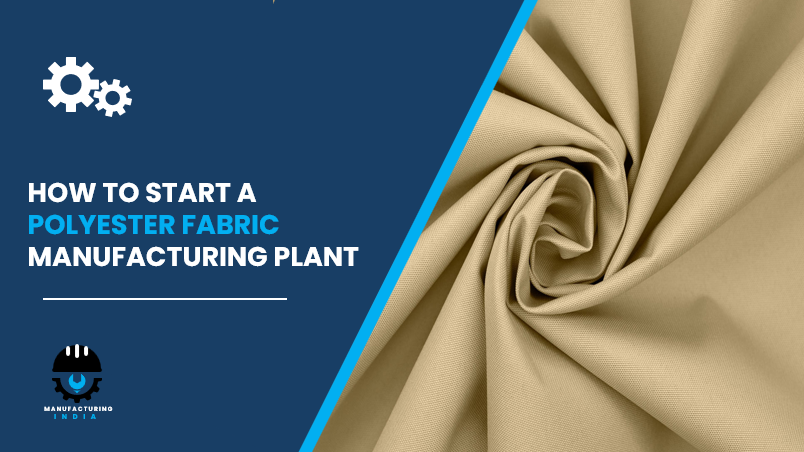
Polyester fabric is a synthetic textile material primarily produced from PET (polyethylene terephthalate) through a chemical reaction called polymerisation. The resulting fabric is highly characterised by high tensile strength, wrinkle resistance, dimensional stability, abrasion resistance, and low moisture absorption. It is valued for its excellent durability, colour retention, and resistance to both shrinkage and stretching — properties that make it highly suitable for both apparel and technical textile applications. The compatibility of polyester fabric with blends such as cotton-polyester further enhances performance versatility across consumer and industrial end uses.
The production method follows a multi-stage sequence: polymerisation of PET, melt spinning and fibre extrusion, drawing and texturising, yarn winding, weaving or knitting, dyeing, finishing, and inspection. End-use industries served include apparel and fashion, home textiles, automotive, industrial and technical textiles, and packaging and furnishings. Product applications span garments, upholstery, curtains, seat covers and airbags, industrial belts and geotextiles, and decorative and functional fabrics across consumer and industrial segments.
Cost of Setting Up a Polyester Fabric Manufacturing Plant in India
The total cost of establishing a polyester fabric manufacturing plant in India depends on production capacity, technology selection, geographic location, degree of automation, and regulatory compliance requirements. Investors must plan comprehensively across both capital expenditure (CapEx) and operational expenditure (OpEx) to develop an accurate financial model for this unit.
1. Capital Expenditure (CapEx)
Land and site development costs form a substantial part of the overall capital investment, covering land registration, boundary development, drainage, and related site preparatory works. Positioning the facility within a Special Economic Zone (SEZ) or a state-designated industrial estate – particularly in established textile corridors – can reduce land acquisition costs and deliver duty and tax advantages during the ramp-up phase. Civil works and construction costs cover the main spinning and weaving shed, raw material storage for PTA, MEG, and chips, quality control laboratory, dyeing and finishing hall, finished goods warehouse, and administrative block.
Machinery and equipment represent the single largest component of capital expenditure for this production unit. Key machinery required includes:
- Polymerisation reactors
- Melt spinning machines
- Draw texturising machines
- Weaving and knitting looms
- Dyeing and finishing equipment
- Inspection and winding systems
Other capital costs include effluent treatment plant (ETP) setup — essential for managing dyeing effluents — pre-operative and project development expenses, commissioning charges, and import duties applicable to specialised spinning or texturising machinery not manufactured domestically.
Request a Sample Report for In-Depth Market Insights: https://www.imarcgroup.com/polyester-fabric-manufacturing-plant-project-report/requestsample
2. Operational Expenditure (OpEx)
Raw material cost is the dominant driver of operational expenditure for this production unit. PTA (purified terephthalic acid), MEG (monoethylene glycol), and polyester chips — the core feedstocks — account for approximately 70–80% of total OpEx. Securing long-term supply contracts with reliable PTA and MEG producers, several of whom are located within India’s petrochemical clusters, is essential for stabilising input costs and maintaining consistent production quality. Utility costs, covering electricity for spinning and weaving equipment, water and steam for dyeing and finishing processes, account for a further 10–15% of OpEx.
Other ongoing operational costs include transportation and logistics for inbound feedstocks and outbound finished fabric rolls, packaging materials for dispatch to apparel manufacturers and industrial buyers, salaries and wages for skilled machine operators and textile engineers, routine maintenance of spinning, weaving, and dyeing equipment, depreciation on civil and mechanical assets, and applicable taxes and levies. By the fifth year of operations, total operational cost is expected to increase substantially, driven by inflation, market fluctuations, rising feedstock costs, supply chain disruptions, and shifts in the global economy.
3. Plant Capacity
The proposed manufacturing facility as referenced on the source page is designed with an annual production capacity ranging between 20,000 and 40,000 metric tonnes (MT) of fabric, enabling economies of scale while maintaining operational flexibility. Capacity can be customised per investor requirements depending on available capital, target end markets, and raw material sourcing strategy. Profitability improves meaningfully with higher capacity utilisation, as the fixed costs of polymerisation reactors, spinning lines, and weaving infrastructure are distributed across a larger volume of finished fabric output.
4. Profit Margins and Financial Projections
The polyester fabric manufacturing plant demonstrates healthy profitability under normal operating conditions. Gross profit margins typically range between 20–30%, supported by stable demand and value-added applications across apparel, automotive, and industrial textile segments. Net profit margins average 8–12% over a five-year projection horizon. A comprehensive financial model should incorporate NPV (Net Present Value), IRR (Internal Rate of Return), payback period analysis, gross and net margin tracking by operating year, and sensitivity analysis around PTA and MEG commodity pricing cycles. This level of financial planning is essential for securing term loans, working capital facilities, or institutional equity participation for the facility.
Why Set Up a Polyester Fabric Manufacturing Plant in India?
High and Diversified Demand Across Industries. Polyester fabric is consumed at significant scale by apparel, automotive, and industrial sectors, ensuring consistent and diversified demand for domestic manufacturers. India’s growing middle class is accelerating apparel consumption, while the automotive sector’s expansion drives demand for seat fabrics, headliners, safety belts, and interior trims. Industrial buyers across conveyor belt, filter fabric, geotextile, and protective clothing segments further broaden the customer base.
Fast-Fashion and Apparel Growth Across Asia-Pacific. Increasing growth in the apparel and fast-fashion sectors, particularly across developing regions such as Asia-Pacific, remains a primary growth driver due to polyester’s cost efficiency and scalability. India’s own domestic apparel industry — served by a large and growing working-age population — is a natural off-take partner for a domestic polyester fabric production unit, reducing export dependency and logistics costs for fabric buyers.
Automotive and Infrastructure Investment Driving Technical Textile Demand. Rising automotive production and infrastructure investments are accelerating demand for polyester-based technical textiles such as airbags, seat fabrics, and geotextiles. India’s expanding road and civil infrastructure pipeline is a particularly strong driver for geotextile applications, where polyester fabric is preferred for its mechanical stability and dimensional consistency under load-bearing conditions.
Sustainability and Recycled Polyester Creating New Demand Streams. Global brands are increasingly shifting toward recycled polyester, and the growing adoption of recycled polyester (rPET) currently represents 15% of all polyester fibres globally. This sustainability-driven transition is directly strengthening the polyester fabric market by aligning production with circular economy goals while preserving the performance and cost advantages that make polyester the dominant synthetic textile. Indian manufacturers investing in rPET-compatible production infrastructure are well positioned to serve this fast-growing segment.
Active Industry Investment Confirming Sector Momentum. In November 2025, Syre announced a multi-year agreement with NIKE, Inc., marking a milestone toward a circular materials future for the global apparel industry, with Syre positioned as Nike’s lead strategic supplier for textile-to-textile recycled polyester. In May 2025, Teijin Frontier Co., Ltd. developed a new high-performance polyester fabric replicating the appearance and texture of natural fibres while offering advanced comfort and functionality — validating continued innovation investment in the sector.
Export-Oriented Opportunities Through Global Textile Trade. Global textile trade enables manufacturers to serve international apparel and technical textile markets beyond India’s domestic consumption. India’s established export relationships with apparel brands in Europe, the United States, and Southeast Asia — combined with its duty advantages under trade agreements — position a well-run polyester fabric production unit for meaningful export revenue alongside domestic sales.
Manufacturing Process Step by Step
The polyester fabric manufacturing process uses polymerisation of PET as the foundation of the primary production method, followed by a multi-stage fibre, yarn, and fabric conversion sequence.
- Polymerisation of PET: PTA and MEG are reacted in polymerisation reactors under controlled heat and pressure to produce PET polymer in chip or melt form — the foundational material for all downstream processing.
- Melt Spinning and Fibre Extrusion: PET chips are melted and extruded through spinnerets using melt spinning machines to produce continuous polyester filament fibres of defined denier and cross-section.
- Drawing and Texturising: Extruded fibres are mechanically drawn using draw texturising machines to orient the polymer chains, improving tensile strength, elongation, and surface texture. Texturising imparts bulk and soft-hand characteristics required for apparel end uses.
- Yarn Winding: Drawn and texturised yarns are wound onto bobbins or packages using winding systems, in preparation for weaving or knitting operations.
- Weaving or Knitting: Wound yarns are interlaced on weaving looms or knitting machines to produce the base fabric structure. Weave or knit pattern selection determines fabric weight, porosity, and mechanical properties for specific end-use applications.
- Dyeing: Greige fabric is dyed using dyeing equipment to achieve specified colour, fastness, and uniformity. Dye formulations, temperatures, and fixation times are controlled to meet buyer quality standards.
- Finishing: Dyed fabric undergoes finishing treatments to impart final performance properties including wrinkle resistance, dimensional stability, softness, or flame retardancy depending on the target application.
- Inspection and Packaging: Finished fabric is inspected on inspection and winding systems for defects, width consistency, and weight per metre before being rolled, packaged, and dispatched to buyers in the apparel, home textiles, automotive, and industrial textile sectors.
Key Applications
A polyester fabric manufacturing plant serves a broad range of industries requiring cost-effective, durable, and performance-consistent textile materials. Key applications include:
- Apparel and Fashion: Shirts, trousers, sportswear, and outerwear leveraging wrinkle resistance, durability, and easy-care properties.
- Home Textiles: Bed linens, curtains, carpets, and upholstery benefiting from colour fastness and long service life.
- Automotive: Seat fabrics, headliners, safety belts, and interior trims requiring strength and abrasion resistance.
- Industrial and Technical Textiles: Conveyor belts, filter fabrics, geotextiles, and protective clothing where mechanical stability is critical.
- Packaging and Furnishings: Decorative and functional fabrics used in furniture upholstery, window coverings, and protective packaging applications.
Leading Manufacturers
The global polyester fabric industry is served by several multinational manufacturers with extensive production capacities and diverse end-market portfolios. Key players in the sector include:
- Reliance Industries Limited
- Sarla Performance Fibers Limited
- Märkische Faser GmbH
- Poly Fiber Industries
- Toray Industries Inc.
- Nirmal Fibers (P) Ltd
- Indorama Ventures Public Company Limited
- Stein Fibers LTD.
- Green Group S.A.
Timeline to Start the Plant
- Feasibility study and project report preparation
- Land acquisition and site development
- Regulatory approvals and environmental clearances
- Factory licence and fire safety compliance
- Machinery procurement and installation
- Raw material supplier agreements and supply chain setup
- Trial production and quality testing
- Commercial production launch
Licences and Regulatory Requirements
Starting a polyester fabric manufacturing unit in India requires several approvals:
- Business registration (Proprietorship, LLP, or Pvt Ltd)
- Factory Licence under the Factories Act
- Environmental Clearance from the State Pollution Control Board
- GST Registration
- Fire Safety NOC
- Hazardous and chemical compliance applicable to dyeing chemicals, PTA, and MEG handling
- Effluent Treatment Plant (ETP) operational clearance for dyeing and finishing effluents
- Occupational Health and Safety compliance
Key Challenges to Consider
High Capital Requirements. Establishing a fully integrated polyester fabric production unit with polymerisation reactors, melt spinning lines, draw texturising machines, weaving looms, and dyeing and finishing equipment demands significant upfront capital investment — a potential barrier for investors without access to institutional financing or government-backed textile credit schemes.
Raw Material Price Volatility. PTA and MEG — the primary feedstocks — account for 70–80% of OpEx and are directly linked to crude oil and petrochemical commodity cycles. Price fluctuations in these inputs can significantly compress margins if not managed through long-term supply contracts and hedging strategies.
Regulatory Compliance. Operating a polyester fabric unit with dyeing and finishing processes requires ongoing compliance with effluent treatment standards, chemical handling regulations, and environmental clearance conditions. The water and chemical intensity of dyeing operations makes ETP performance a continuous operational and regulatory priority.
Technology and Innovation Pressure. The development of new high-performance polyester fabrics — such as Teijin Frontier’s May 2025 innovation replicating natural fibre aesthetics — and the growth of rPET-based production streams mean manufacturers must plan for technology upgrades and process adaptation to remain competitive and meet evolving buyer specifications.
Competition from Established Players. The presence of large integrated manufacturers including Reliance Industries Limited, Indorama Ventures Public Company Limited, and Toray Industries Inc. means that new entrants must differentiate on product quality, customer service, delivery reliability, and sustainability credentials to win and maintain buyer relationships in apparel and industrial markets.
Skilled Manpower. Operating polymerisation reactors, melt spinning equipment, and precision weaving and dyeing lines requires trained chemical engineers, textile technologists, and machine operators — a skilled workforce that must be actively recruited, trained, and retained to maintain consistent fabric quality and production efficiency.
Frequently Asked Questions
1. How much does it cost to set up a polyester fabric manufacturing plant in India?
The total setup cost depends on production capacity, technology selection, location, and automation level. Capital investment covers land acquisition, civil construction, machinery including polymerisation reactors, spinning, texturising, weaving, dyeing, and finishing equipment, ETP setup, pre-operative expenses, and initial working capital. The IMARC project report provides a detailed CapEx breakdown for a facility producing 20,000–40,000 MT of fabric per year.
2. Is polyester fabric manufacturing profitable in India in 2026?
Yes. Gross profit margins of 20–30% and net margins of 8–12% demonstrate solid profitability for well-structured facilities. India’s growing apparel sector, automotive expansion, and infrastructure-driven demand for technical textiles support sustained revenue generation across buyer segments.
3. What machinery is required for a polyester fabric manufacturing plant in India?
Key equipment includes polymerisation reactors, melt spinning machines, draw texturising machines, weaving and knitting looms, dyeing and finishing equipment, and inspection and winding systems.
4. What licences and approvals are required to start a polyester fabric manufacturing plant in India?
Required approvals include business registration, a Factory Licence, Environmental Clearance from the State Pollution Control Board, GST Registration, a Fire Safety NOC, ETP operational clearance for dyeing effluents, chemical handling compliance for PTA and MEG, and Occupational Health and Safety certification.
5. What raw materials are needed for polyester fabric manufacturing?
The primary raw materials are PTA (purified terephthalic acid), MEG (monoethylene glycol), and polyester chips – the PET feedstocks from which polyester fibres and yarn are produced for downstream weaving and finishing.
6. What are the environmental compliance requirements for a polyester fabric manufacturing plant in India?
The facility must obtain Environmental Clearance from the State Pollution Control Board, operate a certified Effluent Treatment Plant to manage dyeing and finishing effluents, comply with chemical storage and handling regulations for PTA and MEG, and maintain air emission standards from the dyeing and finishing processes.
7. What is the best location to set up a polyester fabric manufacturing plant in India?
Textile manufacturing clusters in Gujarat, Maharashtra, and Tamil Nadu offer strong advantages including proximity to PTA and MEG feedstock suppliers, skilled spinning and weaving workforces, established export logistics infrastructure, and industrial estate options with reliable utilities and regulatory support.
8. What is the break-even period for this type of plant in India?
The break-even period depends on installed capacity, utilisation rates, fabric pricing, and the operating cost structure — particularly feedstock costs. A detailed payback period and NPV analysis, as included in the IMARC project report, provides project-specific projections based on realistic capacity ramp-up and demand assumptions.
9. What government incentives are available for manufacturers in India?
India’s Make in India initiative, PLI (Production Linked Incentive) schemes for textile manufacturing, the Technology Upgradation Fund Scheme (TUFS) for textile machinery investment, and state-level industrial investment incentives are among the policy frameworks available to polyester fabric manufacturers. Specific incentive structures should be confirmed with state textile departments and the Ministry of Textiles.
Key Takeaways for Investors
The polyester fabric manufacturing plant investment opportunity in India is supported by deep structural demand from apparel and fashion, home textiles, automotive, and industrial and technical textile sectors — all requiring cost-efficient, durable, and performance-consistent fabric at growing scale. The facility demonstrates financial viability across its target production range of 20,000 to 40,000 MT per year, with gross profit margins of 20–30% and net margins of 8–12% underpinning a sound return profile across the investment horizon. With the global polyester fabric market projected to grow from USD 119.46 Billion in 2025 to USD 246.87 Billion by 2034 at a CAGR of 8.4%, demand visibility is both long-term and globally reinforced. Investors who establish capacity in India now — particularly those integrating rPET processing capabilities aligned with the sustainability commitments of global apparel brands — are positioned to capture a growing share of a market whose structural growth drivers across fast fashion, automotive, and technical textiles remain robust and policy-supported across economic cycles.
About the Author