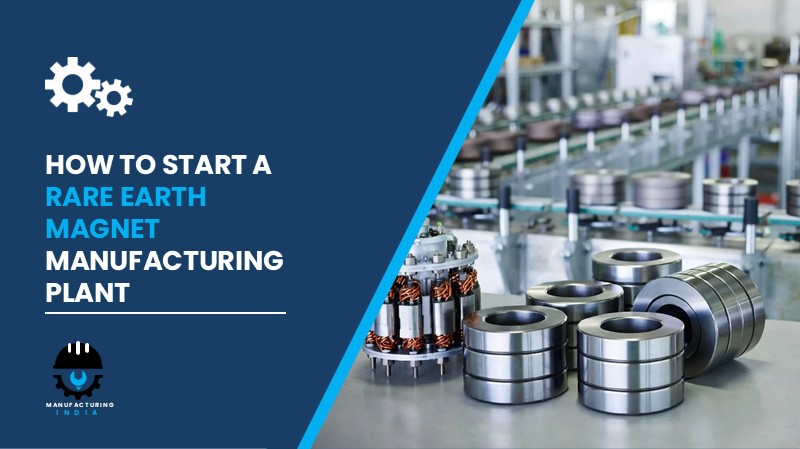
Setting up a rare earth magnet manufacturing plant in India presents one of the most strategically significant industrial opportunities of the decade, driven by surging domestic demand from the electric vehicle, renewable energy, and advanced electronics sectors. India’s policy ecosystem — anchored by the Make in India initiative — combined with a large and growing industrial base, positions the country as a compelling destination for investors seeking to establish high-performance magnet production at competitive costs.
India’s rapidly expanding electric vehicle market, government-backed renewable energy targets, and a booming electronics manufacturing sector are generating unprecedented demand for rare earth magnets domestically. With the Union Cabinet approving a dedicated scheme to promote sintered rare earth permanent magnet manufacturing of integrated production — the policy framework for domestic investors has never been more clearly defined or financially supported.
“With over billion consumers, Make in India policy tailwinds, cost-competitive manufacturing infrastructure, and a booming EV and renewable energy sector, India offers one of the most financially attractive environments for rare earth magnet manufacturing — with gross margins of 35–45% and a net profit potential of 15–20%.”
What is a Rare Earth Magnet?
Rare earth magnets are powerful permanent magnets constructed from various combinations of rare earth elements like neodymium, praseodymium, and dysprosium. They are extremely vital in the field of magnetism due to excellent magnetic potency far superior to common magnets. Rare earth magnets are used in various applications involving motors, generators, sensors, and different types of electric equipment owing to their optimum performance and efficiency. They are extremely compact in nature and provide incomparable performance; hence, they are often required in applications involving compact space like electric vehicles and solar panels.
Cost of Setting Up a Rare Earth Magnet Manufacturing Plant in India
The Rare Earth Magnet Manufacturing Plant Cost in India depends on several parameters including production capacity, technology deployed, level of automation, plant location, and regulatory compliance standards. Below is a structured breakdown of all major cost components:
1. Capital Expenditure (CapEx)
The total capital investment in a rare earth magnet manufacturing plant covers the following major components:
Land and Site Development Costs
This includes land acquisition, site preparation, boundary development, land registration charges, and essential infrastructure setup. Costs vary depending on whether the site is within an industrial estate, SEZ, or privately acquired land.
Civil Works Costs
Building costs cover the main manufacturing shed, raw material storage, quality control laboratory, sintering and pressing areas, administrative block, and worker facilities. Construction norms depend on plant scale and compliance requirements.
Machinery Costs
Machinery costs account for the largest portion of the total capital expenditure. Key equipment required for a rare earth magnet plant includes:
• High-purity material handling systems
• Vacuum induction melting furnaces
• Jet milling units
• Isostatic pressing machines
• Sintering furnaces
• Machining and grinding centers
• Magnetization systems
• Quality control testing apparatus
Other Capital Costs
These include pre-operative expenses, commissioning charges, import duties (if machinery is sourced internationally), utilities installation, fire safety systems, and Effluent Treatment Plant (ETP) setup.
Request a Sample Report for In-Depth Market Insights: https://www.imarcgroup.com/rare-earth-magnet-manufacturing-plant-project-report/requestsample
2. Operational Expenditure (OpEx)
Once the plant is commissioned, the ongoing cost structure is dominated by the following key components:
Raw Material Cost (Rare Earth Metals): 60–70% of Total OpEx
The primary raw materials — Neodymium, Praseodymium, and Dysprosium — along with iron and boron, account for approximately 60–70% of total operating expenses. These rare earth metals are the dominant cost driver and are subject to global supply chain dynamics.
Utility Cost: 20–25% of Total OpEx
Utilities — primarily electricity consumed by sintering furnaces, melting equipment, and pressing machines — represent 20–25% of total operating expenditure. Water and compressed air systems add to this cost.
Other Operating Costs
The remaining budget covers transportation, packaging, salaries and wages, depreciation, taxes, and miscellaneous overhead. By the fifth year of operations, total operational costs are expected to increase substantially due to inflation, market fluctuations, and potential rises in the cost of key raw materials.
3. Plant Capacity
The proposed manufacturing facility is designed with an annual production capacity ranging between 500 to 2,000 MT. This range enables economies of scale while maintaining operational flexibility to serve multiple end-use segments including automotive, electronics, and renewable energy.
4. Profit Margins and Financial Projections
• Gross Profit Margin: 35–45%
• Net Profit Margin: 15–20%
Financial projections must account for capital investment, operating costs, capacity utilization rates, pricing trends, and demand outlook. A thorough analysis should also include Net Present Value (NPV), Internal Rate of Return (IRR), Payback Period, sensitivity analysis, and liquidity analysis.
Why Set Up a Rare Earth Magnet Plant in India?
India presents a uniquely favorable environment for establishing a rare earth magnet manufacturing plant:
Crucial Component for Green Technologies: Rare earth magnets are essential for the development and implementation of renewable energy resources, electric vehicles, and electronics, positioning them as integral to the world’s shift to energy-sustainable growth.
Strategic Policy and Infrastructure Support: The Union Cabinet has approved the Scheme to Promote Manufacturing of Sintered Rare Earth Permanent Magnets with a financial outlay aiming to establish MTPA of integrated rare earth permanent magnet manufacturing in India. The Make in India initiative further supports domestic production.
High Barriers to Entry: The manufacturing process involves significant capital requirements and complex operational know-how, providing established players with a clear competitive advantage and protecting margins over time.
Alignment with Global Megatrends: The increasing usage of EVs and renewable energy is propelling healthy market growth, with global EV sales on track to surpass 20 million units in 2025 — directly driving demand for rare earth magnets.
Supply Chain Localization: Rising interest in reducing dependence on imports is creating opportunities for domestic manufacturers who can secure a stable, cost-efficient supply chain for rare earth elements.
Cost-Competitive Manufacturing: India offers competitive land costs, a large pool of trained technical labor, and a developing polymer and industrial raw material supply chain, making it one of the most cost-effective locations for magnet production in Asia.
Manufacturing Process — Step by Step
The rare earth magnet manufacturing process primarily uses sintering, alloying, and magnetization technologies. The complete process flow is as follows:
- Raw material sourcing — procurement of rare earth metals (Neodymium, Praseodymium, Dysprosium), iron, and boron from certified suppliers
- Alloying — high-purity materials are melted and combined in vacuum induction melting furnaces to form the alloy
- Powder milling — the alloy is processed through jet milling units to produce fine, uniform magnetic powder
- Pressing — isostatic pressing machines are used to compact the powder into the required shape
- Sintering — the pressed forms are sintered in high-temperature furnaces to achieve final density and magnetic properties
- Machining and grinding — components are precision-machined and ground to required dimensional tolerances
- Magnetization — finished magnets are magnetized using dedicated magnetization systems
- Quality inspection — comprehensive quality control testing covering product concentration, purity, magnetic strength, and dimensional accuracy
- Packaging and dispatch — final products are packed and prepared for shipment to end-use customers
Key Applications of Rare Earth Magnets
Rare earth magnets manufactured in India serve a wide range of high-value end-use industries:
- Electric Motors and Generators: High-performance permanent magnets for EV drivetrains, wind turbines, and industrial motors
- Consumer Electronics: Speakers, microphones, vibration motors, and magnetic sensors
- Automotive Systems: Traction motors, power steering motors, braking systems, and position sensors
- Renewable Energy and Industrial Equipment: Wind turbine generators, robotics, automation systems, and magnetic couplings
Timeline to Start the Plant
Setting up a rare earth magnet manufacturing plant from ideation to commissioning requires careful planning across multiple phases. The key stages include:
• Feasibility study and Detailed Project Report (DPR) preparation
• Land acquisition, site selection, and site development
• Regulatory approvals and environmental clearances
• Factory license and fire safety compliance
• Machinery procurement, import, and installation
• Raw material supplier finalization and long-term contracts
• Trial production and quality testing
• Commercial production launch
Licenses and Regulatory Requirements
Starting a rare earth magnet manufacturing unit in India requires several approvals, including:
• Business registration (Proprietorship, LLP, or Private Limited Company)
• Factory License under the Factories Act
• Environmental Clearance from the State Pollution Control Board
• GST Registration
• Fire Safety NOC
• Import Export Code (IEC) for sourcing raw materials and exporting finished magnets
• Bureau of Indian Standards (BIS) certification for applicable product categories
• Compliance with MOEF (Ministry of Environment, Forest and Climate Change) norms
• Customs and excise compliance for imported rare earth metals
Key Challenges
Before investing, entrepreneurs should be aware of the common challenges in this business:
High Capital Requirements: The manufacturing process involves significant capital requirements for advanced machinery such as vacuum induction melting furnaces, sintering equipment, and precision machining centers.
Raw Material Price Volatility: Rare earth metal prices — particularly Neodymium, Praseodymium, and Dysprosium — are linked to global supply chain dynamics and geopolitical factors, directly impacting margins.
High Barriers to Entry: Availability of rare earth raw materials and the complexity of the manufacturing process create high entry hurdles for new players unfamiliar with the sector.
Regulatory Compliance: Meeting environmental standards, import compliance for rare earth metals, and quality certifications requires continuous investment in systems and processes.
Skilled Manpower: Operating precision sintering, melting, and magnetization equipment requires a trained and specialized technical workforce, which can be challenging to source and retain.
Frequently Asked Questions
The following questions are answered in the report:
- How much does it cost to set up a rare earth magnet manufacturing plant in India?
- What machinery is required for a rare earth magnet plant in India?
- Is rare earth magnet manufacturing profitable in India in 2026?
- What are the raw material requirements for rare earth magnet production?
- What licences and approvals are required to start a rare earth magnet plant in India?
- What is the annual production capacity of a typical rare earth magnet plant?
- What government schemes support rare earth magnet manufacturing in India?
- What are the key applications of rare earth magnets in India’s EV and renewable energy sector?
Key Takeaways for Investors
The Rare Earth Magnet Manufacturing Plant Cost in India remains competitive and financially viable, with gross profit margins of 35–45%, net profit margins of 15–20%, and a production capacity range of 500–2,000 MT per annum. The global rare earth magnet market, valued at USD 20.47 billion in 2025 and projected to reach USD 31.76 billion by 2034 at a CAGR of 5.0%, combined with India’s dedicated policy support for rare earth magnet manufacturing, makes this a high-potential and strategically sound industrial investment.
About the Author