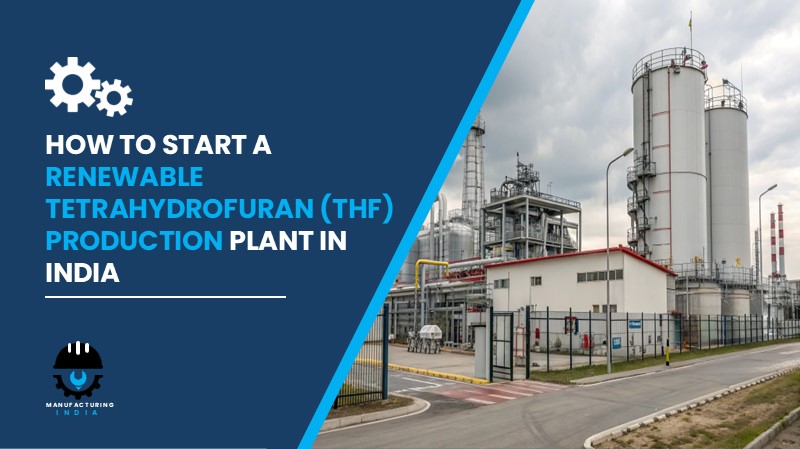
Setting up a renewable tetrahydrofuran (THF) production plant in India presents an exceptional investment opportunity as the nation rapidly establishes itself as one of the most cost-competitive and innovation-driven destinations for bio-based chemical manufacturing. Driven by surging demand from the polymer, pharmaceutical, adhesives, coatings, and specialty chemicals industries, renewable THF has emerged as a critical green chemical intermediate in India’s rapidly evolving sustainable materials economy.
“With a growing bioeconomy, robust policy support under Make in India, competitive land and labor costs, and rising demand for bio-based solvents across polymers and pharmaceuticals, India offers a highly attractive environment for renewable THF production — with gross margins of 20–30% and a commercially viable production capacity of 50,000 to 100,000 metric tons annually.”
What is Renewable Tetrahydrofuran (THF)?
Renewable tetrahydrofuran (THF) is a bio-based version of conventional THF — a colorless, low-viscosity cyclic ether (C₄H₈O) widely used as a polar aprotic solvent and chemical intermediate. It is produced through catalytic cyclodehydration of renewable 1,4-butanediol (bio-BDO), or via catalytic routes starting from biomass-derived furfural or furan. Renewable THF retains all the key properties of conventional THF — including high solvent power, complete miscibility with water, volatility, and stability — while offering significant lifecycle greenhouse-gas reductions based on its bio-based feedstock and mass-balance approach.
Globally, industries spanning polymers and fibers, pharmaceuticals, adhesives and coatings, chemical synthesis, and electronics rely on THF as an essential input. As per industrial reports, renewable THF accounts for 87% share in the overall THF market, reflecting the industry’s strong shift toward lower-carbon and bio-based chemical intermediates.
Cost of Setting Up a Renewable Tetrahydrofuran (THF) Production Plant in India
The Renewable Tetrahydrofuran (THF) production plant cost in India depends on several parameters including production capacity, feedstock sourcing strategy, technology used, plant location, level of automation, and regulatory compliance. Here is a structured breakdown of all major cost components:
1. Capital Expenditure (CapEx)
The total capital investment in a renewable THF production plant typically covers the following:
Land and Site Development: This includes land acquisition, boundary development, land registration charges, and basic site preparation. Cost varies depending on whether the plant is established in an industrial corridor, Special Economic Zone (SEZ), or a privately acquired plot with proximity to biomass supply chains.
Civil Works and Construction: Building costs cover the main manufacturing shed, reactor and processing areas, raw material storage, quality control laboratory, effluent treatment zone, administrative block, and worker amenities. Construction specifications depend on plant scale and compliance with local environmental and safety norms.
Machinery and Equipment: This is the single largest component of CapEx. Key machinery required for a renewable THF production plant includes:
- Pre-Treatment Reactors
- Hydrolysis Units
- Catalytic Conversion Systems
- Hydrogenation Reactors
- Distillation and Purification Columns
- Molecular Sieves
- Quality Control Analyzers
- Specialized Storage and Drumming Systems
Machinery costs represent the largest share of overall capital expenditure, reflecting the precision engineering and specialized catalytic processing involved in bio-based THF production.
Other Capital Costs: These include pre-operative expenses, commissioning charges, import duties on internationally sourced machinery, utilities installation, fire safety systems, and Effluent Treatment Plant (ETP) setup.
2. Operational Expenditure (OpEx)
Once the plant is commissioned, the ongoing cost structure is dominated by the following key components:
Raw Material Cost (Lignocellulosic Sugars & Catalysts): 55–65% of Total OpEx: Lignocellulosic sugars are the primary raw material and account for the majority of operating expenses. Additional materials may include catalysts, solvents, and performance additives depending on the production route and end-use application.
Utility Cost: 8–12% of Total OpEx: Utilities include electricity (consumed by hydrogenation reactors, distillation columns, and compressors), water (used in cooling systems and hydrolysis), and steam supply.
Other Operating Costs: The remaining budget covers transportation, secondary packaging, salaries and wages, maintenance, depreciation, taxes, and miscellaneous overhead.
3. Plant Capacity
The proposed manufacturing facility is designed with an annual production capacity ranging between 50,000 to 100,000 Metric Tons. This range allows the plant to achieve economies of scale while maintaining flexibility to serve multiple end-use segments including polymers, pharmaceuticals, adhesives, and specialty chemicals.
Smaller pilot setups may start at lower capacities, but profitability significantly improves with higher capacity utilization and optimized feedstock procurement.
4. Profit Margins and Financial Projections
- Gross Profit Margin: 20–30%
- Net Profit Margin: 5–15%
- Break-Even Period: Dependent on production scale, market demand, raw material cost management, and sales efficiency
Financial projections must account for capital investment, operating costs, capacity utilization rates, pricing trends, and demand outlook. A thorough analysis should also include sensitivity analysis, Net Present Value (NPV), Internal Rate of Return (IRR), and Payback Period.
Request a Sample Report for In-Depth Market Insights: https://www.imarcgroup.com/renewable-tetrahydrofuran-manufacturing-plant-project-report/requestsample
Why Set Up a Renewable THF Production Plant in India?
India presents a uniquely favorable environment for establishing a renewable tetrahydrofuran (THF) production plant:
Surging Domestic Demand for Green Chemicals
India’s polymer, pharmaceutical, adhesive, and specialty chemicals industries are growing rapidly. The bio-based polyurethane market alone is expected to reach USD 72.1 million by 2030, driving significant demand for renewable THF as a key precursor for polyurethanes, PTMEG, and other biopolymers. The pharmaceutical sector’s expansion further boosts demand for high-purity solvents.
Policy and Regulatory Tailwinds
The Government of India’s emphasis on the bioeconomy, green chemistry mandates, domestic manufacturing under the Make in India initiative, and ESG-driven procurement policies is creating a highly supportive regulatory environment for bio-based chemical manufacturers. Incentives for sustainable manufacturing and renewable feedstock programs further enhance the investment case.
Cost-Competitive Manufacturing
India offers competitive land costs, a large pool of trained technical labor, and an evolving biomass and renewable feedstock supply chain, making it one of the most cost-effective locations for renewable THF production in Asia. Proximity to agricultural biomass sources further reduces input costs.
Export Opportunities
India-based manufacturers can tap into growing export demand from Southeast Asia, the Middle East, and Africa, where local bio-based chemical production capacity remains limited. Stringent sustainability regulations in Europe and North America are also creating opportunities for Indian producers of renewable chemical intermediates.
Supply Chain Resilience and Localization
Downstream polymer, pharmaceutical, and FMCG companies are increasingly prioritizing regional, reliable suppliers to reduce exposure to petrochemical price volatility, supply disruptions, and carbon-intensive imports. This creates strong opportunities for domestic renewable THF producers with secure biomass sourcing and efficient operations.
Production Process Overview
The renewable THF production process primarily utilizes two core technological routes:
- Catalytic Cyclodehydration of Bio-BDO
- Catalytic Routes from Biomass-Derived Furfural or Furan
The complete process flow involves raw material sourcing and pre-treatment, biomass hydrolysis, catalytic conversion and hydrogenation, distillation and purification, molecular sieve treatment, quality inspection and analysis, and final packaging and dispatch for industrial applications.
Key Applications of Renewable Tetrahydrofuran (THF)
Renewable THF manufactured in India serves a wide variety of end-use industries:
- Polymer Production: Renewable precursor for polyurethanes, PTMEG, polyesters, and spandex elastomers for textile and industrial applications
- Pharmaceutical Packaging & Formulation: High-purity solvent for active pharmaceutical ingredients, drug formulation processes, and PVC cement for medical tubing
- Adhesives, Coatings & Sealants: Solvent base for industrial adhesives, specialty coatings, and chemical synthesis applications
- Energy & Green Chemistry: Component in biofuel production, renewable chemical energy carriers, and lithium-ion battery binder systems
Global Market Outlook
The global renewable THF market is primarily driven by the accelerating transition toward sustainable chemicals across the polymer, pharmaceutical, and specialty chemicals industries. Regulatory frameworks in Europe, North America, and parts of Asia increasingly favor low-carbon and bio-based solvents and intermediates. Demand for bio-based PTMEG in spandex fibers and polyurethane elastomers further supports renewable THF consumption globally.
Advancements in fermentation and catalytic technologies have significantly improved yields from biomass-derived intermediates, enhancing commercial viability and reducing production costs. Additionally, brand owners’ commitments to reduce Scope 3 emissions are influencing procurement strategies toward renewable intermediates such as THF, positioning the market for sustained long-term growth.
Leading global players in the renewable THF industry include:
- BASF
- Ashland
- Dairen Chemical
- Mitsubishi Chemical
- Huafon Group
Timeline to Start a Renewable THF Production Plant
Setting up a renewable tetrahydrofuran (THF) production plant from ideation to commissioning typically requires 12 to 18 months. This covers:
- Feasibility study and detailed project report preparation
- Land acquisition and site development
- Regulatory approvals and environmental clearances
- Factory license and fire safety compliance
- Machinery procurement and installation
- Trial production and quality testing
- Commercial production launch
Licenses and Regulatory Requirements
Starting a renewable THF production unit in India requires several approvals, including:
- Business registration (Proprietorship, LLP, or Private Limited Company)
- Factory License under the Factories Act
- Environmental Clearance from the State Pollution Control Board
- GST Registration
- Fire Safety NOC
- Hazardous Chemicals License (for THF handling and storage)
- BIS Certification (for pharmaceutical-grade or industrial applications)
- FSSAI Approval (if used in food-contact applications)
Key Challenges to Consider
Before investing, entrepreneurs should be aware of the common challenges in this business:
- High Capital Requirements: Initial CapEx for advanced bio-processing machinery and infrastructure is significant, particularly for mid to large-scale plants targeting international-quality specifications.
- Raw Material Price Volatility: Lignocellulosic sugar and biomass feedstock prices can fluctuate based on agricultural cycles and supply chain dynamics, directly impacting operating margins.
- Technical Complexity: Renewable THF production requires advanced catalytic know-how, process optimization expertise, and stringent purity specifications — demanding technically capable teams and rigorous quality systems.
- Regulatory Compliance: Meeting pharmaceutical-grade, polymer-grade, and environmental standards requires continuous investment in quality management and compliance infrastructure.
- Customer Qualification Cycles: Long qualification cycles with polymer and pharmaceutical customers require patience and upfront investment in product validation before revenue is realized.
Frequently Asked Questions
The following questions are answered in the report:
- How much does it cost to set up a renewable THF production plant in India?
- Is renewable tetrahydrofuran (THF) manufacturing profitable in India in 2026?
- What machinery is required for a renewable THF production plant in India?
- What licences and approvals are required to start a renewable THF plant in India?
- How long does it take to commission a renewable THF manufacturing plant in India?
- What is the best state or location to set up a renewable THF plant in India?
- What government incentives are available for bio-based chemical manufacturers in India?
- What is the break-even period for a renewable THF production plant in India?
- What are the environmental compliance requirements for renewable THF manufacturing in India?
Key Takeaways for Investors
The renewable tetrahydrofuran (THF) production industry in India represents a compelling and strategically aligned investment opportunity backed by growing domestic and global demand for bio-based chemical intermediates and supportive government bioeconomy policies. With gross margins of 20–30%, an annual production capacity of 50,000 to 100,000 metric tons, and strong long-term demand from polymers, pharmaceuticals, and specialty chemicals, a well-planned renewable THF production plant cost in India remains competitive and financially viable across plant capacities. Investors who act decisively on this high-growth green chemistry opportunity stand to establish a durable, scalable, and export-ready manufacturing enterprise in one of Asia’s most attractive bioeconomy destinations.
About the Author