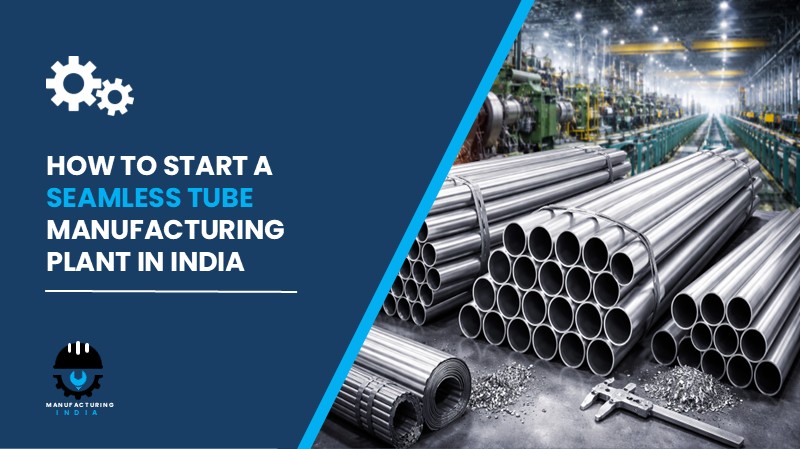
Setting up a seamless tube manufacturing plant in India presents a compelling investment case driven by the country’s accelerating demand across oil and gas, power generation, automotive, industrial machinery, construction, and chemical processing sectors. Seamless tubes are hollow cylindrical metal pieces produced without a welding seam, making them indispensable wherever high-pressure integrity and mechanical reliability are non-negotiable. As India continues to expand its energy infrastructure, refinery networks, and heavy engineering base, the domestic requirement for precision seamless tubes is rising in step with each new project commission.
India’s competitive advantages affordable land, a large technical workforce, robust steel supply chains, and proactive industrial policy under the Make in India initiative make it one of the most strategically sound locations to establish this type of plant. Key manufacturing states such as Gujarat, Maharashtra, and West Bengal offer well-developed industrial estates, proximity to port infrastructure for raw material imports and export dispatch, and strong connections to both domestic OEM customers and EPC contractors. With original equipment manufacturers and engineering, procurement, and construction firms increasingly favouring local suppliers for assured quality, faster delivery, and stable pricing, an Indian production base positions the investor at the centre of a consolidating supply chain.
A seamless tube manufacturing plant in India combines policy-backed demand drivers energy infrastructure, automotive growth, and industrial expansion with cost-competitive manufacturing economics that support gross margins of 25-30% and net margins of 12-16%, making it a financially viable and strategically sound industrial investment with a clearly defined break-even pathway.
What is a Seamless Tube?
Seamless tubes, also known as hollow cylindrical metal pieces, are products made without a welding seam and therefore possess superior mechanical strength, structural uniformity, and resistance to pressure compared to welded alternatives. These tubes are typically manufactured from carbon steel, alloy steel, stainless steel, or specialty alloys using either hot or cold deformation processes. The absence of a weld line gives seamless tubes exceptional tensile strength, dimensional accuracy, corrosion resistance, and fatigue performance, making them the material of choice in high-pressure and high-temperature operating environments. Critically, the uniformity of the seamless tube’s structure guarantees that material properties remain consistent throughout the entire tube length, considerably reducing the risk of failure under cyclic stress.
The primary production method is a multi-stage thermo-mechanical process involving billet heating, rotary piercing, hot rolling or extrusion, cold drawing, heat treatment, and finishing. End-use industries served include oil and gas, power generation, automotive, construction, industrial machinery, and chemical processing sectors that collectively represent a large and growing portion of India’s industrial output.
Cost of Setting Up a Seamless Tube Manufacturing Plant in India
The total cost of establishing a seamless tube manufacturing plant depends on plant capacity, technology selection, geographic location, degree of automation, and regulatory compliance requirements. Investors must account for both one-time capital expenditure and recurring operational costs when building a credible financial plan.
1. Capital Expenditure (CapEx)
Land and Site Development constitutes a substantial portion of the overall investment. This covers land registration charges, boundary development, levelling, drainage, and road access. Locating the plant within a Special Economic Zone or a state-notified industrial estate can yield significant benefits, including reduced land costs, pre-cleared utilities, and faster regulatory approvals.
Civil Works and Construction include the main manufacturing shed, raw material storage yards, finished goods warehousing, a quality control laboratory, an administrative block, and worker facilities. The scale of civil works is directly proportional to the proposed annual production capacity, which for a standard seamless tube facility is designed in the range of 50,000-100,000 MT per annum, enabling economies of scale while maintaining operational flexibility.
Machinery and Equipment represent the largest single component of CapEx. Key machinery required includes:
- Billet heating furnaces
- Rotary piercing mills (Mannesmann or rotary piercing type)
- Mandrel and plug mills
- Cold drawing benches
- Cold pilger mills
- Heat treatment furnaces
- Stretch reducing and sizing mills
- Straightening and finishing machines
- Cutting and finishing units
- Non-destructive testing (NDT) equipment (ultrasonic and eddy-current systems)
- Packaging and inspection equipment
Other Capital Costs include effluent treatment plant (ETP) installation, pre-operative and trial-run expenses, import duties on specialised equipment, commissioning charges, and initial working capital provisions.
Request a Sample Report for In-Depth Market Insights: https://www.imarcgroup.com/seamless-tube-manufacturing-plant-project-report/requestsample
2. Operational Expenditure (OpEx)
Raw Material Cost is the dominant operational expense, with steel billets in carbon, alloy, or stainless-steel grades accounting for approximately 50–55% of total OpEx. Additional processing materials include lubricants, cooling agents, acids used in surface treatment, and protective coatings, along with alloying elements such as chromium, molybdenum, or nickel added to achieve required material properties. Long-term supply contracts with reliable domestic and import-linked suppliers are essential to stabilise input costs and mitigate price volatility risk.
Utility Costs primarily electricity for furnace operations, drive systems, and NDT equipment, alongside water for cooling circuits and steam for heat treatment account for approximately 12-14% of OpEx, making energy efficiency a meaningful lever for margin management.
Other Operating Costs include transportation, packaging materials, salaries and wages for skilled engineers and machine operators, routine maintenance and spares, depreciation on heavy equipment, and applicable taxes. By the fifth year of operations, the total operational cost is projected to increase substantially due to inflation, market fluctuations, potential rises in the cost of key raw materials, and supply chain dynamics.
3. Plant Capacity
The proposed manufacturing facility is designed with an annual production capacity ranging between 50,000 and 100,000 MT, enabling investors to capture volume efficiencies while retaining the flexibility to serve niche, high-specification segments. Capacity can be customised per individual investor requirements, and profitability consistently improves with higher capacity utilisation rates as fixed costs are spread over a greater output volume.
4. Profit Margins and Financial Projections
Financial projections for a seamless tube plant are developed based on realistic assumptions covering capital investment, operating costs, production capacity utilisation, pricing trends, and demand outlook. Gross profit margins typically range between 25-30%, supported by stable demand and the premium pricing commanded by value-added, precision-engineered applications. Net profit margins range between 12–16% under normal operating conditions. The complete financial model incorporates NPV, IRR, payback period analysis, a profit and loss account, sensitivity analysis, and uncertainty modelling to give investors a comprehensive view of long-term financial viability.
Why Set Up a Seamless Tube Plant in India?
Critical Industrial Material Demand. Seamless tubes remain essential across energy, automotive, and heavy engineering industries where pressure sensitivity and operational safety are critical. India’s ongoing investment in oil refining capacity, cross-country pipelines, and power generation infrastructure sustains a structurally growing base of domestic demand that local producers are uniquely positioned to serve.
Strong Alignment with Industrial Megatrends. The construction of energy infrastructure, development of new oil and gas fields, expansion of green power plants, automotive lightweighting programmes, and industrial automation initiatives are all long-term trends that drive sustained demand for seamless tubes. India’s participation in each of these megatrends creates a multi-sectoral demand floor that de-risks the investment thesis across economic cycles.
Policy and Regulatory Tailwinds. Government support through investments in power production, oil refining, pipeline networks, and domestic manufacturing under Make in India provides institutional momentum for the seamless tube segment. Investors in industrial manufacturing in India benefit from capital subsidies, tax exemptions, reduced utility tariffs, export incentives, and interest subsidies available under various national and regional industrial policies.
Cost-Competitive Manufacturing Base. India offers investors competitive access to land in industrial estates, a large and technically trained manufacturing workforce, an established domestic steel supply chain, and lower utility tariffs compared to many competing jurisdictions. These structural cost advantages directly support the unit economics of a seamless tube plant and contribute to the healthy margin profile the sector offers.
Active Industry Investment and Expansion. Recent industry activity underscores the growing commercial confidence in this segment. In August 2025, Sun Mark Stainless commissioned a new stainless steel seamless pipes and tubes production line with a capacity of 2,000 MT per month for the oil and gas, power, infrastructure, and chemical processing sectors. In May 2025, Venus Pipes & Tubes secured a Letter of Intent from a major integrated power plant equipment manufacturer in India for stainless-steel seamless boiler tubes, valued at INR 190 crore. In April 2025, Jindal (India) entered the steel section pipes and tubes segment with an investment of INR 100 crore at its West Bengal facility, targeting 5,000 MT per month capacity and projected revenue of INR 315 crore by FY26.
Local Supply Chain Preference. OEMs and EPC contractors are increasingly selecting local seamless tube producers to secure quicker deliveries, guaranteed quality, and price stability. This structural shift toward supply chain localisation creates a sustained commercial opportunity for Indian manufacturers able to meet international specification standards.
Manufacturing Process Step by Step
The seamless tube manufacturing process uses billet heating and rotary piercing as the primary production method, followed by a series of forming, heat treatment, and finishing operations to produce tubes of consistent dimensions and mechanical properties.
- Billet Selection and Inspection: Steel billets are evaluated for chemical composition and physical quality before entering production.
- Billet Heating: Billets are heated in rotary or induction furnaces to the temperature required for plastic deformation.
- Rotary Piercing: Heated billets are pierced using a Mannesmann or rotary piercing mill and mandrel to form hollow shells without a weld seam.
- Elongation and Wall Reduction: The hollow shell is elongated and reduced in plug or mandrel mills to achieve the required wall thickness.
- Rolling and Sizing: Tubes are rolled and sized in stretch reducing or finishing mills for dimensional accuracy and surface quality.
- Heat Treatment: Tubes undergo heat treatment in heat treatment furnaces for mechanical strength enhancement and microstructural refinement.
- Straightening and Cutting: Finished tubes are straightened using finishing machines and cut to required lengths.
- Non-Destructive Testing (NDT): Ultrasonic and eddy-current NDT systems are used for quality inspection without compromising tube integrity.
- Surface Finishing and Marking: Tubes receive final surface treatment, marking, and inspection before being packaged and dispatched to end-use industries.
Key Applications
Seamless tubes serve a wide range of high-specification industrial applications across multiple sectors:
- Oil and Gas: Used extensively in drilling, casing, tubing, and transmission pipelines due to their ability to withstand high pressure and resist corrosive media.
- Power Generation: Serve as main components in boilers, superheaters, and heat exchangers operating under very high thermal and pressure conditions.
- Automotive: Found in axles, drive shafts, and fuel injection systems where high-strength-to-weight ratios are essential.
- Industrial Machinery: Applied in hydraulic cylinders, bearings, and mechanical components that demand exact dimensional tolerances and high wear resistance.
- Construction: Used in structural components requiring reliable mechanical performance under load-bearing conditions.
- Chemical Processing: Deployed in process pipelines and pressure vessels where corrosion resistance and material uniformity are critical.
Leading Manufacturers
The global seamless tube market is served by several large multinational producers with extensive manufacturing capacities and diversified application portfolios. Key players active in this industry include:
- Vallourec SA
- Sandvik AB
- ArcelorMittal
- Jindal Saw Limited
- Tata Steel Limited
- United States Steel Corporation
- Nippon Steel Corporation
- Tenaris SA
- Shenqiang Steel Manufacturing Co., Ltd.
- Shandong Tanglu Metal Material Co., Ltd.
Timeline to Start the Plant
Establishing a seamless tube manufacturing unit typically requires 18 to 36 months from initial planning to commercial production, depending on site conditions, regulatory timelines, and machinery procurement lead times.
- Feasibility study and project report preparation
- Land acquisition and site development
- Regulatory approvals and environmental clearances
- Factory licence and fire safety compliance
- Machinery procurement and installation
- Raw material supplier agreements and supply chain setup
- Trial production and quality testing
- Commercial production launch
Licences and Regulatory Requirements
Starting a seamless tube manufacturing unit in India requires several approvals:
- Business registration (Proprietorship, LLP, or Private Limited Company)
- Factory Licence under the Factories Act
- Environmental Clearance from the State Pollution Control Board
- GST Registration
- Fire Safety NOC
- Hazardous and chemical compliance, including handling of acids and lubricants used in processing
- Effluent Treatment Plant (ETP) operational clearance
- Occupational Health and Safety compliance
Key Challenges to Consider
High Capital Requirements. Machinery costs particularly for piercing mills, mandrel mills, cold drawing benches, pilger mills, heat treatment furnaces, and NDT systems represent the largest component of CapEx, making initial capital mobilisation a significant barrier to entry and an important consideration in project financing strategy.
Raw Material Price Volatility. Steel billets, whether carbon, alloy, or stainless-steel grades, account for 50-55% of total operating expenses. Fluctuations in global steel prices, driven by trade policy shifts, energy cost changes, and supply chain disruptions, can materially affect profitability, making long-term supply contracts and hedging strategies essential.
Regulatory Compliance. Obtaining environmental clearances, factory licences, fire safety NOCs, and ETP operational approvals across central and state regulatory bodies requires time and specialist expertise. Delays in clearances directly extend the pre-revenue period and increase pre-operative costs.
Technology and Innovation Pressure. Technological advancements in tube forming, heat treatment, and quality inspection are continuously enhancing production efficiency and product reliability. Investors must allocate capital for equipment upgrades and process innovation to remain competitive.
Competition from Established Players. The market includes well-capitalised global players such as Vallourec SA, Sandvik AB, ArcelorMittal, Tata Steel Limited, and Jindal Saw Limited. New entrants must compete on quality, delivery reliability, and customer service rather than price alone.
Skilled Manpower. Operating a seamless tube facility requires engineers and machine operators trained in metallurgy, precision forming, NDT interpretation, and heat treatment process control. Recruiting and retaining qualified personnel in competitive industrial labour markets is an ongoing operational challenge.
Frequently Asked Questions
1. How much does it cost to set up a seamless tube manufacturing plant in India? Capital requirements include land acquisition, construction, machinery procurement, installation, pre-operative expenses, and initial working capital. The exact amount varies with capacity, technology level, location, and automation.
2. Is seamless tube manufacturing profitable in India in 2026? Yes- gross profit margins typically range between 25-30% and net profit margins between 12–16%, supported by stable demand across oil and gas, power, and automotive sectors.
3. What machinery is required for a seamless tube plant in India? Key equipment includes billet heating furnaces, rotary piercing mills, mandrel and plug mills, cold drawing benches, cold pilger mills, heat treatment furnaces, straightening machines, NDT systems, cutting and finishing units, and packaging and inspection equipment.
4. What licences and approvals are required to start a seamless tube plant in India? Required approvals include business registration, Factory Licence, Environmental Clearance, GST Registration, Fire Safety NOC, chemical and hazardous material compliance, ETP clearance, and Occupational Health and Safety certification.
5. What raw materials are needed for seamless tube manufacturing? The primary raw material is high-quality steel billets in carbon, alloy, or stainless-steel grades. Processing materials include lubricants, cooling agents, acids, and alloying elements such as chromium, molybdenum, and nickel.
6. What are the environmental compliance requirements for a seamless tube plant in India? Requirements include Environmental Clearance from the State Pollution Control Board, an operational ETP to manage effluent from acid pickling and cooling processes, emission monitoring, and compliance with hazardous waste disposal norms.
7. What is the best location to set up a seamless tube plant in India? Optimal locations offer proximity to steel billet suppliers, reliable industrial infrastructure, access to transportation corridors, and pre-approved industrial estate or SEZ status. States such as Gujarat, Maharashtra, and West Bengal are well-suited based on industrial ecosystem maturity.
8. What is the break-even period for this type of plant in India? The break-even period typically ranges from 5 to 9 years depending on plant scale, raw material pricing, regulatory compliance costs, and prevailing market demand. Higher capacity utilisation and export opportunities can accelerate returns.
9. What government incentives are available for manufacturers in India? Governments offer incentives including capital subsidies, tax exemptions, reduced utility tariffs, export benefits, and interest subsidies under national and regional industrial promotion schemes.
Key Takeaways for Investors
A seamless tube manufacturing plant in India represents a high-conviction industrial investment opportunity, underpinned by structurally growing demand from the oil and gas, power generation, automotive, industrial machinery, construction, and chemical processing sectors all of which are expanding in line with India’s long-term infrastructure and industrialisation agenda. The investment demonstrates financial viability across a range of plant capacities, with gross margins of 25-30% and net margins of 12-16% achievable under normal operating conditions, and a break-even period of 5 to 9 years depending on scale and market execution. The APAC region, of which India is a key constituent, holds the largest share of the global seamless tube market at approximately 40%, anchoring the regional demand case for new manufacturing capacity. With policy tailwinds under Make in India, deepening supply chain localisation by OEMs and EPC contractors, and active capacity investments from players including Jindal (India), Venus Pipes & Tubes, and Sun Mark Stainless in 2025 alone, demand sustainability for domestically produced seamless tubes is strongly supported over the medium and long term.
About the Author