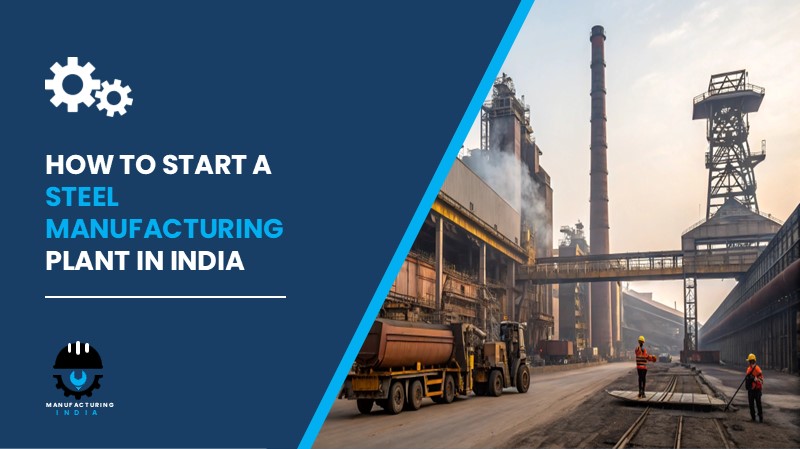
Setting up a steel manufacturing plant in India presents a compelling investment case driven by the country’s accelerating infrastructure expansion, surging automotive production, and the rapidly growing renewable energy sector. Steel — the foundational material for construction, transportation, and industrial machinery — is integral to India’s economic ambitions. With demand surging across structural components, reinforcement bars, machinery frames, and energy infrastructure, domestic steel production is no longer just an industrial activity; it is a strategic national priority. Sectors such as construction, energy and infrastructure, automotive, and appliance manufacturing collectively sustain robust and diversified off-take for any new entrant to the market.
India’s manufacturing landscape offers distinct advantages for investors targeting steel production at scale. The country’s ongoing urbanisation, ambitious smart city programmes, and massive public investment in transport corridors and power infrastructure ensure consistent, long-term demand. Policies such as Make in India and Production-Linked Incentive (PLI) schemes in steel-intensive sectors create both direct and indirect incentives for domestic steel manufacturers. Industrial clusters in Gujarat, Maharashtra, Jharkhand, and Odisha offer proximity to raw material sources, established logistics networks, and a skilled workforce — making them prime locations for greenfield steel investments.
India’s steel manufacturing opportunity is anchored in megatrend alignment: rapid urbanisation, EV adoption, renewable energy infrastructure, and government-led industrialisation all point to sustained demand growth. With gross profit margins of 15–25% and a well-structured CapEx-to-OpEx model, a steel manufacturing plant in India can achieve competitive returns and a defensible market position within a reasonable payback period.
What is Steel?
Steel is an alloy of iron and carbon in which the carbon content ranges between 0.02 and 2.1 percent by weight. This precise carbon ratio gives steel significantly greater strength, durability, and versatility than pure iron alone. Depending on the intended application and processing method, steel may also incorporate elements such as manganese, chromium, nickel, and molybdenum, each contributing specific mechanical, thermal, or corrosion-resistant properties to the final product.
Steel is manufactured in a variety of grades to serve diverse end-use requirements. These include carbon steel, alloy steel, stainless steel, and tool steel. Key material properties include high tensile strength, recyclability, formability, and resistance to mechanical stress — characteristics that collectively make steel one of the most indispensable materials underpinning modern industrial economies. The primary production methods used in a steel manufacturing plant are hot rolling, annealing, and galvanizing.
Steel serves a wide range of end-use industries, including construction, infrastructure, automotive, industrial machinery, and appliance manufacturing. Within these sectors, finished steel products take the form of structural beams, reinforcement bars, automotive chassis, machinery frames, and appliance housings — underscoring the breadth of commercial applications available to producers.
Cost of Setting Up a Steel Manufacturing Plant in India
The cost of establishing a steel manufacturing plant in India depends on several interrelated variables, including plant capacity, choice of technology, geographic location, level of automation, and the extent of regulatory compliance infrastructure required.
1. Capital Expenditure (CapEx)
The total capital investment for a steel manufacturing facility covers multiple cost heads, each of which must be carefully planned during the project development phase.
Land and Site Development represents a substantial portion of overall CapEx. This includes charges for land registration, boundary development, and site preparation. Investors may consider locating the plant within a Special Economic Zone (SEZ) or designated industrial estate to benefit from concessional land rates, pre-approved utility connections, and streamlined regulatory approvals.
Civil Works and Construction cover the construction of the main production shed, quality control laboratory, raw material storage yards, effluent treatment infrastructure, and the administrative block. Given the scale of steel manufacturing operations, civil works form a significant capital commitment.
Machinery and Equipment account for the largest share of capital expenditure. Key machinery required includes:
- Blast furnaces
- Basic oxygen furnaces
- Electric arc furnaces
- Continuous casters
- Hot and cold rolling mills
- Annealing furnaces
- Pickling lines
- Finishing and coating systems
Other Capital Costs include the establishment of an Effluent Treatment Plant (ETP), pre-operative and commissioning expenses, and applicable import duties on specialised equipment not available domestically.
Request a Sample Report for In-Depth Market Insights: https://www.imarcgroup.com/steel-manufacturing-plant-project-report/requestsample
2. Operational Expenditure (OpEx)
Raw Material Cost is the dominant driver of operating expenses in a steel manufacturing plant, with iron ore and coal collectively accounting for approximately 60–70% of total OpEx. Securing long-term contracts with reliable domestic and international suppliers is essential for mitigating price volatility and ensuring production continuity. A diversified supplier base reduces dependency risk.
Utility Cost — covering electricity, water, and steam — represents 20–25% of OpEx. Given the energy-intensive nature of steelmaking processes such as electric arc furnace operation and continuous casting, utility management is a key lever for cost optimisation.
Other Operating Costs include transportation, packaging, salaries and wages, maintenance, depreciation, and applicable taxes. By the fifth year of operations, total operational cost is expected to increase substantially due to inflation, market fluctuations, potential rises in input material costs, supply chain disruptions, and shifts in global economic conditions.
3. Plant Capacity
The proposed manufacturing facility is designed with an annual production capacity ranging between 1 and 3 million metric tonnes (MT), enabling economies of scale while maintaining operational flexibility. Plant capacity can be customised based on the specific requirements and investment scale of the promoter. Profitability improves meaningfully with higher capacity utilisation, as fixed costs are spread over a larger output base, driving down per-unit cost of production.
4. Profit Margins and Financial Projections
A steel manufacturing plant in India demonstrates healthy profitability potential under normal operating conditions. Gross profit margins typically range between 15–25%, supported by stable demand and the value-added nature of specialty and structural steel applications. Net profit margins are projected in the range of 5–10% after accounting for depreciation, taxes, and financing costs. The financial model for this investment covers Net Present Value (NPV), Internal Rate of Return (IRR), payback period analysis, liquidity assessment, sensitivity analysis, and a full profit and loss account — providing investors with a comprehensive view of long-term financial viability.
Why Set Up a Steel Plant in India?
Foundation of Infrastructure and Industrial Growth. Steel products form the backbone of construction, transportation, energy, automotive, machinery, and heavy engineering sectors. As India accelerates investment in railways, highways, ports, and urban housing, domestic steel demand receives structural support from public expenditure alone.
Megatrend Alignment Across Multiple Sectors. Fast urbanisation, infrastructure rollout, the adoption of electric mobility, renewable energy project development, rail network expansion, and the automation of industrial processes are all key drivers. Multiple segments within the steel consumption universe are growing at mid to high single-digit rates, offering diverse revenue streams to producers.
Policy and Regulatory Tailwinds. Government-directed investments in transport corridors, smart cities, defense manufacturing, and renewable energy — backed by Make in India and PLI schemes in steel-intensive sectors — directly and indirectly stimulate steel consumption. These policy frameworks reduce demand-side risk for new steel manufacturing investors.
Cost-Competitive Manufacturing. India’s combination of relatively lower land acquisition costs in industrial zones, competitive labour rates, and proximity to iron ore and coal deposits in Jharkhand, Odisha, and Chhattisgarh creates a structurally cost-efficient base for integrated steel production.
Active Industry Investment. The global steel industry is seeing significant investment activity directly relevant to India. In August 2025, JSW Steel and POSCO Group signed a non-binding Heads of Agreement (HoA) to jointly explore setting up a 6 million tonnes per annum integrated steel plant in India. In July 2025, Tata Steel and Australia’s InQuik Group signed a Memorandum of Understanding (MoU) to introduce Tata Steel’s modular bridge construction technology to India, reinforcing demand for domestic steel in infrastructure applications.
Local Supply Chain Preference. Original Equipment Manufacturers (OEMs), EPC contractors, and infrastructure developers increasingly prefer reliable domestic steel suppliers to reduce import dependence, manage price volatility, ensure timely delivery, and comply with local sourcing norms — creating durable commercial relationships for well-positioned regional steel producers.
Manufacturing Process Step by Step
The steel manufacturing process uses hot rolling, annealing, and galvanizing as the primary production methods, integrated within a multi-stage operation involving careful unit operations, material handling, and quality checks.
- Raw Material Intake and Preparation: Iron ore and coal are received, inspected, and prepared for the smelting stage, with mass balance checks performed to ensure input consistency.
- Ironmaking via Blast Furnace: Iron ore and coal are fed into the blast furnace, where iron is extracted through a reduction process at high temperatures.
- Steelmaking via Basic Oxygen Furnace or Electric Arc Furnace: Molten iron is converted into steel by controlling carbon content and adding alloying elements such as manganese, chromium, nickel, or molybdenum as required.
- Continuous Casting: Liquid steel is poured into a continuous caster to produce semi-finished forms such as billets, blooms, or slabs.
- Hot Rolling: Semi-finished forms pass through hot rolling mills to produce flat or long products including plates, coils, bars, and structural sections.
- Annealing: Rolled steel undergoes controlled heating and cooling in annealing furnaces to relieve internal stresses and improve ductility.
- Pickling: Steel surfaces are treated in pickling lines to remove oxides and scale, preparing the material for finishing.
- Finishing and Coating (Galvanizing): Final surface treatments, including galvanizing and other coating applications, are applied to enhance corrosion resistance and surface quality.
- Quality Assurance and Dispatch: Products undergo technical tests and quality assurance checks before packaging and dispatch to end-use industries such as construction, automotive, and appliance manufacturing.
Key Applications
Steel produced at a manufacturing plant in India serves a wide range of industries, each with distinct product specifications and volume requirements:
- Automotive: Structural components, exhaust systems, chassis frames, and safety reinforcements for passenger vehicles, commercial vehicles, and electric vehicles.
- Machinery and Equipment: Industrial machines, tools, gears, and load-bearing components across diverse manufacturing sectors.
- Construction: Structural beams, rebar, columns, roofing systems, and reinforcement materials for residential, commercial, and infrastructure projects.
- Energy and Infrastructure: Pipelines, transmission towers, railways, and power plant components for both conventional and renewable energy installations.
Leading Manufacturers
The global steel industry is served by several multinational companies with extensive production capacities and diverse application portfolios. Key players in the industry include:
- ArcelorMittal
- China Baowu Steel Group
- Nippon Steel Corporation
- POSCO
- Tata Steel
Timeline to Start the Plant
- Feasibility study and project report preparation
- Land acquisition and site development
- Regulatory approvals and environmental clearances
- Factory licence and fire safety compliance
- Machinery procurement and installation
- Raw material supplier agreements and supply chain setup
- Trial production and quality testing
- Commercial production launch
Licences and Regulatory Requirements
Starting a steel manufacturing unit in India requires several approvals:
- Business registration (Proprietorship, LLP, or Pvt Ltd)
- Factory Licence under the Factories Act
- Environmental Clearance from State Pollution Control Board
- GST Registration
- Fire Safety NOC
- Hazardous and chemical compliance (applicable given coal and chemical inputs)
- Effluent Treatment Plant (ETP) operational clearance
- Occupational Health and Safety compliance
Key Challenges to Consider
High Capital Requirements: Establishing a steel manufacturing plant is capital-intensive. Land, civil works, blast furnaces, electric arc furnaces, rolling mills, and ancillary infrastructure together represent a significant upfront investment that demands careful financial structuring.
Raw Material Price Volatility: Iron ore and coal — the two principal raw materials — are globally traded commodities subject to price fluctuations driven by geopolitical developments, supply disruptions, and shifting trade policies. Long-term procurement contracts help mitigate this risk.
Regulatory Compliance: Steel manufacturing involves high energy consumption, emissions, and effluent generation. Meeting environmental clearance conditions, emission standards, and ETP operational norms requires ongoing investment in compliance infrastructure.
Technology and Innovation Pressure: Advancements in energy-efficient furnaces and recycling-based steelmaking are improving production economics and sustainability compliance. Investors must ensure their chosen technology remains competitive over the plant’s operating life.
Competition: The Indian and global steel markets include formidable players such as ArcelorMittal, Tata Steel, POSCO, Nippon Steel Corporation, and China Baowu Steel Group. New entrants must compete on quality, cost, and reliability of supply.
Skilled Manpower: Operating blast furnaces, electric arc furnaces, continuous casters, and rolling mills demands a technically trained workforce. Investment in talent acquisition and ongoing training is necessary to sustain quality and safety standards.
Frequently Asked Questions
- How much does it cost to set up a steel manufacturing plant in India?
The total cost depends on plant capacity, technology selection, location, automation level, and regulatory compliance requirements. The financial model covers full CapEx and OpEx breakdowns, customised per project. - Is steel manufacturing profitable in India in 2026?
Yes. With gross profit margins in the 15–25% range and net margins of 5–10%, and with demand driven by infrastructure, automotive, and energy sectors, steel manufacturing remains a financially viable investment. - What machinery is required for a steel manufacturing plant in India?
Essential equipment includes blast furnaces, basic oxygen furnaces, electric arc furnaces, continuous casters, hot and cold rolling mills, annealing furnaces, pickling lines, and finishing and coating systems. - What licences and approvals are required to start a steel plant in India?
These include business registration, Factory Licence, Environmental Clearance, GST Registration, Fire Safety NOC, ETP operational clearance, hazardous material compliance, and occupational health and safety certification. - What raw materials are needed for steel manufacturing?
The primary raw materials are iron ore and coal, which together account for 60–70% of total operating expenses. - What are the environmental compliance requirements for a steel plant in India?
Plants must obtain Environmental Clearance from the State Pollution Control Board, operate a compliant Effluent Treatment Plant, and meet emission standards for furnace operations and waste handling. - What is the best location to set up a steel plant in India?
Locations with proximity to iron ore and coal deposits — such as Jharkhand, Odisha, Chhattisgarh, and surrounding industrial zones — offer cost and logistics advantages. SEZs and industrial estates in Gujarat and Maharashtra also provide infrastructure and regulatory benefits. - What is the break-even period for this type of plant in India?
The payback period depends on capacity utilisation, pricing trends, and operating cost management. A detailed financial analysis including NPV, IRR, and break-even projections is covered in the full project report. - What government incentives are available for manufacturers in India?
Make in India, PLI schemes in steel-intensive sectors, and government-directed investments in infrastructure and defense manufacturing provide both direct and indirect incentives for steel production units.
Key Takeaways for Investors
A steel manufacturing plant in India represents one of the most strategically grounded large-scale industrial investments available today, with demand anchored across construction, automotive, energy infrastructure, and industrial machinery sectors. The investment demonstrates strong financial viability across a range of plant capacities, with gross margins of 15–25% and net margins of 5–10% attainable under normal operating conditions. The global steel market was valued at USD 5,130.60 billion in 2025 and is projected to reach USD 6,776.60 billion by 2034, exhibiting a CAGR of 3.14% from 2026 to 2034 — confirming that demand sustainability is underwritten by long-term structural growth. For investors seeking a high-barrier, policy-supported, and industrially critical manufacturing opportunity in India, the steel sector offers compelling fundamentals and a durable commercial outlook.
About the Author