Setting up a syringe manufacturing plant in India presents a compelling investment case driven by surging demand across healthcare, pharmaceuticals, hospitals, clinics, and laboratories. As India rapidly expands its public health infrastructure and immunisation programmes, the requirement for safe, sterile, and disposable syringes has grown substantially. The global syringe market was valued at USD 22.574 billion in 2025 and is projected to reach USD 41.47 billion by 2034, exhibiting a CAGR of 7.0% from 2026 to 2034 and India represents one of the most dynamic growth corridors within this trajectory.
India’s structural advantages make it ideally suited for syringe production at scale. The country offers cost-competitive land and labour, a deep base of medical-grade polymer suppliers, and a government actively promoting domestic healthcare manufacturing through Make in India and Production Linked Incentive (PLI) schemes. Industrial states such as Gujarat, Maharashtra, Himachal Pradesh, and Uttar Pradesh offer dedicated pharmaceutical and medical device manufacturing clusters with established regulatory and logistics infrastructure. Combined with India’s position as a leading exporter of medical disposables, a domestic syringe unit can simultaneously serve local demand and export markets across Asia, Africa, and the Middle East.
India’s combination of policy support under Make in India, cost-competitive manufacturing, and rising domestic demand from healthcare and pharmaceutical sectors makes a syringe manufacturing plant a financially viable and strategically sound investment. With gross profit margins ranging between 25–35% and a break-even horizon of 4-8 years, the unit economics justify investment across a range of plant capacities.
What is a Syringe?
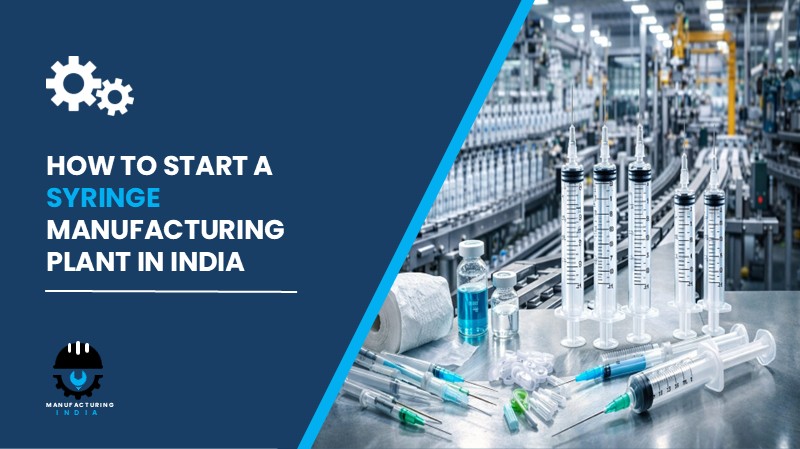
Syringes are essential medical devices used to inject fluids into the body or withdraw fluids for diagnostic and therapeutic purposes. They typically consist of a cylindrical barrel, a plunger, and a needle or nozzle that allows precise delivery or extraction of liquids. Syringes are manufactured using medical-grade plastics for the barrel, rubber components for the plunger to ensure smooth movement and sealing, and stainless steel for the needle to provide strength and sharpness.
Available in a wide range of sizes and designs, product variants include disposable syringes, insulin syringes, safety syringes, and specialised types for specific medical needs. The syringe manufacturing process involves raw material preparation, injection molding, needle assembly, sterilisation, and packaging a multi-step operation with rigorous quality checkpoints at each stage. End-use industries served include healthcare, pharmaceuticals, hospitals, clinics, and laboratories, with applications spanning vaccine administration, insulin delivery, intravenous fluid management, blood sampling, and drug delivery.
Cost of Setting Up a Syringe Manufacturing Plant in India
The total investment required depends on plant capacity, technology choice, degree of automation, site location, and regulatory compliance. Investors must account for both one-time capital expenditure and recurring operational costs when evaluating project feasibility.
1. Capital Expenditure (CapEx)
Land and Site Development forms a substantial part of the overall capital investment, covering land registration, boundary development, drainage, and ancillary site infrastructure. Locating the facility within a Special Economic Zone (SEZ) or notified industrial estate can reduce land acquisition costs and accelerate regulatory approvals.
Civil Works and Construction encompasses the main production shed, cleanroom construction, raw material storage warehouse, finished goods storage, quality control laboratory, and administrative block. For a syringe plant, cleanroom standards are mandatory given the sterile nature of the product.
Machinery and Equipment account for the largest single component of total CapEx. Key machinery required includes:
- Injection molding machines
- Needle assembly units
- Barrel and plunger molds
- Automatic printing and labeling machines
- Sterilisation units (ethylene oxide sterilisers)
- Automated packaging systems
- Cleanroom facilities for aseptic operations and quality control
Other Capital Costs include effluent treatment plant (ETP) setup, pre-operative expenses, installation and commissioning charges, import duties on specialised equipment, and initial working capital provisioning.
Access the Detailed Feasibility Analysis: https://www.imarcgroup.com/syringe-manufacturing-plant-project-report/requestsample
2. Operational Expenditure (OpEx)
Raw Material Cost is the dominant operating cost driver, accounting for approximately 48-52% of total OpEx. Core raw materials include medical-grade polypropylene (PP) or polyethylene for barrels and plungers, stainless steel for needles, rubber or synthetic elastomers for gaskets, lubricants for smooth plunger movement, and sterilisation agents. Securing long-term supply contracts with domestic and international suppliers is essential to manage price volatility and ensure production continuity.
Utility Cost – covering electricity, water, and steam represents a further 6–8% of total operating expenditure. Cleanroom HVAC systems and sterilisation chambers are the primary energy consumers.
Other Operating Costs include transportation and distribution, primary and secondary packaging materials, employee salaries and wages, equipment maintenance and repairs, depreciation on fixed assets, and applicable taxes. By the fifth year of operations, total operational costs are expected to increase substantially due to inflation, rising material costs, supply chain dynamics, and higher production volumes required to meet growing demand.
3. Plant Capacity
The proposed manufacturing facility is designed with an annual production capacity ranging between 1.5 and 2.5 billion units, enabling economies of scale while maintaining operational flexibility. Capacity can be customised per investor requirements smaller greenfield plants can begin at lower volumes and scale as market penetration grows. Profitability improves materially with higher capacity utilisation rates, as fixed costs are spread across a larger production base.
4. Profit Margins and Financial Projections
A syringe manufacturing plant demonstrates healthy profitability under normal operating conditions. Gross profit margins typically range between 25-35%, supported by stable demand and value-added product applications. Net profit margins average 12-16% over the project life cycle. Key financial indicators covered in a full feasibility study include Net Present Value (NPV), Internal Rate of Return (IRR), payback period (typically 4-8 years), sensitivity analysis, and a detailed profit and loss projection over a five-year horizon.
Why Set Up a Syringe Plant in India?
Rising Healthcare Demands. The increasing global and domestic focus on healthcare and the rise in chronic diseases is driving the need for medical syringes, particularly disposable variants. India’s expanding hospital network and diagnostic centre infrastructure directly translate to higher syringe consumption per capita year on year.
Growth in Immunisation Programmes. The global rise in immunisation programmes for both children and adults significantly augments syringe consumption, particularly disposable and safety types. According to data cited in the IMARC report, global vaccination coverage has increased dramatically, with the share of children receiving three doses of DTP3 vaccines rising from 5% in 1974 to 85% in 2024, and the number of diseases recommended for global vaccination doubling from 7 before 1980 to 14 by 2024.
Chronic Disease and Speciality Therapy Demand. Growing prevalence of chronic and non-communicable diseases such as diabetes, cancer, and cardiovascular disorders is leading to higher demand for insulin and speciality syringes used in long-term treatment. The rise in aging populations and increased access to healthcare services further supports sustained market growth well into the next decade.
Disposable Nature and Infection Control Needs. The shift toward disposable syringes in hospitals and clinics for infection control and safety is fuelling demand for large-scale, efficient production. Heightened awareness of infection control and strict regulatory guidelines promoting single-use medical devices are expected to accelerate development in the sector.
Active Industry Investment. The sector continues to attract product innovation and capacity investment. In January 2026, Terumo Medical Corporation introduced the SurTract Safety Syringe in the United States, incorporating passive needle retraction technology, with availability across hospitals and clinics from Q1 2026 onwards. In October 2025, SCHOTT Pharma launched its first 5.5 ml large-volume prefillable staked-needle glass syringe under the syriQ BioPure platform, compatible with Ypsomed’s YpsoMate 5.5 autoinjector, supporting subcutaneous therapies and home injection use cases.
Cost-Competitive Manufacturing. Syringe production requires moderate capital investment with strong potential for scalability and high-volume output. India’s cost advantages in land, labour, and domestic polymer supply chains make this facility type significantly more economical to operate than comparable plants in Western markets.
Manufacturing Process Step by Step
The syringe manufacturing process uses raw material preparation, injection molding, needle assembly, sterilisation, and packaging as the primary production method. The full sequence involves:
- Raw Material Sourcing: High-quality medical-grade polymers (PP/PE) and stainless steel are procured from approved suppliers and subjected to incoming quality inspection.
- Injection Molding: Barrels and plungers are produced using precision injection molding machines operating under controlled temperature and pressure conditions.
- Needle Forming and Assembly: Stainless-steel needles are formed, sharpened, and attached to hubs for integration with the barrel assembly.
- Component Assembly: Syringe components including barrels, plungers, needles, and gaskets are assembled on automated production lines.
- Lubrication and Sealing: Medical-grade silicone lubricant is applied and gaskets are inserted to ensure smooth plunger movement and a leak-free seal.
- Printing and Calibration Marking: Accurate calibration markings and brand details are applied to syringe barrels using automated printing machines.
- Sterilisation: Finished syringes are sterilised through ethylene oxide or gamma radiation to ensure product safety and regulatory compliance.
- Packaging and Dispatch: Syringes are packed in sterile blister packs, stored in hygienic finished goods warehousing, and dispatched to medical suppliers, hospitals, clinics, and healthcare institutions.
Key Applications
Syringes serve critical roles across multiple end-use industries, each with distinct quality and specification requirements:
- Healthcare Sector: Used extensively for administering vaccines, medications, and intravenous fluids in hospitals and clinics.
- Pharmaceutical Industry: Play a crucial role in drug delivery systems, especially for vaccines, insulin, and biologics.
- Laboratories and Research: Used for precise fluid measurement and sample collection during laboratory procedures.
Leading Manufacturers
The global syringe industry is served by several multinational companies with extensive production capacities and diverse application portfolios. Key players in the syringe market include:
- Hindustan Syringes & Medical Devices Ltd
- Wuxi Yushou Medical Appliances Co., Ltd
- Nipro Europe Group Companies
- Abu Dhabi Medical Devices Company
- B. Braun SE
- BD
- Sharps Technology, Inc.
- Cardinal Health
Timeline to Start the Plant
Establishing a syringe manufacturing plant in India typically requires 12–14 months from project initiation to commercial production launch. The key phases are:
- Feasibility study and project report preparation
- Land acquisition and site development
- Regulatory approvals and environmental clearances
- Factory licence and fire safety compliance
- Machinery procurement and installation
- Raw material supplier agreements and supply chain setup
- Trial production and quality testing
- Commercial production launch
Licences and Regulatory Requirements
Starting a syringe manufacturing unit in India requires several approvals:
- Business registration (Proprietorship, LLP, or Pvt Ltd)
- Factory Licence under the Factories Act
- Environmental Clearance from State Pollution Control Board
- GST Registration
- Fire Safety NOC
- Medical Device Manufacturing Licence under the Central Drugs Standard Control Organisation (CDSCO) under the Medical Devices Rules
- Effluent Treatment Plant (ETP) operational clearance
- Occupational Health and Safety compliance
Key Challenges to Consider
High Capital Requirements. Setting up a cleanroom-standard syringe plant with injection molding and sterilisation infrastructure involves significant upfront capital. Investors must plan carefully for both CapEx and working capital across the ramp-up period.
Raw Material Price Volatility. Medical-grade polypropylene (PP), stainless steel for needles, rubber elastomers for gaskets, and sterilisation agents are subject to global commodity price fluctuations. Long-term supplier contracts help mitigate this risk, but price escalation remains a key sensitivity in financial projections.
Regulatory Compliance. Syringe manufacturing is subject to stringent quality, sterility, and safety standards from CDSCO, Bureau of Indian Standards (BIS), and international export certification bodies. Maintaining continuous compliance requires investment in quality systems and documentation.
Technology and Innovation Pressure. The emergence of safety-engineered syringes, needle-free designs, and large-volume prefillable formats as evidenced by recent product launches from Terumo and SCHOTT Pharma means that manufacturers must continually evaluate technology upgrades to remain competitive.
Competition from Established Players. The global competitive landscape includes large, well-capitalised players such as BD, B. Braun SE, Hindustan Syringes & Medical Devices Ltd, and Cardinal Health. New entrants need differentiated positioning in terms of product type, pricing, or geographic focus.
Skilled Manpower. Cleanroom operations, injection molding setup, sterilisation management, and quality control require trained technical personnel. Recruitment and retention of qualified staff in manufacturing clusters remains a consistent operational challenge.
Frequently Asked Questions
1. How much does it cost to set up a syringe manufacturing plant in India? Total investment varies based on plant capacity, automation level, location, and technology. Cost components include land, civil works, injection molding and sterilisation machinery, utilities, and pre-operative expenses. A detailed feasibility report provides plant-specific cost estimates.
2. Is syringe manufacturing profitable in India in 2026? Yes. With gross margins of 25-35% and net margins of 12-16%, and a global market growing at 7.0% CAGR through 2034, the investment demonstrates strong profitability potential, particularly at higher capacity utilisation.
3. What machinery is required for a syringe plant in India? Key equipment includes injection molding machines, needle assembly units, barrel and plunger molds, automatic printing and labeling machines, ethylene oxide sterilisation units, automated packaging systems, and cleanroom facilities.
4. What licences and approvals are required to start a syringe plant in India? Requirements include business registration, factory licence, CDSCO medical device manufacturing licence, environmental clearance, GST registration, fire safety NOC, ETP clearance, and occupational health and safety compliance.
5. What raw materials are needed for syringe manufacturing? Medical-grade polypropylene or polyethylene for barrels and plungers, stainless steel for needles, rubber or synthetic elastomers for gaskets, lubricants for smooth plunger movement, and sterilisation agents are the primary inputs.
6. What are the environmental compliance requirements for a syringe plant in India? An Effluent Treatment Plant (ETP) must be operational. Environmental Clearance from the State Pollution Control Board is mandatory. Compliance with solid waste disposal norms and emission standards for sterilisation gases (particularly ethylene oxide) is required.
7. What is the best location to set up a syringe plant in India? States with established medical device and pharmaceutical manufacturing clusters such as Gujarat, Maharashtra, Himachal Pradesh, and Uttar Pradesh offer logistical, regulatory, and supply chain advantages.
8. What is the break-even period for this type of plant in India? The break-even period for a syringe manufacturing plant typically ranges from 4 to 8 years, depending on plant scale, capacity utilisation, raw material pricing, and market demand conditions.
9. What government incentives are available for manufacturers in India? Governments may offer incentives such as capital subsidies, tax exemptions, reduced utility tariffs, export benefits, or interest subsidies to promote manufacturing under various national and regional industrial policies, including Make in India and PLI schemes.
Key Takeaways for Investors A syringe manufacturing plant in India offers a well-grounded investment opportunity driven by strong and growing demand across healthcare, pharmaceuticals, hospitals, clinics, and laboratories sectors that are both domestically expanding and structurally supported by government policy. The project demonstrates financial viability across a range of plant capacities, with gross margins of 25-35%, net margins of 12-16%, and a break-even horizon of 4-8 years. The global syringe market, valued at USD 22.574 billion in 2025 and projected to reach USD 41.47 billion by 2034 at a CAGR of 7.0%, provides a durable demand foundation. With rising immunisation coverage, chronic disease prevalence, and the global shift toward single-use safety devices, demand sustainability for this production investment is well assured over the long term.
About the Author