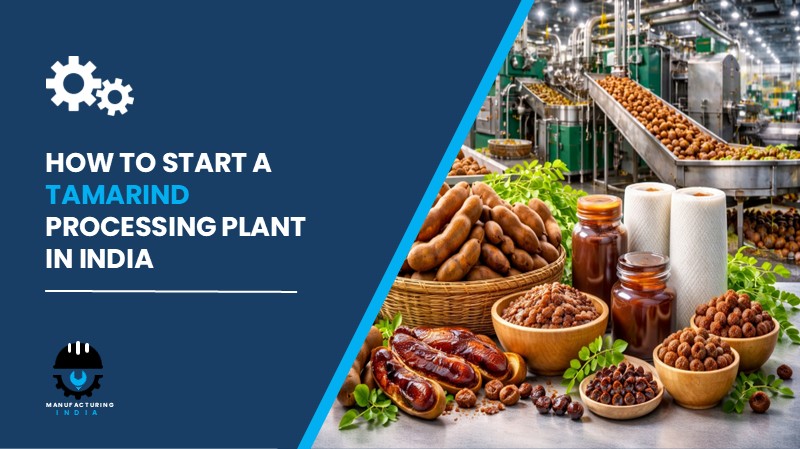
Setting up a tamarind processing plant in India presents a compelling investment case driven by surging demand from the food and beverage industry, the spice and seasoning sector, and the rapidly expanding ready-to-eat and convenience food market. Tamarind’s unique natural acidity and flavour versatility make it an indispensable ingredient in sauces, chutneys, curries, beverages, and spice blends products consumed daily by hundreds of millions across Indian households and exported to Asia, Africa, the Middle East, and Latin America. As consumer preference firmly shifts away from synthetic acidulants toward clean-label, minimally processed ingredients, tamarind stands out as one of the most commercially attractive natural food ingredients available today.
India’s inherent advantages abundant tropical agricultural land, a cost-competitive labour force, well-established agri-processing clusters in states such as Maharashtra, Tamil Nadu, Andhra Pradesh, and Karnataka, and the central government’s Make in India initiative create a strategically sound foundation for this investment. Rapid urbanisation is reshaping dietary habits, with more consumers seeking ready-to-use cooking ingredients and packaged food products. Simultaneously, the food service industry’s growing reliance on standardised tamarind pulp and concentrates reinforces the case for commercial-scale processing. APAC, which includes India, holds the dominant share of the global tamarind processing market at 45.3%, confirming that domestic production is aligned with the world’s highest-demand geography.
Setting up a tamarind processing plant in India combines policy support through Make in India, access to the world’s largest tamarind-growing belt, and strong demand from food processors, spice manufacturers, and beverage producers. With gross profit margins of 30-40% and a break-even horizon of four to eight years, this facility represents a commercially viable, long-term investment for agri-food entrepreneurs and institutional investors alike.
What is Tamarind?
Tamarind is a tropical fruit harvested from the Tamarindus indica tree, prized globally for its distinct tangy taste and remarkable culinary versatility. The tree yields three principal commercial forms: whole pods, deseeded pulp, and paste. In its processed forms, tamarind offers a longer shelf life, more stable quality, and far greater ease of handling compared to raw pods all of which make commercial processing highly valuable.
Beyond cooking, tamarind is used in beverages, sauces, chutneys, seasonings, confectionery, and herbal medicine, owing to its antioxidant, digestive, and antimicrobial properties. Its natural sourness makes it the preferred choice over artificial acidulants in clean-label food formulations. The primary production method is a multi-step operation covering cleaning and sorting of raw pods, shell removal, deseeding, pulp extraction, filtration, concentration or drying, quality inspection, and packaging.
The end-use industries served by a tamarind processing unit include the food and beverage industry, producers of spices and seasonings, manufacturers of ready-to-eat and convenience foods, beverage production companies, and retail food brands. Principal applications span sauces, chutneys, curries, spice mixes, soups, beverages, marinades, and traditional food preparations.
Cost of Setting Up a Tamarind Processing Plant in India
The total cost of establishing a tamarind processing plant in India depends on several interdependent variables, including plant capacity, chosen technology and automation level, geographic location, and the extent of regulatory compliance infrastructure required.
1. Capital Expenditure (CapEx)
Land and site development represent a substantial component of the initial investment, covering land registration charges, boundary development, and related site preparation expenses. Investors may explore locating the facility within a Special Economic Zone (SEZ) or a state-designated industrial estate to access concessional land rates, streamlined approvals, and infrastructure benefits. Civil works costs cover construction of the processing shed, laboratory, raw material and finished goods storage, and the administrative block all of which must meet food safety and FSSAI compliance standards.
Machinery and equipment costs account for the largest single portion of capital expenditure in a tamarind processing plant. Key machinery required includes:
- Pod breakers
- Deseeding machines
- Pulping machines
- Soaking tanks
- Juice extractors
- Filters
- Evaporators
- Dryers
- Mixers
- Sterilizers
- Labeling systems
- Packaging units
- Quality inspection systems
- Storage facilities
Other capital costs include effluent treatment plant (ETP) construction, pre-operative and commissioning expenses, and applicable import duties on specialised equipment procured internationally.
Request a Sample Report for In-Depth Market Insights: https://www.imarcgroup.com/tamarind-processing-plant-project-report/requestsample
2. Operational Expenditure (OpEx)
Raw material cost is the dominant driver of operating expenditure in a tamarind processing facility, accounting for approximately 60-70% of total OpEx. The primary raw materials are fresh tamarind pods, water, sugar, and preservatives, with salt and spices added depending on the product. Packaging materials including pouches, jars, and bulk containers form an additional procurement line. To stabilise pricing and ensure consistent supply, operators are strongly advised to negotiate long-term contracts with reliable regional suppliers, particularly given the seasonal nature of tamarind harvests.
Utility costs covering electricity, water, and steam constitute approximately 15-20% of operational expenditure. Additional operating costs include transportation and logistics, packaging, salaries and wages, maintenance, depreciation, taxes, and quality control expenditure. By the fifth year of operations, total operational costs are projected to increase substantially, driven by inflation, market fluctuations, potential rises in key material costs, supply chain dynamics, and rising consumer demand.
3. Plant Capacity
The proposed processing facility is designed with an annual production capacity ranging between 5,000 and 10,000 MT, enabling economies of scale while maintaining operational flexibility. Capacity can be customised per investor requirements, and profitability improves meaningfully with higher capacity utilisation rates over time.
4. Profit Margins and Financial Projections
The tamarind processing plant demonstrates healthy profitability under normal operating conditions. Gross profit margins typically range between 30–40%, supported by stable demand and value-added product applications. Net profit margins fall in the range of 12–18% on an average basis across the five-year projection window. Comprehensive financial projections, including NPV, IRR, break-even analysis, liquidity ratios, and sensitivity analysis, are developed based on realistic assumptions about capital investment, OpEx, capacity utilisation, pricing trends, and demand outlook. Break-even is typically achieved within four to eight years depending on scale, market pricing, and export revenue.
Why Set Up a Tamarind Processing Plant in India?
Growing Demand for Natural Ingredients. The clean-label and minimally processed food movement is creating sustained demand for tamarind as a natural souring and flavouring agent. Indian and global consumers are actively moving away from synthetic acidulants, and tamarind’s natural credentials place it squarely in the preferred ingredients category for food manufacturers reformulating their product lines.
Strong Culinary Versatility and Export Pull. Tamarind is used extensively across Asian, African, Middle Eastern, and Latin American cuisines, creating durable demand in both domestic and export markets. Processed tamarind products offer consistent quality and longer shelf life, making them highly sought after in international markets where raw tamarind supply is unavailable.
Value Addition Opportunity. The price differential between raw tamarind pods and commercially processed forms pulp, concentrate, powder, or paste is significant enough to provide strong margins for manufacturers. The unit demonstrates particularly attractive returns when production is scaled and value-added product lines are introduced alongside commodity forms.
Urbanisation and Changing Eating Habits. Rising urbanisation across Indian Tier-1 and Tier-2 cities is reshaping consumption patterns, with consumers seeking ready-to-use cooking ingredients and convenience food solutions. According to Fontana Flavors, approximately 72% of consumers expressed curiosity to try new foods and dishes discovered on social media in 2023, with Gen Z and Millennials showing the strongest interest a behavioural trend that directly accelerates demand for bold, tangy tamarind flavours gaining visibility through viral recipes and global cuisine content.
Active Industry Investment. The tamarind ingredients space is attracting fresh investment from established FMCG and nutraceutical players. In June 2025, Tylenol’s parent company launched a new dietary supplement range, “Proactive Support,” incorporating a proprietary tamarind-based ingredient (TamaFlex) alongside turmeric extract for joint health. In April 2025, Dharampal Satyapal Group (DS Group) expanded its Pulse portfolio with Pulse Golmol Imli Flavoured Goli, a tamarind-profile digestive candy priced at INR 1 per pouch, targeting nationwide consumers across generations. These developments confirm the product’s expanding commercial footprint.
Scalable Processing Technology. Tamarind processing is a moderately capital-intensive operation that allows for easy capacity expansion as market demand grows. This scalability makes the investment suitable for both start-up agri-food ventures and larger players looking to integrate tamarind processing into an existing food manufacturing operation.
Manufacturing Process – Step by Step
The tamarind processing manufacturing process uses cleaning, extraction, and concentration or drying as the primary production method, encompassing multiple unit operations, material handling stages, and quality checkpoints.
- Sourcing and Sorting: Ripe tamarind pods are procured from farms or suppliers and sorted based on quality and ripeness.
- De-shelling and Deseeding: Pods are processed manually or mechanically using pod breakers and deseeding machines to separate the pulp from the husk and seeds.
- Soaking and Softening: Pulp is soaked in water using soaking tanks to facilitate extraction and improve consistency.
- Pulping and Filtering: Pulping machines and filters are used to obtain smooth tamarind concentrate or paste, free from fibrous material.
- Mixing: Sugar, salt, or preservatives are blended into the pulp depending on the type of product required.
- Heating and Concentration: Evaporators heat and concentrate the pulp to achieve desired texture, flavour, and shelf stability.
- Drying or Paste Formation: Dryers are used for tamarind powder, blocks, or semi-solid pulp production as per market requirements.
- Quality Inspection: Analytical instruments monitor product concentration, purity, and stability at this stage.
- Packaging and Labeling: Finished products are packaged in jars, sachets, or bulk containers using packaging units and labeling systems, then dispatched to food processors, spice manufacturers, beverage producers, and retail food brands.
Key Applications
Tamarind in its processed forms serves a wide range of industries, each relying on its natural acidity, flavour profile, and clean-label credentials.
- Food and Beverage Industry: Used in industrially manufactured sauces, chutneys, curries, soups, and beverages for its natural acidity and distinctive flavour.
- Spice and Seasoning Industry: Tamarind pulp and powder are common components in masala and spice blends produced for both domestic and global markets.
- Ready-to-Eat and Convenience Foods: Used in packed meals, instant mixes, and snacks as a flavour enhancer and clean-label souring ingredient.
- Retail and Household Consumption: Packaged tamarind in pouches provides consistent flavour, convenience, and hygiene for everyday home cooking.
Leading Manufacturers
The global tamarind processing industry includes a set of established players with significant production capacities and diverse end-use application portfolios. Key players in the industry include:
- Tamarind Kernel Products Pvt. Ltd.
- Tamarind House
- Kancor Ingredients Limited
- PT. Indofood Sukses Makmur Tbk
- Mevive International Food Ingredients
- Everest Spices
- Synthite Industries
- Tamarind Cooperative Society of Thailand
- Rani Group of Companies
- Unilever Food Solutions
- Paras Food Products
- MTR Foods
Timeline to Start the Plant
Establishing a tamarind processing plant in India typically requires 12 to 24 months from initiation to commercial launch, subject to site conditions and regulatory timelines. Key phases include:
- Feasibility study and project report preparation
- Land acquisition and site development
- Regulatory approvals and environmental clearances
- Factory licence and fire safety compliance
- Machinery procurement and installation
- Raw material supplier agreements and supply chain setup
- Trial production and quality testing
- Commercial production launch
Licences and Regulatory Requirements
Starting a tamarind processing manufacturing unit in India requires several approvals, each critical to legal and operational compliance:
- Business registration (Proprietorship, LLP, or Pvt Ltd)
- Factory Licence under the Factories Act
- Environmental Clearance from State Pollution Control Board
- GST Registration
- Fire Safety NOC
- FSSAI licence for food processing operations
- Effluent Treatment Plant (ETP) operational clearance
- Occupational Health and Safety compliance
Key Challenges to Consider
High Capital Requirements. Land, civil works, and specialised machinery such as evaporators, pulpers, and dryers represent a substantial upfront investment that demands careful project financing and phased execution planning.
Raw Material Price Volatility. Fresh tamarind pods, sugar, and preservatives are subject to seasonal supply fluctuations and price variability, with raw materials accounting for 60–70% of OpEx. Long-term procurement contracts are essential to mitigating this exposure.
Regulatory Compliance. Obtaining environmental clearances, factory licences, FSSAI approvals, and ETP compliance certification involves multi-agency coordination and can extend the pre-operative timeline significantly.
Competition. The presence of established players such as Kancor Ingredients Limited, Synthite Industries, MTR Foods, and Unilever Food Solutions means new entrants must compete on quality, consistency, and value-added product differentiation.
Skilled Manpower. Recruiting and retaining technically trained staff for pulp extraction, quality control, and packaging operations is a recurring operational challenge, particularly in locations away from agri-food processing clusters.
Technology and Innovation Pressure. Technological advances in pulp extraction and drying are continuously raising yield benchmarks and product quality standards, requiring periodic capex reinvestment to remain competitive.
Frequently Asked Questions
1. How much does it cost to set up a tamarind processing plant in India? The total investment depends on capacity, technology, and location, covering land, civil works, machinery including pod breakers, pulpers, dryers and evaporators, pre-operative costs, and working capital. A detailed project report provides a unit-specific cost model.
2. Is tamarind processing profitable in India in 2026? Yes. The facility demonstrates gross profit margins of 30–40% and net margins of 12–18%, supported by strong domestic and export demand for natural, clean-label food ingredients.
3. What machinery is required for a tamarind processing plant in India? Key equipment includes pod breakers, deseeding machines, pulping machines, soaking tanks, juice extractors, filters, evaporators, dryers, mixers, sterilizers, packaging units, labeling systems, and quality inspection systems.
4. What licences and approvals are required to start a tamarind processing plant in India? Requirements include business registration, Factory Licence, Environmental Clearance from the State Pollution Control Board, FSSAI licence, GST Registration, Fire Safety NOC, and ETP operational clearance.
5. What raw materials are needed for tamarind processing? The primary raw material is fresh ripe tamarind pods, along with water, sugar, preservatives, and sometimes salt or spices depending on the end product. Packaging materials such as pouches, jars, and containers are also required.
6. What are the environmental compliance requirements for a tamarind processing plant in India? The facility must install and operate an Effluent Treatment Plant (ETP), obtain Environmental Clearance from the State Pollution Control Board, and comply with emission and effluent discharge norms under applicable environmental regulations.
7. What is the best location to set up a tamarind processing plant in India? Ideal locations offer proximity to tamarind-producing regions, reliable transport and utility infrastructure, and access to agri-processing industrial estates. States such as Tamil Nadu, Andhra Pradesh, Karnataka, and Maharashtra are among the most suitable options.
8. What is the break-even period for this type of plant in India? Break-even for a tamarind processing facility typically ranges from four to eight years, depending on plant scale, raw material pricing, capacity utilisation, and export market penetration.
9. What government incentives are available for manufacturers in India? Governments may offer capital subsidies, tax exemptions, reduced utility tariffs, export benefits, and interest subsidies under various national and state industrial promotion schemes, including Make in India and agri-processing cluster programmes.
Key Takeaways for Investors
The tamarind processing plant in India represents a commercially sound opportunity anchored by durable demand from the food and beverage industry, spice and seasoning manufacturers, ready-to-eat food producers, and retail food brands seeking clean-label natural ingredients. The facility is financially viable across a range of plant capacities, with gross margins of 30-40% and net margins of 12-18% achievable under normal operating conditions and standard capacity utilisation trajectories. APAC holds 45.3% of the global tamarind processing market share, and India sits at the centre of this dominant regional demand zone, benefiting simultaneously from the world’s most extensive tamarind cultivation base and one of the fastest-growing processed food consumption markets. With urbanisation accelerating, clean-label demand intensifying, and industry investment flowing from both FMCG conglomerates and nutraceutical companies, the long-term demand sustainability for commercially processed tamarind is well established.
About the Author