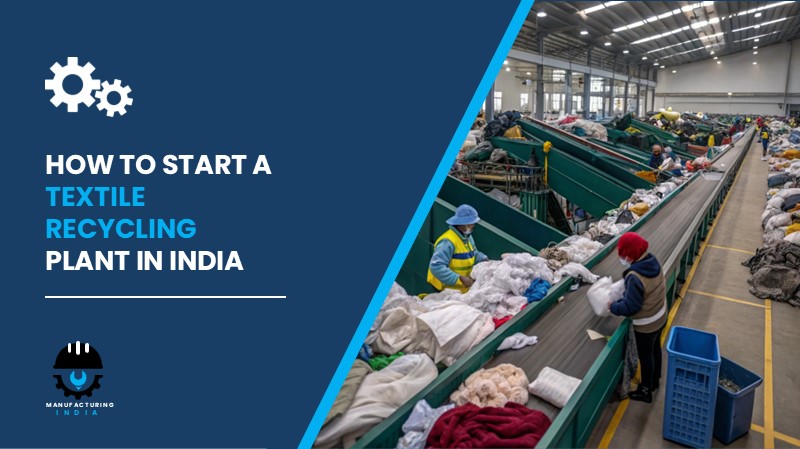
Setting up a textile recycling manufacturing plant in India presents a compelling investment case, driven by surging demand from the apparel and fashion, home textiles, automotive, and industrial sectors. As one of the world’s largest textile producers and consumers, India generates enormous volumes of post-consumer and pre-consumer textile waste, creating an abundant and cost-effective feedstock base for recyclers. Recycled fibers — including recycled cotton, polyester, wool, and blended variants — are increasingly critical to India’s broader sustainability agenda, feeding into yarn manufacturing, nonwoven fabrics, insulation materials, automotive interiors, cleaning textiles, and furniture padding.
India’s strategic advantages make it an ideal base for establishing this facility. The country’s accelerating urbanisation, large-scale infrastructure development, and the Make in India initiative collectively drive demand for recycled industrial textiles, automotive interiors, and home furnishing materials. Key manufacturing states such as Gujarat, Maharashtra, Tamil Nadu, and Rajasthan already host mature textile ecosystems, offering proximity to raw material flows, skilled labour, and downstream buyers. Investors who move early can lock in cost-competitive positioning within a supply chain that is rapidly pivoting toward circular economy models.
India’s combination of policy support, a vast post-consumer textile waste base, cost-competitive land and labour, and sustained demand across apparel, automotive, and home textiles makes a textile recycling plant a financially viable and strategically sound investment. With gross margins of 30–40% and net margins of 10–18%, and growing regulatory pressure on extended producer responsibility, this segment offers compelling break-even viability for investors seeking sustainable manufacturing opportunities.
What is Textile Recycling?
Textile recycling is the process of retrieving textile materials — including fibers, yarns, and fabrics — from both pre-consumer and post-consumer textile waste, and transforming them into reusable raw materials. The process begins with sorting and shredding, followed by mechanical or chemical fiber recovery, and concludes with cleaning and reprocessing to produce recycled fibers such as recycled cotton, polyester, wool, and blended fibers.
The practice of textile recycling delivers measurable environmental benefits: it decreases landfill volume, reduces the need for virgin raw materials, conserves water and energy resources, and decreases greenhouse gas emissions. These advantages are becoming central to corporate ESG commitments and government sustainability mandates globally and within India. The primary production method applied in the textile recycling process is a multi-stage sequence involving sorting, shredding, fiber recovery (mechanical or chemical), cleaning, and re-spinning or baling.
Recycled fibers produced through this process serve a wide range of end-use industries, including apparel and fashion, home textiles, automotive textiles, and industrial applications. Product forms include recycled yarns, blended fabrics, nonwoven fabrics, insulation materials, seat padding, interior linings, carpets, rugs, upholstery fabrics, and industrial wipes — demonstrating the breadth of commercial opportunity available to investors entering this sector.
Cost of Setting Up a Textile Recycling Plant in India
The total cost of establishing a textile recycling plant in India depends on a combination of factors: production capacity, technology selection (mechanical versus chemical recycling), plant location, degree of automation, and regulatory compliance requirements. Investors should conduct a detailed feasibility study before committing capital, as costs can vary significantly across these parameters.
1. Capital Expenditure (CapEx)
Land and Site Development represents a substantial component of total capital investment. In India, investors may consider locating within a Special Economic Zone (SEZ) or a designated industrial estate to benefit from infrastructure subsidies, streamlined approvals, and lower land registration costs. Charges for land acquisition, boundary development, and related site preparation form a foundational part of the overall investment outlay.
Civil Works and Construction cover the fabrication of the main production shed, quality control laboratory, raw material and finished goods storage areas, effluent treatment infrastructure, and the administrative block. The scale of civil works will depend on the chosen plant capacity and the automation level of the recycling line.
Machinery and Equipment account for the largest share of total capital expenditure. Key machinery required includes:
- Textile sorters
- Shredders
- Fiber openers
- Washing units
- Dryers
- Balers
- Re-spinning systems
The selection of high-quality, corrosion-resistant machinery tailored specifically for textile recycling production is critical to achieving consistent fiber quality and operational reliability. All equipment must comply with industry standards for safety, efficiency, and throughput.
Other Capital Costs include effluent treatment plant (ETP) installation, pre-operative expenses, commissioning charges, and applicable import duties on specialised machinery components not manufactured domestically.
Request a Sample Report for In-Depth Market Insights: https://www.imarcgroup.com/textile-recycling-plant-project-report/requestsample
2. Operational Expenditure (OpEx)
Raw Material Cost is the single largest driver of ongoing operating expenses, accounting for approximately 40–50% of total OpEx. The primary raw material for a textile recycling plant is post-consumer and industrial textile waste. Given price volatility in this input category, investors are advised to negotiate long-term contracts with reliable waste aggregators, garment manufacturers, and industrial textile generators to stabilise procurement costs and ensure supply continuity.
Utility Cost — covering electricity, water, and steam — constitutes the second-largest operational cost bucket, representing approximately 20–25% of total OpEx. Shredding, fiber opening, and washing operations are energy-intensive, making electricity tariff rates and renewable energy access important location selection factors.
Other Operating Costs include transportation and inbound logistics for raw material collection, outbound packaging and dispatch, salaries and wages for production and supervisory staff, routine equipment maintenance, depreciation on fixed assets, GST and statutory taxes, and third-party quality testing. By the fifth year of operations, total operational costs are expected to increase due to inflation, market fluctuations, potential rises in waste textile procurement costs, supply chain disruptions, and shifts in the global economy.
3. Plant Capacity
The proposed textile recycling facility is designed with an annual production capacity ranging between 5,000 and 20,000 metric tonnes (MT), enabling economies of scale while maintaining operational flexibility. This capacity range allows investors to configure the plant to match available waste feedstock volumes and target market demand. Plant capacity can be customised to meet specific investor requirements, and profitability improves substantially with higher capacity utilisation as fixed costs are spread across greater production volumes.
4. Profit Margins and Financial Projections
The textile recycling plant demonstrates healthy profitability potential under normal operating conditions. Gross profit margins typically range between 30–40%, supported by stable downstream demand and value-added applications across apparel, automotive, and industrial sectors. Net profit margins average between 10–18% over the project lifecycle. A comprehensive financial analysis covering Net Present Value (NPV), Internal Rate of Return (IRR), payback period, liquidity analysis, profit and loss account, uncertainty analysis, and sensitivity analysis is essential to evaluating project viability and securing project funding.
Why Set Up a Textile Recycling Plant in India?
Growing Post-Consumer Textile Waste Volumes: India is among the world’s top textile-producing and consuming nations, generating massive volumes of post-consumer garment waste and industrial off-cuts. This creates a structurally abundant and low-cost feedstock base that supports competitive raw material procurement for recycling operations at scale.
Rising Demand from Apparel Brands Committing to Recycled Content: The demand for recycled fibers is accelerating as apparel brands commit to using recycled or sustainable materials in line with ESG goals. Recycled polyester is gaining particular traction due to its lower carbon footprint compared to virgin polyester, driving procurement volumes across India’s large domestic fashion manufacturing sector.
Regulatory and Brand Pressure Through EPR and Recycled Content Mandates: Fashion brands and governments have implemented increasingly stringent sustainability requirements, including extended producer responsibility (EPR) and recycled content regulations, creating a sustained and growing market demand for recycled fibers. These mandates are expected to tighten over the coming years, rewarding early movers who establish compliant recycling infrastructure.
Cost-Competitive Manufacturing Environment: India offers investors access to cost-effective land in industrial zones, a large and trainable labour pool, and an established textile supply chain ecosystem. Manufacturing states such as Gujarat, Maharashtra, and Tamil Nadu provide proximity to both raw material generators and downstream yarn and fabric producers, reducing transportation costs across the value chain.
Active Global and Domestic Investment Signals: In January 2026, French textile recycling company Reju planned to invest approximately $390 million to establish a major North American recycling hub in Rochester. In October 2025, Selenis and Syre entered a strategic alliance to develop a textile-to-textile recycling facility in Cedar Creek, North Carolina, integrating advanced depolymerisation and polymerisation technologies. In June 2025, Lululemon announced a multi-year collaboration with recycling startup Samsara Eco to advance circular textile solutions using enzyme-based technology. These global commitments signal that institutional capital is flowing into textile recycling infrastructure — validating the business model for Indian investors.
Localization and Supply Chain Security for Circular Economy Goals: Brands are increasingly shifting toward regional recycling partners because these partners offer better material traceability, reduced transportation emissions, and reliable raw material delivery. Indian recyclers serving domestic apparel, home textiles, and automotive manufacturers are well-positioned to capture this preference for near-shored circular supply chains.
Manufacturing Process Step by Step
The textile recycling process uses sorting, shredding, fiber recovery (mechanical or chemical), cleaning, and re-spinning or baling as the primary production method. This multi-stage textile recycling process involves several unit operations, material handling steps, and quality checks throughout.
- Sorting: Incoming post-consumer and industrial textile waste is sorted by fiber type, colour, and composition using textile sorters to ensure consistent feedstock quality for downstream processing.
- Shredding: Sorted textile waste is fed into industrial shredders that break down garments, fabrics, and textile off-cuts into smaller fibre-rich fragments suitable for further processing.
- Fiber Opening: Shredded material passes through fiber openers, which mechanically separate and loosen individual fibers, producing a fibrous mass ready for cleaning and recovery.
- Washing: Fiber material is processed through washing units to remove contaminants, dyes, chemical residues, and impurities, ensuring the recovered fiber meets quality specifications.
- Drying: Washed fiber passes through industrial dryers to remove moisture, preparing the material for baling or re-spinning operations.
- Fiber Recovery (Mechanical or Chemical): Depending on the fiber type and target output quality, mechanical or chemical recovery processes are applied to maximise fiber yield and product purity.
- Re-Spinning or Baling: Recovered fibers are either re-spun into recycled yarn on re-spinning systems for apparel and home textile applications, or compacted into bales for supply to nonwoven fabric, insulation material, and industrial textile manufacturers.
- Quality Control and Dispatch: Final recycled fiber or yarn products undergo quality testing for concentration, purity, and consistency before packaging and dispatch to end-use industries including apparel, home textiles, automotive, and industrial sectors.
Key Applications
Textile recycling output serves a diverse range of industries, with recycled fibers and yarns used across apparel, home furnishings, automotive, and industrial manufacturing sectors.
- Apparel and Fashion: Used in recycled yarns, blended fabrics, and sustainable garments by clothing manufacturers seeking recycled content for ESG compliance.
- Home Textiles: Employed in the production of carpets, rugs, upholstery fabrics, and blankets for the domestic and commercial interior furnishings market.
- Automotive: Utilised in seat padding, insulation felts, and interior linings within the vehicle manufacturing supply chain.
- Industrial: Used in nonwoven fabrics, industrial wipes, and insulation materials serving construction, engineering, and manufacturing applications.
Leading Manufacturers
The global textile recycling market features a mix of multinational corporations, specialised recyclers, and vertically integrated textile groups with extensive production capacities and diverse application portfolios. Key players operating in this industry include:
- BLS Ecotech Ltd. (BLS Group)
- Boer Group
- Lenzing AG
- Martex Fiber (Leigh Fibers)
- Pistoni S.r.l.
- Remondis SE & Co. KG
- Respun (Kay Gee Enterprises)
- Unifi Inc.
- Usha Yarns Ltd.
- Birla Cellulose (Aditya Birla Group)
These players serve end-use sectors including apparel, home textiles, automotive, and industrial textiles, and set competitive benchmarks that Indian investors should evaluate when designing their own plant configurations and go-to-market strategies.
Timeline to Start the Plant
Establishing a textile recycling manufacturing plant involves a structured sequence of phases typically spanning 18–30 months from planning to commercial launch in India, depending on plant scale and location approvals:
- Feasibility study and project report preparation
- Land acquisition and site development
- Regulatory approvals and environmental clearances
- Factory licence and fire safety compliance
- Machinery procurement and installation
- Raw material supplier agreements and supply chain setup
- Trial production and quality testing
- Commercial production launch
Licences and Regulatory Requirements
Starting a textile recycling manufacturing unit in India requires several approvals across central and state-level regulatory bodies:
- Business registration (Proprietorship, LLP, or Private Limited Company)
- Factory Licence under the Factories Act, 1948
- Environmental Clearance from the State Pollution Control Board
- GST Registration under the Goods and Services Tax framework
- Fire Safety NOC from the local Fire Department
- Hazardous and Chemical Waste compliance under the Environment Protection Act (applicable given chemical processing stages)
- Effluent Treatment Plant (ETP) operational clearance to manage wash-water discharge
- Occupational Health and Safety compliance under applicable labour and industrial safety legislation
Key Challenges to Consider
High Capital Requirements: The initial capital investment for land, civil construction, and specialised textile recycling machinery — including textile sorters, shredders, fiber openers, washing units, dryers, balers, and re-spinning systems — is substantial and requires careful financial planning and access to project funding.
Raw Material Price Volatility: Post-consumer and industrial textile waste procurement costs can fluctuate based on waste collection infrastructure, competing demand from other recyclers, and shifts in the domestic garment manufacturing cycle. Long-term supplier contracts and diversified sourcing strategies are essential risk mitigation tools.
Regulatory Compliance: Meeting environmental clearance, ETP operational, effluent discharge, and hazardous waste handling requirements adds complexity and cost to plant setup and ongoing operations. Staying ahead of evolving EPR mandates will require dedicated compliance resources.
Technology and Innovation Pressure: Technological advancements in fiber separation and chemical recycling — such as enzyme-based processes and advanced depolymerisation — are expected to further enhance recovery rates and profitability. Investors must evaluate their textile recycling process technology choices carefully to avoid premature obsolescence and stay competitive with global players who are investing heavily in next-generation recycling systems.
Competition from Established Players: The presence of global players such as Lenzing AG, Unifi Inc., Birla Cellulose (Aditya Birla Group), and Remondis SE & Co. KG means that new entrants must differentiate on fiber quality, service reliability, or cost efficiency to secure offtake agreements with domestic buyers.
Skilled Manpower Availability: Operating fiber recovery, re-spinning, and quality control equipment requires trained technical staff. Investing in workforce development and retaining skilled operators is critical to achieving consistent production quality and maintaining plant uptime.
Frequently Asked Questions
1. How much does it cost to set up a textile recycling manufacturing plant in India?
The total investment varies based on plant capacity (5,000–20,000 MT per annum), automation level, textile recycling process technology type, and location. Key cost heads include land and site development, civil works, machinery (sorters, shredders, fiber openers, washers, dryers, balers, re-spinning systems), and pre-operative expenses. A detailed project report is recommended to obtain location-specific investment estimates.
2. Is textile recycling manufacturing profitable in India in 2026?
Yes. The textile recycling plant demonstrates strong profitability potential with gross margins of 30–40% and net margins of 10–18%, supported by growing demand for recycled fibers, regulatory-driven procurement mandates, and a cost-competitive raw material base within India.
3. What machinery is required for a textile recycling plant in India?
Key equipment includes textile sorters, shredders, fiber openers, washing units, dryers, balers, and re-spinning systems. Equipment must comply with industry standards for safety, efficiency, and reliability.
4. What licences and approvals are required to start a textile recycling plant in India?
Required approvals include business registration, Factory Licence under the Factories Act, Environmental Clearance from the State Pollution Control Board, GST Registration, Fire Safety NOC, Hazardous/Chemical compliance, ETP operational clearance, and Occupational Health and Safety compliance.
5. What raw materials are needed for textile recycling manufacturing?
The primary raw material is post-consumer and industrial textile waste, which accounts for 40–50% of total operating expenditure. Securing long-term supply contracts with reliable waste aggregators, garment manufacturers, and industrial textile generators is essential for cost stability.
6. What are the environmental compliance requirements for a textile recycling unit in India?
The unit must obtain Environmental Clearance from the State Pollution Control Board, maintain an operational Effluent Treatment Plant to manage wash-water discharge, comply with hazardous and chemical waste handling norms, and maintain emissions monitoring in line with applicable environmental protection regulations.
7. What is the best location to set up a textile recycling manufacturing plant in India?
Optimal locations are in states with established textile manufacturing clusters and ready access to post-consumer and industrial textile waste, such as Gujarat, Maharashtra, Tamil Nadu, and Rajasthan. Proximity to raw material sources, reliable utilities, and logistics infrastructure are key site selection criteria.
8. What is the break-even period for this type of plant in India?
The payback period depends on plant capacity, capacity utilisation rate, product pricing, and financing structure. A detailed financial analysis covering NPV, IRR, and payback period projections is included in a comprehensive project report to provide investor-specific timelines.
9. What government incentives are available for manufacturers in India?
Investors in textile recycling can explore benefits under the Make in India initiative, state industrial promotion policies, SEZ incentives for eligible locations, and emerging extended producer responsibility (EPR) frameworks that may provide compliance-linked market access advantages.
Key Takeaways for Investors
A textile recycling plant in India represents a high-potential investment opportunity anchored by strong and growing demand from the apparel and fashion, home textiles, automotive, and industrial sectors, all of which are increasingly required to incorporate recycled fiber content within their supply chains. The investment demonstrates sound financial viability across a broad range of plant capacities — from 5,000 to 20,000 MT per annum — with gross margins of 30–40% and net margins of 10–18% under normal operating conditions. The global textile recycling market was valued at USD 5.53 billion in 2025 and is projected to reach USD 6.84 billion by 2034, exhibiting a CAGR of 2.4% from 2026 to 2034, reflecting the long-term structural growth of this sector. With regulatory mandates tightening around extended producer responsibility, brand-driven recycled content commitments accelerating, and global capital flowing into recycling infrastructure as evidenced by recent major investments, the demand sustainability outlook for Indian textile recycling investors is firmly positive.
About the Author