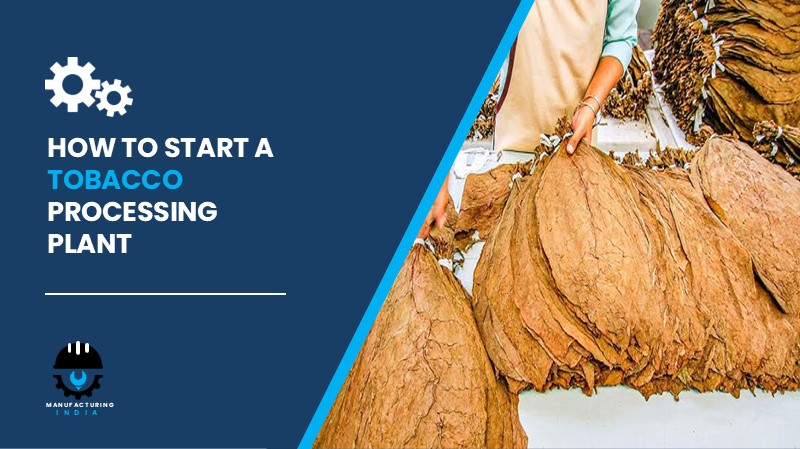
Setting up a tobacco processing plant in India presents a commercially grounded investment case supported by the country’s position as one of the world’s largest tobacco producers and exporters, its well-established leaf tobacco growing belts, and the consistent domestic and international demand for processed tobacco across cigarette manufacturing, cigar production, and the growing heat-not-burn (HNB) product segment. India’s tobacco sector – anchored in the agricultural states of Andhra Pradesh, Telangana, Karnataka, and Gujarat provides investors with direct access to large-volume flue-cured, burley, and oriental tobacco leaf at competitive prices, combined with an established export infrastructure through ports in Kakinada, Guntur, and Chennai that serves buyers across Europe, the Middle East, and Asia-Pacific. The tobacco processing industry occupies a strategically significant position in India’s agricultural value chain, converting raw leaf into specification-consistent, commercially ready processed tobacco that commands significant price premiums over unprocessed farm gate leaf.
India’s structural advantages make it a well-positioned location for establishing a tobacco processing facility. The Tobacco Board of India, operating under the Ministry of Commerce and Industry, provides a structured regulatory and licensing framework for tobacco processors, while the country’s large workforce in tobacco-growing states supplies experienced labour for leaf grading, processing, and quality sorting operations. The increasing demand for tobacco due to the rising number of smokers globally, the growing adoption of innovative flavoured cigarette products including menthol, honey, peach, apple, cherry, and chocolate variants, and the wide availability of various heat-not-burn tobacco products with different properties are all contributing to the sustained commercial attractiveness of processed tobacco supply. For investors seeking a manufacturing opportunity in India with established export demand, a structured regulatory environment, and direct agricultural feedstock access, the tobacco processing plant is a commercially viable and carefully understood investment category.
A tobacco processing plant in India leverages one of the world’s largest leaf tobacco production bases, established export relationships with global cigarette manufacturers, a growing domestic demand environment driven by rising smoking prevalence and product innovation in flavoured and HNB formats, and a structured Tobacco Board licensing framework. With multi-channel demand across cigarette manufacturing, cigar and pipe tobacco, and heat-not-burn products, this investment delivers commercially viable financial returns for operators with established leaf procurement networks and export market access.
What is Tobacco?
Tobacco refers to a plant from the nightshade family with viscid foliage and tubular flowers, which is primarily smoked in cigarettes and pipes. It contains nicotine, carbon monoxide, arsenic, formaldehyde, and benzene. The processed product is finely cut and often combined with various additives – including licorice, menthol, and lactic acid- before rolling into paper cylinders to manufacture cigars or cigarettes. Processed tobacco is kept in airtight plastic bags or cans and stored in cool temperature conditions to retain its aroma and flavour.
Tobacco activates the reward circuits of the brain and increases the levels of the chemical messenger dopamine, which reinforces rewarding behaviour in smokers. It also releases the hormone epinephrine that stimulates the nervous system and elevates mood while providing relaxation – factors that contribute to its habitual consumption pattern and the stable, recurring demand environment that underpins the tobacco processing industry. Beyond conventional cigarettes, tobacco is increasingly utilised in manufacturing heat-not-burn (HNB) tobacco products – non-combusted cigarettes that produce an inhalable aerosol rather than burning like traditional cigarettes – which represent the fastest-growing product innovation segment within the global tobacco industry. End-use sectors include cigarette manufacturing companies, cigar and pipe tobacco producers, HNB product manufacturers, and export buyers serving global retail and wholesale distribution networks.
Cost of Setting Up a Tobacco Processing Plant in India
The total investment required to establish a tobacco processing plant in India depends on plant capacity, processing technology selection, geographic location, and compliance with Tobacco Board licensing and regulatory requirements. Investors must account comprehensively for both one-time capital expenditure and recurring operational costs when preparing a feasibility study or detailed project report (DPR) for this facility.
1. Capital Expenditure (CapEx)
Land and Site Development constitutes a foundational investment. Costs for land registration, boundary development, drainage infrastructure, internal road construction, and site levelling vary based on whether the facility is located within a Tobacco Board-designated processing zone, an agricultural processing industrial estate, or on privately acquired land in tobacco-growing districts. Processing plant locations in Andhra Pradesh, Telangana, and Karnataka benefit from proximity to primary leaf procurement areas, reducing inbound transportation costs and enabling rapid delivery of freshly cured leaf to the processing floor.
Civil Works and Construction encompasses the primary leaf processing hall accommodating threshing, redrying, and blending operations, along with a raw leaf receiving and storage area – which must maintain controlled humidity and temperature conditions to preserve leaf quality – a blending and conditioning room, quality control laboratory, finished processed tobacco storage facility maintained at specified moisture conditions, and administrative block. Temperature and humidity control requirements throughout the leaf storage and processing areas add to civil construction costs relative to ambient-temperature manufacturing facilities.
Machinery and Equipment represent the single largest component of capital expenditure. Key machinery required for a tobacco processing plant includes:
- Leaf threshing and stemming machines
- Primary redrying cylinders
- Conditioning and humidification equipment
- Blending and mixing conveyors
- Casing and flavouring application systems
- Secondary drying and cooling equipment
- Moisture control and measurement instruments
- Automated packaging and baling machines
- Quality inspection and grading systems
- Storage and climate control systems
Other Capital Costs include the effluent treatment plant (ETP) for managing tobacco dust and process water streams, pre-operative expenses covering Tobacco Board licensing applications and feasibility study preparation, plant commissioning charges, utility connection fees, and import duties applicable to specialised redrying or automated packaging equipment sourced internationally.
Request a Sample Report for In-Depth Market Insights: https://www.imarcgroup.com/tobacco-processing-plant-project-report/requestsample
2. Operational Expenditure (OpEx)
Raw Material Cost is the dominant driver of operating expenditure for this plant type. The primary input is raw tobacco leaf sourced from growers across India’s tobacco-producing districts in Andhra Pradesh, Telangana, Karnataka, and Gujarat. Leaf prices are subject to auction-market pricing dynamics at regulated Tobacco Board auction platforms, with prices varying by leaf grade, colour, body, and nicotine content. Investors are advised to establish direct procurement relationships with contract farming networks and registered tobacco growers to supplement auction procurement, providing price predictability and quality consistency for key leaf grades. Leaf quality – including moisture content, grade uniformity, and chemical composition – directly determines the yield, quality, and commercial value of finished processed tobacco, making raw material quality management as important as cost management in the operating model.
Utility Costs – covering energy for redrying cylinders, conditioning equipment, climate-controlled storage facilities, and packaging lines – represent a significant component of operating expenses. Redrying operations are energy-intensive, requiring controlled heat application across large volumes of leaf material to achieve specified final moisture content. Investors in locations with reliable industrial energy supply and competitive electricity tariffs can manage this cost component more effectively.
Other Operating Costs include outbound transportation to cigarette manufacturers, cigar producers, HNB product manufacturers, and export freight to international buyers; packaging materials for processed tobacco bales, cartons, and moisture-barrier wrapping; employee salaries and wages for leaf graders, processing operators, and quality assurance personnel; equipment maintenance; quality testing for nicotine content, moisture, and contaminant levels; depreciation on civil and machinery assets; and applicable taxes including GST and tobacco-specific levies. By the fifth year of operations, total operational costs are expected to increase substantially due to inflation, market fluctuations, and potential rises in leaf procurement costs driven by agricultural input price trends and seasonal variability.
3. Plant Capacity
Plant capacity for tobacco processing operations is customised based on the investor’s leaf procurement network, target market offtake volume, and available infrastructure. The IMARC Group project report provides detailed analysis of production capacity modelling, mass balance, and unit operations that enable investors to right-size their facility to match sourcing capability and contracted demand. Profitability improves consistently with higher capacity utilisation and premium grade leaf mix, making it commercially prudent to plan processing infrastructure with the flexibility to scale output across different processing seasons and leaf variety programs.
4. Profit Margins and Financial Projections
A comprehensive financial analysis for this type of plant covers income projections, expenditure forecasts, gross margin and net margin tracking across Years 1 through 5, net present value (NPV), internal rate of return (IRR), payback period, and a full profit and loss account. Specific margin data, capital and operating cost breakdowns, and profitability projections at defined plant capacities are detailed within the IMARC Group project report. Sensitivity analysis covering leaf procurement price variability and export market pricing fluctuations is recommended for investment-grade financial planning. Revenue projections account for the price premium that specification-consistent processed tobacco commands over unprocessed leaf in both domestic and export markets.
Why Set Up a Tobacco Processing Plant in India?
Rising Global Demand from Increasing Smoker Populations. The increasing demand for tobacco due to the rising number of smokers around the world represents one of the primary factors sustaining commercial activity in the tobacco processing industry. Consistent baseline demand from established cigarette manufacturing buyers – both domestic and international – provides tobacco processing plants with predictable, recurring order volumes that support investment planning and working capital management.
Innovative Flavoured Cigarette Formats Driving Product Diversification. Key market players are introducing a wide range of innovative flavoured cigarettes including menthol, honey, peach, apple, cherry, and chocolate variants – to expand their product portfolios and cater to evolving consumer preferences. This product innovation trend creates demand for specific processed tobacco blends with tailored flavour profiles, providing processors capable of delivering specification-consistent blended tobacco with precision casing and flavouring application a premium market positioning.
Growth of Heat-Not-Burn Tobacco Products Expanding Application Scope. The wide availability of various heat-not-burn tobacco products – which are non-combusted and produce an inhalable aerosol rather than burning like traditional cigarettes – represents a growing and commercially significant application category for processed tobacco. Manufacturers of HNB products require processed tobacco in highly specified, consistent formats that differ from conventional cigarette cut filler specifications, creating a differentiated demand stream for processors with the technical capability to meet these exacting product requirements.
Working Individuals’ Consumption Patterns Sustaining Domestic Demand. The increasing smoking habits among working individuals to cope with work-related stress and anxiety continue to sustain domestic tobacco consumption in India. This demand base – combined with the increasing prevalence of nicotine dependency among younger demographics – provides domestic cigarette manufacturers with a stable end-user market that drives their leaf procurement requirements and, by extension, the commercial activity of tobacco processing facilities supplying them.
India’s Established Export Infrastructure and Global Buyer Relationships. India is a major global tobacco leaf exporter with established trade relationships spanning Europe, the Middle East, and Asia-Pacific. Tobacco processors in India benefit from this existing export infrastructure – including Tobacco Board quality certification systems, export documentation frameworks, and established freight logistics from major tobacco port hubs – that reduces the market access barriers for new processor entrants seeking to serve international cigarette manufacturing buyers.
Cost-Competitive Processing Environment Near Agricultural Supply Chains. India offers competitive land, construction, labour, and utility costs for tobacco processing relative to comparable processing locations in other major tobacco-producing countries. Locating processing facilities within or adjacent to India’s established tobacco-growing districts in Andhra Pradesh and Telangana minimises raw leaf transportation costs and enables rapid access to freshly cured tobacco at optimal processing moisture conditions – a critical quality advantage in leaf-to-processed-tobacco value conversion.
Processing Process – Step by Step
The tobacco processing plant uses threshing, conditioning, redrying, blending, casing and flavouring, final drying, and packaging as the primary production method. Below are the main stages involved in the tobacco processing process flow:
- Raw Leaf Receipt and Inspection: Raw tobacco leaf is received from growers or auction platforms, weighed, and inspected for grade, moisture content, leaf body, colour, and chemical composition before being allocated to storage or immediate processing scheduling.
- Primary Conditioning: Leaf threshing and stemming machines process the received leaf through initial conditioning to bring it to the optimal moisture level for efficient threshing, using conditioning and humidification equipment to adjust leaf pliability without damaging the lamina structure.
- Threshing and Stemming: Leaf threshing and stemming machines mechanically separate the tobacco lamina (leaf blade) from the central midrib stem, producing lamina strips and stems as distinct product streams. Lamina strip is the primary value-added output for cigarette and HNB product manufacturers.
- Primary Redrying: Primary redrying cylinders apply controlled heat to reduce the moisture content of the threshed lamina to specified levels suitable for storage and subsequent blending operations, while setting the tobacco’s physical structure and preserving flavour components.
- Blending: Blending and mixing conveyors combine tobacco from different leaf grades, growing origins, or variety types in defined proportions to achieve the target blend specification – including nicotine content, burn characteristics, and flavour profile – required by the end-use buyer.
- Casing and Flavouring Application: Casing and flavouring application systems apply moisture-retaining casing solutions and flavour additives – including licorice, menthol, lactic acid, and proprietary flavour concentrates – to the blended tobacco at precisely controlled application rates, enhancing flavour character, burn quality, and product consistency.
- Secondary Drying and Cooling: Secondary drying and cooling equipment processes the cased and flavoured tobacco to the final target moisture specification, with cooling to ambient temperature conditions before packaging to prevent condensation and quality degradation.
- Quality Inspection and Testing: Moisture control and measurement instruments verify final product moisture content across the production batch, while quality inspection and grading systems assess leaf grade consistency, cut filler specification compliance, and additive application uniformity. Nicotine content, chemical composition, and contaminant levels are verified through laboratory testing.
- Packaging and Baling: Automated packaging and baling machines compress and wrap finished processed tobacco into moisture-barrier-sealed bales or cartons of specified weights, with labelling including grade designation, blend code, moisture content, and batch traceability information for domestic and export buyers.
- Controlled Storage and Dispatch: Finished processed tobacco is stored in climate-controlled storage systems at specified temperature and humidity conditions to preserve quality and prevent re-absorption of moisture, before dispatch to cigarette manufacturers, cigar producers, HNB product manufacturers, and export buyers.
Key Applications
Processed tobacco produced at this type of facility serves a range of end-use manufacturing and consumption categories:
- Cigarette Manufacturing: The primary application for processed tobacco cut filler, used by cigarette companies in their blended tobacco recipes for conventional cigarette production across standard, light, and flavoured variants including menthol, honey, peach, apple, cherry, and chocolate formats.
- Cigar and Pipe Tobacco: Processed leaf used in premium cigar manufacturing and pipe tobacco blending, requiring specific leaf grades, flavour profiles, and presentation formats distinct from cigarette cut filler specifications.
- Heat-Not-Burn (HNB) Tobacco Products: Processed tobacco in highly specified, uniformly consistent formats used in non-combusted HNB product manufacturing, which produces an inhalable aerosol rather than burning like traditional cigarettes.
- Export Supply to International Buyers: Processed and graded tobacco exported to international cigarette manufacturers across Europe, the Middle East, and Asia-Pacific who source Indian tobacco for specific blend positions requiring Indian leaf character.
Key Challenges to Consider
Extensive Regulatory and Licensing Framework. Tobacco processing in India operates under the oversight of the Tobacco Board of India, which requires dealers, processors, and exporters to hold specific licences and comply with grading standards, auction platform participation rules, and export documentation requirements. Additionally, the Cigarettes and Other Tobacco Products Act (COTPA) governs production, sale, and advertising standards. Maintaining continuous compliance across this multi-authority regulatory framework demands dedicated regulatory affairs capability and ongoing documentation discipline.
Raw Leaf Procurement Price Volatility. Tobacco leaf prices at Tobacco Board auction platforms are subject to seasonal and weather-related variability driven by crop quality, harvest volume, and competing buyer demand. Premium grade leaf – which commands the highest conversion margins – is subject to intense competition from both domestic and international buyers at auction. Establishing direct contract farming relationships and multi-season procurement commitments helps manage this price volatility risk.
Quality and Grade Consistency Management. Processed tobacco quality – including nicotine content, moisture, burn characteristics, and chemical composition – must meet exacting specifications across every production batch to satisfy long-term buyer contracts. Managing input leaf grade variability from multiple agricultural sources while consistently delivering specification-compliant finished product requires sophisticated blending expertise, analytical testing infrastructure, and experienced leaf quality management personnel.
Reputational and Regulatory Risk from Evolving Tobacco Policy. The global regulatory environment for tobacco is progressively restrictive, with governments implementing graphic health warning requirements, flavour bans, advertising restrictions, and in some jurisdictions, broader product prohibitions. Investors must assess how evolving tobacco regulatory developments – including potential domestic policy changes under India’s COTPA framework and international trade buyer requirements – may affect long-term product demand and market access for specific tobacco product categories.
Skilled Manpower for Leaf Grading and Processing. Tobacco leaf grading and quality assessment require highly experienced personnel with knowledge of leaf grade characteristics, curing quality indicators, and blend composition principles. This expertise is regionally concentrated in traditional tobacco-growing districts of Andhra Pradesh and Telangana, and sourcing, training, and retaining qualified leaf grading and processing personnel for new facilities entering the market is a meaningful operational challenge.
Export Market Competition. India competes with Brazil, Zimbabwe, Malawi, and other major tobacco-exporting nations for global cigarette manufacturer leaf procurement. Maintaining competitive pricing, consistent quality, and reliable supply chain execution is essential for Indian processors seeking to build and defend long-term international buyer relationships against competitive sourcing alternatives.
Frequently Asked Questions
1. How much does it cost to set up a tobacco processing plant in India?
The total cost depends on plant capacity, processing technology selection, location, and automation level. CapEx covers land, humidity-controlled civil construction, and machinery including leaf threshing and stemming machines, primary redrying cylinders, conditioning and humidification equipment, blending conveyors, casing and flavouring systems, secondary drying equipment, and automated packaging and baling machines, along with Tobacco Board licensing and pre-operative costs.
2. Is tobacco processing profitable in India in 2026?
Yes, with India’s established position as a major global tobacco leaf producer and exporter, consistent demand from domestic cigarette manufacturers, and growing application in HNB tobacco products and flavoured cigarette formats, tobacco processing delivers commercially viable returns for operators with strong leaf procurement networks, quality management systems, and established buyer relationships.
3. What machinery is required for a tobacco processing plant in India?
Key equipment includes leaf threshing and stemming machines, primary redrying cylinders, conditioning and humidification equipment, blending and mixing conveyors, casing and flavouring application systems, secondary drying and cooling equipment, moisture control and measurement instruments, automated packaging and baling machines, and quality inspection and grading systems.
4. What licences and approvals are required to start a tobacco processing plant in India?
Required approvals include business registration, Tobacco Board dealer and processor licence, factory Licence under the Factories Act, Environmental Clearance, GST Registration with applicable tobacco-specific duty registrations, Fire Safety NOC, ETP operational clearance, and COTPA compliance documentation for tobacco product manufacture and sale.
5. What raw materials are needed for tobacco processing?
The primary raw material is raw tobacco leaf – including flue-cured, burley, and oriental varieties – sourced from growers through Tobacco Board auction platforms or direct contract farming arrangements. Processing additives include licorice, menthol, lactic acid, and proprietary flavouring concentrates applied during casing and flavouring operations.
6. What are the environmental compliance requirements for a tobacco processing plant in India?
Environmental Clearance from the State Pollution Control Board is required, along with an operational effluent treatment plant for managing tobacco dust and process water streams, compliance with ambient air quality standards for dust emissions from redrying and threshing operations, and adherence to solid waste management rules for tobacco by-product disposal.
7. What is the best location to set up a tobacco processing plant in India?
Andhra Pradesh and Telangana – the heartland of India’s flue-cured Virginia tobacco belt – offer the best combination of raw leaf procurement access, experienced leaf grading and processing labour, Tobacco Board infrastructure, export logistics connectivity, and state-level agricultural processing incentives for tobacco processing plant investors.
8. What is the break-even period for this type of plant in India?
The break-even period depends on plant scale, leaf procurement costs, product mix between domestic and export sales, and buyer contract pricing. A full NPV and IRR analysis incorporating sensitivity testing for leaf price variability and export market pricing is recommended for investment-grade financial planning.
9. What government incentives are available for tobacco processors in India?
State-level agricultural processing industrial incentives in Andhra Pradesh and Telangana, export promotion support through the Tobacco Board and Agricultural and Processed Food Products Export Development Authority (APEDA), and general manufacturing investment incentives under Make in India provide relevant financial and regulatory support for qualifying tobacco processing investments.
Key Takeaways for Investors
A tobacco processing plant in India represents a commercially established investment opportunity for operators with the capability to navigate the sector’s regulatory framework, manage leaf procurement quality and cost dynamics, and build durable relationships with domestic cigarette manufacturers and international export buyers. Demand sustainability is supported by increasing smoker populations globally, active product innovation in flavoured cigarette formats including menthol, honey, peach, apple, cherry, and chocolate variants, and the growing manufacturing requirements for heat-not-burn tobacco products across both domestic and export markets. India’s position as a major global tobacco leaf producer – with established auction infrastructure, export certification systems, and experienced agricultural labour in dedicated tobacco-growing districts – provides processing plant investors with a competitive raw material and operational environment that is difficult to replicate in new geographies. For investors prepared to operate within the sector’s regulatory framework, execute a disciplined leaf procurement and quality management strategy, and maintain the buyer relationships that convert processed tobacco production into sustainable revenue, this investment delivers the financial returns and market access that justify careful and well-prepared entry.
About the Author