Setting up an aluminum extrusion manufacturing plant in India presents a compelling investment case driven by the country’s accelerating infrastructure development, expanding automotive lightweighting demand, rapid growth in renewable energy installations, and surging industrial automation across electronics, telecommunications, and machinery manufacturing sectors. As one of the world’s fastest-growing economies, India is investing heavily in smart cities, metro rail networks, housing projects, solar power capacity, and electric vehicle infrastructure – all of which are primary end-use segments for extruded aluminum profiles. The structural shift toward lightweight, corrosion-resistant, and recyclable materials across these industries is creating durable and multi-sector demand for domestically produced aluminum extrusions at scale.
India’s strategic advantages make it an exceptionally sound location for this investment. The country’s established aluminum smelting capacity, expanding network of industrial estates in Gujarat, Maharashtra, Rajasthan, and Tamil Nadu, and the government’s active policy support through Make in India and the Production-Linked Incentive (PLI) scheme for automotive and electronics components provide investors with competitive land costs, reliable raw material sourcing, and a growing base of OEM, contractor, and system integrator clients preferring local extrusion partners for shorter lead times and consistent supply. India’s large and technically skilled engineering workforce further supports precision-oriented aluminum extrusion operations at competitive labour costs compared to manufacturing locations in Europe or North America.
An aluminum extrusion manufacturing plant in India offers investors access to a global market valued at USD 104.61 billion in 2025, growing at a 7.4% CAGR toward USD 198.88 billion by 2034, underpinned by construction, automotive lightweighting, renewable energy, and electronics demand. With gross profit margins of 25–35% and net margins of 10–15%, combined with Make in India policy support and a competitive raw material supply chain, this investment delivers strong returns and a viable break-even trajectory across a plant capacity range of 20,000 to 50,000 MT per annum.
What is Aluminum Extrusion?
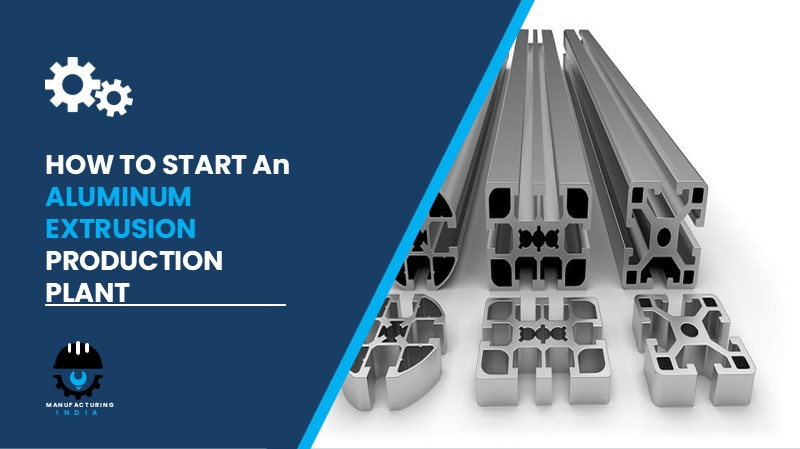
Aluminum extrusion is a production technology where aluminum alloy billets are heated and extruded through a mold to form profiles with uniform cross-sections. The aluminum extrusion process produces components with several highly favorable properties: corrosion resistance, high thermal and electrical conductivity, recyclability, and an exceptional high strength-to-weight ratio. Depending on the aluminum alloy selected and the heat treatment process applied, extruded profiles can offer targeted improvements in mechanical properties, formability, and surface finish, making them adaptable to a wide range of structural, architectural, thermal management, and industrial applications.
The primary production method for this plant type involves three integrated stages: extrusion, heat treatment, and surface finishing. Due to these versatile properties, demand for the aluminum extrusion process has increased across applications including structural and architectural frameworks, transportation components, industrial machinery, and renewable energy systems. The extruded aluminum profiles produced can withstand high temperatures and can be joined using various methods, making them highly compatible with complex assembly and fabrication requirements in construction, automotive, electronics, and telecommunications end-use industries.
Cost of Setting Up an Aluminum Extrusion Manufacturing Plant in India
The total investment required to establish an aluminum extrusion manufacturing plant in India depends on plant capacity, technology selection, geographic location, level of automation, and compliance with industrial safety and environmental regulations. Investors must account comprehensively for both one-time capital expenditure and recurring operational costs when preparing a feasibility study or detailed project report (DPR) for this facility.
1. Capital Expenditure (CapEx)
Land and Site Development constitutes a substantial foundational cost component. Charges for land registration, boundary wall construction, drainage infrastructure, internal roads, and site levelling vary depending on whether the facility is located within a government-notified industrial estate, a Special Economic Zone (SEZ), a metal manufacturing cluster, or on privately acquired industrial land. Industrial estates in states such as Gujarat, Maharashtra, and Tamil Nadu typically offer infrastructure-ready plots at competitive rates, reducing pre-development costs and time to commissioning.
Civil Works and Construction encompasses the main extrusion production hall – which must accommodate large-footprint extrusion presses and die storage – along with the billet heating area, die preparation workshop, heat treatment bay, surface finishing facility, quality control laboratory, finished goods warehouse, and administrative block. High-bay construction requirements for extrusion press installation and the need for heavy-duty flooring capable of bearing substantial press loads add to civil construction expenditure relative to lighter manufacturing facilities.
Machinery and Equipment represent the single largest component of capital expenditure. Key machinery required includes:
- Aluminum extrusion presses
- Billet heating furnaces
- Extrusion dies and tooling
- Cooling systems (air and water quench)
- Stretching and straightening machines
- Aging ovens (for heat treatment)
- Surface finishing equipment (anodising lines, powder coating systems)
- Cut-to-length saws
- Conveyors and material handling equipment
- Quality control and dimensional inspection systems
- Packaging equipment
Other Capital Costs include the effluent treatment plant (ETP), pre-operative expenses covering regulatory filings and feasibility study preparation, plant commissioning charges, utility connection fees, and import duties applicable to specialised extrusion press equipment or surface treatment technology procured from international suppliers.
Request a Sample Report for In-Depth Market Insights: https://www.imarcgroup.com/aluminum-extrusion-manufacturing-plant-project-report/requestsample
2. Operational Expenditure (OpEx)
Raw Material Cost is the dominant driver of operating expenditure for this plant type, accounting for approximately 70–80% of total OpEx. The primary inputs are aluminum billets, dies, and lubricants. Aluminum billet prices are linked to London Metal Exchange (LME) aluminum commodity pricing and are subject to volatility driven by global energy markets, bauxite supply dynamics, and currency movements. Investors are advised to negotiate long-term procurement contracts with domestic aluminum producers or established importers to stabilise input costs and ensure uninterrupted production scheduling. Sourcing billets from suppliers in geographic proximity to the plant site reduces inbound logistics expenses and supply chain disruption risk.
Utility Costs — covering electricity for extrusion presses, billet heating furnaces, aging ovens, and surface finishing lines – account for approximately 10–15% of total OpEx, a notably higher proportion than in many other manufacturing sectors, reflecting the energy-intensive nature of metal heating and forming operations. Investors in regions with reliable industrial power infrastructure and access to competitive electricity tariffs are better positioned to manage utility cost escalation. Captive solar power or renewable energy sourcing can materially reduce electricity costs over the plant’s operational life.
Other Operating Costs include outbound transportation to construction sites, automotive OEMs, electronics manufacturers, and solar installation contractors; packaging materials for finished profiles; employee salaries and wages for press operators, die technicians, and quality inspectors; equipment maintenance; quality assurance testing; depreciation on civil and machinery assets; and applicable taxes. By the fifth year of operations, total operational costs are expected to increase substantially due to inflation, market fluctuations, potential rises in the cost of key raw materials, supply chain disruptions, and shifts in global industrial demand patterns.
3. Plant Capacity
The proposed aluminum extrusion production facility is designed with an annual production capacity ranging between 20,000 and 50,000 MT, enabling economies of scale while maintaining operational flexibility across different profile specifications and end-use market requirements. This capacity range is well-aligned with the procurement volumes of construction contractors, automotive OEMs, solar EPC companies, and electronics manufacturers in India’s growing industrial base. Capacity can be customised based on investor requirements, feedstock availability, and target market coverage. Profitability improves consistently with higher capacity utilisation, making it financially prudent to plan plant infrastructure with scalability provisions built into the initial layout design.
4. Profit Margins and Financial Projections
The aluminum extrusion manufacturing plant demonstrates healthy profitability potential under normal operating conditions. Gross profit margins typically range between 25–35%, supported by stable multi-sector demand and the value-added nature of precision extruded profiles relative to commodity aluminum products. Net profit margins range between 10–15%, reflecting the capital and energy intensity of the production process. A comprehensive financial analysis for this investment should include income projections, expenditure forecasts, gross and net margin tracking across Years 1 through 5, net present value (NPV), internal rate of return (IRR), payback period, and a full profit and loss account. Sensitivity analysis and uncertainty analysis are recommended given the exposure to LME aluminum price volatility and energy cost fluctuations.
Why Set Up an Aluminum Extrusion Manufacturing Plant in India?
Construction and Infrastructure Boom Driving Structural Profile Demand. India’s rapid urbanisation and large-scale infrastructure development – encompassing housing, metro rail, commercial real estate, and smart city projects – are driving strong demand for aluminum window and door frames, curtain walls, structural framing, railings, and architectural profiles. The ongoing expansion of India’s built environment provides a large and growing captive market for domestically produced structural and architectural aluminum extrusions.
Automotive Lightweighting as a Structural Growth Driver. The automotive industry’s focus on vehicle lightweighting to improve fuel efficiency and meet increasingly stringent emission regulations is accelerating the substitution of steel with extruded aluminum components across structural parts, battery enclosures, heat sinks, roof rails, and lightweight chassis elements. As per the IBEF, the automotive industry dominates industrial robot adoption in India, accounting for 42% of the total market share, with installations increasing by 139% to 3,551 units in 2023 – reflecting the rapid modernisation of Indian automotive manufacturing and the growing role of precision aluminum components within it.
Renewable Energy Installations Generating Large-Volume Demand. Growth in renewable energy installations, especially solar power systems, is driving significant demand for aluminum mounting structures, solar panel frames, and racking system profiles. As India aggressively expands its solar power capacity toward its national renewable energy targets, the volume of extruded aluminum required for solar installation infrastructure represents a substantial and fast-growing end-use market for domestic producers.
Electronics and Telecommunications Expansion. Expanding industrial automation, electronics manufacturing, and telecommunications infrastructure are increasing the use of modular aluminum profiles for heat dissipation systems, equipment enclosures, mounting frames, antenna structures, and heat management components. India’s growing electronics manufacturing ecosystem – supported by PLI incentives – creates a proximate and expanding client base for precision extrusions serving these applications.
Active Global Industry Investment Validating Sectoral Growth. In May 2025, Hammerer Aluminium Industries (HAI) invested in a 13,800 square metre production hall with a fully automated extrusion line in partnership with LS Cable and System, reflecting strong global confidence in automated, high-efficiency extrusion capacity expansion. In December 2025, Constellium successfully started up new finishing lines at its Singen plant in Germany, completing a €30 million investment made in collaboration with Lotte Infracell to produce premium aluminium foilstock for battery applications – highlighting the convergence of extrusion technology investment with electric vehicle battery supply chain requirements. These global investment signals reinforce the sectoral trajectory that benefits Indian market entrants.
Policy Support and Localisation Preference. Government initiatives promoting electric mobility, energy-efficient construction, renewable power, rail modernisation, and domestic manufacturing through Make in India and PLI schemes indirectly boost demand for locally produced aluminum extrusions. OEMs, contractors, and system integrators increasingly prefer local, reliable extrusion partners to shorten lead times, reduce logistics costs, and ensure consistent material quality — creating a structural commercial advantage for Indian producers over import-dependent supply chains.
Manufacturing Process – Step by Step
The aluminum extrusion manufacturing process uses extrusion, heat treatment, and surface finishing as the primary production method. Below are the main stages involved in the aluminum extrusion production process flow:
- Billet Receipt and Inspection: Aluminum billets are received, weighed, and quality-inspected for alloy composition, dimensional accuracy, and surface condition before being cleared for the production line.
- Billet Heating: Billets are loaded into billet heating furnaces and heated to the optimal extrusion temperature – typically between 400°C and 500°C – to achieve the required plasticity for extrusion without compromising alloy properties.
- Die Preparation: Extrusion dies are preheated and inspected before mounting on the press to ensure dimensional accuracy of the extruded profile and to extend die service life.
- Extrusion: The heated aluminum billet is placed in the extrusion press container and forced through the die under high hydraulic pressure, forming a continuous profile with the cross-section defined by the die geometry. This is the core unit operation of the aluminum extrusion process.
- Cooling and Quenching: The extruded profile exits the press onto a run-out table and is cooled using air or water quench systems at controlled rates to achieve the required mechanical properties and microstructure for the specified alloy and temper.
- Stretching and Straightening: Stretching machines grip and elongate the cooled profiles to relieve residual stresses and correct any curvature introduced during extrusion and cooling, ensuring dimensional straightness within specification tolerances.
- Cut-to-Length Sawing: Cut-to-length saws trim the straightened profiles to the finished lengths required by customer orders or standard stock dimensions.
- Heat Treatment (Aging): Profiles requiring specific mechanical property tempers are loaded into aging ovens for controlled heat treatment cycles that optimise the alloy’s strength, hardness, and formability through precipitation hardening.
- Surface Finishing: Profiles are processed through surface finishing lines – including anodising or powder coating systems – to enhance corrosion resistance, surface aesthetics, and durability for end-use in architectural, automotive, and industrial applications.
- Quality Control and Dimensional Inspection: Analytical instruments and dimensional inspection systems verify profile geometry, surface quality, mechanical properties, and coating thickness against customer specifications and applicable standards.
- Packaging and Dispatch: Finished extruded aluminum profiles are packaged using protective materials and dispatched to construction contractors, automotive OEMs, solar EPC installers, electronics manufacturers, and industrial machinery producers.
Key Applications
Extruded aluminum profiles produced at this type of facility serve a wide range of industries and end-use applications, each requiring specific alloy, temper, dimensional tolerance, and surface finish specifications:
- Automotive: Structural components, battery enclosures, heat sinks, roof rails, and lightweight chassis parts for passenger vehicles, commercial vehicles, and electric vehicle platforms.
- Electronics: Heat dissipation profiles, enclosures, frames, and mounting systems for consumer electronics, industrial control equipment, and data centre infrastructure.
- Construction: Window and door frames, curtain walls, structural framing, railings, and architectural profiles for residential, commercial, and infrastructure construction projects.
- Telecommunication: Antenna structures, equipment housings, mounting frames, and heat management components for mobile network infrastructure and telecom equipment installations.
- Renewable Energy: Solar panel frames and mounting structures for utility-scale and rooftop solar power installations, supporting India’s national renewable energy expansion program.
Leading Aluminum Extrusion Producers
The global aluminum extrusion industry is served by several large-scale producers with diversified production capacities and strong multi-sector end-use market presence. Key players include:
- Hydro Extrusions
- Constellium SE
- Arconic Corporation
- Hindalco Industries Limited
- Gulf Extrusions
- Kaiser Aluminum
Timeline to Start the Plant
Investors planning to establish an aluminum extrusion manufacturing plant in India should anticipate the following project development phases:
- Feasibility study and project report preparation
- Land acquisition and site development
- Regulatory approvals and environmental clearances
- Factory licence and fire safety compliance
- Machinery procurement and installation
- Raw material supplier agreements and supply chain setup
- Trial production and quality testing
- Commercial production launch
Licences and Regulatory Requirements
Starting an aluminum extrusion manufacturing unit in India requires several approvals:
- Business registration (Proprietorship, LLP, or Private Limited Company)
- Factory Licence under the Factories Act
- Environmental Clearance from the State Pollution Control Board
- GST Registration
- Fire Safety NOC
- Bureau of Indian Standards (BIS) certification for applicable aluminum profile specifications
- Effluent Treatment Plant (ETP) operational clearance covering anodising and surface treatment chemical waste streams
- Occupational Health and Safety compliance covering press operation, furnace safety, and chemical handling in surface finishing
- Import licences for specialised extrusion press equipment or die tooling sourced internationally, where applicable
Key Challenges to Consider
High Capital Requirements. Establishing a commercial-scale aluminum extrusion manufacturing plant requires significant upfront investment in large-format extrusion presses, billet heating furnaces, aging ovens, and surface finishing lines. The precision and durability requirements for this equipment translate into substantial CapEx relative to lighter-duty manufacturing facility types, which may present a financing challenge for investors without access to institutional funding or government capital subsidy support.
Raw Material Price Volatility. Aluminum billets — accounting for 70–80% of total OpEx — are priced against LME aluminum benchmarks and are subject to significant volatility driven by global energy costs, bauxite supply dynamics, and foreign exchange movements. Securing long-term supply contracts with domestic aluminum producers or established importers is essential to maintaining production economics and margin predictability.
Regulatory Compliance. Aluminum extrusion manufacturing in India involves chemical-intensive surface treatment processes — particularly anodising — that generate liquid effluents requiring treatment before discharge. Environmental compliance demands dedicated ETP infrastructure, regular monitoring, documentation for traceability, and ongoing engagement with State Pollution Control Board requirements.
Technology and Innovation Pressure. The global industry is moving toward fully automated extrusion lines with real-time process monitoring, as demonstrated by HAI’s May 2025 investment in a fully automated extrusion hall in partnership with LS Cable and System. Investors must evaluate automation and technology choices carefully at the time of plant setup to ensure the facility remains cost-competitive and operationally efficient as global productivity benchmarks advance.
Competition from Established Global and Domestic Players. The market includes well-capitalised global producers such as Hydro Extrusions, Constellium SE, and Arconic Corporation, as well as established Indian producers including Hindalco Industries Limited. New entrants must differentiate through product quality, precision tolerance capabilities, surface finishing expertise, or sector-specific focus to build sustainable competitive positioning.
Skilled Manpower. Operating extrusion presses, die preparation workshops, heat treatment systems, and surface finishing lines requires engineers and technicians trained in metallurgy, precision machining, chemical process operations, and industrial quality management. Sourcing and retaining qualified personnel in this specialised technical domain remains a challenge in many Indian industrial locations.
Frequently Asked Questions
1. How much does it cost to set up an aluminum extrusion manufacturing plant in India?
The total cost depends on plant capacity (20,000–50,000 MT per annum), equipment selection, location, and automation level. CapEx covers land, civil construction, and machinery including extrusion presses, billet heating furnaces, cooling systems, stretching machines, aging ovens, surface finishing lines, and quality inspection systems, along with pre-operative and regulatory costs.
2. Is aluminum extrusion manufacturing profitable in India in 2026?
Yes. With gross profit margins of 25–35% and net margins of 10–15%, supported by strong multi-sector demand across construction, automotive, solar energy, and electronics, and a global market growing at a 7.4% CAGR, the investment presents a well-supported profitability case for appropriately scaled and located plants.
3. What machinery is required for an aluminum extrusion manufacturing plant in India?
Key equipment includes aluminum extrusion presses, billet heating furnaces, extrusion dies and tooling, cooling and quench systems, stretching and straightening machines, aging ovens, surface finishing equipment such as anodising lines and powder coating systems, cut-to-length saws, conveyors, and quality control and dimensional inspection systems.
4. What licences and approvals are required to start an aluminum extrusion manufacturing plant in India?
Required approvals include business registration, Factory Licence, Environmental Clearance, GST Registration, Fire Safety NOC, BIS certification for applicable specifications, ETP operational clearance for surface treatment effluent, and Occupational Health and Safety compliance.
5. What raw materials are needed for aluminum extrusion manufacturing?
The primary raw materials are aluminum billets, extrusion dies, and lubricants. Surface finishing processes additionally require anodising chemicals, powder coating materials, and process water.
6. What are the environmental compliance requirements for an aluminum extrusion manufacturing plant in India?
An operational effluent treatment plant is mandatory to manage chemical waste from anodising and surface treatment lines, along with Environmental Clearance from the State Pollution Control Board and compliance with emission norms applicable to metal manufacturing and chemical processing operations.
7. What is the best location to set up an aluminum extrusion manufacturing plant in India?
Locations with proximity to primary aluminum production or import ports, strong industrial infrastructure, and established manufacturing client bases — such as Gujarat, Maharashtra, Tamil Nadu, and Rajasthan — offer the best combination of raw material access, logistics connectivity, skilled labour availability, and state-level industrial incentives.
8. What is the break-even period for this type of plant in India?
The break-even period depends on plant scale, capacity utilisation, raw material pricing, and product mix. A full payback period analysis using NPV and IRR metrics, as detailed in the IMARC Group aluminum extrusion production cost analysis report, is recommended for investment-grade financial planning.
9. What government incentives are available for aluminum extrusion manufacturers in India?
Make in India incentives, PLI schemes for automotive and electronics components, state-level industrial subsidies in Gujarat and Maharashtra, capital subsidy schemes for metal manufacturing, and reduced electricity tariffs available in designated industrial zones all provide meaningful financial and infrastructure support for eligible aluminum extrusion manufacturing investments.
Key Takeaways for Investors
An aluminum extrusion manufacturing plant in India represents a strategically well-timed investment opportunity supported by robust and diversifying demand across construction, automotive lightweighting, solar energy, electronics, and telecommunications sectors. Financial viability is demonstrated across a plant capacity range of 20,000 to 50,000 MT per annum, with gross margins of 25–35% and net margins of 10–15% achievable under normal operating conditions and competitive raw material procurement. The global aluminum extrusion market, valued at USD 104.61 billion in 2025, is projected to reach USD 198.88 billion by 2034 at a CAGR of 7.4% — providing investors with a large and rapidly expanding global demand base to serve from an Indian production platform. With the convergence of electric vehicle growth, renewable energy expansion, smart building development, and industrial automation continuing to drive demand for lightweight, corrosion-resistant, and thermally efficient extruded aluminum profiles, long-term demand sustainability for this manufacturing plant type is structurally well-supported for the decade ahead.
About the Author