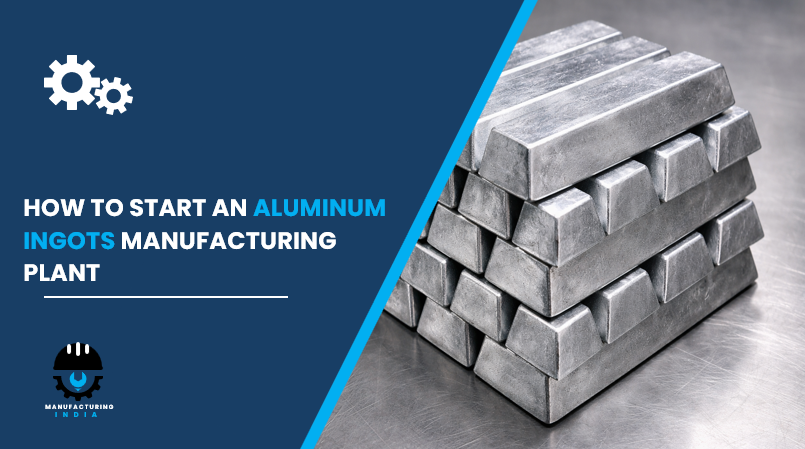
Setting up an aluminum ingots manufacturing plant in India presents a compelling investment case driven by surging demand from the automotive, construction, packaging, and aerospace sectors — all of which depend on aluminum ingots as a foundational upstream raw material. Aluminum ingots are the primary feedstock for producing sheets, coils, foils, extrusions, and forged components that go into everything from automobile engine blocks and aircraft fuselage panels to building façades and beverage cans. As India’s industrial base deepens and its infrastructure ambitions scale, the domestic requirement for high-quality, reliably sourced aluminum ingots is rising at a pace that domestic production has not yet fully matched, creating a clear white space for new investment.
India’s strategic advantages for this production are considerable. The country’s rapid urbanisation, accelerating electric vehicle adoption, growing renewable energy infrastructure, and the government’s Make in India and Production-Linked Incentive (PLI) programmes for automotive and electronics are creating multi-year structural demand tailwinds for aluminum. States with established heavy-industry infrastructure — Odisha, Gujarat, Jharkhand, and Chhattisgarh — combine proximity to bauxite-rich mineral belts, access to captive power, port connectivity for alumina imports, and a growing base of downstream OEM customers. For investors with the capital appetite and operational capability to manage an energy-intensive process, India offers a strategically sound and commercially rewarding platform.
India’s combination of policy support through Make in India and PLI schemes, cost-competitive land and power availability in mineral-rich states, and rapidly growing downstream demand from automotive, construction, and packaging sectors makes an aluminum ingots manufacturing plant a financially defensible investment with gross margins of 20–30% and a credible multi-decade demand horizon.
What are Aluminum Ingots?
Aluminum ingots are solid forms of aluminum produced through the melting of aluminum in its primary form, normally extracted from bauxite ore. They serve as the principal raw material for a wide range of downstream industries, enabling the production of rolled, extruded, and forged aluminum products that are critical to modern manufacturing and construction. The defining properties of aluminum ingots — a high strength-to-weight ratio, corrosion resistance, and recyclability — make them ideal inputs for industries that demand materials combining structural performance with weight efficiency and long service life.
The product does not come in a single grade or configuration. Downstream processors select ingot alloys and purities based on their specific application, whether that is a high-strength aerospace structural component, a lightweight automotive body panel, a thermally conductive electronics enclosure, or a thin-gauge packaging foil. The primary production method is melting, casting, and refining — a sequence that transforms raw alumina and supporting electrolytic materials into uniform, standardised ingot forms ready for onward processing. End-use industries served include construction, automotive, packaging, and aerospace.
Cost of Setting Up an Aluminum Ingots Manufacturing Plant in India
The total investment in an aluminum ingots manufacturing plant depends on capacity, technology selection, plant location, degree of automation, and regulatory compliance obligations. Given the energy-intensive nature of the smelting process, utility access and cost are equally as important as capital outlays in determining overall project economics.
1. Capital Expenditure (CapEx)
Capital investment in this facility spans several major heads. Land and site development costs cover land registration, boundary development, site levelling, and related preparatory expenditures, and investors may consider locating within Special Economic Zones (SEZs) or state-designated industrial estates in Odisha, Gujarat, or Jharkhand to access fiscal incentives and ready infrastructure. Civil works costs encompass the construction of high-bay smelting and casting sheds, raw material storage facilities, quality laboratory, finished goods yard, and administrative block — all of which must be engineered to withstand high-temperature operating conditions.
Machinery costs represent the single largest component of total capital expenditure in this production unit. Key machinery required includes:
- Smelting furnaces
- Casting machines
- Homogenization ovens
- Rolling or extrusion lines
- Finishing saws
- Quality testing spectrometers
- Bundling systems for shipment
Other capital costs include effluent treatment plant (ETP) construction, pre-operative expenses such as feasibility study and detailed project report preparation, commissioning charges, and applicable import duties on specialised smelting and casting equipment sourced internationally.
Request a Sample Report for In-Depth Market Insights: https://www.imarcgroup.com/aluminum-ingots-manufacturing-plant-project-report/requestsample
2. Operational Expenditure (OpEx)
The operating cost structure of an aluminum ingots manufacturing plant is driven by two dominant categories: raw material consumption and utilities. Raw materials — primarily alumina, carbon anodes, and cryolite — account for approximately 40–50% of total OpEx. Securing long-term supply contracts with reliable alumina and carbon anode suppliers is critical to stabilising input costs and protecting margins against global commodity price swings. Massive electricity is also listed as a core input, reflecting the fundamentally energy-intensive nature of the electrolytic smelting process.
Utility costs — chiefly electricity for the smelting furnaces and homogenization ovens — represent a further 40–45% of OpEx, making this one of the highest utility-cost manufacturing categories. Investors must therefore prioritise captive power sourcing, power purchase agreement structuring, or location in states with competitive industrial electricity tariffs. Additional operating costs include inbound and outbound transportation, packaging and bundling materials, employee salaries, routine machinery maintenance and repairs, depreciation on fixed assets, and applicable taxes including GST. By the fifth year of operations, total operational costs are expected to increase substantially due to inflation, market fluctuations, and potential rises in the cost of key materials, making cost efficiency programmes and energy optimisation an ongoing management priority.
3. Plant Capacity
The proposed manufacturing facility is designed with an annual production capacity ranging between 250,000 and 500,000 metric tonnes, enabling economies of scale while maintaining operational flexibility. Capacity can be customised per investor requirements — a smaller entry-level smelter targeting domestic downstream customers and a larger facility serving both domestic and export markets are both commercially viable configurations. Profitability improves meaningfully with higher capacity utilisation, as the substantial fixed costs of smelting infrastructure, utilities contracts, and skilled supervisory staff are spread across a larger output volume.
4. Profit Margins and Financial Projections
The project demonstrates healthy profitability potential under normal operating conditions. Gross profit margins typically range between 20–30%, supported by stable downstream demand and value-added alloy applications. Net profit margins range between 8–15%, reflecting the impact of high utility costs, depreciation on capital-intensive smelting equipment, taxation, and financing costs. A robust financial model covering net present value (NPV), internal rate of return (IRR), payback period, liquidity analysis, sensitivity analysis, and uncertainty analysis is essential before committing capital — particularly given the OpEx exposure to global alumina and energy price cycles.
Why Set Up an Aluminum Ingots Plant in India?
Foundation of Automotive and Industrial Value Chains. Aluminum ingots are the main raw material for the automobile industry, construction industry, power transmission industry, packaging industry, railway industry, and consumer durables industry. According to IBEF, the automotive industry accounts for 42% of India’s total industrial robot market share, with installations increasing by 139% to 3,551 units in 2023 — a signal of deep, accelerating capital investment in auto manufacturing that directly drives aluminum ingot demand.
Strong Alignment with Electric Vehicles and Renewable Energy. Rapid growth in electric vehicles, renewable energy infrastructure, and lightweight materials adoption is accelerating aluminum demand across India. EVs require aluminum-intensive body and battery structures; solar mounting systems and wind turbine nacelles are constructed from aluminum extrusions and castings — all of which originate from aluminum ingots as the upstream feedstock.
Policy and Infrastructure Tailwinds. Government spending on infrastructure development and renewable energy projects, combined with domestic production initiatives such as Make in India and PLI programmes for automotive and electronics, will result in increased aluminum usage through both direct and indirect channels. The recyclability of aluminum also supports India’s decarbonisation commitments and circular economy initiatives, making the product favourably positioned from a regulatory and ESG standpoint.
Active Industry Investment in India. In January 2026, Hindalco Industries Ltd announced a ₹21,000-crore, 3.6 lakh-tonne-per-annum smelter expansion project at its Aditya Aluminium complex in Sambalpur, Odisha, alongside a ₹4,500-crore, 1.7 lakh-tonne-per-annum Flat Rolled Products and battery-grade aluminum foil manufacturing unit. In July 2025, Vedanta Aluminium announced a capacity expansion at its Special Economic Zone unit in Jharsuguda, increasing the installed capacity of its Primary Foundry Alloy (PFA) unit by 120 kilo tonnes per annum to strengthen India’s position in the global automotive and engineering aluminium market. These commitments from India’s largest players confirm institutional confidence in the long-term demand outlook.
Supply Chain Localisation and Reliability Advantage. OEMs, EPC contractors, and extrusion and rolling mills are increasingly drawn to local, reliable aluminum ingot suppliers that can reduce logistics costs, stabilise raw material price volatility, and ensure consistent quality. New domestic entrants who can optimise their smelting process and energy consumption are well placed to capture this growing local-sourcing preference, particularly as India’s downstream manufacturing base continues to expand and diversify.
Growing Demand from Asia-Pacific. Asia-Pacific, particularly China and India, is expected to remain the fastest-growing region for aluminum ingots due to rising industrialisation and infrastructure development. India’s share of this regional growth is poised to increase as domestic downstream industries scale, making this a favourable time to establish indigenous smelting capacity ahead of peak demand.
Manufacturing Process — Step by Step
The aluminum ingots manufacturing process uses melting, casting, and refining as the primary production method.
- Raw Material Preparation: Alumina, carbon anodes, and cryolite are received, inspected, and staged for the smelting operation. Massive electricity supply is confirmed and load-balanced across smelting circuits.
- Smelting (Electrolytic Reduction): Alumina is dissolved in molten cryolite within electrolytic cells using smelting furnaces. A powerful direct electrical current — the “massive electricity” input — drives the reduction of aluminium oxide to liquid aluminum metal, which collects at the cell bottom.
- Tapping and Transfer: Liquid aluminum is periodically tapped from the reduction cells and transferred to holding furnaces for alloying and temperature management.
- Refining and Alloying: The molten metal is refined to remove impurities and, where required, alloying elements are added to achieve target metallurgical specifications. Quality testing spectrometers are used to verify alloy composition and purity against customer and industry standards.
- Casting: The refined molten aluminum is fed into casting machines where it is shaped into standardised ingot forms through controlled solidification. Homogenization ovens are used to ensure uniform internal grain structure, improving downstream processability.
- Finishing and Sawing: Solidified ingots are processed through finishing saws to achieve required dimensional tolerances and surface quality.
- Quality Control and Testing: Each ingot batch is tested against quality assurance criteria covering chemical composition, dimensional accuracy, surface integrity, and mechanical properties using quality testing spectrometers and associated analytical instruments.
- Bundling, Packaging, and Dispatch: Approved ingots are assembled into bundles using bundling systems for shipment and dispatched to construction, automotive, packaging, and aerospace end-use customers via road, rail, or port.
Key Applications
Aluminum ingots serve as the upstream raw material for a wide spectrum of industries, each requiring specific alloy grades and physical specifications.
- Automotive: Used to produce engine blocks, transmission housings, wheels, and structural components, enabling vehicle lightweighting for improved fuel efficiency and EV range.
- Electronics: Converted into heat sinks, enclosures, frames, and thermal management components where lightweight and thermal conductivity are critical.
- Construction: Processed into structural frames, window and door systems, roofing, and façade elements for residential and commercial buildings.
- Packaging: Rolled into beverage cans, food containers, and foil products where corrosion resistance, formability, and recyclability are essential.
- Aerospace: Forged and extruded into high-strength structural airframe components where the high strength-to-weight ratio of aluminum is indispensable.
Leading Manufacturers
The global aluminum ingots industry is served by several large-scale multinational producers with extensive smelting capacities and well-established downstream customer relationships. Key players include:
- Alcoa Corporation
- Rio Tinto
- Norsk Hydro
- China Hongqiao Group
- UC Rusal
Timeline to Start the Plant
- Feasibility study and project report preparation
- Land acquisition and site development
- Regulatory approvals and environmental clearances
- Factory licence and fire safety compliance
- Machinery procurement and installation
- Raw material supplier agreements and supply chain setup
- Trial production and quality testing
- Commercial production launch
Licences and Regulatory Requirements
Starting an aluminum ingots manufacturing unit in India requires several approvals:
- Business registration (Proprietorship, LLP, or Pvt Ltd)
- Factory Licence under the Factories Act
- Environmental Clearance from State Pollution Control Board
- GST Registration
- Fire Safety NOC
- Hazardous/Chemical compliance (applicable for handling cryolite, carbon anodes, and fluoride-bearing process materials)
- Effluent Treatment Plant (ETP) operational clearance
- Occupational Health and Safety compliance
Key Challenges to Consider
High Capital Requirements. Smelting furnaces, casting machines, homogenization ovens, and associated electrolytic infrastructure represent a very substantial initial investment. The proposed capacity range of 250,000–500,000 MT per annum places this firmly in the large-scale industrial project category, requiring careful capital structuring and phased investment planning.
Raw Material Price Volatility. The cost of alumina, carbon anodes, and cryolite is subject to global commodity price cycles, trade policy changes, and logistics disruptions that can significantly compress margins if not mitigated through long-term supply contracts and hedging strategies.
Utility Cost Exposure. With electricity accounting for 40–45% of OpEx, access to competitively priced, reliable power is the single most important operational variable for this facility. Inadequate power infrastructure or rising industrial tariffs can quickly erode the project’s financial viability.
Regulatory Compliance. The smelting of aluminum generates process emissions and solid waste streams — including spent pot lining — that require rigorous environmental management, ETP operation, and multi-authority clearances that can extend the pre-production timeline.
Competition from Established Players. The presence of large, vertically integrated global producers — including Alcoa Corporation, Rio Tinto, Norsk Hydro, China Hongqiao Group, and UC Rusal — as well as dominant domestic players such as Hindalco and Vedanta means that new entrants must compete on cost efficiency, alloy quality, and service reliability to win and retain customers.
Skilled Manpower. Operating electrolytic smelting cells, homogenization furnaces, and spectrometric quality control equipment requires metallurgical engineers and trained furnace operators. Sourcing, training, and retaining such technically qualified personnel in industrial locations is a persistent operational challenge.
Frequently Asked Questions
1. How much does it cost to set up an aluminum ingots manufacturing plant in India?
The total investment depends on plant capacity (250,000–500,000 MT per annum), location, technology, and automation level. A detailed CapEx breakdown covering land, civil works, smelting machinery, and pre-operative costs is available in the full project report.
2. Is aluminum ingots manufacturing profitable in India in 2026?
Yes. The project demonstrates healthy profitability potential, with gross profit margins of 20–30% and net profit margins of 8–15% under normal operating conditions, underpinned by steady demand from automotive, construction, packaging, and aerospace sectors.
3. What machinery is required for an aluminum ingots plant in India? Key machinery includes smelting furnaces, casting machines, homogenization ovens, rolling or extrusion lines, finishing saws, quality testing spectrometers, and bundling systems for shipment.
4. What licences and approvals are required to start an aluminum ingots plant in India?
Required approvals include business registration, Factory Licence, Environmental Clearance from the State Pollution Control Board, GST Registration, Fire Safety NOC, hazardous chemical compliance, ETP operational clearance, and Occupational Health and Safety compliance.
5. What raw materials are needed for aluminum ingots manufacturing?
Core raw materials are alumina, carbon anodes, cryolite, and massive electricity for the electrolytic smelting process.
6. What are the environmental compliance requirements for an aluminum ingots plant in India?
The facility must obtain Environmental Clearance from the State Pollution Control Board, operate a certified Effluent Treatment Plant, and comply with emission norms governing fluoride emissions, particulate matter, and solid waste disposal from the smelting and refining operations.
7. What is the best location to set up an aluminum ingots plant in India?
States such as Odisha, Jharkhand, Gujarat, and Chhattisgarh offer proximity to bauxite and alumina resources, access to captive or low-cost power, port connectivity, and established heavy-industry infrastructure. Locating within an SEZ, as Vedanta does in Jharsuguda, can provide additional fiscal advantages.
8. What is the break-even period for this type of plant in India?
The break-even period depends on plant capacity, capacity utilisation rate, power cost, and financing structure. A detailed payback period analysis and NPV calculation are included in the full project report. Investors are encouraged to request a sample for plant-specific financial projections.
9. What government incentives are available for manufacturers in India?
Investors may access incentives under Make in India, state industrial promotion policies, capital subsidy schemes for large industries, PLI programmes for automotive and electronics sectors, and fiscal benefits available to units located within Special Economic Zones.
Key Takeaways for Investors
The aluminum ingots manufacturing plant in India represents a high-conviction industrial investment anchored by structural demand from the automotive, construction, packaging, and aerospace sectors — all of which are on long-duration growth trajectories in the Indian economy. The project is financially viable across the proposed capacity range of 250,000–500,000 MT per annum, with gross margins of 20–30% and net margins of 8–15% providing a credible return profile for investors who can secure competitive power and long-term raw material contracts. The global aluminum ingots market stood at 15.52 million tons in 2025 and is projected to reach 20.78 million tons by 2034, expanding at a CAGR of 3.3% — with Asia-Pacific, and India in particular, driving a disproportionate share of incremental volume. With Hindalco and Vedanta both committing billions of rupees to capacity expansion in early 2025 and 2026, domestic institutional confidence in the demand outlook is unambiguous, and the window for new investors to establish a cost-efficient, well-located production unit ahead of peak domestic consumption remains open.
About the Author