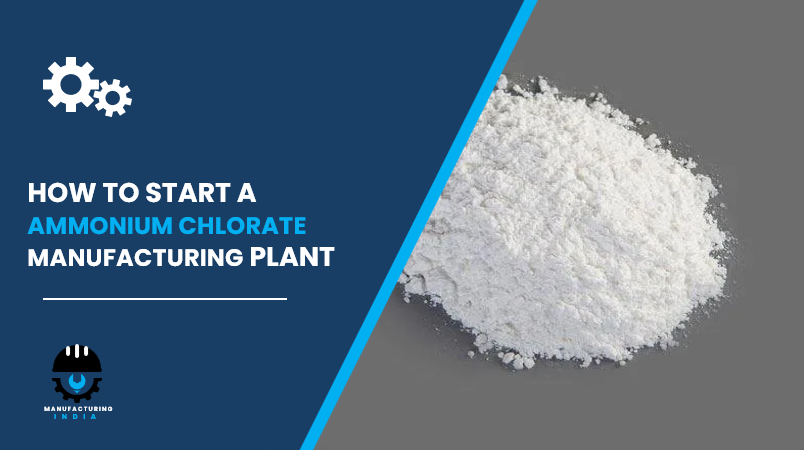
Setting up an ammonium chlorate manufacturing plant in India presents a compelling investment case for technically capable entrepreneurs and specialty chemical producers seeking exposure to a strategically important, high-barrier industrial chemicals segment. Ammonium chlorate is a powerful inorganic oxidizing agent whose unique chemical properties make it indispensable to a narrow but strategically critical set of industries — including mining and quarrying explosives, fireworks and pyrotechnics, defense and aerospace energetic materials, laboratory reagents, and specialty chemical formulations. As India’s mining sector expands to meet rising mineral and metals demand, infrastructure development drives sustained blasting activity, and defence modernisation programmes accelerate procurement of controlled energetic materials, domestic demand for reliably produced ammonium chlorate is growing in a market still heavily dependent on imports.
India is increasingly well-positioned to host this production. The country’s chemical manufacturing ecosystem — anchored by industrial clusters in Gujarat, Maharashtra, Andhra Pradesh, and Uttar Pradesh — offers access to chemical-grade raw material supply chains, established regulatory frameworks for hazardous substance production, and a growing base of trained chemical engineering talent. The government’s emphasis on domestic chemical manufacturing and supply chain security, reinforced through the Make in India initiative and Production-Linked Incentive schemes, further strengthens the long-term commercial case for establishing an indigenous ammonium chlorate production unit that reduces the country’s import dependency in this strategically sensitive compound.
India’s combination of policy support for domestic specialty chemical manufacturing, access to raw materials including ammonium chloride and sodium chlorate, and growing end-use demand from mining, defence, and pyrotechnics sectors positions an ammonium chlorate manufacturing plant as a technically demanding but financially rewarding long-horizon investment, with gross margins of 30–50% and significant regulatory barriers protecting the market position of compliant producers.
What is Ammonium Chlorate?
Ammonium chlorate is an inorganic chemical compound consisting of both ammonium and chlorate ions, presenting as a crystalline solid that is soluble in water. It is produced through controlled chemical reactions of ammonium salts and chlorate compounds carried out under very strictly managed conditions. Its strong oxidizing character enables the compound to readily support combustion and decomposition reactions — a property that defines its entire commercial value and application profile.
The foremost applications of this compound include explosives formulations, pyrotechnic compositions, laboratory research, and the synthesis of specialty chemicals. Because ammonium chlorate is sensitive to heat, friction, and contamination, it requires very strict handling and storage practices throughout its production, transportation, and end-use lifecycle, making quality control and safety systems indispensable at every stage. The primary production method covers the full sequence of chemical synthesis, crystallization, filtration, drying, and packaging. End-use industries served include mining, defense, fireworks and pyrotechnics, chemical research, and specialty chemicals, with additional applications in the automotive sector for battery cables, grounding straps, and electrical systems in vehicles.
Cost of Setting Up an Ammonium Chlorate Manufacturing Plant in India
The total cost of an ammonium chlorate manufacturing plant depends on plant capacity, technology and reactor configuration, location, automation level, and the stringent safety and regulatory compliance infrastructure required for producing a classified energetic chemical. Both capital and recurring operational costs must be modelled carefully — particularly given the non-trivial compliance burden specific to this compound.
1. Capital Expenditure (CapEx)
Capital investment spans several primary heads. Land and site development is a foundational outlay that must account for zoning requirements applicable to hazardous chemical manufacturing, buffer zone specifications, and proximity to raw material suppliers including ammonium chloride and sodium chlorate distributors. Investors may consider state-designated chemical industrial estates or Special Economic Zones (SEZs) in Gujarat, Maharashtra, or Andhra Pradesh, which offer pre-cleared infrastructure and streamlined regulatory access. Civil works costs encompass the construction of purpose-built chemical synthesis bays with explosion-proof and corrosion-resistant design, raw material and finished goods storage compliant with explosive precursor storage norms, a quality control laboratory, and administrative facilities.
Machinery costs represent the largest component of total capital expenditure. Key machinery required includes:
- Reactors
- Crystallizers
- Filtration units
- Dryers
- Automated packaging systems
- Electrolytic cells
- Precipitation vessels
- Liquid-solid separators (centrifuges or filters)
- Salt evaporators
- Particle size separators (vibro-screens)
- Reaction tanks and mother liquor tanks
- Specialised conduits and scrubbers for waste gas treatment
Other capital costs include pre-operative expenses such as feasibility study and detailed project report preparation, hazardous chemical facility licensing and explosives regulatory certification costs, safety system installation, machinery commissioning expenses, initial working capital requirements, and contingency provisions for unforeseen regulatory or safety compliance requirements during plant establishment.
Request a Sample Report for In-Depth Market Insights: https://www.imarcgroup.com/ammonium-chlorate-manufacturing-plant-project-report/requestsample
2. Operational Expenditure (OpEx)
Raw material cost is the dominant operating expenditure category, accounting for approximately 50–65% of total OpEx. The core inputs are ammonium chloride and sodium chlorate (or an electrolysis setup for in-house chlorate production). Alternative synthesis routes use barium chlorate, ammonium sulfate, or chloric acid neutralised with ammonia or ammonium carbonate. Regardless of the route chosen, establishing long-term supply contracts with reliable chemical-grade raw material suppliers is essential to stabilising input costs and ensuring uninterrupted production of this safety-critical compound.
Utility costs — covering electricity for electrolytic cells, reactors, and dryers, as well as water, steam, and process cooling — account for a further 20–30% of OpEx, reflecting the energy demands of controlled chemical synthesis and crystallization operations. Additional operating costs include inbound and outbound transportation under hazardous goods regulations, specialised packaging materials that meet explosive precursor compliance standards, employee salaries for qualified chemical engineers and safety officers, routine equipment maintenance and calibration, effluent treatment, depreciation on fixed assets, and applicable taxes including GST. By the fifth year of operations, total operational costs are expected to increase substantially due to inflation, market fluctuations, and potential rises in the cost of key raw materials and energy inputs.
3. Plant Capacity
The proposed production facility is designed with an annual production capacity ranging between 500 and 2,000 MT per year, enabling economies of scale while maintaining operational flexibility. Capacity can be customised per investor requirements — a smaller entry-level unit supplying domestic pyrotechnics and specialty chemical customers, and a larger facility targeting authorised mining, defence, and export markets are both commercially viable configurations. Profitability improves meaningfully with higher capacity utilisation, as the fixed costs of specialised reactor infrastructure, regulatory certifications, and safety systems are spread across a greater output volume.
4. Profit Margins and Financial Projections
The project demonstrates strong profitability potential relative to most general-purpose chemical sectors, with gross profit margins typically ranging between 30–50% — a reflection of the technical barriers, regulatory compliance costs, and value-added nature of this product. Net profit margins range between 5–15%, after accounting for the elevated utility costs, specialised labour, certification and compliance expenses, depreciation, and taxation applicable to this class of production. A comprehensive financial model covering net present value (NPV), internal rate of return (IRR), payback period — typically 3–6 years — liquidity analysis, sensitivity analysis, and uncertainty analysis is essential before committing capital. Break-even timelines can be shortened through export opportunities and capacity utilisation optimisation. Efficient production and export demand are key accelerators of returns in this segment.
Why Set Up an Ammonium Chlorate Plant in India?
Critical Oxidizing Agent for Mining and Infrastructure Expansion. Ammonium chlorate plays a vital role in explosives formulations, pyrotechnic compositions, and energetic material systems, making it a strategically important chemical for mining, defense, and industrial research sectors. As mining activities in India expand to meet rising demand for minerals and metals — and as infrastructure development drives sustained quarrying and blasting activity — the consumption of high-quality oxidizing agents used in controlled explosives is projected to increase correspondingly, creating a structural demand tailwind for domestic producers.
Growing Pyrotechnics and Fireworks Demand. The growing use of pyrotechnics for commercial events, signaling applications, and defense training exercises continues to support market expansion for ammonium chlorate globally. In 2024, total fireworks consumption in the United States alone reached 322.7 million lbs., comprising 295.3 million lbs. of consumer fireworks and 27.4 million lbs. of display fireworks, according to the American Pyrotechnics Association. This rising global demand for fireworks and pyrotechnic compositions is expected to drive growth in key chemical ingredients, including ammonium chlorate, which is essential for producing high-performance pyrotechnic formulations.
Defence Modernisation and Specialty Chemical Demand. Defence modernisation programmes and government procurement of controlled energetic materials ensure consistent demand from authorised industrial and defence users, supporting stable long-term consumption of ammonium chlorate in specialized energetic material and propellant system applications. India’s defence sector expansion creates a direct and growing domestic procurement base for compliant specialty chemical manufacturers.
Specialised Production Barriers Protecting Market Position. Stringent safety protocols, precise reaction control, and multi-authority regulatory approvals create high entry barriers that effectively protect technically capable and fully compliant manufacturers from low-cost competition. Once established with the required certifications and customer qualifications, an ammonium chlorate production unit enjoys a durable competitive position in its authorised market segments.
APAC Leadership and Domestic Supply Chain Advantage. APAC holds the largest share in the global ammonium chlorate market, and India’s position within this region makes it a natural candidate for expanded domestic production. Local manufacturing reduces dependency on imports, improves supply reliability for downstream explosive and pyrotechnic manufacturers, and supports cost optimisation across the domestic specialty chemicals value chain. The increasing emphasis on domestic chemical manufacturing and supply chain security further strengthens the long-term outlook for this production within India.
Technological Advancement in Safer Production Methods. Technological advancements in controlled synthesis and safety-enhanced production methods are improving manufacturing efficiency while reducing operational risks across the global ammonium chlorate industry. Indian investors who adopt modern reactor configurations, automated process monitoring, and advanced scrubbing and waste treatment systems will be well-positioned to meet both domestic and international quality and safety standards as the market evolves.
Manufacturing Process – Step by Step
The ammonium chlorate manufacturing process uses chemical synthesis, crystallization, filtration, drying, and packaging as the primary production method.
- Raw Material Sourcing and Preparation: Ammonium chloride, sodium chlorate (or ammonium salts and chlorate compounds), and all reagents are received, quality-inspected, and staged in compliant hazardous chemical storage before entering the synthesis process.
- Chloric Acid Production via Electrolysis: Chloric acid is produced through electrolysis of hydrochloric acid in specialised electrolytic cells, or sourced externally. Alternatively, sodium chlorate is used as the chlorate source. Concurrently, ammonia is mixed with water to form an aqueous ammonia solution in reaction tanks.
- Neutralisation Reaction (Chemical Synthesis): Chloric acid reacts with aqueous ammonia in reactors under precisely controlled temperature, pressure, and concentration conditions to form an ammonium chlorate solution. In alternative synthesis routes, suitable metal chlorates react with ammonium sulfate or ammonium carbonate in precipitation vessels to yield ammonium chlorate with a salt by-product, which is filtered off.
- Crystallization: The ammonium chlorate solution is passed through crystallizers where controlled cooling and evaporation produce uniform, homogeneous ammonium chlorate crystals with consistent size and purity characteristics.
- Filtration and Separation: Liquid-solid separators — centrifuges or filters — separate ammonium chlorate crystals from residual mother liquor and by-products. Particle size separators such as vibro-screens classify the crystalline product to specification.
- Drying: The filtered ammonium chlorate crystals are conveyed to dryers where residual moisture is removed under controlled conditions to achieve the target moisture content without triggering thermal sensitivity risks.
- Quality Testing: Every production batch is tested against quality assurance criteria covering chemical purity, crystal density, moisture content, particle size distribution, and physicochemical stability to ensure full compliance with customer and regulatory specifications.
- Packaging and Distribution: Approved product is filled and sealed using automated packaging systems into compliant, explosion-precursor-certified packaging and dispatched under hazardous goods transport regulations to mining, defence, pyrotechnics, and specialty chemical end-use customers.
Key Applications
Ammonium chlorate serves a range of technically demanding, application-specific end-use segments where its oxidizing properties are either irreplaceable or uniquely advantageous.
- Mining and Explosives: Utilised as an oxidizing component in controlled blasting formulations for mining and quarrying operations, enabling efficient rock fragmentation in mineral extraction.
- Pyrotechnics: Used in fireworks and signaling devices to enhance combustion characteristics and deliver bright, sustained colour output in pyrotechnic compositions.
- Defense and Aerospace: Applied in specialised energetic materials and research-oriented propellant systems for defence training and aerospace research applications.
- Laboratory and Research: Employed as a reagent in chemical synthesis and experimental oxidizing reactions across university and industrial research settings.
- Specialty Chemicals: Used in the synthesis of specialty chemical intermediates and formulations requiring a controlled, high-purity oxidizing agent.
- Automotive: Applied in battery cables, grounding straps, and other electrical systems in vehicles where chemical stability and controlled reactivity are required.
Leading Manufacturers
The global ammonium chlorate industry is served by a group of established multinational specialty chemical companies with extensive production capabilities across mining, pyrotechnics, defense, and research application sectors. Key players include:
- BASF SE
- OxyChem
- PPG Industries
- Tata Chemicals Limited
- Ercros S.A.
- AkzoNobel N.V.
- INOVYN (Ineos Group)
- Vynova Group
- Nouryon
- Westlake Chemical Corporation
- Aditya Birla Chemicals
- AGC Chemicals
- Chemtrade Logistics
- Shandong Huatai Paper
Timeline to Start the Plant
- Feasibility study and project report preparation
- Land acquisition and site development
- Regulatory approvals and environmental clearances
- Factory licence and fire safety compliance
- Machinery procurement and installation
- Raw material supplier agreements and supply chain setup
- Trial production and quality testing
- Commercial production launch
Note: The timeline from initiation to commercial production for an ammonium chlorate production plant typically ranges from 24 to 36 months, depending on site development, machinery installation, environmental clearances, safety systems commissioning, and trial run completion.
Licences and Regulatory Requirements
Starting an ammonium chlorate manufacturing unit in India requires several approvals:
- Business registration (Proprietorship, LLP, or Pvt Ltd)
- Factory Licence under the Factories Act
- Environmental Clearance from State Pollution Control Board
- GST Registration
- Fire Safety NOC
- Hazardous and explosive precursor chemical compliance — including licensing under the Explosives Act and Central Explosive Rules, and PESO (Petroleum and Explosives Safety Organisation) authorisation where applicable
- Effluent Treatment Plant (ETP) operational clearance
- Occupational Health and Safety compliance
Key Challenges to Consider
High Capital Requirements. The specialised reactor, crystallizer, electrolytic cell, and safety system infrastructure required for ammonium chlorate production involves a substantial initial investment that places this firmly in the medium-to-large specialty chemical project category.
Raw Material Price Volatility. The cost of ammonium chloride, sodium chlorate, and other synthesis inputs is subject to global chemical commodity price cycles and supply chain disruptions that can compress margins if not managed through long-term supply contracts and alternative sourcing strategies.
Regulatory Compliance Complexity. Ammonium chlorate is classified as an explosive precursor and oxidizing agent, attracting multi-layered oversight from chemical, explosives, environmental, and industrial safety authorities. Securing and maintaining the full stack of required licences — including PESO authorisation and explosive precursor compliance — demands dedicated legal and safety management resources throughout the plant’s operating life.
Safety and Operational Risk. The compound’s sensitivity to heat, friction, and contamination requires continuous investment in safety monitoring systems, explosion-proof infrastructure, staff training, and emergency response preparedness. Any operational deviation can create serious safety and liability consequences.
Competition from Established Players. The presence of well-capitalised global manufacturers — including BASF SE, AkzoNobel N.V., Nouryon, and domestic players such as Tata Chemicals Limited and Aditya Birla Chemicals — means that new entrants must compete on product purity, delivery reliability, and compliance track record to win authorised customer qualifications in this tightly regulated market.
Skilled Manpower. Operating chemical synthesis reactors, crystallizers, and analytical quality control instruments for explosive precursor production requires qualified chemical engineers, certified safety officers, and trained plant operators. Recruiting and retaining this level of technical talent — particularly outside major industrial cities — is a persistent and structurally important operational challenge.
Frequently Asked Questions
1. How much does it cost to set up an ammonium chlorate manufacturing plant in India?
The total investment depends on plant capacity (500–2,000 MT per year), location, technology configuration, and the safety and regulatory infrastructure required for explosive precursor production. A detailed CapEx breakdown covering land, civil works, specialised machinery, and compliance costs is available in the full project report.
2. Is ammonium chlorate manufacturing profitable in India in 2026?
Yes. The project demonstrates strong profitability potential, with gross margins of 30–50% and net margins of 5–15% under normal operating conditions. The elevated gross margin reflects the technical barriers, regulatory compliance investment, and high value-added nature of this specialised chemical product.
3. What machinery is required for an ammonium chlorate plant in India?
Key equipment includes reactors, crystallizers, filtration units, dryers, automated packaging systems, electrolytic cells, precipitation vessels, liquid-solid separators, salt evaporators, vibro-screens, reaction tanks, mother liquor tanks, and specialised waste gas scrubbers.
4. What licences and approvals are required to start an ammonium chlorate plant in India?
Required approvals include business registration, Factory Licence, Environmental Clearance from the State Pollution Control Board, GST Registration, Fire Safety NOC, explosive precursor compliance and PESO authorisation under the Explosives Act, ETP operational clearance, and Occupational Health and Safety compliance.
5. What raw materials are needed for ammonium chlorate manufacturing?
Core raw materials are ammonium chloride and sodium chlorate (or an in-house electrolysis setup for chlorate production). Alternative synthesis routes use barium chlorate, ammonium sulfate, ammonium carbonate, or chloric acid neutralised with ammonia.
6. What are the environmental compliance requirements for an ammonium chlorate plant in India?
The facility must obtain Environmental Clearance from the State Pollution Control Board, operate a certified Effluent Treatment Plant, and comply with emission norms governing process off-gases, waste streams from crystallization and filtration, and safe disposal of by-products from the synthesis route used.
7. What is the best location to set up an ammonium chlorate plant in India?
Chemical industrial estates or SEZs in Gujarat, Maharashtra, and Andhra Pradesh offer pre-cleared hazardous chemical infrastructure, proximity to ammonium chloride and sodium chlorate suppliers, access to skilled chemical engineering talent, and established regulatory pathways for specialty and explosive precursor chemical manufacturing.
8. What is the break-even period for this type of plant in India?
Break-even for an ammonium chlorate production business typically ranges from 3 to 6 years, depending on plant scale, capacity utilisation, raw material pricing, regulatory compliance costs, and market demand. Export opportunities and higher capacity utilisation can accelerate the return timeline.
9. What government incentives are available for manufacturers in India?
Investors may access capital subsidies, tax exemptions, reduced utility tariffs, export benefits, and interest subsidies available under national and state industrial policies. Specialty chemical manufacturing units may also qualify for support under MSME schemes and state-level chemical cluster development programmes, subject to meeting product classification and safety compliance criteria.
Key Takeaways for Investors
The ammonium chlorate manufacturing plant in India represents a technically demanding but commercially compelling investment for qualified specialty chemical producers, anchored by consistent demand from mining, defence, pyrotechnics, and chemical research sectors — all of which are growing in scale and sophistication across the APAC region. The production unit is financially viable across the proposed capacity range of 500–2,000 MT per year, with gross margins of 30–50% and net margins of 5–15% providing a return profile that is notably stronger than commodity chemical manufacturing, justified by the regulatory complexity, safety investment, and technical barriers that protect compliant producers’ market positions. APAC holds the largest share of the global ammonium chlorate market, and India’s domestic demand is poised to increase as mining activity, defence procurement, and specialty chemical consumption all expand in parallel. With the American Pyrotechnics Association recording 322.7 million lbs. of fireworks consumption in 2024 — signalling the scale of global demand for pyrotechnic chemical inputs — and with technological advancements in controlled synthesis continuing to improve production safety and efficiency, the long-term demand trajectory for high-quality ammonium chlorate produced under rigorous compliance standards is firmly positive for well-positioned Indian manufacturers.
About the Author