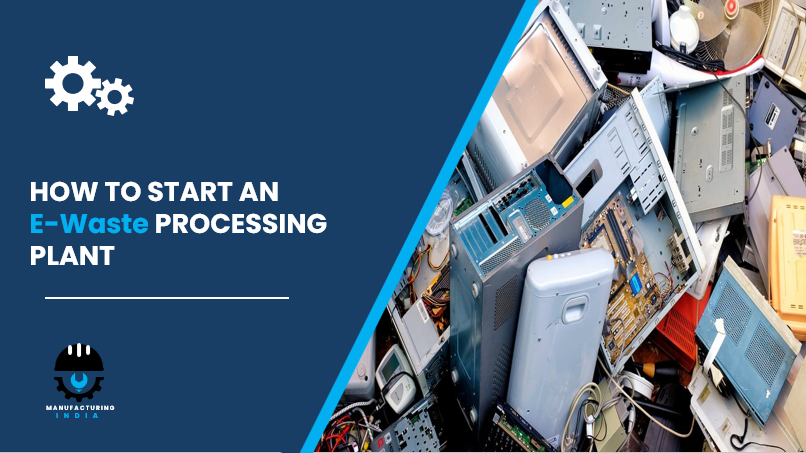
Setting up an e-waste processing plant in India presents a compelling investment case driven by the country’s surging consumption of electronics, increasingly stringent regulatory mandates, and rising demand from industries such as electronics manufacturing, metallurgy and metal refining, automotive and EV supply chains, renewable energy supply chains, and the plastics industry. Electronic waste — spanning computers, mobile phones, televisions, refrigerators, and other electrical equipment — contains both valuable recoverable materials like copper, aluminium, gold, silver, and rare earth elements, as well as hazardous substances including lead, mercury, and cadmium that require responsible management. As India’s digital economy deepens and gadget replacement cycles grow shorter, the volume of end-of-life electronics is expanding rapidly, creating an urgent and commercially significant need for organised, high-recovery e-waste processing infrastructure.
India’s advantages as a production location for this sector are substantial. The country offers cost-competitive land and labour relative to Western markets, a rapidly urbanising population accelerating electronics consumption, and a government policy environment shaped by Make in India and extended producer responsibility (EPR) regulations that are pushing formal e-waste collection and processing volumes upward. Key manufacturing and industrial states such as Gujarat, Maharashtra, and Tamil Nadu provide excellent access to transportation networks, utilities, and supply chains. With the global e-waste management market valued at USD 88.88 Billion in 2025 and projected to reach USD 229.21 Billion by 2034, positioning a processing facility in India now places investors at the forefront of one of the fastest-growing environmental and resource-recovery sectors worldwide.
India’s e-waste processing investment opportunity is underpinned by EPR compliance mandates, a cost-competitive manufacturing environment, and demand from electronics, automotive, and renewable energy sectors. Gross profit margins of 30–40% and a net margin of 12–18% make this a financially viable and strategically sound venture with a clear break-even trajectory.
What is E-Waste?
“Electronic waste,” or e-waste, refers to electronic and electrical equipment that is no longer useful. Products categorised as e-waste include computers, mobile phones, televisions, refrigerators, and a wide range of other electronic equipment. These discarded devices contain a dual profile of materials: valuable resources such as copper, aluminium, precious metals like gold, silver, and rare earth elements, alongside toxic materials in the form of lead, mercury, cadmium, and other heavy metals. The improper disposal of e-waste can cause serious harm to the surrounding environment — contaminating soil, water sources, and air which is why organised processing is both an environmental imperative and a commercially valuable activity.
The production method applied in an e-waste processing plant follows a multi-stage sequence involving collection and receipt, depollution and data destruction, manual dismantling, shredding and size reduction, physical separation (including magnetic separation, eddy current separation, air classification, screening, and optical sorting), downstream recovery through hydrometallurgical and/or pyrometallurgical routes, and finally refining and residue treatment with effluent treatment. End-use industries served by the recovered outputs include electronics manufacturing, metallurgy and metal refining, automotive and EV supply chains — particularly battery materials — renewable energy supply chains, construction through secondary metals, and the plastics industry through reprocessed polymers.
Cost of Setting Up an E-Waste Processing Plant in India
The total cost of establishing an e-waste processing plant in India depends on a range of factors including processing capacity, technology selection, geographic location, degree of automation, and regulatory compliance requirements. Investors should plan for both capital expenditure (CapEx) and operational expenditure (OpEx) across a structured financial model.
1. Capital Expenditure (CapEx)
Land and site development costs form a substantial part of the overall capital investment, covering land registration, boundary development, drainage, and related infrastructure. Locating the facility within a Special Economic Zone (SEZ) or designated industrial estate can reduce land costs and provide tax benefits in the early years of operation. Civil works and construction costs cover the processing shed, laboratory, hazardous material storage areas, effluent treatment plant housing, and the administrative block.
Machinery and equipment represent the single largest component of capital expenditure. Key machinery required includes:
- Conveyors and bunkers
- Manual dismantling stations
- Depollution tools
- Secure data destruction equipment
- Shredders, crushers, granulators, and mills
- Magnetic separators
- Eddy current separators
- Air classifiers
- Optical and laser sorting systems
- Dust collection systems and scrubbers
- Furnaces and kilns
- Leaching and reactor systems
Other capital costs include effluent treatment plant (ETP) setup, pre-operative expenses, commissioning charges, and applicable import duties on specialised equipment not manufactured domestically.
Request a Sample Report for In-Depth Market Insights: https://www.imarcgroup.com/e-waste-manufacturing-plant-project-report/requestsample
2. Operational Expenditure (OpEx)
Raw material cost is the dominant driver of operational expenditure. Electronic waste — the primary feedstock — accounts for approximately 40–50% of total OpEx. Securing long-term supply contracts with institutional collectors, corporate IT asset disposition (ITAD) providers, and authorised e-waste aggregators is essential for ensuring consistent feedstock availability and mitigating price volatility. Utility costs, covering electricity for shredding and separation equipment, water for processing and effluent treatment, and steam for pyrometallurgical operations, account for an additional 20–25% of OpEx.
Other operating costs include transportation and logistics for inbound feedstock and outbound recovered materials, packaging of refined outputs, salaries and wages for skilled technicians and plant workers, routine maintenance and equipment upkeep, depreciation on machinery and civil assets, and applicable taxes and levies. By the fifth year of operations, total operational cost is expected to increase substantially, driven by inflation, market fluctuations, potential rises in feedstock costs, supply chain developments, and shifts in global commodity prices for recovered metals.
3. Plant Capacity
The proposed processing facility as described on the source page is designed with an annual processing capacity ranging between 10,000–20,000 metric tonnes (MT), enabling economies of scale while maintaining operational flexibility. Capacity can be customised per investor requirements depending on available capital, target markets, and feedstock availability in a given geography. Profitability improves meaningfully with higher capacity utilisation, as fixed overhead costs are distributed across a larger volume of processed material.
4. Profit Margins and Financial Projections
The e-waste processing plant demonstrates healthy profitability under normal operating conditions. Gross profit margins typically range between 30–40%, supported by stable demand and value-added applications in metals and materials recovery. Net profit margins average 12–18% across a five-year projection horizon. Financial projections should incorporate NPV (Net Present Value), IRR (Internal Rate of Return), payback period analysis, and sensitivity analysis accounting for feedstock price variability and recovered metal commodity cycles. A detailed income and expenditure projection, along with a profit and loss account, is essential for securing institutional funding and structuring investor returns.
Why Set Up an E-Waste Processing Plant in India?
Recovery of Valuable Materials Driving Investment Returns. Electronic waste contains economically significant concentrations of copper, aluminium, gold, silver, and rare earth elements. Processing these streams generates revenue from the sale of recovered metals back into electronics manufacturing, automotive, and industrial machinery supply chains, creating a strong commercial rationale for investment in high-recovery processing infrastructure.
Critical Minerals Security as a Strategic Priority. Critical mineral security has emerged as a national and global strategic imperative. The EU, for instance, aims to meet 25% of its demand for critical minerals through recycling by 2030, reinforcing legislative and investment momentum around high-recovery e-waste processing. India’s own push for domestic critical mineral availability makes this sector highly aligned with national resource security objectives.
Tightening EPR and WEEE-Style Regulations. Regulators are enforcing stricter end-of-life compliance through Extended Producer Responsibility (EPR) frameworks, forcing more electronic material into streams of certified processing and official collection. This regulatory momentum guarantees a growing volume of formally channelled e-waste feedstock, reducing supply risk for organised processors operating in compliance with these frameworks.
Cost-Competitive Manufacturing Environment. India offers significantly lower land acquisition costs, competitive labour rates for both skilled technicians and general plant workers, and an established supply chain for industrial equipment and utilities. These structural cost advantages translate directly into stronger operating margins relative to processing facilities in Western markets.
Active Industry Investment Signalling Market Growth. In September 2025, Aurubis AG — the largest copper producer in Europe — began production at its newly constructed metal recycling facility in Richmond, Georgia, designed to recover copper, precious metals, and other strategic elements from e-waste streams, with full capacity expected in the first half of 2026. In August 2024, ERI announced the opening of its first alkaline battery recycling facility within its 315,000-square-foot e-waste recycling and ITAD facility in Plainfield, Indiana, expanding formal processing capacity for hazardous e-waste streams and reducing landfill dependence. These global investments signal strong confidence in the sector’s long-term growth trajectory.
Circular Economy and Local Supply Chain Preference. Industries across electronics manufacturing, construction, and automotive sectors are actively seeking certified secondary raw material suppliers to meet sustainability and circular economy commitments. A well-positioned e-waste processing facility in India can capitalise on these localised sourcing preferences, reducing customer logistics costs while securing off-take agreements with major manufacturing buyers.
Manufacturing Process Step by Step
The e-waste processing process uses a multi-stage hydrometallurgical and/or pyrometallurgical recovery method as the primary production method. Below are the core process steps carried out within the facility:
- Collection and Receipt: Inbound electronic waste is received, weighed, logged, and inventoried. Quality checks confirm the composition and condition of the incoming feedstock.
- Depollution and Data Destruction: Hazardous fluids, batteries, and components containing toxic materials are safely removed. Secure data destruction is performed on storage devices to meet compliance requirements.
- Manual Dismantling: Trained technicians manually disassemble devices to separate components by material type, improving downstream recovery efficiency.
- Shredding and Size Reduction: Shredders, crushers, granulators, and mills reduce the dismantled material into homogeneous fractions suitable for automated separation.
- Physical Separation: Magnetic separators recover ferrous metals; eddy current separators extract non-ferrous metals; air classifiers separate light plastics; screening systems grade material by particle size; and optical or laser sorting systems identify and separate materials by composition.
- Downstream Recovery: Hydrometallurgical processes (leaching and reactor systems) and/or pyrometallurgical processes (furnaces and kilns) extract high-value and critical metals including copper, gold, silver, lithium, cobalt, nickel, and rare earth elements at high purity levels.
- Refining and Residue Treatment: Refined outputs are processed to final commercial specifications. Effluent treatment systems manage process water and residual streams in compliance with environmental standards.
- Packaging and Dispatch: Recovered metals, reprocessed polymers, and secondary raw materials are packaged and dispatched to end-use industries including electronics manufacturing, metallurgy, automotive and EV supply chains, renewable energy supply chains, and the plastics industry.
Key Applications
An e-waste processing plant serves a broad range of industries requiring secondary raw materials and responsible waste management. Key applications include:
- Metal Recovery and Refining: Recovery of copper, aluminium, gold, silver, and rare earth elements for reuse in electronic products, automotive components, and industrial machinery.
- Plastics Recycling: Extraction and reprocessing of plastics from electronic waste into industrial-grade recyclates used in consumer products, auto parts, construction materials, and packaging.
- E-Waste Recycling: Responsible processing and recycling of batteries, circuit boards, and electronic components to prevent environmentally unsafe leakage of critical materials.
- Environmental Protection and Waste Management: Processed e-waste reduces landfill pressure and prevents toxic substances from contaminating soil, water, and air.
- Secondary Raw Materials Supply: Recycled outputs serve as secondary raw materials in production sectors, supporting the circular economy and reducing dependence on primary mining.
Leading Manufacturers
The global e-waste processing industry is served by a number of established multinational players with significant production capacities and diverse end-market portfolios. Key players in the sector include:
- Aurubis AG
- Boliden Group
- Desco Electronic Recyclers
- EcoCentric
- ENVIRO-HUB HOLDINGS LTD.
- ERI
- Greentec
Timeline to Start the Plant
- Feasibility study and project report preparation
- Land acquisition and site development
- Regulatory approvals and environmental clearances
- Factory licence and fire safety compliance
- Machinery procurement and installation
- Raw material supplier agreements and supply chain setup
- Trial production and quality testing
- Commercial production launch
Licences and Regulatory Requirements
Starting an e-waste processing unit in India requires several approvals:
- Business registration (Proprietorship, LLP, or Pvt Ltd)
- Factory Licence under the Factories Act
- Environmental Clearance from the State Pollution Control Board
- GST Registration
- Fire Safety NOC
- Hazardous and chemical waste compliance under applicable e-waste and hazardous materials regulations
- Effluent Treatment Plant (ETP) operational clearance
- Occupational Health and Safety compliance
Key Challenges to Consider
High Capital Requirements. Establishing a technologically advanced e-waste processing facility with automated separation, pyrometallurgical, and hydrometallurgical systems demands significant upfront capital investment in land, civil works, and specialised machinery — a potential barrier for smaller investors without access to institutional funding.
Raw Material Price Volatility. Electronic waste feedstock availability and pricing can fluctuate based on consumer replacement cycles, formal collection infrastructure, and competition from informal processors. Dependency on a consistent and affordable supply of e-waste as the primary raw material makes long-term supply agreements and diversified sourcing strategies essential.
Regulatory Compliance. Operating an e-waste processing unit requires ongoing compliance with EPR frameworks, hazardous waste regulations, effluent treatment standards, and evolving WEEE-style requirements. Non-compliance risks both operational shutdowns and reputational damage.
Technology and Innovation Pressure. The rapid deployment of automation, robotics, AI-enabled sorting systems, and advanced hydrometallurgical and pyrometallurgical technologies across global facilities means that investors must plan for technology upgrades to remain competitive and maintain high recovery yields.
Competition from Established Players. The presence of well-capitalised global operators such as Aurubis AG, Boliden Group, ERI, and others means that new entrants must differentiate on technology, recovery efficiency, compliance credentials, and customer service to win long-term off-take commitments.
Skilled Manpower. Operating advanced separation and refining equipment requires trained metallurgists, chemical engineers, and equipment technicians — a talent pool that is growing in India but remains competitive to recruit and retain at scale.
Frequently Asked Questions
How much does it cost to set up an e-waste processing plant in India?
The total setup cost depends on processing capacity, technology selection, location, and automation level. Capital investment covers land acquisition, civil construction, machinery, pre-operative expenses, and initial working capital. The source report provides a detailed CapEx breakdown for a facility processing 10,000–20,000 MT per year.
Is e-waste processing manufacturing profitable in India in 2026?
Yes. Gross profit margins of 30–40% and net margins of 12–18% indicate strong profitability for well-structured facilities. India’s growing electronics consumption, tightening EPR mandates, and demand for secondary metals support sustained revenue generation.
What machinery is required for an e-waste processing plant in India?
Key equipment includes conveyors and bunkers, manual dismantling stations, depollution tools, secure data destruction equipment, shredders, crushers, granulators, mills, magnetic separators, eddy current separators, air classifiers, optical and laser sorting systems, dust collection systems, scrubbers, furnaces, kilns, and leaching and reactor systems.
What licences and approvals are required to start an e-waste processing plant in India?
Required approvals include business registration, a Factory Licence, Environmental Clearance from the State Pollution Control Board, GST Registration, Fire Safety NOC, ETP operational clearance, hazardous waste compliance, and Occupational Health and Safety compliance.
What raw materials are needed for e-waste processing manufacturing?
The primary raw material is electronic waste — including computers, mobile phones, televisions, refrigerators, and other electrical and electronic equipment — sourced through formal collection networks, corporate ITAD programmes, and authorised aggregators.
What are the environmental compliance requirements for an e-waste processing plant in India?
The facility must obtain Environmental Clearance from the State Pollution Control Board, operate a certified Effluent Treatment Plant, comply with hazardous waste handling regulations, and maintain emission standards for airborne pollutants from shredding and thermal processing operations.
What is the best location to set up an e-waste processing plant in India?
Industrial estates in states such as Gujarat, Maharashtra, and Tamil Nadu offer advantages including access to transportation networks, reliable utilities, proximity to electronics manufacturing clusters, and supportive regulatory environments. SEZ locations may offer additional tax and import duty benefits.
What is the break-even period for this type of plant in India?
Break-even period depends on installed capacity, utilisation rates, recovered metal commodity prices, and operating cost structure. A detailed payback period and NPV analysis, as included in the IMARC project report, is required for project-specific projections.
What government incentives are available for manufacturers in India?
India’s Make in India initiative, PLI (Production Linked Incentive) schemes for electronics, EPR compliance support mechanisms, and state-level industrial investment incentives are among the policy frameworks that can benefit e-waste processing investors. Specific incentive structures should be verified with state investment promotion boards.
Key Takeaways for Investors
The e-waste processing plant investment opportunity in India is underpinned by strong structural demand from electronics manufacturing, automotive and EV supply chains, renewable energy, metallurgy, and the plastics industry — all sectors seeking certified secondary raw materials at scale. The project demonstrates financial viability across a range of processing capacities, with gross profit margins of 30–40% and net margins of 12–18% supporting investor confidence in capital recovery and returns. With the global e-waste management market valued at USD 88.88 Billion in 2025 and forecast to reach USD 229.21 Billion by 2034 at a CAGR of 11.1%, the long-term demand trajectory is robust and regulation-backed. India’s combination of growing electronics consumption, tightening EPR compliance requirements, cost-competitive operations, and policy support positions this facility type as a forward-looking, sustainability-aligned investment with durable demand across economic cycles.
About the Author