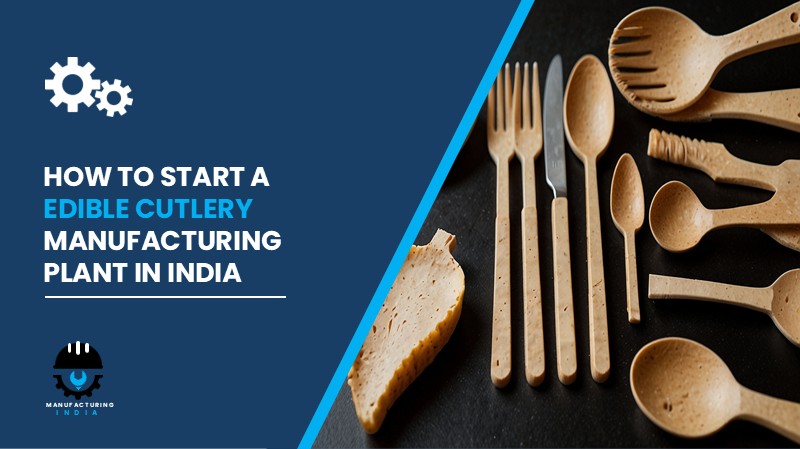
Setting up an edible cutlery manufacturing plant in India presents a compelling investment case at a moment when the country’s foodservice sector, quick-service restaurant chains, airline catering operations, and events and outdoor catering industry are all converging on a single urgent need — sustainable, biodegradable alternatives to plastic utensils. Edible cutlery, produced from food-grade materials including wheat flour, rice flour, sorghum, millets, and natural flavouring agents, eliminates single-use plastic waste by serving as both a functional utensil and a consumable item. India’s rapidly expanding food delivery market, the tightening of plastic waste regulations under the Plastic Waste Management Rules 2025 amendment, and the growing preference of institutional buyers for eco-friendly dining solutions together create a structural demand environment that is both immediate and durable.
India’s advantages for producing this category are significant and well-aligned with the product’s core supply chain requirements. Wheat, sorghum, and millets are domestically cultivated at scale, placing raw material sourcing within reach of agricultural belts in states like Madhya Pradesh, Rajasthan, Maharashtra, and Uttar Pradesh. The Make in India initiative actively supports food processing and sustainable packaging investments with policy incentives, and the country’s cost-competitive land and labour base strengthens the unit economics of a scalable production facility. As the HoReCa sector and organised food delivery platforms deepen their sustainability commitments, an India-based edible cutlery manufacturing unit is strategically positioned to capture both domestic demand and export opportunities across Asia-Pacific markets.
Investing in an edible cutlery manufacturing plant in India aligns powerful regulatory tailwinds — including India’s mandatory recycled content targets and single-use plastic restrictions — with a cost-competitive agricultural raw material base and robust demand from foodservice, QSR, and airline catering sectors. With gross profit margins of 40–50% and net profit margins of 20–30%, the financial case is strong, and the plant’s scalable production model supports viable break-even outcomes across a wide range of output capacities.
What is Edible Cutlery?
Edible cutlery refers to biodegradable eating utensils — including spoons, forks, knives, and stirrers — that manufacturers produce from food-grade materials that consumers can safely eat or discard without harming the environment. These products are created from wheat flour, rice flour, sorghum, millets, and natural flavouring agents, which provide both functional properties and sustainable solutions to the growing global problem of single-use plastic waste. Edible cutlery maintains its structural integrity with hot and cold food items alike, and its shelf life is comparable to that of standard dry food products, making it a practical and commercially viable alternative to conventional plastic utensils.
Restaurants, airlines, and catering services use these utensils in three flavour variants — plain, sweet, and savoury — enabling product differentiation and brand customisation for business buyers. The product serves simultaneously as a utensil and a consumable item, reducing post-meal waste and supporting the principles of the circular economy. The production process covers raw material preparation and mixing, dough formation, moulding and shaping, baking or drying, cooling, quality inspection, and packaging.
The primary end-use industries served are the foodservice and HoReCa sector, quick-service restaurants, airline catering, the eco-friendly packaging industry, and events and catering services. Applications span sustainable alternatives to plastic cutlery in takeaway meals, packaged food services, institutional catering, and environmentally conscious dining solutions.
Cost of Setting Up an Edible Cutlery Manufacturing Plant in India
The cost of establishing an edible cutlery manufacturing plant in India depends on plant capacity, technology selection, geographic location, degree of automation, and applicable regulatory compliance requirements across food safety and environmental domains.
1. Capital Expenditure (CapEx)
Land and Site Development constitutes a foundational component of total capital investment, encompassing land registration charges, boundary development, drainage infrastructure, and site utilities. Investors may explore industrial estates and food processing zones under state government schemes in agricultural surplus states — Maharashtra, Madhya Pradesh, and Uttar Pradesh are particularly relevant given their proximity to sorghum and wheat cultivation belts. SEZ-based options may offer additional fiscal advantages for export-oriented production.
Civil Works and Construction cover the production shed, raw material storage areas with appropriate humidity control for grain-based inputs, a quality control laboratory, finished goods warehousing, staff welfare facilities, and an administrative block. Unlike capital-intensive heavy industry, the civil requirements for an edible cutlery unit are relatively moderate, which supports a faster construction-to-commissioning timeline.
Machinery and Equipment represent the largest component of total CapEx for an edible cutlery manufacturing plant. Key machinery required includes:
- Mixers
- Dough kneading machines
- Moulding machines
- Baking ovens
- Drying units
- Cooling conveyors
- Packaging systems
Other Capital Costs include an effluent treatment plant (ETP) to manage process water, pre-operative expenses, commissioning charges, food safety compliance infrastructure, and any applicable import duties on specialised moulding or baking equipment not sourced domestically.
Request a Sample Report for In-Depth Market Insights: https://www.imarcgroup.com/edible-cutlery-manufacturing-plant-project-report/requestsample
2. Operational Expenditure (OpEx)
Raw Material Cost is the dominant operational expense, accounting for approximately 50–60% of total OpEx. The primary raw materials — sorghum/wheat flour, rice flour, and water — are agricultural commodities subject to seasonal price variation. Long-term procurement contracts with reliable grain suppliers are strongly advisable to stabilise input costs and ensure uninterrupted production continuity. Selecting plant locations in proximity to agricultural supply zones reduces freight costs on the highest-volume input category.
Utility Cost is the second largest OpEx component, representing 15–20% of total operating expenses, covering electricity for baking ovens, drying units, mixing equipment, cooling conveyors, and packaging systems, as well as water for dough preparation and process cleaning.
Other Operating Costs include transportation and distribution to foodservice and institutional buyers, packaging materials, salaries and wages for production and quality staff, routine machinery maintenance, depreciation on food processing equipment, and applicable taxes. By the fifth year of operations, total operational costs are projected to increase substantially as a result of inflation, market fluctuations, potential rises in grain prices, supply chain pressures, and rising consumer demand — all factors that investors must incorporate into multi-year financial planning.
3. Plant Capacity
The proposed manufacturing facility for an edible cutlery plant is designed with an annual production capacity ranging between 100 million and 1 billion pieces, enabling economies of scale while maintaining operational flexibility suited to varying market entry strategies. Plant capacity can be customised to match investor requirements, phased ramp-up schedules, and demand secured through foodservice or institutional supply agreements. As with all volume-driven food manufacturing, profitability improves meaningfully with higher capacity utilisation, making anchor customer relationships a strategic priority from the early stages of commercial production.
4. Profit Margins and Financial Projections
The financial projections for an edible cutlery manufacturing plant demonstrate healthy profitability potential under normal operating conditions. Gross profit margins typically range between 40–50%, supported by stable demand and value-added applications across the foodservice and eco-friendly packaging sectors. Net profit margins are projected at 20–30%. A comprehensive financial analysis covering NPV (net present value), IRR (internal rate of return), payback period, gross margin trajectory, and net margin progression across a five-year horizon should be completed before capital commitment. The project’s financial viability and long-term sustainability are assessed against realistic assumptions on capital investment, production capacity utilisation, grain price trends, and demand outlook.
Why Set Up an Edible Cutlery Plant in India?
Rising Regulatory Pressure on Single-Use Plastics. India’s Plastic Waste Management Rules, under the 2025 amendment, introduced mandatory recycled plastic content targets starting at 30% for 2025–2026 and rising to 60% by 2028–2029 for rigid packaging. These progressively stricter norms are accelerating the shift toward sustainable alternatives, significantly supporting the commercial growth trajectory of edible cutlery solutions across the domestic market.
Expanding Food Delivery and Takeaway Culture. The rapid growth of online food delivery platforms is increasing consumption of disposable cutlery at scale. As foodservice operators come under both regulatory and consumer pressure to move away from single-use plastics, demand for biodegradable and edible alternatives is rising structurally across takeaway and home delivery channels — a trend that directly benefits India-based production capacity.
Growing Sustainability Awareness Among Consumers and Businesses. Consumers are increasingly preferring eco-friendly products, encouraging restaurants, QSR chains, and institutional catering operations to adopt edible cutlery solutions as part of their sustainability commitments. This shift in buyer preference is creating a pull-through demand effect that is broadening the addressable market for edible cutlery beyond early-adopter niche buyers.
Product Innovation and Premiumisation Opportunities. Manufacturers can introduce flavoured, fortified, or customised edible cutlery — such as the chocolate-flavoured variety launched through a partnership between Edible Cutlery and Yo-Chi in November 2025 across 63 outlets — to differentiate in the market and command premium pricing. That campaign sold four weeks of stock within one week, preventing over 100,000 single-use spoons from entering landfills and demonstrating strong consumer acceptance at the QSR scale.
Active Global Retail Adoption. In January 2025, French start-up Koovee secured a distribution partnership with Carrefour covering rollout across more than 10% of Carrefour stores in France, signalling stronger retailer-led sustainability efforts and the integration of edible cutlery into mainstream ready-to-eat meal offerings. This global retail momentum validates the category’s commercial scalability and supports the investment case for building dedicated production capacity in India for both domestic and export markets.
Cost-Competitive Manufacturing and Local Supply Chain Depth. India’s agricultural base provides cost-competitive access to the category’s primary raw materials — sorghum, wheat flour, and rice flour — reducing import dependence and supply chain risk. Competitive land costs, a large food-processing labour pool, and established logistics infrastructure in food processing states make India one of the most cost-efficient locations globally for scaling edible cutlery production.
Manufacturing Process — Step by Step
The edible cutlery manufacturing process uses raw material preparation and mixing, dough formation, moulding and shaping, baking or drying, cooling, quality inspection, and packaging as the primary production method. Each stage requires precise process control, hygiene compliance, and quality assurance throughout.
- Raw Material Preparation and Mixing: Sorghum/wheat flour, rice flour, and natural flavouring agents are weighed, cleaned, and blended in mixers to achieve a consistent, food-grade composite mixture.
- Dough Formation: Water is added in controlled quantities to the flour blend, and the mixture is processed through dough kneading machines to achieve the required consistency and elasticity for subsequent shaping.
- Moulding and Shaping: The prepared dough is fed into moulding machines that press and form the dough into the shapes of spoons, forks, knives, or stirrers as required by the production schedule.
- Baking or Drying: Moulded pieces are passed through baking ovens or drying units at controlled temperatures to remove moisture, harden the structure, and achieve the product’s characteristic rigidity and shelf stability.
- Cooling: Baked or dried pieces are transferred onto cooling conveyors to bring product temperature down to ambient levels before quality inspection and packaging.
- Quality Inspection: Cooled pieces undergo physical and quality checks to ensure dimensional accuracy, structural integrity, absence of defects, and compliance with food safety standards.
- Packaging: Inspected pieces are packed using packaging systems into retail, foodservice, or bulk formats for dispatch to restaurants, QSR chains, airlines, institutional caterers, and events and outdoor catering end-use customers.
Key Applications
Edible cutlery manufactured in India serves a growing range of foodservice, retail, and institutional buyers committed to reducing plastic waste:
- Foodservice and HoReCa Sector: Restaurants, cafes, and catering services use edible cutlery to replace plastic utensils and build sustainable brand value with environmentally conscious customers.
- Quick-Service Restaurants (QSRs): QSR chains use these utensils to decrease plastic waste while offering customers new, environmentally friendly dining experiences at scale.
- Airline and Institutional Catering: Airlines and institutions use edible cutlery as a lightweight, disposable product that protects the environment during large-scale meal service operations.
- Events and Outdoor Catering: Zero-waste solutions benefit large gatherings and events, as edible cutlery eliminates the need for plastic disposal and reduces post-event waste management costs.
Leading Manufacturers
The global edible cutlery industry is served by a growing group of specialist producers with diverse production capacities and application portfolios across foodservice, retail, and institutional segments. Key players in the global market include:
- incrEDIBLE eats inc.
- Frenvi Private Limited
- Mede Cutlery Company
- KOOVEE
- Wisefood GmbH
Timeline to Start the Plant
Establishing an edible cutlery manufacturing plant in India follows a structured multi-phase development sequence. Investors should plan for the following phases:
- Feasibility study and project report preparation
- Land acquisition and site development
- Regulatory approvals and environmental clearances
- Factory licence and fire safety compliance
- Machinery procurement and installation
- Raw material supplier agreements and supply chain setup
- Trial production and quality testing
- Commercial production launch
Licences and Regulatory Requirements
Starting an edible cutlery manufacturing unit in India requires several approvals spanning business registration, food safety, environmental, and industrial compliance domains:
- Business registration (Proprietorship, LLP, or Pvt Ltd)
- Factory Licence under the Factories Act
- Environmental Clearance from the State Pollution Control Board
- GST Registration
- Fire Safety NOC
- FSSAI (Food Safety and Standards Authority of India) licence, applicable given the food-grade nature of the product
- Effluent Treatment Plant (ETP) operational clearance
- Occupational Health and Safety compliance
Key Challenges to Consider
High Capital Requirements for Scaling Production. While the edible cutlery manufacturing plant has relatively moderate civil construction requirements compared to heavy industry, achieving the annual production capacities of 100 million to 1 billion pieces needed for competitive unit economics requires meaningful investment in moulding machines, baking ovens, drying units, and automated packaging systems.
Raw Material Price Volatility. Sorghum/wheat flour and rice flour are agricultural commodities subject to seasonal pricing cycles and monsoon-related supply variability. Raw material costs account for 50–60% of total OpEx, making grain procurement strategy and long-term supplier contracts essential tools for margin protection.
Regulatory Compliance Across Food and Environment Domains. An edible cutlery manufacturing unit sits at the intersection of food safety regulation — requiring FSSAI compliance — and industrial environmental regulation, including ETP operation and waste management. Managing this dual compliance landscape requires dedicated regulatory expertise and ongoing monitoring.
Competition From Established Global Players. The competitive landscape includes incrEDIBLE eats inc., Wisefood GmbH, KOOVEE, Mede Cutlery Company, and Frenvi Private Limited, among others. New entrants in India will need to differentiate through price competitiveness, product customisation, flavour innovation, or secured institutional supply contracts to establish market position.
Consumer and Buyer Education. Despite growing awareness, a portion of the foodservice and institutional buyer market remains unfamiliar with the functional performance, shelf life, and cost comparison of edible cutlery versus conventional plastic utensils. Sales cycles may require investment in product demonstration and buyer education.
Skilled Manpower for Food-Grade Production. Maintaining the hygiene standards and process consistency required for food-grade manufacturing demands trained production staff and quality control personnel — a workforce segment that requires ongoing investment in training, certification, and retention.
Frequently Asked Questions
1. How much does it cost to set up an edible cutlery manufacturing plant in India?
The total setup cost depends on plant capacity, technology selection, location, and automation level. CapEx covers land and site development, food-grade civil construction, machinery including mixers, moulding machines, baking ovens, drying units, and packaging systems, as well as other capital costs. A detailed project report with CapEx and OpEx specifics is available on request.
2. Is edible cutlery manufacturing profitable in India in 2026?
Yes. The project demonstrates gross profit margins of 40–50% and net profit margins of 20–30% under normal operating conditions, supported by the rapid growth of food delivery, QSR chain expansion, and tightening plastic waste regulations driving demand for sustainable alternatives.
3. What machinery is required for an edible cutlery plant in India?
Key machinery includes mixers, dough kneading machines, moulding machines, baking ovens, drying units, cooling conveyors, and packaging systems.
4. What licences and approvals are required to start an edible cutlery plant in India?
Required approvals include business registration, a Factory Licence under the Factories Act, Environmental Clearance from the State Pollution Control Board, GST registration, a Fire Safety NOC, FSSAI food safety licensing, ETP operational clearance, and Occupational Health and Safety compliance.
5. What raw materials are needed for edible cutlery manufacturing?
The primary raw materials are sorghum/wheat flour, rice flour, natural flavouring agents, and water. Sorghum/wheat flour accounts for approximately 50–60% of total operating expenses, making grain procurement strategy central to cost management.
6. What are the environmental compliance requirements for an edible cutlery plant in India?
The unit must obtain Environmental Clearance from the State Pollution Control Board, operate a certified Effluent Treatment Plant for process water management, comply with solid waste disposal norms, and install monitoring systems to ensure compliance with emission standards.
7. What is the best location to set up an edible cutlery plant in India?
Optimal locations offer proximity to wheat, sorghum, and rice cultivation belts, reliable utilities and transportation infrastructure, access to foodservice and institutional markets, and compliance with zoning and environmental regulations. Food processing zones in Madhya Pradesh, Maharashtra, Rajasthan, and Uttar Pradesh are strategically relevant options.
8. What is the break-even period for this type of plant in India?
The break-even period depends on plant capacity, capacity utilisation rate, grain pricing trends, and demand conditions. A detailed financial analysis including payback period, NPV, and IRR projections is included in the full project report, available via the sample request link.
9. What government incentives are available for manufacturers in India?
The Make in India initiative and food processing sector schemes provide financial and regulatory support for investors in sustainable food product manufacturing. State-level industrial promotion policies and food processing park incentives may offer additional fiscal benefits depending on the chosen location.
Key Takeaways for Investors
An edible cutlery manufacturing plant in India represents a timely and financially sound investment opportunity anchored by regulatory-driven demand from the foodservice and HoReCa sector, quick-service restaurants, airline catering, and events and catering services industries that are all transitioning away from single-use plastic utensils. The project demonstrates financial viability across a wide range of annual production capacities — from 100 million to 1 billion pieces — with gross profit margins of 40–50% and net profit margins of 20–30% confirming strong unit economics at commercial scale. The global edible cutlery market, valued at USD 37.70 Million in 2025, is projected to reach USD 76.90 Million by 2034, growing at a CAGR of 7.4% from 2026 to 2034, with Asia-Pacific regulatory momentum and India’s own plastic waste restrictions driving an accelerating share of that growth domestically. With bans on single-use plastics tightening, the food delivery economy expanding, and consumer preference for eco-friendly products continuing to strengthen, demand sustainability for India-based edible cutlery production is structurally robust for the foreseeable investment horizon.
About the Author