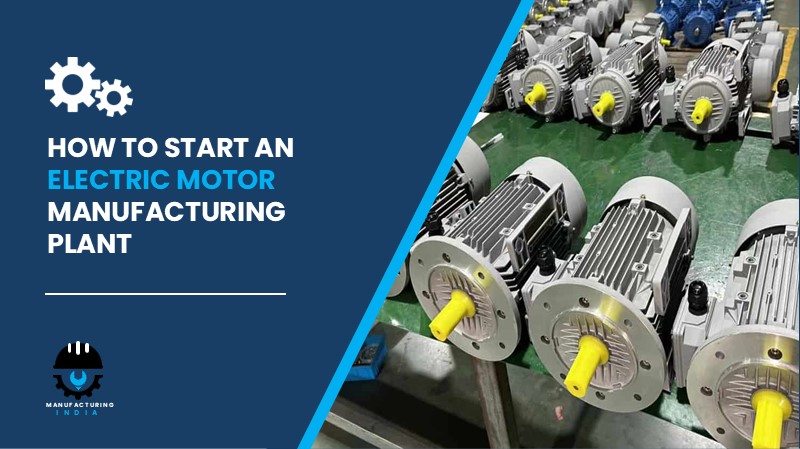
Setting up an electric motor manufacturing plant in India presents a compelling investment case anchored in the country’s accelerating industrial automation, rapidly expanding electric vehicle adoption, surging renewable energy infrastructure deployment, and the broad-based modernisation of manufacturing, HVAC, robotics, and household appliance sectors across the economy. Electric motors – which convert electrical energy into mechanical energy using electromagnetic principles – are the fundamental enabling components behind virtually every modern electromechanical system, from EV drivetrains and wind turbines to conveyor lines, compressors, and household refrigerators. As India’s manufacturing sector continues to contribute 16–17% of the country’s GDP, according to IBEF, the domestic demand for precision-engineered electric motors across industrial, commercial, automotive, and residential applications is growing at a pace that outstrips current domestic production capacity, creating a large and structurally sound opening for new manufacturing investment.
India’s strategic advantages make it an exceptionally well-positioned location for establishing an electric motor manufacturing facility. The government’s active push through Make in India, the PLI scheme for white goods and automotive components, and the FAME EV incentive framework collectively support localisation of electric motor production across multiple end-use verticals simultaneously. Established industrial clusters in Maharashtra, Gujarat, Tamil Nadu, Haryana, and Uttar Pradesh offer access to a growing domestic supply chain for copper wire, steel laminations, bearings, and insulation materials – the key raw materials for motor production – alongside a large pool of mechanical and electrical engineering talent and proximity to OEM buyers across automotive, industrial machinery, and consumer electronics sectors. The global electric motor market was valued at USD 119.02 billion in 2025 and is projected to reach USD 159.70 billion by 2034 at a CAGR of 3.3%, providing investors with a large and stable long-term global demand foundation alongside India’s own fast-growing domestic requirements.
An electric motor manufacturing plant in India is positioned at the intersection of a global market valued at USD 119.02 billion in 2025 growing toward USD 159.70 billion by 2034 at a 3.3% CAGR, India’s rapidly expanding EV, renewable energy, industrial automation, and robotics sectors, and a Make in India policy environment actively supporting domestic electromechanical manufacturing. With gross profit margins of 25–35% and net margins of 10–15% achievable across a production capacity of 1 to 2 million units per annum, this investment delivers strong, multi-sector-backed financial returns.
What is an Electric Motor?
An electric motor is an electrical device that operates on the basis of electromagnetic principles and converts electrical energy into mechanical energy. These motors are essential across many fields of application, including powering industrial machines, vehicles, household appliances, and renewable energy systems. Electric motors come in various types – AC motors including induction and synchronous motors, DC motors including brushed and brushless variants, and specialised types such as servo motors and stepper motors. Their characteristics of high efficiency, reliability, compact design, and flexibility have made them indispensable across a vast range of modern applications.
Electric motors are extensively used in industrial automation for accurate motion control, in electric vehicles as the primary driving force, in robotics for precision movement, and in HVAC systems and household appliances for energy-efficient operation. The primary production method involves stator and rotor fabrication, winding, insulation, assembly, balancing, testing, and final packaging – a multi-stage precision manufacturing process requiring both electrical engineering expertise and quality-controlled mechanical assembly. End-use industries served include automotive, industrial machinery, home appliances, robotics, HVAC systems, and renewable energy sectors.
Cost of Setting Up an Electric Motor Manufacturing Plant in India
The total investment required to establish an electric motor manufacturing plant in India depends on plant capacity, motor type and specification range, geographic location, level of automation, and compliance with industrial quality and safety standards. Investors must account comprehensively for both one-time capital expenditure and recurring operational costs when preparing a feasibility study or detailed project report (DPR).
1. Capital Expenditure (CapEx)
Land and Site Development constitutes a substantial foundational investment. Costs for land registration, boundary construction, internal road layout, drainage infrastructure, and site levelling vary based on whether the facility is located within a government-notified engineering or electronics manufacturing zone, an industrial estate, a Special Economic Zone (SEZ), or on privately acquired industrial land. Industrial clusters in states such as Maharashtra, Gujarat, Tamil Nadu, and Haryana offer infrastructure-ready plots with proximity to OEM buyer networks across automotive, industrial machinery, and consumer appliance sectors.
Civil Works and Construction encompasses the main production hall accommodating winding lines, stamping presses, and assembly stations, along with the raw material storage area, quality control and testing laboratory, insulation treatment facility, finished goods warehouse, and administrative block. High-bay construction to accommodate automated assembly lines and material handling conveyors, combined with electrical safety standards for high-current winding and testing operations, adds to civil construction costs relative to lighter manufacturing facilities.
Machinery and Equipment represent the single largest component of capital expenditure. Key machinery required includes:
- Winding machines
- Stamping presses
- Vacuum impregnation units
- Balancing machines
- Testing rigs
- Automated assembly lines
Other Capital Costs include the effluent treatment plant (ETP) for managing varnish and insulation chemical waste streams, pre-operative expenses covering regulatory filings and feasibility study preparation, plant commissioning charges, utility connection fees, and import duties applicable to specialised winding machines, vacuum impregnation equipment, or high-precision testing rigs sourced from international suppliers.
Request a Sample Report for In-Depth Market Insights: https://www.imarcgroup.com/electric-motor-manufacturing-plant-project-report/requestsample
2. Operational Expenditure (OpEx)
Raw Material Cost is the dominant driver of operating expenditure, accounting for approximately 70–80% of total OpEx. The primary inputs are copper wire, steel laminations, bearings, magnets, housings, and insulation materials. Copper wire represents the single largest raw material cost line, with pricing directly linked to London Metal Exchange copper commodity prices, which are subject to significant volatility driven by global energy transition demand, mining supply dynamics, and macroeconomic cycles. Investors are advised to negotiate long-term supply contracts with copper wire manufacturers and steel lamination suppliers to stabilise input costs. Steel laminations for stator and rotor cores, permanent magnets for brushless motor variants, and precision bearings are additional critical inputs requiring reliable, specification-consistent supply chains. Sourcing raw materials from domestic suppliers wherever possible reduces import dependency and benefits from localisation incentives under India’s PLI and Make in India frameworks.
Utility Costs – covering electricity for winding machines, stamping presses, vacuum impregnation ovens, and automated assembly line operations – account for approximately 10–15% of total OpEx, reflecting the moderate-to-high energy intensity of electric motor production relative to lighter manufacturing categories. Investors in regions with competitive industrial electricity tariffs and access to renewable energy options are better positioned to manage this cost component over the plant’s operational life.
Other Operating Costs include outbound transportation to automotive OEMs, industrial machinery manufacturers, appliance producers, renewable energy project developers, and robotics system integrators; packaging for finished motors and spare parts; employee salaries and wages for electrical engineers, winding technicians, quality inspectors, and assembly line operators; equipment maintenance; quality assurance testing for BIS and international standards compliance; depreciation on civil and machinery assets; and applicable taxes. By the fifth year of operations, total operational costs are expected to increase substantially due to inflation, market fluctuations, potential rises in copper and steel input prices, and supply chain disruptions driven by global electrification demand pressures.
3. Plant Capacity
The proposed electric motor manufacturing facility is designed with an annual production capacity ranging between 1 and 2 million units, enabling significant economies of scale while maintaining operational flexibility across different motor types – AC induction, brushless DC, servo, and stepper motors – and power ratings. This capacity range serves the requirements of automotive OEMs, industrial machinery manufacturers, appliance producers, EV component buyers, and renewable energy system integrators across India’s growing domestic and export markets. Capacity can be customised based on investor requirements, target market focus, and motor type specialisation strategy. Profitability improves consistently with higher capacity utilisation, and plants designed with modular production line architecture can expand output through additional winding and assembly lines with contained incremental CapEx.
4. Profit Margins and Financial Projections
The electric motor manufacturing plant demonstrates strong and stable profitability potential under normal operating conditions. Gross profit margins typically range between 25–35%, supported by stable multi-sector demand and the precision-engineered, application-specific nature of electric motors that commands premium pricing relative to undifferentiated commodity components. Net profit margins range between 10–15%, reflecting the raw material intensity of copper-dominant production and the capital requirements of precision manufacturing infrastructure. A comprehensive financial analysis should include income projections, expenditure forecasts, gross and net margin tracking across Years 1 through 5, net present value (NPV), internal rate of return (IRR), payback period, and a full profit and loss account. Sensitivity analysis covering copper price movements and demand volume scenarios across automotive and industrial segments is particularly important for investment-grade planning in this sector.
Why Set Up an Electric Motor Manufacturing Plant in India?
EV and Automotive Sector Driving Structural Motor Demand Growth. The rising adoption of electric vehicles across India – supported by FAME scheme subsidies, EV-friendly state policies, and major OEM investment commitments – is creating large and rapidly growing demand for traction motors, auxiliary motors, and EV drivetrain components that are primarily sourced from domestic manufacturers for cost and localisation compliance reasons. In November 2025, Yamaha Motor launched two new electric scooters in India, including the AEROX E and the EC-06, supporting its EV strategy and carbon neutrality goals – illustrating the continued momentum of EV model launches that directly drive demand for high-performance electric motors from domestic production facilities.
Industrial Automation and Modernisation Creating Large-Volume Demand. India’s manufacturing sector – already contributing 16–17% of GDP according to IBEF – is undergoing rapid automation and modernisation, increasing the use of electric motors in conveyor systems, pumps, compressors, robotics, and automated machinery across virtually every industry vertical. The ongoing expansion of manufacturing capacity across automotive, pharmaceuticals, food processing, textiles, and consumer goods sectors is sustaining multi-year demand growth for industrial electric motors at scale.
Renewable Energy Infrastructure Accelerating Motor Applications. Growth in renewable energy installations – particularly wind and solar power – is increasing demand for motors in energy conversion, tracking, and generation systems. India’s national renewable energy targets and the rapid expansion of utility-scale solar and wind projects generate consistent demand for motors used in solar panel tracking systems, wind turbine pitch and yaw control mechanisms, and balance-of-plant equipment – providing electric motor manufacturers with a long-term infrastructure-linked buyer category.
Technology Innovation Expanding Product Application Range. The electric motor market is being reshaped by technology innovation across motor design, materials, and efficiency standards. In March 2025, UK-based Advanced Electric Machines (AEM) launched the HDRM300C, a second-generation magnet-free heavy-duty electric motor for commercial vehicles featuring advanced coil compression, enhanced thermal management, and improved speed, offering over 80% conductor slot fill, higher efficiency, and easier installation. These technological developments signal the ongoing evolution of motor performance benchmarks that manufacturers must track and incorporate into their product development roadmaps.
Product Diversification Across AC, DC, Brushless, Servo, and Stepper Types. The wide range of electric motor types – including AC induction motors, brushless DC motors, servo motors, and stepper motors – offers manufacturers multiple product specialisation pathways with different customer bases, pricing structures, and margin profiles. Manufacturers that build capability across multiple motor types can serve automotive, industrial automation, robotics, HVAC, and consumer appliance sectors simultaneously, reducing revenue concentration risk and improving capacity utilisation.
Cost-Competitive Manufacturing with Strong Engineering Talent Base. India offers competitive land, construction, utility, and labour costs for electric motor manufacturing relative to production locations in Germany, Japan, or the United States. The country’s large pool of electrical and mechanical engineering graduates, combined with established precision manufacturing clusters in Maharashtra, Gujarat, and Tamil Nadu, provides manufacturers with the technical workforce required to operate winding machines, stamping presses, vacuum impregnation systems, and automated assembly lines at globally competitive productivity levels.
Manufacturing Process – Step by Step
The electric motor manufacturing process uses stator and rotor fabrication, winding, insulation, assembly, balancing, testing, and final packaging as the primary production method. Below are the main stages involved in the electric motor manufacturing process flow:
- Raw Material Receipt and Inspection: Copper wire, steel laminations, bearings, magnets, housings, and insulation materials are received, inspected against dimensional and material specification requirements, and cleared for production line entry following quality verification.
- Stator Core Fabrication: Stamping presses punch silicon steel sheets into the precise lamination shapes that form the stator core. Individual laminations are stacked and bonded to form the stator core assembly, with dimensional accuracy verified against motor design specifications.
- Rotor Core Fabrication: Stamping presses similarly produce rotor laminations, which are stacked and assembled around the rotor shaft. For brushless DC and permanent magnet motors, permanent magnets are installed into rotor slots at this stage according to polarity arrangement specifications.
- Winding: Winding machines precisely wind copper wire onto the stator core according to the specified winding pattern, turn count, and wire gauge for the motor design. Winding quality — including conductor fill factor, insulation integrity, and connection accuracy — is critical to motor efficiency and performance.
- Insulation Treatment – Vacuum Impregnation: The wound stator assembly is processed through vacuum impregnation units, which evacuate air from the winding structure and impregnate it with varnish or resin under vacuum and pressure. This process fills voids in the winding, mechanically binds conductors, provides moisture resistance, and enhances thermal conductivity for heat dissipation during motor operation.
- Curing: Impregnated stator assemblies are cured in ovens at controlled temperatures to fully polymerise the varnish or resin, achieving the specified insulation class and mechanical strength.
- Motor Assembly: Automated assembly lines bring together the stator, rotor, shaft, bearings, end shields, and housing in the correct assembly sequence. Precision tolerances on shaft alignment, bearing seating, and air gap dimensions are maintained throughout the assembly process to ensure motor performance and longevity.
- Balancing: Balancing machines dynamically balance the rotor assembly to the specified residual imbalance tolerance, minimising vibration, noise, and bearing load during motor operation. Balancing is particularly critical for high-speed and precision servo motor applications.
- Testing: Testing rigs subject each assembled motor to a comprehensive suite of electrical, mechanical, and performance tests – including no-load current, winding resistance, insulation resistance, high-voltage withstand, vibration, noise, and efficiency verification – with all test results recorded for batch traceability and quality compliance documentation.
- Quality Inspection and Certification: Quality inspection systems verify dimensional accuracy, surface finish, nameplate information, and assembly completeness. Motors destined for automotive, renewable energy, or export applications undergo additional application-specific certification testing as required.
- Packaging and Dispatch: Finished electric motors are packaged with protective materials appropriate to their size, weight, and transport requirements, and dispatched to automotive OEMs, industrial machinery manufacturers, appliance producers, renewable energy project developers, robotics system integrators, and HVAC equipment manufacturers.
Key Applications
Electric motors produced at this type of facility serve a wide range of end-use industries and application categories, each requiring specific motor type, power rating, efficiency class, and certification:
- Automotive Industry: Powering electric vehicles, hybrid vehicles, and EV components including traction motors, power steering systems, cooling fans, and auxiliary drive systems.
- Industrial Automation: Drive motors for conveyors, pumps, compressors, machine tools, and automated manufacturing systems across virtually every industrial sector.
- Renewable Energy: Wind turbines and solar tracking systems using motors for pitch and yaw control, energy conversion, and balance-of-plant equipment in utility-scale and distributed renewable installations.
- Household Appliances: Air conditioners, refrigerators, washing machines, and fans using energy-efficient motors that comply with BEE star rating requirements for residential and commercial applications.
- Robotics: Servo motors and precision stepper motors used for high-accuracy motion control in industrial robots, collaborative robots, and automated assembly systems across electronics, automotive, and pharmaceutical manufacturing.
Leading Electric Motor Manufacturers
The global electric motor industry is served by several large-scale manufacturers with diversified product portfolios and strong multi-sector market presence. Key players include:
- ABB Ltd.
- Siemens AG
- WEG S.A.
- Nidec Corporation
- Regal Rexnord Corporation
- Mitsubishi Electric Corporation
- Toshiba Corporation
Timeline to Start the Plant
Investors planning to establish an electric motor manufacturing plant in India should anticipate the following project development phases:
- Feasibility study and project report preparation
- Land acquisition and site development
- Regulatory approvals and environmental clearances
- Factory licence and fire safety compliance
- Machinery procurement and installation
- Raw material supplier agreements and supply chain setup
- Trial production and quality testing
- Commercial production launch
Licences and Regulatory Requirements
Starting an electric motor manufacturing unit in India requires several approvals:
- Business registration (Proprietorship, LLP, or Private Limited Company)
- Factory Licence under the Factories Act
- Bureau of Indian Standards (BIS) certification for applicable electric motor standards under IS 325 (induction motors) and other relevant IS specifications
- Environmental Clearance from the State Pollution Control Board
- GST Registration
- Fire Safety NOC
- Effluent Treatment Plant (ETP) operational clearance for varnish, insulation chemical, and process waste management
- Occupational Health and Safety compliance covering high-voltage winding and testing operations
- BEE (Bureau of Energy Efficiency) energy efficiency compliance for motors under the Standards and Labelling program where applicable
- Export certification compliance for motors destined for international automotive or industrial equipment OEM supply chains
Key Challenges to Consider
Copper Price Volatility. Copper wire – the dominant raw material accounting for 70–80% of total OpEx – is linked to LME copper pricing, which is subject to significant and persistent volatility driven by global energy transition demand, mining supply constraints, and macroeconomic cycles. Securing long-term supply contracts and exploring copper hedging strategies are essential risk management priorities for electric motor manufacturers.
High Precision Manufacturing Standards. Electric motor manufacturing requires tight dimensional tolerances on lamination punching, winding accuracy, shaft alignment, air gap geometry, and dynamic balancing. Any deviation from specification tolerances can result in performance shortfalls, vibration, excessive noise, premature bearing failure, or safety failures – making precision manufacturing process control and quality management system investment non-negotiable operational requirements.
Regulatory and Certification Complexity. Supplying electric motors to automotive OEMs, industrial equipment manufacturers, and export markets requires compliance with BIS standards, BEE energy efficiency labelling, automotive OEM-specific quality management certifications (such as IATF 16949), and country-specific import compliance certifications for export. Maintaining this multi-standard compliance framework adds to ongoing quality assurance overhead.
Technology and Innovation Pressure. The electric motor industry is rapidly evolving toward higher efficiency classes, magnet-free designs, integrated drives, and smart motor architectures – as illustrated by AEM’s March 2025 launch of the second-generation HDRM300C magnet-free motor for commercial vehicles. Manufacturers must invest in R&D capability or technology licensing to keep their product portfolio current against advancing global efficiency and performance benchmarks.
Competition from Established Global and Domestic Players. The market is dominated by globally scaled manufacturers including ABB, Siemens, Nidec, and Mitsubishi Electric, with deep OEM relationships, broad product portfolios, and established quality reputations. New Indian manufacturers must differentiate through application-specific motor expertise, competitive pricing for domestic OEM buyers, or focus on high-growth segments such as EV traction motors, servo motors for industrial automation, or energy-efficient motors for the appliance sector.
Skilled Manpower in Electrical Engineering and Precision Manufacturing. Operating winding machines, stamping presses, vacuum impregnation units, dynamic balancing equipment, and high-voltage testing rigs requires engineers and technicians with specialised training in electrical machine design, precision mechanical assembly, and quality management for electromechanical products. Recruiting and retaining this talent pool – particularly for facilities located outside established engineering manufacturing hubs – remains a meaningful operational challenge.
Frequently Asked Questions
1. How much does it cost to set up an electric motor manufacturing plant in India?
The total cost depends on plant capacity (1–2 million units per annum), motor type and power rating range, location, and automation level. CapEx covers land, industrial-grade civil construction, and machinery including winding machines, stamping presses, vacuum impregnation units, balancing machines, testing rigs, and automated assembly lines, along with pre-operative and regulatory costs.
2. Is electric motor manufacturing profitable in India in 2026?
Yes. With gross margins of 25–35% and net margins of 10–15%, supported by growing multi-sector demand across EVs, industrial automation, renewable energy, HVAC, and household appliances, and a global market expanding from USD 119.02 billion in 2025 toward USD 159.70 billion by 2034, the investment presents a well-supported profitability case at appropriate production scale.
3. What machinery is required for an electric motor manufacturing plant in India?
Key equipment includes winding machines, stamping presses, vacuum impregnation units, balancing machines, testing rigs, and automated assembly lines.
4. What licences and approvals are required to start an electric motor manufacturing plant in India?
Required approvals include business registration, Factory Licence, BIS certification for applicable motor standards, Environmental Clearance, GST Registration, Fire Safety NOC, ETP operational clearance, BEE energy efficiency compliance, and Occupational Health and Safety compliance.
5. What raw materials are needed for electric motor manufacturing?
The primary raw materials are copper wire, steel laminations, bearings, permanent magnets, motor housings, and insulation materials. Additional inputs include varnish or resin for vacuum impregnation, shafts, end shields, terminal boxes, and fasteners.
6. What are the environmental compliance requirements for an electric motor manufacturing plant in India?
An operational effluent treatment plant is mandatory for managing varnish, resin, and insulation chemical waste streams, along with Environmental Clearance from the State Pollution Control Board and compliance with chemical waste disposal and emission standards applicable to electromechanical manufacturing operations.
7. What is the best location to set up an electric motor manufacturing plant in India?
States with established automotive and industrial manufacturing ecosystems, strong engineering talent availability, and active PLI scheme incentives — such as Maharashtra, Gujarat, Tamil Nadu, Haryana, and Uttar Pradesh — offer the best combination of OEM buyer proximity, raw material supply chain access, skilled workforce availability, and state-level industrial incentives.
8. What is the break-even period for this type of plant in India?
The break-even period depends on plant scale, product mix, capacity utilisation, and OEM supply contract values. A full NPV and IRR analysis incorporating sensitivity testing for copper price movements and demand volume variability across automotive and industrial segments is recommended for investment-grade financial planning.
9. What government incentives are available for electric motor manufacturers in India?
Make in India incentives, PLI schemes for white goods, automotive components, and electronics, FAME EV component localisation incentives, BEE energy efficiency programme support, state-level industrial incentive schemes in Maharashtra and Gujarat, and export promotion support through engineering export councils provide meaningful financial and regulatory backing for qualifying electric motor manufacturing investments.
Key Takeaways for Investors
An electric motor manufacturing plant in India represents a structurally sound, multi-sector investment opportunity backed by a global market valued at USD 119.02 billion in 2025 and growing toward USD 159.70 billion by 2034 at a CAGR of 3.3%, driven by converging demand from electric vehicles, industrial automation, renewable energy, robotics, HVAC, and household appliance sectors. Financial viability is demonstrated across a production capacity range of 1 to 2 million units per annum, with gross margins of 25–35% and net margins of 10–15% achievable under competitive raw material procurement and efficient production operations. India’s manufacturing sector – already contributing 16–17% of GDP – is undergoing rapid automation and electrification, creating a large and expanding domestic demand base for locally produced precision electric motors. With global technology innovation advancing toward magnet-free, high-efficiency, and smart motor architectures – as evidenced by AEM’s March 2025 HDRM300C launch – and India’s EV market generating growing traction motor demand validated by OEM launches including Yamaha’s November 2025 electric scooter introductions, the long-term demand trajectory and technology opportunity for Indian electric motor manufacturers are comprehensively well-supported for the decade ahead.
About the Author