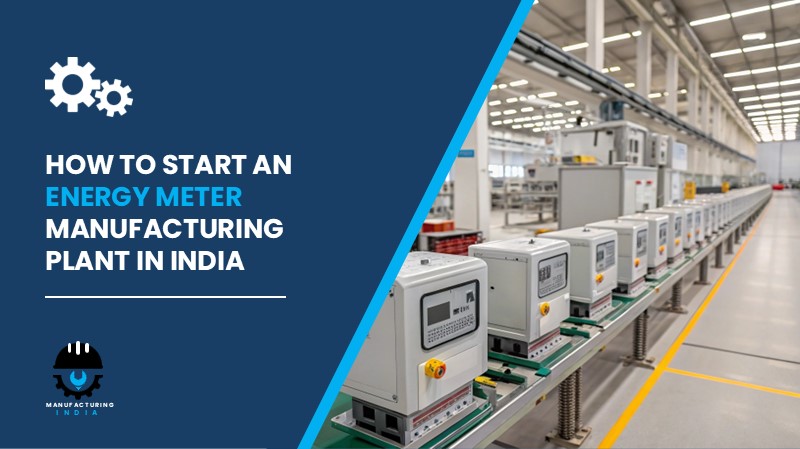
Setting up an energy meter manufacturing plant in India presents a compelling investment case as the country rapidly emerges as one of the most cost-competitive and high-demand destinations for electronics and smart-grid component manufacturing. Driven by accelerating demand from power utilities, smart city projects, residential and commercial electrification, and renewable energy integration, energy meters have become an indispensable part of India’s rapidly modernising power distribution infrastructure.
“With over 1.4 billion consumers, a rapidly urbanising population, aggressive smart-grid rollout under the Revamped Distribution Sector Scheme (RDSS), and a government mandate for 250 million smart meters, India offers one of the most financially attractive environments for energy meter manufacturing — with gross margins of 35–45% and a break-even window of 3–5 years.”
What is an Energy Meter?
An energy meter is a precise electronic device that measures and records electrical energy usage in residential, commercial, and industrial settings. The device monitors multiple parameters, including voltage, current, power factor, frequency, and total energy usage, to create accurate billing systems and energy management solutions. Modern energy meter technology encompasses single-phase and three-phase variants, smart meters, prepaid meters, and advanced communication-enabled devices that support remote monitoring and data transfer. Smart energy meters use RF, PLC, NB-IoT, and cellular communication modules, enabling utilities to obtain real-time consumption data to improve grid efficiency. Energy meters serve vital functions in reducing power losses, increasing billing accuracy, enabling demand response programmes, and empowering consumers to manage their energy use. As crucial elements of contemporary power distribution systems, they deliver dependable performance and precise measurements that meet stringent regulatory requirements.
Cost of Setting Up an Energy Meter Manufacturing Plant in India:
The energy meter manufacturing plant cost in India depends on several parameters including production capacity, technology used, plant location, level of automation, and regulatory compliance requirements. Here is a structured breakdown of all major cost components:
1. Capital Expenditure (CapEx):
The total capital investment in an energy meter manufacturing plant typically covers the following:
Land and Site Development:
This includes land acquisition, boundary development, land registration charges, and basic site preparation. Cost varies significantly depending on whether the land is located in an electronics manufacturing cluster, Special Economic Zone (SEZ), Industrial Development Corporation estate, or a privately purchased plot. Proximity to established electronics supply chain hubs such as Noida, Pune, Bengaluru, Hyderabad, and Chennai can reduce component logistics costs significantly.
Civil Works and Construction:
Building costs cover the main manufacturing and assembly shed, ESD-controlled production zones, raw material and component storage, quality control and calibration laboratory, firmware programming room, administrative block, and worker amenities. Construction specifications depend on plant scale, ESD compliance requirements, cleanroom standards for PCB assembly, and local regulatory norms.
Machinery and Equipment:
This is the single largest component of CapEx. Key machinery required for an energy meter manufacturing plant includes:
- SMT (Surface Mount Technology) Lines
- Pick-and-Place Machines
- Reflow Soldering Ovens
- Wave Soldering Machines
- Automated Optical Inspection (AOI) Systems
- Calibration Benches and Reference Standards
- Automated Test Systems (ATS)
- Firmware Programming and Loading Stations
- Enclosure Assembly and Sealing Machines
- Labelling and Packaging Systems
- Conveyors and Material Handling Equipment
Machinery costs represent the largest share of overall capital expenditure, reflecting the high degree of precision electronics assembly, calibration infrastructure, and automated testing involved in energy meter production.
Other Capital Costs:
These include pre-operative expenses, commissioning charges, import duties on specialised electronic manufacturing equipment sourced internationally, ESD flooring and anti-static workstation setup, utilities installation, fire safety systems, and Effluent Treatment Plant (ETP) setup where applicable.
2. Operational Expenditure (OpEx):
Once the plant is commissioned, the ongoing cost structure is dominated by a few key components:
Raw Material Cost (PCB, Components, and Assemblies): 60–70% of Total OpEx:
Printed Circuit Boards (PCBs) and associated electronic components are the primary raw materials and account for the majority of operating expenses. Additional materials include current transformers, display units, communication modules (RF/PLC/NB-IoT), meter housings, terminal blocks, sealing compounds, and firmware licences. Long-term supplier contracts and domestic component sourcing help mitigate import dependency and price volatility.
Utility Cost: 5–10% of Total OpEx:
Utilities include electricity (consumed by SMT lines, soldering ovens, test systems, and calibration benches), compressed air supply, and climate control systems for ESD-compliant assembly areas. Energy-efficient equipment and solar power integration on the plant roof can materially reduce utility costs over the project lifecycle.
Other Operating Costs:
The remaining budget covers transportation and logistics, secondary packaging, salaries and wages for skilled electronics technicians and quality engineers, maintenance, depreciation, taxes, calibration standards renewal, and miscellaneous overhead. BIS certification maintenance and periodic audit costs also form a recurring part of operational expenditure.
3. Plant Capacity:
The proposed manufacturing facility is designed with an annual production capacity ranging between 1 to 5 million units. This range allows the plant to achieve economies of scale while maintaining flexibility to serve multiple end-use segments including power utilities, state electricity distribution companies (DISCOMs), residential developers, industrial consumers, and renewable energy project developers. Smaller pilot setups with semi-automated assembly may start at lower capacity, but profitability significantly improves with higher capacity utilisation and longer production runs.
4. Profit Margins and Financial Projections:
- Gross Profit Margin: 35–45%, supported by stable demand from utility mandates and smart metering rollouts
- Net Profit Margin: 15–25%, improving with capacity utilisation and efficient component sourcing
- Break-Even Period: 3 to 5 years, depending on production scale, DISCOM order volumes, raw material cost management, and sales efficiency
Financial projections must account for capital investment, operating costs, capacity utilisation rates, pricing trends, and demand outlook. A thorough analysis should also include sensitivity analysis, Net Present Value (NPV), Internal Rate of Return (IRR), and Payback Period.
Request a Sample Report for In-Depth Market Insights: https://www.imarcgroup.com/energy-meter-manufacturing-plant-project-report/requestsample
Why Set Up an Energy Meter Plant in India?
India presents a uniquely favourable environment for establishing an energy meter manufacturing plant:
Surging Domestic Demand from Smart Metering Mandates:
The Government of India’s Revamped Distribution Sector Scheme (RDSS) mandates the replacement of conventional meters with smart prepaid meters across the country, targeting 250 million smart meter installations. State DISCOMs are tendering large-scale procurement orders, creating a sustained and high-volume demand pipeline for domestic energy meter manufacturers for years to come.
Policy and Regulatory Tailwinds:
The Government of India’s emphasis on domestic electronics manufacturing under the Make in India initiative, the Production Linked Incentive (PLI) scheme for electronics, and the preference for domestically manufactured meters in government procurement (through Public Procurement Order provisions) create a strongly policy-favourable environment for Indian energy meter manufacturers over importers.
Cost-Competitive Manufacturing:
India offers competitive land costs, a large pool of skilled electronics engineering graduates, and a rapidly expanding domestic PCB and electronics component supply chain. Proximity to growing smart meter component clusters in Noida, Pune, and Hyderabad reduces input logistics costs. These structural advantages make India one of the most cost-effective manufacturing bases for energy meters in Asia.
Export Opportunities:
India-based manufacturers can leverage competitive cost structures to tap into growing export demand from Southeast Asia, Africa, the Middle East, and South Asia, where grid modernisation and electrification programmes are gaining momentum. India’s established electronics export infrastructure and trade agreements support international market entry at competitive price points.
Rapid Urbanisation and Electrification:
Nearly 36% of India’s population lived in urban areas in 2025, with projections pointing to almost 50% by 2050. This rapid urbanisation, combined with expanding industrial and commercial electrification, creates a constant and growing need for new energy measurement installations — a direct and recurring opportunity for domestic energy meter manufacturers across all product categories.
Manufacturing Process Overview:
The energy meter manufacturing process is a multi-step operation involving precision electronics assembly, firmware integration, calibration, and rigorous quality testing:
- PCB Fabrication and Component Procurement — sourcing and incoming quality inspection of bare PCBs and electronic components
- SMT Assembly — automated placement and soldering of surface-mount components onto PCBs using pick-and-place machines and reflow ovens
- Wave Soldering — soldering of through-hole components using wave soldering machines
- Automated Optical Inspection (AOI) — automated visual inspection of soldered PCBs for defects and misalignments
- Firmware Programming — loading of calibrated firmware and communication protocols into the meter’s microcontroller
- Component Sub-Assembly — integration of current transformers, display units, communication modules, and terminal blocks
- Enclosure Assembly and Sealing — fitting the PCB assembly into the meter housing and sealing for tamper resistance and IP protection
- Calibration — precision calibration of each unit against certified reference standards to meet accuracy class requirements
- Automated Testing — functional, communication, and load testing of each finished meter
- Quality Inspection, Labelling, and Packaging — final QC check, BIS marking, labelling, and dispatch packaging
Key Applications of Energy Meters:
Energy meters manufactured in India serve a wide variety of end-use industries and applications:
- Power Utilities and Distribution Companies: Accurate billing measurement, commercial loss reduction, and continuous monitoring of transmission and distribution networks by state DISCOMs and private utilities
- Residential and Commercial Buildings: Smart and prepaid meters enabling consumers to track real-time energy usage, manage consumption, and reduce electricity bills
- Industrial Facilities: High-accuracy multi-function meters for load monitoring, energy audits, power quality analysis, and compliance with energy efficiency standards
- Renewable Energy Projects: Solar and wind installations using bidirectional net meters to measure energy export to the grid and maintain synchronisation under net metering regulations
- Smart City and Infrastructure Projects: Advanced metering infrastructure (AMI) deployments enabling demand response, outage management, and data-driven grid optimisation
Global Market Outlook:
The global energy meter market was valued at USD 21.3 billion in 2025 and is projected to reach USD 44.76 billion by 2034, growing at a CAGR of 8.6% from 2026 to 2034. This robust growth is driven by worldwide smart grid investments, regulatory mandates for accurate billing, the growing adoption of prepaid and smart metering systems, and the integration of renewable energy sources requiring bidirectional measurement capabilities.
Leading global players in the energy meter industry include:
- Eaton Corporation PLC
- Siemens AG
- General Electric Company
- Kamstrup AS
- Aclara Technologies LLC
- Landis+Gyr Group AG
- Itron Inc.
- Schneider Electric SE
- Honeywell International Inc.
- ABB Ltd.
Timeline to Start an Energy Meter Plant:
Setting up an energy meter manufacturing plant from ideation to commissioning typically requires 12 to 18 months. This covers:
- Feasibility study and detailed project report (DPR) preparation
- Land acquisition and site development
- Regulatory approvals and environmental clearances
- Factory licence and fire safety compliance
- Machinery procurement, installation, and ESD infrastructure setup
- BIS certification testing and type approval
- Trial production, calibration verification, and quality testing
- Commercial production launch and DISCOM order fulfilment
Licenses and Regulatory Requirements:
Starting an energy meter manufacturing unit in India requires several approvals, including:
- Business registration (Proprietorship, LLP, or Private Limited Company)
- Factory Licence under the Factories Act
- Environmental Clearance from the State Pollution Control Board
- GST Registration
- Fire Safety NOC
- BIS Certification under IS 13779 (AC static direct connected watt-hour meters) and related Indian Standards — mandatory for all energy meters sold in India
- Legal Metrology Approval under the Legal Metrology Act, 2009 — required for meters used in billing
- STQC / NABL Accreditation for in-house calibration and testing laboratories
- Udyam Registration (for MSME benefits and PLI scheme eligibility)
- IEC 62052 / IEC 62053 Type Approval (for export-oriented units)
Key Challenges to Consider:
Before investing, entrepreneurs should be aware of the common challenges in this business:
- High Capital Requirements: Initial CapEx for SMT lines, AOI systems, automated test equipment, and calibration infrastructure is significant, particularly for mid to large-scale plants targeting DISCOM orders.
- Component Import Dependency: Key components such as specialised metering ICs, communication modules, and displays are heavily import-dependent. Rupee depreciation and global semiconductor supply disruptions can impact margins.
- BIS and Legal Metrology Compliance: Obtaining and maintaining mandatory BIS certification and Legal Metrology type approval requires substantial investment in testing infrastructure, documentation, and periodic third-party audits.
- Competitive Tendering: DISCOM procurement is largely through reverse auction-based government tenders, which compress margins and require manufacturers to maintain strict cost discipline and scale efficiency.
- Technology Upgradation: Rapid evolution in smart metering standards, communication protocols (NB-IoT, 5G), and cybersecurity requirements demands continuous R&D investment to remain competitive in tender qualification.
- Skilled Manpower: Operating SMT lines, calibration benches, and firmware programming stations requires trained electronics engineers and technicians, who are in high demand across India’s expanding electronics manufacturing sector.
Frequently Asked Questions:
The following questions are answered in the report:
- How much does it cost to set up an energy meter manufacturing plant in India?
- Is energy meter manufacturing profitable in India in 2026?
- What machinery is required for an energy meter plant in India?
- What raw materials and components are required for energy meter production?
- What licences and approvals are required to start an energy meter plant in India?
- How long does it take to commission an energy meter manufacturing plant in India?
- What is the best state or location to set up an energy meter plant in India?
- What government incentives are available for energy meter manufacturers in India?
- What is the break-even period for an energy meter plant in India?
- What are the BIS and Legal Metrology compliance requirements for energy meter manufacturing in India?
Key Takeaways for Investors:
The energy meter manufacturing industry in India represents a strong and scalable investment opportunity backed by government-mandated smart meter rollouts, rapidly growing electricity demand, and a supportive domestic manufacturing policy environment. With gross margins of 35–45% and a break-even window of 3–5 years, a well-planned energy meter manufacturing plant cost in India remains competitive and financially viable across plant capacities. Investors who combine BIS-compliant quality systems, efficient domestic component sourcing, and a strong DISCOM tender execution capability stand to benefit significantly from one of India’s fastest-growing segments of electronics and power infrastructure manufacturing.
About the Author