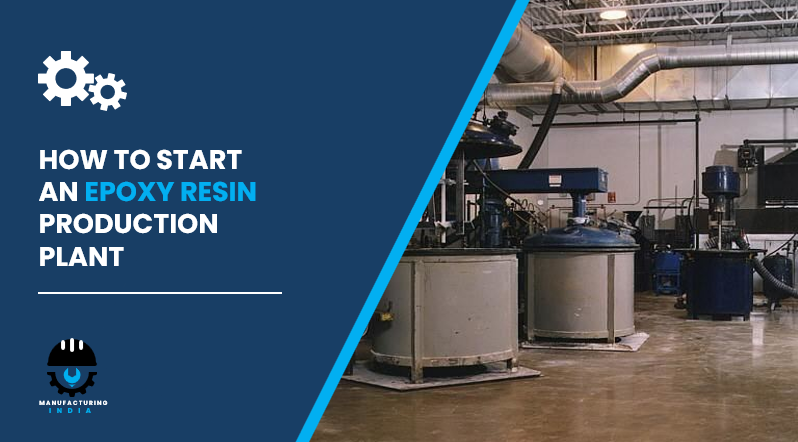
Setting up an epoxy resin production plant in India presents a highly compelling investment opportunity as global demand for thermosetting polymers continues to surge across construction, automotive, aerospace, electronics, and renewable energy industries. Epoxy resins have become indispensable in modern manufacturing due to their exceptional mechanical strength, chemical resistance, electrical insulation, and adhesion properties.
“With a rapidly expanding global market projected to grow at a CAGR of 5.35% through 2034, increasing adoption in wind energy, EV manufacturing, and advanced composites, and gross margins of 20–30%, epoxy resin production offers one of the most financially attractive opportunities in the specialty chemicals sector — with a break-even window of 3–6 years.”
What is an Epoxy Resin?
Epoxy resin is a class of thermosetting polymers formed through the chemical reaction of epichlorohydrin (ECH) with bisphenol-A (BPA) or other phenolic compounds. When mixed with a curing agent or hardener — typically amines, anhydrides, or phenols — epoxy resins undergo a cross-linking reaction to form a rigid, durable material with excellent dimensional stability and low shrinkage.
Epoxy resins are available in various forms including liquid resins, solid resins, and specialty formulations tailored for specific applications. They are widely valued for their superior adhesion to metals, plastics, wood, glass, and ceramics, making them an essential material across diverse industries including aerospace, automotive, construction, electronics, marine, coatings, adhesives, and composite materials manufacturing.
Globally, regulatory bodies and industry standards organizations recognize epoxy resins for their high-performance characteristics. The increasing push for lightweight materials, sustainable energy solutions, and advanced protective coatings is further accelerating epoxy resin demand across industrial and commercial markets worldwide.
Cost of Setting Up an Epoxy Resin Production Plant in India
The epoxy resin production plant cost depends on several parameters including production capacity, technology configuration, plant location, level of automation, raw material sourcing strategy, and regulatory compliance requirements. Here is a structured breakdown of all major cost components:
1. Capital Expenditure (CapEx)
The total capital investment in an epoxy resin production plant typically covers the following:
Land and Site Development
This includes land acquisition, boundary development, land registration charges, and basic site preparation. Cost varies significantly depending on whether the land is in a designated industrial zone, chemical park, Special Economic Zone (SEZ), or a privately purchased plot. Proximity to raw material suppliers and key transportation routes is a critical factor in site selection.
Request a Sample Report for In-Depth Market Insights: https://www.imarcgroup.com/epoxy-resin-manufacturing-plant-project-report/requestsample
Civil Works and Construction
Building costs cover the main production facility, chemical storage areas, raw material warehousing, quality control laboratory, administrative block, utility area, and worker amenities. Construction must comply with chemical plant safety norms including fire resistance, ventilation systems, chemical spill containment, and environmental management standards.
Machinery and Equipment
This is the single largest component of CapEx. Key machinery required for an epoxy resin production plant includes:
- Chemical Reaction Vessels (Stainless Steel Reactors)
- Condensers and Reflux Systems
- Distillation Units
- Blending and Mixing Tanks
- Heat Exchangers and Cooling Systems
- Filtration and Purification Equipment
- Automated Dosing and Metering Systems
- Packaging Lines (Drums, IBCs, and Container Filling)
- Storage Tanks for Raw Materials and Finished Products
- Process Control and Automation Systems (DCS/SCADA)
Machinery costs represent the largest share of overall capital expenditure, reflecting the high degree of precision engineering, corrosion-resistant materials, and process safety requirements involved in epoxy resin production.
Other Capital Costs
These include pre-operative expenses, commissioning charges, import duties (if machinery is sourced internationally), utilities installation, fire safety and explosion-proof systems, Effluent Treatment Plant (ETP) setup, and environmental management infrastructure.
2. Operational Expenditure (OpEx)
Once the plant is commissioned, the ongoing cost structure is dominated by a few key components:
Raw Material Cost (Epichlorohydrin and Bisphenol-A): 65–75% of Total OpEx
Epichlorohydrin (ECH) and bisphenol-A (BPA) are the primary raw materials and account for most operating expenses. Additional materials include caustic soda (sodium hydroxide), curing agents such as amines and anhydrides, solvents, reactive diluents, and performance additives depending on the product formulation and end-use application.
Utility Cost: 10–15% of Total OpEx
Utilities include electricity (heavily consumed by reactors, heating systems, and process control equipment), water (used in cooling systems and washing processes), steam generation, and compressed air supply. Energy-efficient equipment and heat recovery systems can significantly reduce utility costs over time.
Other Operating Costs
The remaining budget covers transportation, packaging (drums, IBCs, tanker logistics), salaries and wages, maintenance, depreciation, insurance, environmental compliance costs, taxes, and miscellaneous overhead.
3. Plant Capacity
The proposed manufacturing facility can be designed across a range of production scales:
- Small-Scale Operations: 2,000–5,000 metric tons annually — suitable for niche markets, specialized formulations, and regional distribution with batch production and flexible equipment.
- Mid-Scale Plants: 10,000–30,000 metric tons annually — designed for national markets with semi-continuous production, moderate automation, and diversified product portfolio.
- Large-Scale Plants: 50,000+ metric tons annually — built for national or global markets with continuous production processes, high automation, multiple parallel production lines, and comprehensive product portfolio spanning coatings, composites, and adhesives.
Profitability significantly improves with higher capacity utilization. Larger plants benefit from economies of scale in raw material procurement, energy efficiency, and distribution logistics.
4. Profit Margins and Financial Projections
- Gross Profit Margin: 20–30%
- Net Profit Margin: 8–15%
- Break-Even Period: 3 to 6 years, depending on production scale, market positioning, raw material cost management, product mix, and sales efficiency.
Financial projections must account for capital investment, operating costs, capacity utilization rates, pricing trends, and demand outlook. A thorough analysis should also include sensitivity analysis, Net Present Value (NPV), Internal Rate of Return (IRR), and Payback Period.
Why Set Up an Epoxy Resin Production Plant in India?
The global market environment presents a uniquely favorable opportunity for establishing an epoxy resin production facility:
Surging Industrial Demand
Epoxy resins are experiencing accelerating demand from construction, automotive, aerospace, electronics, and renewable energy sectors. The global wind energy sector’s expansion alone requires massive quantities of epoxy resin for turbine blade manufacturing and protective coatings.
Renewable Energy and EV Growth
The growing adoption of epoxy technology in renewable energy sources — wind, solar, and new battery technologies — is a major demand driver. Electric vehicle (EV) manufacturers increasingly rely on epoxy-based composites for lightweighting and epoxy encapsulants for battery thermal management.
Construction and Infrastructure Boom
The booming construction industry worldwide extensively uses epoxy resins in flooring systems, structural adhesives, coatings, concrete repair, and waterproofing applications. Rapid urbanization in emerging economies, particularly in Asia Pacific, is fuelling sustained demand growth.
Electronics and Semiconductor Expansion
The expanding electronics industry requires epoxy resins for printed circuit boards (PCBs), semiconductor encapsulation, and electrical insulation applications. The global push for digitalization and advanced electronics is creating sustained long-term demand.
High-Performance Coatings Demand
Paints and coatings represent the largest application segment for epoxy resins. Rising demand for anti-corrosive, chemical-resistant, and high-durability coatings in marine, industrial, and automotive sectors continues to drive market expansion.
Manufacturing Process Overview
The epoxy resin manufacturing process primarily involves the reaction of bisphenol-A (BPA) with epichlorohydrin (ECH) in the presence of caustic soda (sodium hydroxide). The production is divided into two main areas:
- Liquid Epoxy Resin Production — BPA and ECH are mixed with caustic soda in stirred tank reactors where a caustic coupling reaction occurs, followed by dehydrochlorination to yield liquid epoxy resin.
- Solid Epoxy Resin Production — Liquid epoxy resin is further reacted with additional BPA in an advancement reaction to increase molecular weight, producing solid-grade epoxy resins used in powder coatings and specialty applications.
The complete process flow involves raw material sourcing and storage, chemical reaction and polymerization, washing and purification, solvent recovery and distillation, blending and formulation, quality testing and inspection, and final packaging for dispatch.
Key Applications of Epoxy Resins
Epoxy resins serve a wide variety of end-use industries:
- Paints and Coatings: Anti-corrosive coatings, industrial floor coatings, marine coatings, automotive primers, and powder coatings.
- Adhesives and Sealants: Structural bonding for metals, composites, and plastics in automotive, aerospace, and construction applications.
- Composites: Lightweight, high-strength materials for aerospace, wind turbine blades, sporting equipment, and automotive components.
- Electrical and Electronics: PCB laminates, semiconductor encapsulation, transformer insulation, and electronic potting compounds.
- Construction: Flooring systems, concrete repair, waterproofing membranes, grouting, and structural reinforcement.
- Marine: Hull coatings, deck coatings, and anti-fouling systems for vessels and offshore structures.
Global Market Outlook
The global epoxy resin market size was valued at USD 15.17 Billion in 2025. According to IMARC Group estimates, the market is expected to reach USD 24.25 Billion by 2034, exhibiting a CAGR of 5.35% from 2026 to 2034. This sustained growth is driven by expanding construction and infrastructure development, aerospace and automotive lightweighting initiatives, renewable energy growth in wind turbine manufacturing, electronics encapsulation demand, and increasing adoption of high-performance composite materials.
Asia Pacific dominated the market with approximately 60% revenue share in 2024, led by China, India, Japan, and South Korea due to strong manufacturing bases, raw material access, and robust downstream demand.
Leading global players in this industry include:
- Olin Corporation
- Hexion Inc.
- Huntsman Corporation
- Kukdo Chemical
- Nan Ya Plastics
Timeline to Start an Epoxy Resin Production Plant
Setting up an epoxy resin production plant from ideation to commissioning typically requires 18 to 30 months. This covers:
- Feasibility study and detailed project report (DPR) preparation
- Land acquisition and site development
- Environmental impact assessment and regulatory approvals
- Plant design and engineering
- Machinery procurement and installation
- Utility setup and infrastructure commissioning
- Trial production and quality testing
- REACH/TSCA compliance and product certification
- Commercial production launch
Licenses and Regulatory Requirements
Starting an epoxy resin production unit requires several approvals, which may vary by country and jurisdiction, including:
- Business registration and incorporation
- Factory License under applicable labor and manufacturing laws
- Environmental Clearance from relevant pollution control authorities
- Chemical storage and handling permit
- Fire Safety and Explosion-Proof Certification (NOC)
- Hazardous Waste Management Authorization
- REACH Compliance (for EU markets)
- TSCA Inventory Listing (for US markets)
- ISO 9001 Quality Management Certification
- ISO 14001 Environmental Management Certification
- Occupational Health and Safety Certifications
Key Challenges to Consider
Before investing, entrepreneurs and investors should be aware of the common challenges in this business:
High Capital Requirements: Initial CapEx for corrosion-resistant chemical processing equipment, safety systems, and environmental infrastructure is significant, especially for mid to large-scale plants.
Raw Material Price Volatility: Epichlorohydrin and bisphenol-A prices are linked to crude oil markets and petrochemical supply chains. Fluctuations directly impact production costs and profit margins, particularly for smaller-scale manufacturers.
Regulatory Compliance: Meeting chemical safety, environmental, and occupational health standards (including REACH, TSCA, and VOC regulations) requires continuous investment in quality systems, monitoring equipment, and trained personnel.
Competition: The market features established global chemical companies with significant production capacities and strong brand recognition. New entrants must develop a clear differentiation strategy, whether through specialized formulations, regional focus, or technical service excellence.
Technical Expertise: Operating chemical reactors, managing exothermic reactions, and maintaining product quality consistency requires highly trained chemical engineers and process operators.
Frequently Asked Questions
The following questions are answered in the report:
- How much does it cost to set up an epoxy resin production plant?
- Is epoxy resin manufacturing a profitable business in 2026?
- What machinery and equipment are required for an epoxy resin plant?
- What licenses and approvals are required to start an epoxy resin production facility?
- How long does it take to commission an epoxy resin production plant?
- What is the best location to set up an epoxy resin production plant?
- What government incentives are available for epoxy resin manufacturers?
- What is the break-even period for an epoxy resin production plant?
- What is the REACH and TSCA compliance requirements for epoxy resin production?
- What are the key raw materials and their sourcing strategies for epoxy resin manufacturing?
Key Takeaways for Investors
The epoxy resin production industry represents a strong and scalable investment opportunity backed by growing global demand across multiple high-value sectors and supportive industrial policy environments. With gross margins of 20–30% and a break-even window of 3–6 years, a well-planned epoxy resin production plant cost remains competitive and financially viable across plant capacities. The convergence of renewable energy growth, EV manufacturing expansion, infrastructure development, and electronics sector demand creates a robust and diversified revenue base for epoxy resin manufacturers entering or expanding in this market.
About the Author