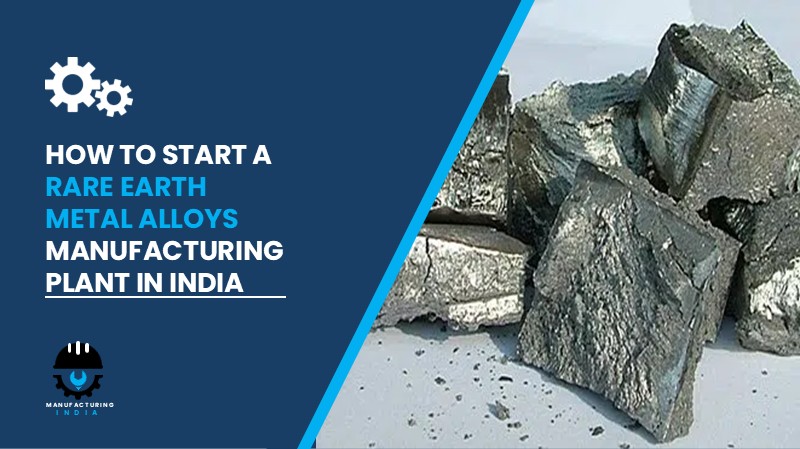
Setting up a rare earth metal alloys manufacturing plant in India presents a compelling investment case of the highest strategic order — one where commercial opportunity, national security, and the clean energy transition converge into a single, government-backed industrial priority. Rare earth metal alloys — engineered materials consisting of rare earth elements combined with selected metals to produce materials with precisely designed magnetic, thermal, and mechanical properties — are the foundational input for high-performance permanent magnets in electric vehicle motors, wind turbine generators, aerospace components, advanced electronics, and battery systems. India’s accelerating EV adoption, expanding renewable energy capacity, growing defence modernisation programme, and the government’s explicit commitment to building a domestic rare earth supply chain are together creating the most favourable policy and market conditions the country has ever offered for investment in this strategically critical materials category.
India’s structural positioning for rare earth metal alloy production is strengthening rapidly. The APAC region — of which India is an increasingly important manufacturing hub — holds the largest market share, accounting for over 55% of the global rare earth metal alloys market. In November 2025, the Union Cabinet approved an INR 7,280 Crore scheme to establish 6,000 MTPA integrated rare earth permanent magnet manufacturing in India, directly supporting domestic rare earth metal alloy conversion, reducing import dependence, and strengthening EV and renewable energy supply chains. This landmark policy commitment is backed by active institutional collaboration: in February 2026, the TEXMiN Foundation of India and GIREDMET of Russia established a partnership through an MoU to develop technologies for rare earth materials, including extraction, refining, recycling, and pilot-scale testing. Industrial zones in Tamil Nadu, Karnataka, Odisha, and Jharkhand — states with strategic minerals policy frameworks and proximity to India’s rare earth mineral deposits — offer the infrastructure, regulatory support, and supply chain foundations that a technically sophisticated rare earth metal alloy plant requires to operate at commercial scale.
Investing in a rare earth metal alloys manufacturing plant in India today aligns the most powerful industrial megatrends — EV adoption, renewable energy expansion, and defence modernisation — with INR 7,280 Crore in direct government scheme support, active international technology collaboration, and a structurally undersupplied domestic market for NdFeB and SmCo permanent magnet alloys. With gross profit margins of 35–45% and net profit margins of 18–28%, the unit economics are among the strongest across all advanced materials manufacturing categories, and the facility’s scalable production model — designed for 500 to 2,000 MT annually — supports commercially compelling returns across a strategically vital investment horizon.
What are Rare Earth Metal Alloys?
Rare earth metal alloys are engineered materials consisting of rare earth elements combined with selected base metals to form materials with precisely designed magnetic, thermal, and mechanical properties unavailable in conventional engineering alloys. The production of these alloys involves multiple technically demanding steps — including melting, refining, alloying, casting, and controlled cooling — conducted in inert or vacuum conditions to ensure the material purity and performance properties that high-specification end-use applications demand.
The unique magnetic strength and temperature stability of rare earth metal alloys create their essential function in contemporary energy systems and technological advancements. The two dominant alloy families are NdFeB (neodymium-iron-boron), which produces the world’s strongest permanent magnets and is the critical material in EV motors and wind turbine generators, and SmCo (samarium-cobalt), valued for its superior high-temperature magnetic performance in aerospace and defence applications. Additional alloy types include hydrogen storage alloys for battery electrodes and fuel cell systems, catalytic alloys for chemical and refining applications, and high-performance structural alloys for aerospace components.
The primary production process covers rare earth oxide or metal reduction, melting in induction or vacuum furnaces, alloying with base metals, casting, controlled cooling, crushing or machining, quality testing, and packaging. End-use industries served include electric vehicles, renewable energy, aerospace, defence, electronics, battery manufacturing, and industrial machinery. Applications span permanent magnets including NdFeB and SmCo variants, hydrogen storage alloys, battery electrodes, catalysts, and high-performance structural components.
Cost of Setting Up a Rare Earth Metal Alloys Manufacturing Plant in India
The cost of establishing a rare earth metal alloys manufacturing plant in India depends on plant capacity, furnace technology selection between induction and vacuum systems, alloy product mix, geographic location, inert atmosphere infrastructure requirements, and the stringent quality and purity compliance standards applicable to permanent magnet and aerospace-grade alloy production.
1. Capital Expenditure (CapEx)
Land and Site Development forms a foundational component of total capital investment, covering land acquisition charges, site registration, boundary development, drainage and containment infrastructure, and site utilities including high-capacity electrical supply for induction and vacuum furnace operations. Investors may explore special economic zones, strategic minerals processing parks, or industrial estates in Tamil Nadu — where Chennai-based Entellus Industries raised INR 50 Crore in January 2026 to expand its rare earth manufacturing facilities — as well as Odisha and Jharkhand, where proximity to India’s strategic mineral deposits provides the most cost-advantaged raw material supply position in the country.
Civil Works and Construction cover the main production building housing vacuum melting and induction furnace systems — which require specially reinforced foundations and inert gas supply infrastructure — raw material storage facilities for rare earth metals and alloying elements under controlled atmosphere conditions, a quality control and characterisation laboratory equipped for X-ray diffraction, magnetic property measurement, and composition analysis, finished goods warehousing with appropriate humidity control, an administrative block, and utilities infrastructure including high-capacity transformer substations and inert gas supply systems.
Machinery and Equipment represent the largest single component of total CapEx for a rare earth metal alloys manufacturing plant. Key machinery required includes:
- High-performance induction furnaces
- Vacuum melting systems
- Casting moulds
- Cooling systems
- Crushing and milling units
- Packaging equipment
Other Capital Costs include an effluent treatment plant (ETP) for managing process effluents and any rare earth-containing waste streams, inert gas handling and recovery infrastructure, radiation monitoring systems where applicable for certain rare earth processing streams, pre-operative expenses, commissioning and trial run charges, and import duties on vacuum melting systems and specialised casting equipment not available through domestic machinery suppliers at the required specification level.
Request a Sample Report for In-Depth Market Insights: https://www.imarcgroup.com/rare-earth-metal-alloys-manufacturing-plant-project-report/requestsample
2. Operational Expenditure (OpEx)
Raw Material Cost is the overwhelmingly dominant operational expense, accounting for approximately 80–85% of total OpEx — the highest raw material cost concentration ratio of any manufacturing category covered in this investment guide series. The primary raw materials are rare earth metals and alloying elements. Rare earth metals — including neodymium, praseodymium, dysprosium, samarium, and other rare earth elements depending on the alloy grade — are globally traded specialty metals whose pricing is subject to geopolitical supply dynamics, export quota decisions by producing nations, and technology-demand cycles tied to EV and clean energy growth. Alloying elements such as iron, cobalt, and boron add additional procurement complexity. Long-term supply contracts with reliable rare earth metal suppliers — including emerging domestic sources being developed under India’s critical minerals programmes — are essential for production continuity and cost stability.
Utility Cost is the second-largest OpEx component, representing 10–15% of total operating expenses, reflecting the significant energy intensity of vacuum melting and induction furnace operations at the high temperatures required for rare earth alloy processing. Electricity, inert gas including argon and nitrogen for atmosphere control, and process cooling water are the primary utility inputs requiring careful infrastructure planning and competitive tariff negotiation.
Other Operating Costs include transportation and distribution to EV motor manufacturers, wind turbine component producers, aerospace and defence contractors, electronics manufacturers, and battery producers, specialised packaging to protect alloy products from oxidation and moisture during transit, salaries and wages for metallurgical engineers, furnace operators, and quality control specialists, routine machinery maintenance including furnace refractory replacement and vacuum system servicing, depreciation on high-value vacuum and induction furnace equipment, and applicable taxes. By the fifth year of operations, total operational costs are projected to increase substantially due to inflation, rare earth metal price movements, supply chain pressures, rising demand, and shifts in the global economy — all factors requiring careful multi-year financial planning.
3. Plant Capacity
The proposed manufacturing facility for a rare earth metal alloys plant is designed with an annual production capacity ranging between 500 and 2,000 metric tonnes, enabling economies of scale while maintaining the operational flexibility to serve diverse alloy grades and customer application requirements across EV, renewable energy, aerospace, defence, and electronics segments. Plant capacity can be customised per investor requirements and phased to match the development of secured customer relationships and domestic market penetration. Profitability improves meaningfully with higher capacity utilisation, with Entellus Industries’ January 2026 expansion demonstrating the scale trajectory — raising capacity to approximately 2,000 tons of permanent magnets per year through expanded manufacturing of NdPr metal, bonded powders, strip-cast, and sintered magnet alloys to serve India’s EV and wind turbine supply chains.
4. Profit Margins and Financial Projections
The financial projections for a rare earth metal alloys manufacturing plant represent the most attractive unit economics across the advanced materials manufacturing segment. Gross profit margins typically range between 35–45%, reflecting the high value-add conversion from rare earth metal feedstock to engineered alloy products with precisely specified magnetic and physical properties. Net profit margins are projected at 18–28% — the strongest net margin range across all product categories in this investment guide series. A comprehensive financial analysis covering NPV (net present value), IRR (internal rate of return), payback period, gross margin progression, and net margin development across a five-year horizon is essential before committing capital, particularly given the capital intensity and long customer qualification cycles characteristic of this sector.
Why Set Up a Rare Earth Metal Alloys Plant in India?
Growing EV Adoption Creating Sustained Permanent Magnet Demand. Expanding electric vehicle production is the most powerful structural driver of rare earth metal alloy demand globally. NdFeB permanent magnets — the primary application for rare earth metal alloys — are essential for high-efficiency EV traction motors, and every electric passenger car requires several kilograms of rare earth permanent magnets. As India’s EV production scales under FAME and PLI incentive frameworks, domestic demand for NdFeB alloy inputs is entering a sustained, multi-decade growth phase that makes building domestic alloy production capacity an urgent industrial priority.
Renewable Energy Expansion and Wind Turbine Magnet Requirements. Increasing wind turbine installations require high-performance rare earth magnet systems, with direct-drive wind turbines in particular relying heavily on large NdFeB permanent magnet arrays. India’s ambitious renewable energy targets — including expanding offshore and onshore wind capacity — are directly translating into growing domestic demand for rare earth metal alloys from wind turbine component manufacturers seeking localy produced inputs.
Landmark Government Scheme Supporting Domestic Alloy Production. In November 2025, the Union Cabinet approved an INR 7,280 Crore scheme to establish 6,000 MTPA integrated rare earth permanent magnet manufacturing in India. The initiative explicitly supports domestic rare earth metal alloy conversion, reduces import dependence, and strengthens EV and renewable energy supply chains while enhancing India’s strategic self-reliance in critical materials. This scheme represents the largest government commitment to rare earth materials manufacturing in India’s history and provides direct financial support, demand anchoring, and regulatory facilitation for private investors establishing alloy production capacity.
Active International Technology Collaboration. In February 2026, the TEXMiN Foundation of India and GIREDMET of Russia established a partnership through an MoU covering methods for extracting and refining rare earth materials, recycling, and pilot-scale testing aimed at enhancing India’s capacity to produce strategic rare earth metal alloys. This collaboration, combined with the January 2026 expansion by Entellus Industries to produce NdPr metal, bonded powders, strip-cast, and sintered magnet alloys for EV and wind turbine applications, signals an accelerating buildup of India’s rare earth processing ecosystem that benefits all domestic alloy producers.
Strategic Material Importance and Supply Chain Security. Governments across major economies are actively working to build stronger rare earth supply chains to reduce dependence on concentrated global supply sources. India’s critical minerals strategy explicitly identifies rare earth elements as strategic materials requiring domestic processing capability. This policy priority creates a sustained government procurement preference for domestically produced alloys across defence, aerospace, and strategic energy applications that provides institutional demand security alongside commercial market volumes.
High-Value Export Opportunities. Specialised rare earth alloys generate strong international trade and revenue potential. With the APAC region holding over 55% of the global rare earth metal alloys market and major economies actively seeking to diversify their rare earth supply chains away from concentrated production sources, Indian alloy producers with established quality systems and production scale are well-positioned to capture export revenue alongside growing domestic demand from EV, renewable energy, and defence customers.
Manufacturing Process — Step by Step
The rare earth metal alloys manufacturing process uses rare earth oxide or metal reduction, melting in induction or vacuum furnaces, alloying with base metals, casting, controlled cooling, crushing or machining, quality testing, and packaging as the primary production method. Each stage requires precisely controlled process parameters — particularly atmosphere purity and temperature profiles — to achieve the alloy composition, microstructure, and magnetic or mechanical properties specified by permanent magnet, aerospace, and battery application customers.
- Rare Earth Oxide or Metal Reduction: Rare earth oxides sourced from processed rare earth ore concentrates are reduced to metallic form using metallothermic or electrolytic reduction processes, producing the high-purity rare earth metal feedstock required for alloy melting. Alternatively, pre-reduced rare earth metals are sourced directly from certified suppliers for processing.
- Charge Preparation and Loading: Weighed quantities of rare earth metals — neodymium, praseodymium, dysprosium, samarium, or other elements depending on the target alloy grade — and base metal alloying elements including iron, cobalt, and boron are prepared and loaded into high-performance induction furnaces or vacuum melting systems under inert atmosphere or vacuum conditions.
- Melting in Induction or Vacuum Furnaces: The charge is melted under precisely controlled inert or vacuum conditions to prevent oxidation of reactive rare earth components. Vacuum melting systems are used for the highest-purity and most oxidation-sensitive alloy grades, while induction furnaces operating under inert gas blanket are used for less oxidation-sensitive compositions.
- Alloying and Refining: Molten rare earth metals and alloying elements are homogenised under controlled atmosphere conditions to achieve the target alloy composition, with temperature, stirring, and hold time parameters carefully managed to ensure compositional uniformity and the removal of dissolved gases and non-metallic inclusions.
- Casting: The refined alloy melt is cast into casting moulds using strip casting, book mould casting, or other precision casting techniques that control solidification rate and microstructure development — critical factors determining the magnetic and mechanical properties of the finished alloy.
- Controlled Cooling: Cast alloy material undergoes controlled cooling in cooling systems to develop the target microstructural phases — including the Nd₂Fe₁₄B intermetallic phase in NdFeB alloys — that determine permanent magnet performance in end-use applications.
- Crushing and Milling: Cooled alloy ingots or strip-cast flakes are processed through crushing and milling units to produce alloy powder of the particle size required for sintered magnet production, bonded magnet compounding, or other downstream processing applications.
- Quality Testing: Finished alloy products are subjected to comprehensive quality testing covering compositional analysis, magnetic property measurement including remanence and coercivity, particle size distribution, oxygen content, and physical inspection to verify compliance with specification before packaging and dispatch.
- Packaging: Inspected and approved alloy products — in the form of strip-cast flakes, crushed alloy, or milled powder — are packaged under inert atmosphere or vacuum conditions using packaging equipment to prevent oxidation during storage and transit, then dispatched to EV motor manufacturers, wind turbine component producers, aerospace and defence contractors, electronics manufacturers, and battery producers.
Key Applications
Rare earth metal alloys manufactured in India serve the most strategically critical and technologically advanced application categories in the global industrial economy:
- Electric Vehicle Industry: Utilised in high-strength NdFeB permanent magnets for EV traction motors, providing the magnetic flux density and coercivity required for compact, high-efficiency motor designs that maximise vehicle range and performance.
- Renewable Energy Sector: Applied in permanent magnet generators for direct-drive wind turbines and in energy storage systems, where high magnetic performance at operating temperatures is essential for reliable long-term power generation.
- Aerospace and Defence: Used in high-performance components and magnetic systems for aerospace actuators, guidance systems, radar, communications, and defence equipment where extreme temperature stability and compact magnetic performance are mandatory.
- Electronics Industry: Incorporated in advanced devices requiring compact and efficient magnetic materials, including hard disk drives, loudspeakers, MRI systems, industrial sensors, and precision motion control components.
Leading Manufacturers
The global rare earth metal alloys industry is served by a group of specialised producers with significant processing capabilities and strategic positioning across EV, renewable energy, aerospace, and electronics application segments. Key players in the global market include:
- MP Materials
- Avalon Advanced Materials Inc.
- Ucore Rare Metals Inc.
- Eutectix LLC
- American Rare Earths
- Rare Element Resources
- NEO
Timeline to Start the Plant
Establishing a rare earth metal alloys manufacturing plant in India involves a structured multi-phase development sequence. Investors should plan for the following phases:
- Feasibility study and project report preparation
- Land acquisition and site development
- Regulatory approvals and environmental clearances
- Factory licence and fire safety compliance
- Machinery procurement and installation
- Raw material supplier agreements and supply chain setup
- Trial production and quality testing
- Commercial production launch
Licences and Regulatory Requirements
Starting a rare earth metal alloys manufacturing unit in India requires several approvals spanning business registration, strategic minerals processing, environmental, hazardous material handling, and industrial safety compliance domains:
- Business registration (Proprietorship, LLP, or Pvt Ltd)
- Factory Licence under the Factories Act
- Environmental Clearance from the State Pollution Control Board
- GST Registration
- Fire Safety NOC
- Hazardous/Chemical compliance applicable to rare earth metal handling, inert gas systems, and any radioactive material management obligations associated with thorium or uranium co-occurring with certain rare earth ore streams
- Effluent Treatment Plant (ETP) operational clearance for managing rare earth-containing process effluents
- Occupational Health and Safety compliance
Key Challenges to Consider
Extreme Raw Material Cost Concentration and Geopolitical Supply Risk. Rare earth metals and alloying elements account for 80–85% of total OpEx — the highest raw material cost concentration of any manufacturing category — with rare earth metal pricing subject to geopolitical supply dynamics, export policy decisions by rare earth-producing nations, and technology-demand cycles tied to EV and clean energy growth. Securing diversified and reliable rare earth metal supply through long-term contracts, domestic source development under India’s critical minerals programme, and international supply partnerships is the most critical operational risk management challenge for the investment.
High Capital Intensity of Vacuum Processing Technology. Vacuum melting systems, high-performance induction furnaces, inert atmosphere casting and handling infrastructure, and the associated gas management systems represent some of the most capital-intensive production equipment in the advanced materials manufacturing sector. The technical sophistication and import dependency for certain critical equipment categories extend commissioning timelines and require specialised installation and operator training programmes.
Process Technology Complexity and Quality Standards. Producing rare earth metal alloys that meet the compositional, microstructural, and magnetic property specifications required by EV motor manufacturers, wind turbine producers, and aerospace customers demands highly controlled vacuum melting, precise alloying chemistry, and carefully managed solidification parameters. Achieving and maintaining specification compliance requires advanced metallurgical expertise, calibrated characterisation equipment, and rigorous quality management systems across all production stages.
Regulatory Complexity for Strategic and Radioactive Materials. Certain rare earth ore streams and intermediate products may carry trace radioactive contamination from thorium or uranium co-occurrence, requiring specific regulatory compliance under atomic energy and radiation safety regulations that add an additional compliance layer beyond standard industrial environmental requirements. Navigating this regulatory landscape requires specialised legal and technical expertise from the earliest stages of project planning.
Competition and Market Access. The competitive landscape includes globally established producers such as MP Materials, NEO, Ucore Rare Metals, and Eutectix LLC, alongside China’s dominant integrated rare earth processing industry. New Indian entrants must achieve customer qualification through rigorous supply chain audits, demonstrate consistent alloy quality across production runs, and build relationships with EV manufacturers, wind turbine producers, and defence contractors — qualification cycles that can extend across 18–36 months before commercial production volumes are secured.
Skilled Metallurgical Manpower. Rare earth alloy processing requires rare earth metallurgists, vacuum furnace operators, magnetic materials characterisation specialists, and process engineers with expertise in high-temperature reactive metals — a highly specialised technical workforce that is currently scarce in India and must be developed through targeted recruitment, university collaboration, and international knowledge transfer programmes including the TEXMiN-GIREDMET partnership established in February 2026.
Frequently Asked Questions
1. How much does it cost to set up a rare earth metal alloys manufacturing plant in India?
The total setup cost depends on plant capacity, furnace technology selection, alloy product mix, location, and automation level. CapEx covers land and site development, vacuum and inert atmosphere production facility construction, core machinery including high-performance induction furnaces, vacuum melting systems, casting moulds, cooling systems, crushing and milling units, and packaging equipment, along with ETP, inert gas infrastructure, and other capital costs. A detailed project report with full CapEx and OpEx breakdowns is available on request.
2. Is rare earth metal alloys manufacturing profitable in India in 2026?
Yes — and with exceptional margin potential. The project demonstrates gross profit margins of 35–45% and net profit margins of 18–28% under normal operating conditions, the strongest financial performance profile across all advanced materials categories, supported by strong demand from EV, renewable energy, aerospace, and defence sectors and the INR 7,280 Crore government scheme anchoring domestic market demand.
3. What machinery is required for a rare earth metal alloys plant in India? Key machinery includes high-performance induction furnaces, vacuum melting systems, casting moulds, cooling systems, crushing and milling units, and packaging equipment. Vacuum melting systems are the most technically critical and capital-intensive equipment items, essential for producing the highest-purity NdFeB and SmCo alloy grades required by permanent magnet customers.
4. What licences and approvals are required to start a rare earth metal alloys plant in India?
Required approvals include business registration, a Factory Licence under the Factories Act, Environmental Clearance from the State Pollution Control Board, GST registration, a Fire Safety NOC, hazardous and potentially radioactive material handling compliance approvals, ETP operational clearance for rare earth-containing effluents, and Occupational Health and Safety compliance.
5. What raw materials are needed for rare earth metal alloys manufacturing?
The primary raw materials are rare earth metals — including neodymium, praseodymium, dysprosium, and samarium depending on the alloy grade — and alloying elements including iron, cobalt, and boron. Rare earth metals account for approximately 80–85% of total operating expenses, making rare earth metal sourcing strategy and supply chain security the single most critical investment risk factor.
6. What are the environmental compliance requirements for a rare earth metal alloys plant in India?
The unit must obtain Environmental Clearance from the State Pollution Control Board, operate a certified ETP for managing rare earth-containing process effluents, comply with inert and reactive gas safety regulations, implement radiation monitoring where applicable for rare earth ore stream processing, and maintain monitoring systems for air emissions and wastewater discharge in line with applicable state pollution control standards.
7. What is the best location to set up a rare earth metal alloys plant in India?
Optimal locations offer proximity to India’s rare earth mineral deposits and processing infrastructure, high-capacity reliable electricity supply for furnace operations, inert gas supply chain access, and proximity to EV, wind turbine, and electronics manufacturing customer clusters. Industrial zones in Tamil Nadu, Odisha, Jharkhand, and Karnataka are among the most strategically relevant options, with Tamil Nadu already emerging as a hub through Entellus Industries’ Chennai-based operations.
8. What is the break-even period for this type of plant in India?
The break-even period depends on plant capacity, capacity utilisation rate, rare earth metal pricing trends, and the speed of customer qualification across EV, renewable energy, and defence segments. A detailed financial analysis including payback period, NPV, and IRR projections is included in the full project report, available via the sample request link.
9. What government incentives are available for manufacturers in India? The INR 7,280 Crore Union Cabinet scheme approved in November 2025 for integrated rare earth permanent magnet manufacturing provides direct financial support for domestic rare earth metal alloy production. The Make in India initiative, critical minerals policy incentives, and state-level strategic materials manufacturing schemes in Odisha, Tamil Nadu, and Jharkhand provide additional fiscal benefits including capital subsidies, power tariff concessions, and export promotion support.
Key Takeaways for Investors
A rare earth metal alloys manufacturing plant in India represents the single most strategically aligned advanced materials investment opportunity available in the country today — where surging EV adoption, expanding renewable energy capacity, defence modernisation, and the government’s landmark INR 7,280 Crore scheme for integrated rare earth permanent magnet manufacturing combine to create a policy-anchored, commercially compelling, and nationally strategic investment case that is unique in its convergence of financial returns and geopolitical significance. The project demonstrates the strongest financial viability of any advanced materials category, with gross profit margins of 35–45% and net profit margins of 18–28% across annual production capacities of 500 to 2,000 MT. With the APAC region — led by India’s rapidly growing EV and clean energy sectors — holding over 55% of the global rare earth metal alloys market, and with domestic production capacity being actively built through investments such as Entellus Industries’ January 2026 expansion to 2,000 tons of permanent magnets per year, the trajectory for Indian rare earth metal alloy production is one of structural, policy-supported, and commercially driven growth across the full investment horizon. As major economies accelerate their rare earth supply chain diversification programmes and India cements its position as a strategic alloy producer through international collaboration, government schemes, and private investment, demand sustainability for India-based rare earth metal alloy production is not merely robust — it is a matter of national industrial policy.
About the Author