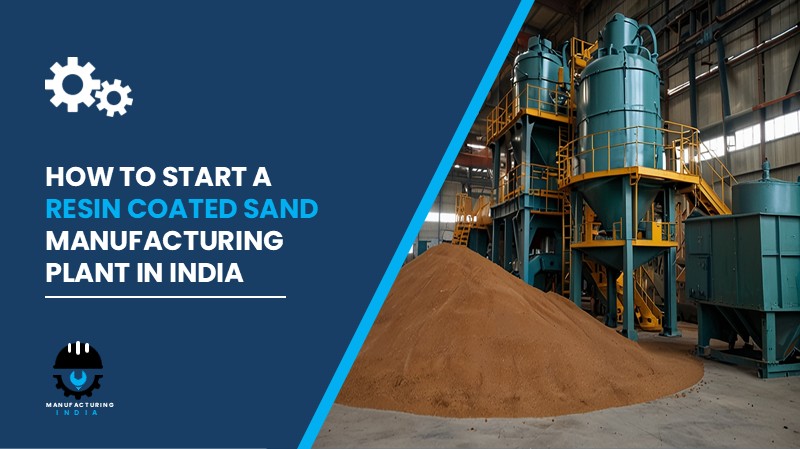
Setting up a resin coated sand manufacturing plant in India presents a compelling investment case driven by the country’s rapidly expanding foundry industry, a surging automotive sector, and growing demand for high-precision industrial castings across engineering, aerospace, and infrastructure applications. Resin Coated Sand (RCS) — the critical moulding material that enables foundries to produce accurate, high-quality metal castings with minimal surface defects — sits at the intersection of several of India’s most capital-active industrial sectors. As domestic vehicle production scales, industrial machinery output expands, and export-oriented foundries modernise to meet international quality standards, the demand for a reliable, domestically produced supply of high-performance resin coated sand is increasing in both volume and strategic importance.
India’s structural advantages make it an exceptionally sound location for establishing this production. The country’s abundant silica sand deposits — found across states including Rajasthan, Gujarat, Andhra Pradesh, and Madhya Pradesh — provide cost-competitive access to the dominant raw material input. The Make in India initiative is actively channelling policy support toward industrial chemicals and advanced materials manufacturing, and well-developed industrial estates across Maharashtra, Gujarat, and Tamil Nadu offer the infrastructure, logistics connectivity, and regulatory frameworks that a resin coated sand plant requires to operate efficiently and serve foundry customers at scale. With rising export demand from high-precision metal casting industries globally, an India-based facility is positioned to serve both domestic foundries and international buyers.
Investing in a resin coated sand manufacturing plant in India today aligns cost-competitive raw material sourcing with strong foundry and automotive sector demand, policy support under Make in India, and rising global export appetite for precision casting inputs. With gross profit margins of 25–35% and net profit margins of 10–15%, the unit economics are sound, and the plant’s scalable production model — designed for 50,000 to 100,000 MT annual capacity — supports a financially viable and strategically defensible investment across a multi-year horizon.
What is Resin Coated Sand?
Resin Coated Sand (RCS) is a high-performance moulding material used in foundries for metal casting with very high precision. It consists of high-quality silica sand coated with thermosetting resin, which makes the moulding process stronger, delivers better quality castings, and maintains the dimensional accuracy of finished cast components. RCS comes in two major categories: cold-setting resins, which cure at room temperature, and hot-setting resins, which require heat for hardening. This differentiation allows foundry operators to select the appropriate variant based on their specific casting process and metal type.
The material is suitable for casting both ferrous and non-ferrous metals, offering key technical properties including good collapsibility, low gas generation, and minimal surface defects on finished castings. By utilising RCS, foundries can increase productivity, decrease scrap rates, and achieve complex casting geometries with strong mechanical properties — guaranteeing consistent, high-quality output across industrial casting applications.
The production process covers sand drying, screening, resin coating, blending, curing, sieving, quality inspection, and packaging. End-use industries served include foundries, automotive, industrial machinery, aerospace, and engineering components. Applications span precision metal castings, automotive engine blocks, industrial valves, turbine components, pump housings, and decorative castings.
Cost of Setting Up a Resin Coated Sand Manufacturing Plant in India
The cost of establishing a resin coated sand manufacturing plant in India depends on plant capacity, technology selection, geographic location, level of automation, and the regulatory compliance requirements applicable to chemical and industrial materials production.
1. Capital Expenditure (CapEx)
Land and Site Development forms a foundational component of total capital investment, covering land registration charges, boundary development, drainage and containment infrastructure, and site preparation. Investors may explore established chemical and industrial estates or Special Economic Zones (SEZs) in silica-sand-rich states such as Rajasthan and Gujarat, where proximity to raw material sources reduces inbound logistics costs and land acquisition is facilitated through dedicated industrial promotion agencies.
Civil Works and Construction encompass the main production shed with appropriate dust containment for sand handling operations, raw material storage for bulk silica sand and phenolic resin, a quality control laboratory, finished goods warehousing, an administrative block, and waste management infrastructure including dust collection systems required for safe plant operation.
Machinery and Equipment represent the largest single component of total CapEx for a resin coated sand manufacturing plant. Key machinery required includes:
- Rotary dryers
- Mixers
- Coating drums
- Curing ovens
- Sieving machines
- Packaging systems
Other Capital Costs include an effluent treatment plant (ETP) to manage process chemical waste and resin-contaminated water, air pollution control systems for dust and volatile organic compound (VOC) management, pre-operative expenses, commissioning charges, and import duties on specialised coating or curing equipment not available domestically.
Request a Sample Report for In-Depth Market Insights: https://www.imarcgroup.com/resin-coated-sand-manufacturing-plant-project-report/requestsample
2. Operational Expenditure (OpEx)
Raw Material Cost is the overwhelmingly dominant operational expense, accounting for approximately 70–80% of total OpEx. The two primary raw material inputs are silica sand and phenolic resin. Silica sand, as the base substrate, is consumed in the largest volumes, while phenolic resin — a thermosetting polymer — is the value-adding coating agent that determines product performance. Long-term procurement contracts with reliable suppliers of both inputs are essential to stabilise production costs and protect margins against commodity price cycles. Selecting plant locations in proximity to silica sand quarrying zones significantly reduces the freight burden on the highest-volume input.
Utility Cost is the second-largest OpEx category, representing 10–15% of total operating expenses, covering electricity for rotary dryers, curing ovens, sieving equipment, coating drums, and general plant operations, as well as water and process utilities.
Other Operating Costs include transportation and distribution to foundry and automotive casting customers, packaging materials for bulk and bagged product formats, salaries and wages for process and quality control personnel, routine machinery maintenance, depreciation on production equipment, and applicable taxes. By the fifth year of operations, total operational costs are projected to increase substantially due to inflation, market fluctuations, potential rises in silica sand and phenolic resin prices, supply chain disruptions, rising consumer demand, and shifts in the global economy — all factors that must be incorporated into the five-year financial model.
3. Plant Capacity
The proposed manufacturing facility for a resin coated sand plant is designed with an annual production capacity ranging between 50,000 and 100,000 metric tonnes, enabling economies of scale while maintaining operational flexibility appropriate to varying market entry strategies and customer base development timelines. Plant capacity can be customised per investor requirements, with phased expansion built into the site layout to accommodate future growth. As with all bulk industrial materials production, profitability improves significantly with higher capacity utilisation, making secured supply agreements with foundry or automotive casting customers a critical commercial foundation for the investment.
4. Profit Margins and Financial Projections
The financial projections for a resin coated sand manufacturing plant demonstrate healthy profitability potential under normal operating conditions. Gross profit margins typically range between 25–35%, supported by stable demand from foundry, automotive, and engineering casting customers and the value-added performance properties that RCS commands over conventional green sand moulding. Net profit margins are projected at 10–15%. A comprehensive financial analysis covering NPV (net present value), IRR (internal rate of return), payback period, gross margin trajectory, and net margin progression across a five-year horizon is essential before committing capital. The project’s ROI profile and long-term financial sustainability are assessed against realistic assumptions on capital investment, production capacity utilisation, silica and resin pricing trends, and demand outlook from key end-use sectors.
Why Set Up a Resin Coated Sand Plant in India?
Rising Demand in Precision Casting Across Automotive and Engineering Sectors. Growth in the automotive, aerospace, and industrial engineering sectors is directly boosting the need for high-quality castings that only resin coated sand can reliably deliver. According to ACEA’s Economic and Market Report, global car sales reached 74.6 million units in 2024, representing 2.5% growth over 2023, with global car production totalling 75.5 million units in the same year. India, as a growing automotive manufacturing hub, is a direct beneficiary of this production expansion, creating sustained domestic demand for RCS as a foundry input.
Foundry Modernisation and Productivity Improvement. Modernisation of foundries and the adoption of advanced manufacturing practices are driving wider use of RCS to improve productivity and reduce scrap rates in precision metal casting operations. Indian foundries supplying automotive, defence, and infrastructure sectors are increasingly specifying RCS over traditional moulding sands to meet tighter dimensional tolerances and surface quality requirements from OEM customers.
Technological Advancements in Resin Formulations. Continual advancements in resin formulations and coating processes are enhancing mould strength, surface finish, dimensional accuracy, and collapsibility, enabling more complex casting designs across turbine components, pump housings, industrial valves, and automotive engine blocks. In June 2025, Sumitomo Bakelite launched the world’s first solid Novolac-type lignin-modified phenolic resin — PR-L-0002, a 15% biomass resin — adopted as a binder for RCS in automotive castings, reducing fossil resource use and carbon footprint while maintaining high strength and recyclability. This signals the direction of product innovation that domestic Indian producers can align with to serve forward-looking casting customers.
Environmentally Aligned Low-Emission Resin Systems. Environmentally friendly and low-emission resin systems are gaining commercial traction as Indian foundries align with stricter regulatory standards and sustainability goals, creating demand for RCS formulated with advanced resin systems. This aligns with broader regulatory and ESG trends in Indian manufacturing and strengthens the case for investing in resin coating capability that can serve next-generation foundry requirements.
Export Market Opportunity. Rising export demand from countries investing in high-precision metal casting industries is driving market expansion for RCS suppliers. The material offers superior performance compared to traditional sand moulds, and Indian producers with cost-competitive manufacturing are well-positioned to serve international foundries in the Middle East, Southeast Asia, and Africa that are expanding casting capacity.
Cost-Competitive Manufacturing and Raw Material Access. India’s abundant silica sand reserves, competitive land and labour costs, and well-established chemical supply chain infrastructure create a favourable cost structure for resin coated sand production. Industrial estates in Gujarat, Rajasthan, and Maharashtra provide proximity to both raw material sources and the automotive and engineering casting clusters that constitute the primary domestic customer base.
Manufacturing Process — Step by Step
The resin coated sand manufacturing process uses sand drying, screening, resin coating, blending, curing, sieving, quality inspection, and packaging as the primary production method. Each stage requires careful process control and quality assurance to deliver consistent moulding performance across the range of ferrous and non-ferrous casting applications.
- Sand Drying: Raw silica sand is fed into rotary dryers to remove moisture content, which is critical for ensuring effective resin adhesion and consistent coating quality in subsequent stages.
- Screening: Dried sand is passed through sieving machines to remove oversized particles and fines, ensuring that only sand of the correct particle size distribution is used as the base substrate for coating.
- Resin Coating: Screened sand is fed into coating drums where phenolic resin — either cold-setting or hot-setting formulations depending on the product grade — is applied uniformly across the sand particle surface using controlled mixing action.
- Blending: Coated sand is blended in mixers with any required additives to achieve the specified mould strength, collapsibility, and gas generation properties required by the end application.
- Curing: Blended, resin-coated sand is passed through curing ovens where controlled heat application activates the thermosetting resin to achieve partial cure, locking the coating onto the sand surface and developing the product’s structural properties.
- Sieving: Cured product is re-sieved to remove any agglomerates formed during the coating and curing stages, ensuring a free-flowing, consistent final product.
- Quality Inspection: Finished RCS is tested against specification parameters covering coating uniformity, mould strength, gas generation, collapsibility, and surface finish performance before release for dispatch.
- Packaging: Inspected RCS is packed using packaging systems into bulk bags or multi-wall sacks for dispatch to foundry, automotive casting, industrial engineering, aerospace, and export market customers.
Key Applications
Resin coated sand manufactured in India serves a diverse range of industrial sectors that require precision metal casting capabilities:
- Foundry Industry: Used for both ferrous and non-ferrous metal castings requiring high dimensional accuracy and superior surface finish compared to conventional moulding sands.
- Automotive Industry: Integral to the production of engine components, transmission parts, and machinery housings where consistent casting quality and tight dimensional tolerances are mandatory.
- Industrial Engineering: Used in the casting of pumps, turbines, valves, and industrial moulds where mechanical property consistency and complex geometry capability are essential.
- Export Markets: High-quality RCS is in demand in international foundries across multiple regions, offering India-based producers an export revenue stream alongside domestic sales.
Leading Manufacturers
The global resin coated sand industry is served by a group of multinational corporations with extensive production capacities and diversified application portfolios across foundry, automotive, and industrial engineering casting sectors. Key players in the global market include:
- Badger Mining Corporation
- Fairmount Santrol
- CARBO Ceramics Inc.
- Hexion Inc.
- Sibelco
- Saint-Gobain
- Other Prominent Players
Timeline to Start the Plant
Establishing a resin coated sand manufacturing plant in India follows a structured multi-phase development sequence. Investors should plan for the following phases:
- Feasibility study and project report preparation
- Land acquisition and site development
- Regulatory approvals and environmental clearances
- Factory licence and fire safety compliance
- Machinery procurement and installation
- Raw material supplier agreements and supply chain setup
- Trial production and quality testing
- Commercial production launch
Licences and Regulatory Requirements
Starting a resin coated sand manufacturing unit in India requires several approvals spanning industrial, environmental, chemical handling, and safety compliance domains:
- Business registration (Proprietorship, LLP, or Pvt Ltd)
- Factory Licence under the Factories Act
- Environmental Clearance from the State Pollution Control Board
- GST Registration
- Fire Safety NOC
- Hazardous/Chemical compliance (applicable given the use of phenolic resin and chemical curing agents in the production process)
- Effluent Treatment Plant (ETP) operational clearance
- Occupational Health and Safety compliance
Key Challenges to Consider
High Capital Requirements for Production Infrastructure. Establishing a resin coated sand manufacturing plant with the annual production capacity of 50,000 to 100,000 MT needed for commercially competitive unit economics requires meaningful investment in rotary dryers, coating drums, curing ovens, sieving machines, and automated packaging systems, as well as dust containment and air pollution control infrastructure specific to sand handling operations.
Raw Material Price Volatility. Silica sand and phenolic resin together represent approximately 70–80% of total OpEx, making procurement strategy the single most consequential lever for margin management. Phenolic resin, as a petrochemical derivative, is subject to crude oil price cycles and global chemical supply conditions. Long-term supplier contracts and dual-source procurement strategies are essential for cost stability.
Regulatory Compliance Across Chemical and Environmental Domains. The use of phenolic resin and thermosetting chemical curing agents places a resin coated sand plant under hazardous chemical handling regulations and VOC emission compliance requirements. Environmental clearance management, ETP operation, and air quality monitoring require dedicated compliance infrastructure and ongoing regulatory engagement.
Technology and Innovation Pressure. Continual technological advancements in resin formulations — including the emergence of biomass-derived binders such as Sumitomo Bakelite’s lignin-modified phenolic resin launched in June 2025 — create pressure on producers to invest in product development and process upgrades to remain specification-compliant with evolving foundry customer requirements.
Competition from Established Global Players. The competitive landscape is led by established multinationals including Badger Mining Corporation, Fairmount Santrol, CARBO Ceramics Inc., Hexion Inc., Sibelco, and Saint-Gobain, all of which bring scale, technology, and long-standing customer relationships. New Indian entrants will need to compete on price, service responsiveness, and supply chain reliability to penetrate domestic foundry accounts.
Skilled Manpower for Process and Quality Control. Maintaining the process consistency and product specification compliance required to supply automotive and precision engineering foundries demands trained chemical process operators and quality control chemists — a technical workforce segment requiring ongoing investment in recruitment, training, and retention.
Frequently Asked Questions
1. How much does it cost to set up a resin coated sand manufacturing plant in India?
The total setup cost depends on plant capacity, technology selection, location, and automation level. CapEx covers land and site development, industrial civil construction including dust containment infrastructure, core machinery such as rotary dryers, coating drums, curing ovens, sieving machines, and packaging systems, and other capital costs including ETP and air pollution control systems. A detailed project report with full CapEx and OpEx breakdowns is available on request.
2. Is resin coated sand manufacturing profitable in India in 2026?
Yes. The project demonstrates gross profit margins of 25–35% and net profit margins of 10–15% under normal operating conditions, supported by stable demand from foundry, automotive casting, and industrial engineering customers and the premium performance properties of RCS over conventional moulding sand alternatives.
3. What machinery is required for a resin coated sand plant in India?
Key machinery includes rotary dryers, mixers, coating drums, curing ovens, sieving machines, and packaging systems.
4. What licences and approvals are required to start a resin coated sand plant in India?
Required approvals include business registration, a Factory Licence under the Factories Act, Environmental Clearance from the State Pollution Control Board, GST registration, a Fire Safety NOC, hazardous/chemical compliance approvals for phenolic resin handling, ETP operational clearance, and Occupational Health and Safety compliance.
5. What raw materials are needed for resin coated sand manufacturing?
The primary raw materials are silica sand and phenolic resin. Together these inputs account for approximately 70–80% of total operating expenses, making raw material procurement strategy the most critical operational cost lever for the investment.
6. What are the environmental compliance requirements for a resin coated sand plant in India?
The unit must obtain Environmental Clearance from the State Pollution Control Board, operate a certified Effluent Treatment Plant for resin-contaminated process water, comply with hazardous chemical handling regulations applicable to phenolic resin, install VOC emission monitoring and control systems, and implement dust containment measures across all sand handling operations.
7. What is the best location to set up a resin coated sand plant in India?
Optimal locations offer proximity to silica sand quarrying zones, access to phenolic resin supply chains, reliable industrial utilities and transportation infrastructure, and proximity to foundry and automotive casting customer clusters. Rajasthan, Gujarat, Maharashtra, and Andhra Pradesh offer relevant combinations of raw material access and industrial customer proximity.
8. What is the break-even period for this type of plant in India?
The break-even period depends on plant capacity, capacity utilisation rate, silica and resin pricing trends, and demand conditions. A detailed financial analysis including payback period, NPV, and IRR projections is included in the full project report, available via the sample request link.
9. What government incentives are available for manufacturers in India?
The Make in India initiative and state-level industrial promotion policies provide financial and regulatory support for chemical and advanced materials manufacturing investments. Industrial estate incentives, capital subsidy schemes under state investment promotion boards, and export-linked benefits may be applicable depending on the location and production profile of the unit.
Key Takeaways for Investors
A resin coated sand manufacturing plant in India represents a strategically well-timed investment opportunity anchored by growing demand from foundry, automotive, industrial machinery, aerospace, and engineering component industries that collectively require precision metal castings deliverable only through high-performance RCS moulding systems. The project demonstrates financial viability across annual production capacities of 50,000 to 100,000 MT, with gross profit margins of 25–35% and net profit margins of 10–15% confirming sound unit economics under normal operating conditions. The global resin coated sand market, valued at USD 3.52 Billion in 2025, is projected to reach USD 4.97 Billion by 2034, growing at a CAGR of 3.9% from 2026 to 2034, with automotive sector expansion, foundry modernisation, and rising export demand for precision casting inputs all contributing to a durable growth trajectory. With technological advancements in low-emission and biomass-derived resin systems aligning with tightening environmental standards, and India’s foundry and automotive casting sectors continuing to scale, demand sustainability for India-based resin coated sand production is structurally sound across the full investment horizon.
About the Author