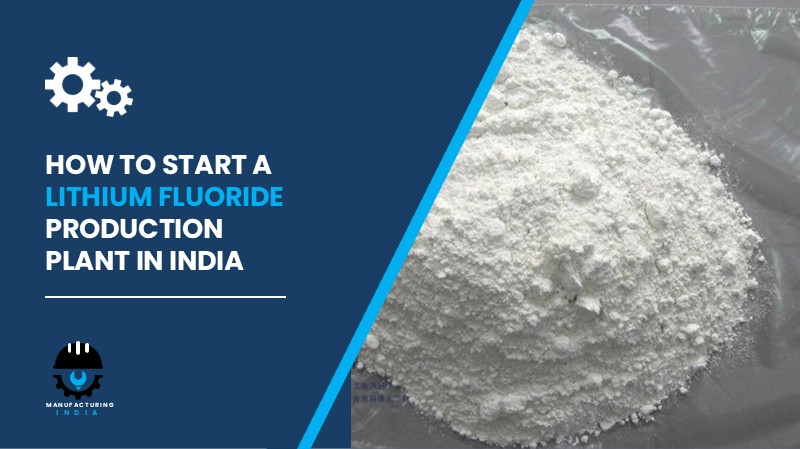
Setting up a lithium fluoride production plant in India presents a compelling investment case as global demand for this high-purity inorganic compound continues to accelerate across optical technology, semiconductor manufacturing, nuclear energy, and advanced ceramics. As industries increasingly rely on lithium fluoride for EUV lithography, metal welding fluxes, nuclear reactor coolants, and specialty glass, establishing a dedicated production facility offers significant strategic and financial value.
“With the global lithium fluoride market expanding on the back of semiconductor demand, nuclear energy development, and advanced materials research, investors who establish production plants today are well-positioned to benefit from sustained long-term demand growth — with favorable margins and a clearly defined path to profitability.”
What is Lithium Fluoride?
Lithium fluoride (LiF) is a vital inorganic compound recognized for its unique combination of chemical and physical properties. As a highly ionic salt, it is widely noted for its remarkable transparency to extreme ultraviolet (EUV) radiation, making it indispensable in optical and radiation detection devices.
Globally, lithium fluoride is deployed across a range of critical industrial applications:
- Optical technology: used in lenses and windows for EUV and vacuum ultraviolet (VUV) systems
- Semiconductor manufacturing: a key material in EUV lithography for advanced chip fabrication
- Metal welding and soldering: functions as an efficient flux that improves process efficiency and weld quality
- Nuclear reactors: serves as a coolant and neutron moderator in molten salt reactor designs
- Production of lithium metal, ceramics, and specialty glass materials
Regulatory bodies and standards organizations globally recognize lithium fluoride as a critical material in high-technology and nuclear applications, with increasing emphasis on domestic supply security for strategic sectors.
Cost of Setting Up a Lithium Fluoride Production Plant
The lithium fluoride production plant cost depends on multiple parameters including production capacity, raw material sourcing, technology selection, geographic location, automation level, and regulatory compliance. Below is a structured breakdown of all major cost components:
1. Capital Expenditure (CapEx)
The total capital investment in a lithium fluoride production facility typically covers the following major components:
Land and Site Development
This includes land acquisition, site preparation, boundary development, and land registration charges. Costs vary based on whether the site is located in an industrial park, special economic zone, or private land purchase. Proximity to lithium and fluorite raw material sources, as well as transportation infrastructure, are important site selection criteria.
Request a Sample Report for In-Depth Market Insights: https://www.imarcgroup.com/lithium-fluoride-manufacturing-plant-project-report/requestsample
Civil Works and Construction
Building costs cover the main production facility, chemical storage zones, utility infrastructure, quality control laboratory, waste treatment systems, administrative offices, and safety facilities. Construction specifications are shaped by plant scale, chemical handling requirements, and environmental compliance standards.
Machinery and Equipment
This is the single largest component of CapEx. Key equipment required for a lithium fluoride production plant includes:
- Reaction vessels and reactors (for fluorination and neutralization steps)
- Filtration and separation systems
- Crystallization and drying equipment
- Calcination furnaces
- Milling and particle size classification systems
- High-purity packaging and filling equipment
- Scrubbers and exhaust treatment units (critical for HF handling)
- Laboratory and quality assurance instrumentation
Machinery and equipment costs represent the dominant share of overall capital expenditure, reflecting the specialized chemical engineering and safety requirements associated with fluoride compound production.
Other Capital Costs
These include pre-operative expenses, commissioning charges, import duties on specialized equipment, utilities installation, HF acid handling infrastructure, fire safety systems, and Effluent Treatment Plant (ETP) setup for fluoride effluent management.
2. Operational Expenditure (OpEx)
Once the plant is commissioned, the ongoing cost structure is driven by the following key elements:
Raw Material Cost: 65–75% of Total OpEx
The primary raw materials for lithium fluoride production are lithium carbonate (or lithium hydroxide) and hydrofluoric acid (HF). Raw material costs dominate the operational budget, making supplier relationships, procurement strategy, and commodity price tracking critical to margin management.
Utility Cost: 10–15% of Total OpEx
Utility consumption includes electricity (for furnaces, drying, and milling), water (cooling and process water), compressed air, and waste treatment chemicals. Energy efficiency investments can deliver meaningful reductions in operating costs over the plant lifecycle.
Other Operating Costs
The remaining budget covers transportation, high-purity packaging materials, salaries and wages for technical staff, maintenance, depreciation, taxes, insurance, regulatory compliance, and miscellaneous overhead.
3. Plant Capacity
A lithium fluoride production facility is typically designed with an annual production capacity tailored to target market segments — ranging from laboratory-grade and optical-grade LiF (low volume, high purity, premium pricing) to industrial-grade LiF for welding flux and ceramic applications (higher volume, competitive pricing).
Capacity selection should be informed by a detailed market demand analysis, competitive landscape review, and customer offtake strategy. Economies of scale are achieved at higher utilization rates, but smaller high-purity plants targeting optical and nuclear sectors may command superior margins on lower volumes.
4. Profit Margins and Financial Projections
Financial projections must incorporate capital investment, operating costs, capacity utilization rates, raw material pricing trends, and grade-specific demand outlook. A comprehensive feasibility model should include sensitivity analysis, Net Present Value (NPV), Internal Rate of Return (IRR), and payback period calculations.
Why Set Up a Lithium Fluoride Production Plant?
The global lithium fluoride market is being shaped by several powerful and long-term demand drivers:
- Semiconductor Industry Expansion: The rapid proliferation of EUV lithography in advanced semiconductor fabrication is driving demand for high-purity optical-grade lithium fluoride. With chipmakers investing hundreds of billions in next-generation fabs, LiF demand from this sector is poised for sustained growth.
- Nuclear Energy Renaissance: Growing interest in molten salt reactors and advanced nuclear technologies has renewed demand for nuclear-grade lithium fluoride as a coolant and neutron moderator. Several countries are accelerating nuclear energy programs to meet decarbonization targets.
- Advanced Materials and Ceramics: Lithium fluoride’s role in specialty glass, ceramics, and lithium metal production is supported by expanding industrial applications in aerospace, defense, and electronics.
- Critical Mineral Supply Chain Security: Governments worldwide are prioritizing domestic production of lithium compounds for strategic and economic security, creating a policy-favorable environment for LiF plant investments in multiple regions.
- Cost-Competitive Manufacturing Opportunities: Countries with access to lithium brine, hard rock lithium, or fluorite deposits offer natural feedstock advantages. Establishing production near raw material sources can significantly improve cost competitiveness.
Manufacturing Process Overview
Lithium fluoride is typically produced through a chemical reaction between a lithium source compound and hydrofluoric acid (HF), followed by purification, drying, and size classification. The main production routes are:
- Route 1 – Lithium Carbonate + HF: Lithium carbonate reacts with dilute hydrofluoric acid to form lithium fluoride and water. The precipitate is filtered, washed, dried, and milled to specification.
- Route 2 – Lithium Hydroxide + HF: Lithium hydroxide monohydrate is reacted with HF in a controlled environment. This route can offer faster reaction kinetics and is preferred in some high-purity production setups.
The complete process flow involves:
- Raw material receipt and quality verification
- Reaction and precipitation (fluorination)
- Solid-liquid separation (filtration/centrifugation)
- Washing and purification stages
- Drying (spray drying or tray drying)
- Calcination (for specific grades)
- Milling and particle size classification
- Quality testing (purity, particle size, moisture, trace metals)
- High-purity packaging and dispatch
Key Applications of Lithium Fluoride
Lithium fluoride produced from a modern plant serves a wide range of high-value end-use industries:
- Optical Technology: EUV and VUV optical components including lenses, prisms, windows, and beam splitters for scientific instrumentation, lithography equipment, and radiation detection systems
- Semiconductor Manufacturing: EUV lithography process as a critical optical material; contributes to precision chip fabrication at sub-10nm nodes
- Nuclear Applications: Coolant and neutron moderator in molten salt reactors (MSR); used in LiF-BeF2 (FLiBe) and other fluoride salt systems in Generation IV reactor designs
- Metal Welding and Soldering: Functions as a flux that lowers the melting point of refractory materials, improves weld quality, and removes surface oxides in aluminum and other metal processing
- Ceramics and Glass: Used in the production of specialty ceramics and glass-ceramics, contributing to thermal shock resistance and microstructural refinement
- Lithium Metal Production: Serves as an electrolyte component in the electrochemical production of lithium metal
Global Market Outlook
The global lithium fluoride market is driven by converging demand from the semiconductor, nuclear, and advanced materials sectors. Market growth is underpinned by:
- Continued semiconductor fab buildouts requiring optical-grade LiF for EUV systems
- Rising nuclear energy investments in Asia, North America, and Europe
- Growing demand for specialty ceramics and glass in aerospace and electronics
- Increasing strategic importance of lithium compounds in national supply chain policies
Key global players in the lithium fluoride industry include specialty chemical producers, lithium compound manufacturers, and integrated fluorochemical companies. The competitive landscape rewards producers that can deliver consistent high-purity product with reliable supply chain performance.
Timeline to Start a Lithium Fluoride Production Plant
Setting up a lithium fluoride production facility from concept to commercial commissioning typically requires 12 to 24 months, depending on plant scale, location, and regulatory environment. This covers:
- Feasibility study and project report preparation
- Site selection and land acquisition
- Environmental impact assessment and regulatory clearances
- Process design and engineering
- Machinery procurement and installation (including specialized HF-handling equipment)
- Operator training and safety system commissioning
- Trial production and quality certification
- Commercial production launch
Licenses and Regulatory Requirements
Establishing a lithium fluoride production plant involves compliance with chemical manufacturing, environmental, and safety regulations. Key requirements typically include:
- Business entity registration (Proprietorship, LLP, or Private Limited Company)
- Factory License under applicable industrial/factory regulations
- Environmental Clearance and consent from the relevant Pollution Control Authority
- Hazardous chemical handling permits (critical for HF acid use)
- GST / VAT Registration
- Fire Safety NOC and emergency response plan approval
- Product quality certifications (optical-grade, nuclear-grade as applicable)
- Export licenses (for supply to international semiconductor and nuclear customers)
Key Challenges to Consider
Before committing to an investment, entrepreneurs and investors should be aware of the major challenges in this business:
- HF Handling and Safety: Hydrofluoric acid is a highly hazardous chemical requiring specialized containment, handling protocols, protective equipment, and emergency response systems. Capital and operational costs for safe HF management are significant.
- Raw Material Price Volatility: Lithium carbonate and lithium hydroxide prices are subject to significant swings driven by EV battery demand. Producers must actively manage raw material cost exposure through hedging and supplier contracts.
- High Purity Requirements: Optical-grade and nuclear-grade LiF require extremely low levels of trace metal impurities. Meeting these specifications demands tight process control, advanced analytical capabilities, and rigorous quality management.
- Regulatory Complexity: Fluoride compound production involves multilayered environmental, safety, and export control regulations that require ongoing compliance investment.
- Capital Requirements: The combination of specialized chemical processing equipment, HF safety infrastructure, and high-purity quality systems results in a capital-intensive initial investment.
- Skilled Manpower: Operating a fluoride chemical plant safely and at specification requires experienced chemical engineers, process operators, and quality control personnel.
Frequently Asked Questions
The following key questions are addressed in a comprehensive lithium fluoride production plant feasibility and cost analysis report:
- How much does it cost to set up a lithium fluoride production plant?
- What is the profitability of lithium fluoride manufacturing in 2026?
- What machinery and equipment are required for a LiF production plant?
- What licenses and approvals are required to start a lithium fluoride plant?
- How long does it take to commission a lithium fluoride production plant?
- What is the best location to set up a lithium fluoride production facility?
- What are the key raw material sourcing strategies for lithium fluoride production?
- What is the break-even period for a lithium fluoride production plant?
- What grade of lithium fluoride commands the highest market price?
- What are the key quality certifications required for optical-grade and nuclear-grade LiF?
Key Takeaways for Investors
The lithium fluoride production industry represents a strategically significant and financially attractive investment opportunity supported by powerful long-term demand drivers from the semiconductor, nuclear energy, and advanced materials sectors. With gross margins of 25–35% and a break-even window of 3–5 years, a well-planned lithium fluoride production plant can deliver compelling returns for investors who carefully manage raw material exposure, product quality, and safety compliance.
A thorough feasibility study and detailed project report — covering process design, cost modeling, regulatory mapping, and financial projections — is the essential foundation for a successful lithium fluoride production plant investment.
About the Author