Tin Oxide Production Plant
Setting up a tin oxide production plant in India presents a compelling investment case as demand for this versatile inorganic compound continues to grow across the glass, electronics, semiconductor, solar energy, and environmental applications sectors. Tin oxide plays a crucial role in the glass-making industry — particularly in the production of float glass — and its catalytic, electrical, and optical properties make it indispensable across a wide and expanding range of industrial applications. India’s growing chemicals and advanced materials manufacturing base, combined with strong downstream demand from the electronics, construction, and energy industries, creates a highly favorable environment for establishing a commercially viable tin oxide production facility.
“Tin oxide’s broad utility — from float glass production and transparent conductive coatings to catalytic environmental applications and photovoltaic cells — combined with the global shift towards sustainable energy and energy-efficient solutions, is solidifying its critical role across multiple high-growth industrial sectors.”
What is Tin Oxide?
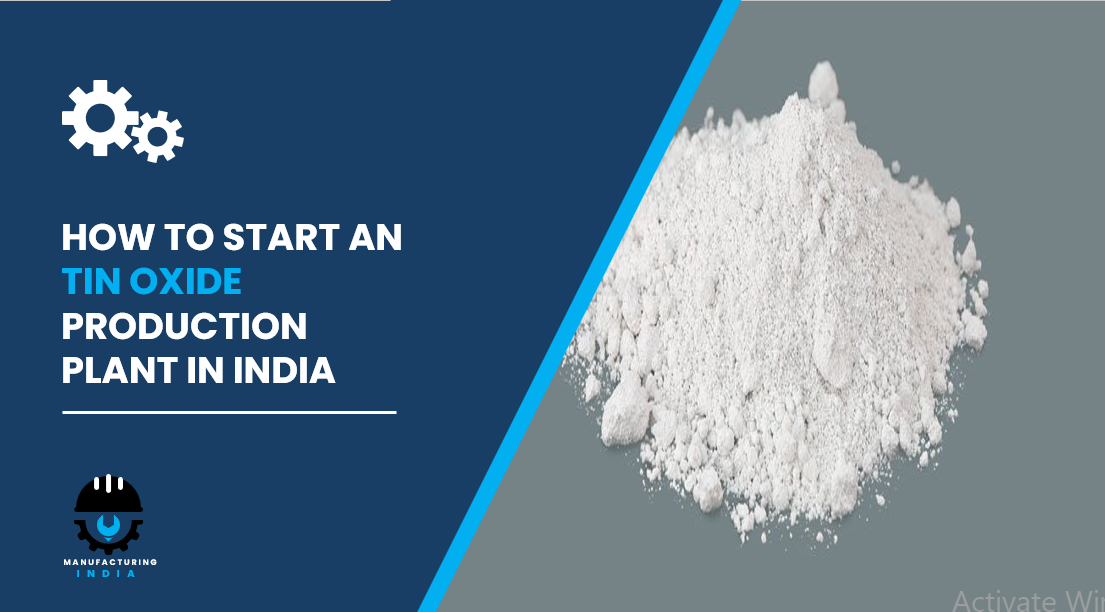
Tin oxide is an inorganic compound of tin and oxygen, most commonly encountered as stannic oxide (SnO₂), a white or off-white powder with excellent chemical stability, high melting point, and a unique combination of electrical conductivity and optical transparency. It is widely used across the glass sector, particularly in the production of float glass — a specialized process in which melted glass is floated on a liquid tin surface to produce smooth and even surfaces without requiring grinding or polishing. This method greatly increases the speed of production and enhances the final product’s quality. In addition, tin oxide increases the chemical resistance of glass, enhances optical characteristics, and adds electrical conductivity.
Beyond glass, tin oxide is valued for its importance in the architectural and automotive sectors, where tin oxide coatings improve the glass’s optical properties and durability. It is also used for its catalytic abilities in environmental applications to break down organic contaminants, demonstrating its effectiveness in combating air and water pollution. These characteristics allow for its application in both technological procedures and architectural blueprints, solidifying tin oxide’s role across electronics, energy efficiency, and environmental industries worldwide.
Cost of Setting Up a Tin Oxide Production Plant in India
The tin oxide production plant cost in India depends on several parameters including production capacity, technology and process route used, plant location, level of automation, and regulatory compliance. Here is a structured breakdown of all major cost components:
1. Capital Expenditure (CapEx)
The total capital investment in a tin oxide production plant typically covers the following:
Land and Site Development This includes land acquisition, boundary development, land registration charges, and basic site preparation. The location must offer easy access to key raw materials such as tin metal or tin concentrates, along with reliable utilities and waste management infrastructure. Cost varies depending on whether the land is in a chemical industrial estate, Special Economic Zone (SEZ), or a privately acquired plot.
Civil Works and Construction Building costs cover the main reaction and processing shed, raw material storage, product drying and calcination area, quality control laboratory, effluent treatment zone, administrative block, and worker amenities. Construction specifications depend on plant scale, the chemical process route adopted, and local compliance norms for chemical manufacturing facilities.
Machinery and Equipment This is the single largest component of CapEx. Key machinery and equipment required for a tin oxide production plant includes:
- Reaction Vessels and Reactors
- Filtration and Washing Systems
- Drying Equipment (Spray Dryers or Rotary Dryers)
- Calcination Furnaces
- Milling and Size Reduction Equipment
- Blending and Mixing Systems
- Quality Control and Testing Instruments (XRF, particle size analyzers)
- Effluent Treatment Plant (ETP)
- Packaging and Bagging Machines
Other Capital Costs These include pre-operative expenses, commissioning charges, import duties (if machinery is sourced internationally), utilities installation, fire safety systems, and hazardous chemical handling infrastructure.
2. Operational Expenditure (OpEx)
Once the plant is commissioned, the ongoing cost structure is dominated by a few key components:
Raw Material Cost (Tin Metal / Tin Compounds) Tin metal or tin-bearing compounds are the primary raw material and account for the majority of operating expenses. Additional inputs include acids or alkalis for the reaction process, process water, and reagents required for purification and quality adjustment.
Utility Cost Utilities include electricity for reactors, dryers, calcination furnaces, and milling equipment, along with process water, steam, and fuel for high-temperature calcination operations. Utility costs form a significant share of ongoing OpEx due to the energy-intensive nature of drying and calcination processes.
Other Operating Costs The remaining budget covers transportation, packaging (drums, bags, or bulk containers), salaries and wages, maintenance, depreciation, taxes, effluent treatment operating costs, and miscellaneous overhead.
Request a Sample Report for In-Depth Market Insights: https://www.imarcgroup.com/tin-oxide-manufacturing-plant-project-report/requestsample
3. Plant Capacity
The proposed production facility is designed with a capacity that enables economies of scale while maintaining operational flexibility to serve multiple end-use segments including glass manufacturing, electronics, coatings, solar energy, and environmental applications. Capacity is scaled based on reactor size, calcination furnace throughput, and the degree of downstream processing and product grading required.
Smaller specialty-grade facilities targeting electronics and solar applications can operate profitably at lower volumes due to higher product value, while larger commodity-grade plants serving the glass sector benefit from economies of scale and long-term off-take agreements with major glass manufacturers.
4. Profit Margins and Financial Projections
The project demonstrates profitability potential under normal operating conditions, with margins varying based on product grade (commodity glass-grade versus high-purity electronics-grade), production scale, raw material cost management, and end-market pricing dynamics. Financial projections must account for capital investment, operating costs, capacity utilization rates, pricing trends, and demand outlook. A thorough analysis should also include sensitivity analysis, Net Present Value (NPV), Internal Rate of Return (IRR), and Payback Period.
Why Set Up a Tin Oxide Production Plant in India?
India presents a uniquely favorable environment for establishing a tin oxide production plant:
Strong Demand from the Glass and Float Glass Industry
Tin oxide plays a crucial role in the glass-making sector, particularly in float glass production, where it is used to improve optical properties, chemical resistance, and surface quality. India’s rapidly expanding construction and automotive sectors are driving strong growth in flat glass demand, creating sustained and growing consumption of tin oxide by domestic glass manufacturers.
Technological Advancements in Electronics and Semiconductors
Rapid technological advancements in the electronics and semiconductor industry are positively influencing tin oxide demand. With the advancement of consumer electronics now equipped with advanced touch interfaces and improved energy efficiency, there has been a significant rise in the need for high-quality tin oxide. India’s growing electronics manufacturing sector, supported by PLI schemes, is creating strong domestic demand for specialty-grade tin oxide.
Growing Demand for Sustainable and Energy-Efficient Solutions
The accelerating emphasis on environmentally sustainable practices and energy efficiency across industries is acting as a key growth driver. The worldwide move towards sustainable energy sources has increased the demand for tin oxide, which plays a vital role in making photovoltaic cells for better solar panel efficiency. India’s ambitious solar energy expansion program provides a direct and growing domestic market for tin oxide used in solar panel manufacturing.
Environmental Catalysis Applications
Tin oxide is used for its catalytic abilities in environmental applications to break down organic contaminants, demonstrating its effectiveness in combating air and water pollution. The growing emphasis on reducing carbon footprint and enhancing environmental compliance across Indian industries is propelling demand for tin oxide-based catalytic solutions.
Architectural and Automotive Coatings Demand
Tin oxide’s importance in the architectural and automotive sectors is highlighted by its application in glass coatings that improve optical properties and durability. India’s booming real estate and automotive industries are expanding the addressable market for tin oxide-coated glass products, supporting consistent demand from downstream coating and glass processing operations.
Manufacturing Process Overview
The tin oxide manufacturing process involves a series of carefully controlled chemical unit operations:
- Raw Material Preparation — tin metal or tin-bearing compounds are received, inspected for purity and specification, and prepared for the reaction stage through weighing, dissolution, or pre-treatment as required by the specific process route
- Chemical Reaction / Oxidation — tin is oxidized through controlled chemical reactions (wet chemical precipitation or direct oxidation routes) to produce tin hydroxide or tin oxide intermediates under precisely controlled temperature, pH, and reagent concentration conditions
- Filtration and Washing — the reaction product is separated from the liquid phase through filtration and washed repeatedly with deionized water to remove impurities, residual reagents, and ionic contaminants to meet product purity specifications
- Drying — the washed filter cake is dried using spray dryers or rotary dryers to reduce moisture content to required levels, producing a dry tin oxide or tin hydroxide intermediate ready for calcination
- Calcination — dried material is subjected to high-temperature calcination in a furnace to convert tin hydroxide to fully crystalline stannic oxide (SnO₂) with controlled particle size, specific surface area, and crystallinity
- Milling and Classification — calcined tin oxide is milled to the required particle size distribution and classified to separate fine and coarse fractions, with product grade determined by particle size, surface area, and purity specifications
- Quality Testing and Blending — finished tin oxide is tested for purity, particle size distribution, specific surface area, and chemical composition; batches are blended as necessary to achieve consistent product specification
- Packaging and Dispatch — quality-approved tin oxide is packed in drums, bags, or bulk containers appropriate to the grade and customer requirements, labeled, and dispatched to downstream customers
Key Applications of Tin Oxide
Tin oxide serves a wide variety of end-use industries and applications:
- Glass and Float Glass Industry: Used in the float glass production process where molten glass is floated on liquid tin to produce perfectly flat glass surfaces; tin oxide coatings also improve the chemical resistance, optical characteristics, and electrical conductivity of architectural and automotive glass
- Electronics and Semiconductors: Used as a transparent conductive oxide (TCO) in touch screens, flat panel displays, and smart glass; high-purity tin oxide is an essential material in the manufacture of advanced electronic devices and interfaces
- Solar Energy (Photovoltaics): Plays a vital role in making photovoltaic cells by serving as a transparent electrode layer in thin-film solar panels, contributing to improved solar panel efficiency and energy output
- Environmental Catalysis: Used for its catalytic abilities to break down organic contaminants in air and water treatment applications, demonstrating effectiveness in combating industrial pollution and supporting environmental compliance programs
- Ceramic Opacifiers and Glazes: Used in the ceramics industry as an opacifier in glazes and enamels for tiles, sanitary ware, and decorative ceramics, providing bright white opacity and chemical durability
- Polishing and Abrasives: High-purity tin oxide is used as a polishing agent for optical glass, gemstones, and metal surfaces due to its fine particle size and controlled abrasive properties
Global Market Outlook
The global tin oxide market continues to be supported by its broad use in the glass sector and its expanding contribution to environmental, electronics, and energy applications. The broad use of tin oxide in the glass sector and its role in environmental applications continue to underpin stable market demand. Additionally, continued efforts in research and development to enhance electronic device performance play a crucial role in driving market growth, with technological progress in semiconductors, photovoltaics, and transparent conductive coatings serving as key factors in market expansion. The Asia-Pacific region, led by China and India, represents the largest and fastest-growing market for tin oxide due to high glass manufacturing volumes, expanding electronics production, and accelerating solar energy deployment.
Leading global players in this industry include:
- American Elements
- Thermo Fisher Scientific Inc.
- Sigma-Aldrich (Merck KGaA)
- Alfa Aesar (Thermo Fisher)
- Stanford Advanced Materials
- Nanoshel LLC
- US Research Nanomaterials, Inc.
- Reade Advanced Materials
Timeline to Start a Tin Oxide Production Plant
Setting up a tin oxide production plant from ideation to commissioning typically requires 12 to 18 months. This covers:
- Feasibility study and detailed project report preparation
- Land acquisition and site development
- Regulatory approvals and environmental clearances
- Factory license and fire safety compliance
- Machinery procurement and plant installation
- Trial production runs, quality testing, and product certification
- Commercial production launch and customer qualification
Licenses and Regulatory Requirements
Starting a tin oxide production unit in India requires several approvals, including:
- Business registration (Proprietorship, LLP, or Private Limited Company)
- Factory License under the Factories Act, 1948
- Environmental Clearance from the State Pollution Control Board (SPCB)
- Consent to Establish and Consent to Operate under Air and Water Acts
- Hazardous Chemicals license under the Manufacture, Storage and Import of Hazardous Chemical Rules
- GST Registration
- Fire Safety NOC from local fire authority
- BIS Certification for applicable chemical product standards
- MSME/Udyam Registration for government incentives and schemes
- Import Export Code (IEC) for businesses targeting export markets
Key Challenges to Consider
Before investing, entrepreneurs should be aware of the common challenges in this business:
- High Capital Requirements: Initial CapEx for reactors, calcination furnaces, milling equipment, and effluent treatment infrastructure is significant, especially for facilities targeting high-purity electronics or solar-grade product specifications that require tighter process control and more sophisticated analytical equipment.
- Raw Material Price Volatility: Tin metal prices are linked to global commodity markets and can be subject to significant fluctuation. As tin is the primary cost driver, effective procurement strategies and supplier diversification are essential to protect operating margins.
- Stringent Quality and Purity Requirements: Electronics, solar, and optical-grade tin oxide require very high purity levels and tightly controlled particle size distributions. Maintaining consistent product quality across batches demands robust process control, advanced analytical capability, and rigorous quality management systems.
- Regulatory and Environmental Compliance: Tin oxide production involves chemical reactions generating acidic or alkaline wastewater and process emissions that must be treated to meet SPCB standards. Continuous investment in effluent treatment, emission monitoring, and chemical waste management is necessary.
- Skilled Manpower: Operating chemical reactors, calcination furnaces, analytical instruments, and effluent treatment systems requires trained chemical engineers and process technicians. Attracting and retaining qualified chemical manufacturing personnel is an ongoing operational challenge.
Frequently Asked Questions
The following questions are answered in the report:
- How has the tin oxide market performed so far and how will it perform in the coming years?
- What is the market segmentation of the global tin oxide market?
- What is the regional breakup of the global tin oxide market?
- What are the price trends of various feedstocks in the tin oxide industry?
- What is the structure of the tin oxide industry and who are the key players?
- What are the various unit operations involved in a tin oxide production plant?
- What is the total size of land required for setting up a tin oxide production plant?
- What is the layout of a tin oxide production plant?
- What are the machinery requirements for setting up a tin oxide production plant?
Key Takeaways for Investors
The tin oxide production industry in India represents a strategically well-timed investment opportunity backed by growing demand across the glass, electronics, solar energy, and environmental applications sectors. The market is driven by rapid technological advancements in the electronics and semiconductor industry, increasing demand for sustainable and energy-efficient solutions, and the expanding use of tin oxide in float glass, photovoltaic cells, and catalytic environmental applications. A well-planned tin oxide production plant cost in India remains competitive and financially viable across plant capacities, with profitability driven by product grade positioning, process efficiency, raw material cost management, and customer qualification in high-value end markets. Investors who establish technically capable, quality-certified facilities aligned with the high-purity requirements of electronics and solar customers are well-positioned to capture growing market share as India’s electronics manufacturing, solar energy, and construction industries continue their strong growth trajectory.
About the Author