Setting up an onion powder manufacturing plant in India has become an increasingly attractive investment proposition, driven by the country’s dominant position as the world’s second-largest onion producer and a rapidly expanding processed food sector. India’s extensive onion belt — covering Maharashtra, Karnataka, Madhya Pradesh, and Gujarat — provides manufacturers with direct access to raw material at competitive prices, creating a natural cost advantage not available in most other geographies.
India’s food processing industry is undergoing a structural transformation fueled by urbanization, rising disposable incomes, and a growing preference for shelf-stable convenience ingredients. The pharmaceutical and FMCG sectors are scaling aggressively, the foodservice industry is expanding into Tier 2 and Tier 3 cities, and export demand from the Middle East, Southeast Asia, and Europe continues to grow. In this environment, onion powder — a high-value, dehydrated derivative of a commodity that India produces in abundance — sits at the intersection of domestic consumption growth and rising export demand.
“With a dominant global onion supply base, Make in India policy support, a booming convenience food and foodservice sector, and direct access to the world’s largest onion-producing regions, India offers one of the most financially compelling environments for onion powder manufacturing — with gross margins of 30–40% and net margins of 12–18%.”
What is Onion Powder?
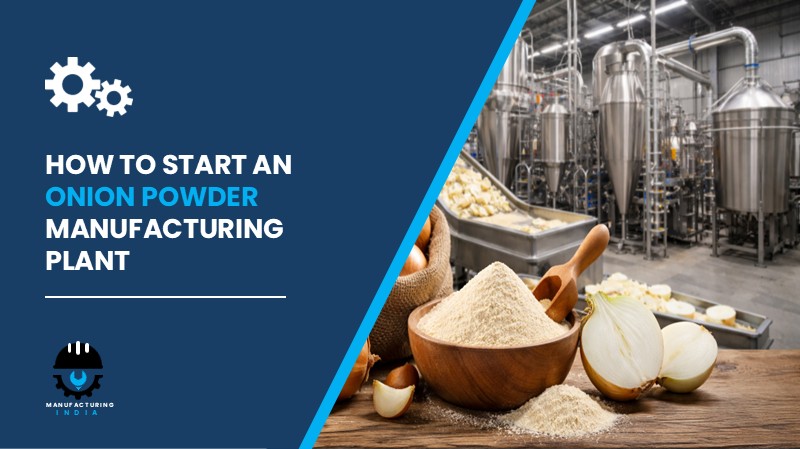
Onion powder is essentially a fresh onion in a dehydrated form, processed into an extremely fine powder. The production process involves the removal of moisture while characteristic flavors, aroma, and functional properties are preserved intact. Onion powder is typically an off-white to pale yellow, free-flowing powder with a very strong onion profile.
Among its characteristics, the freshness of the onion, great shelf stability, and ease of flavor delivery are superior to those of fresh onions. Sulfur compounds that occur naturally are responsible for its taste and aroma, and are present in the powder together with carbohydrates, trace minerals, and dietary fiber. The low moisture content of onion powder gives it a very long shelf life with less risk of microbial contamination — one of the primary reasons it is the preferred ingredient in large-scale food manufacturing and seasoning applications.
Cost of Setting Up an Onion Powder Manufacturing Plant in India:
The onion powder manufacturing plant cost in India depends on several parameters, including production capacity, technology used, plant location, level of automation, and regulatory compliance. Below is a structured breakdown of all major cost components.
1. Capital Expenditure (CapEx):
The total capital investment in an onion powder manufacturing plant covers the following major heads:
- Land and Site Development: This includes land acquisition, boundary development, land registration charges, and basic site preparation. Costs vary depending on whether the land is in an industrial estate, Special Economic Zone (SEZ), or a privately purchased plot. Land and site development costs form a substantial part of the overall investment, ensuring a solid foundation for safe and efficient plant operations.
- Civil Works and Construction: Building costs cover the main manufacturing shed, utility area, raw material storage, quality control laboratory, administrative block, and worker amenities.
- Machinery and Equipment: This is the single largest component of CapEx. Key machinery required for an onion powder plant includes: peelers, slicers, dryers (hot air or freeze drying), grinders, sieves, blenders, and packaging machines. All machinery must comply with industry standards for safety, efficiency, and reliability.
- Other Capital Costs: These include pre-operative expenses, commissioning charges, import duties (if machinery is sourced internationally), utilities installation, fire safety systems, and Effluent Treatment Plant (ETP) setup.
Request a Sample Report for In-Depth Market Insights: https://www.imarcgroup.com/onion-powder-manufacturing-plant-project-report/requestsample
2. Operational Expenditure (OpEx):
Once the plant is commissioned, the ongoing cost structure is dominated by a few key components:
Raw Material Cost (Onions): 70–80% of Total OpEx. Onions are the primary raw material and account for the majority of operating expenses. Long-term contracts with reliable suppliers help mitigate price volatility and ensure a consistent supply.
Utility Cost: 10–15% of Total OpEx. Utilities include electricity (consumed by dryers, grinders, and compressors), water (used in washing and cooling systems), and steam supply.
Other Operating Costs: The remaining budget covers transportation, packaging, salaries and wages, maintenance, depreciation, taxes, and miscellaneous overhead.
3. Plant Capacity:
The proposed manufacturing facility is designed with an annual production capacity ranging between 1,000 to 3,000 MT. This range enables economies of scale while maintaining operational flexibility to serve multiple end-use segments including food processing, seasoning blends, ready-to-eat meals, and export markets.
4. Profit Margins and Financial Projections:
The project demonstrates healthy profitability potential under normal operating conditions:
• Gross Profit Margin: 30–40%
• Net Profit Margin: 12–18%
Financial projections are developed based on realistic assumptions related to capital investment, operating costs, production capacity utilization, pricing trends, and demand outlook. A comprehensive financial analysis includes income projections, expenditures, break-even points, Net Present Value (NPV), Internal Rate of Return (IRR), and sensitivity analysis.
Why Set Up an Onion Powder Manufacturing Plant in India?
India presents a uniquely favorable environment for establishing an onion powder manufacturing plant:
- High Culinary Demand: Onion powder remains a core ingredient in the food processing industry, seasoning, and ready-meals supply, delivering excellent flavor, long shelf life, and easy handling across industrial applications.
- Megatrend Alignment: The increased acceptance of convenience foods, fast-food products, and rising export demand are driving global consumption of onion powder steadily upward. India is strategically placed to capitalize on this shift.
- Government and Export Support: Domestic production and international trade are supported by policy initiatives that promote food processing and exports, including schemes such as “Make in India” and agro-industrial parks.
- Supply Chain Localization: Manufacturers located near India’s onion-producing regions benefit from lower raw material costs, reliable supply, and improved production efficiency.
- Export Momentum: India’s onion powder industry is experiencing significant growth in global markets. Gujarat’s dehydrated white onions, for example, recorded a 67% surge in exports in FY 2023–2024, reaching 83,452 tons — the highest in four years — reflecting strong international demand for Indian dehydrated onion products.
- Moderate Entry Barriers: While investments in technology and drying processes are necessary, the quality consistency and hygiene standards of established producers provide a clear competitive edge, and India’s available manufacturing talent supports scalable operations.
Manufacturing Process — Step by Step:
The onion powder manufacturing process is a multi-step operation involving several unit operations, material handling, and quality checks. Below are the main stages:
Step 1 — Raw Material Procurement: Fresh, pesticide-free onions are sourced directly from farmers or reliable suppliers, with preference given to proximity to onion-producing regions to reduce transportation costs and ensure freshness.
Step 2 — Washing: Onions are thoroughly washed to remove dirt, debris, and surface contaminants, ensuring hygiene standards are met before processing begins.
Step 3 — Peeling: Industrial peelers remove the outer skin layers. Mechanized peeling minimizes raw material loss and ensures consistent output.
Step 4 — Slicing: Peeled onions are passed through industrial slicers to achieve uniform thickness, ensuring even and consistent drying in subsequent stages.
Step 5 — Drying: Sliced onions are subjected to either hot air drying or freeze drying to remove moisture content. The drying method chosen affects the final product’s color, flavor retention, and texture.
Step 6 — Grinding: Dried onion flakes are fed into industrial grinders to convert them into a fine powder. The grinding process is controlled to achieve the required mesh size and particle consistency.
Step 7 — Sieving: Ground powder is passed through sieves to remove any coarse particles and ensure uniform particle size distribution for consistent end-product quality.
Step 8 — Quality Inspection: Finished onion powder is tested for moisture content, color, flavor profile, purity, and microbial safety in compliance with FSSAI and applicable export standards.
Step 9 — Packaging: Quality-approved onion powder is packed in appropriate packaging materials — such as airtight pouches, bags, or containers — to preserve shelf life and protect against moisture and contamination.
Key Applications of Onion Powder:
Onion powder manufactured in India serves a wide variety of end-use industries:
- Food and Beverage Industry: Used in sauces, soups, dressings, frozen foods, and bakery formulations to provide uniform onion flavor without moisture addition.
- Foodservice and Catering Industry: Restaurants and catering units use onion powder for ease of storage, faster preparation, and consistent taste in large-scale cooking.
- Seasoning and Spice Blends Industry: Acts as a core base ingredient in spice mixes, dry rubs, and instant seasoning blends.
- Ready-to-Eat and Convenience Foods: Enhances taste in instant noodles, snacks, extruded products, and meal kits.
Leading Onion Powder Manufacturers:
Key players in the global onion powder industry include:
• Sensient
• Vegenat
• STL
• JISL
• Sodeleg
• Qingdao Lulin Dehydrated Vegetables Co.
• Olam International Inc.
• Giza National Dehydration
• New Benisuef
• Natural Dehydrated Vegetables Pvt. Ltd.
• Xinghua Hengsheng Food Co. Ltd.
Timeline to Start the Plant:
Setting up an onion powder manufacturing plant from ideation to commissioning is a structured, multi-phase process. The key phases include:
• Feasibility Study and Project Report Preparation
• Land Acquisition and Site Development
• Regulatory Approvals and Environmental Clearances
• Factory License and Fire Safety Compliance
• Machinery Procurement and Installation
• Trial Production and Quality Testing
• Commercial Production Launch
Licenses and Regulatory Requirements:
Starting an onion powder manufacturing unit in India requires several approvals and certifications:
Business Registration: Proprietorship, LLP, or Private Limited Company registration as applicable.
Factory License: Under the Factories Act, issued by the State Labour Department.
Environmental Clearance: From the State Pollution Control Board, including ETP compliance.
GST Registration: Mandatory for commercial production and B2B sales.
FSSAI License: Required for food-grade manufacturing; ensures compliance with food safety and hygiene standards applicable to dehydrated food products.
Fire Safety NOC: From the local fire department.
Export Compliance Certifications: Including APEDA registration and applicable food safety certifications for export to target markets.
Key Challenges:
Before investing, entrepreneurs should carefully evaluate the following challenges:
Raw Material Price Volatility: Fresh onion prices fluctuate seasonally and are sensitive to weather conditions, government export policies, and supply chain disruptions — directly impacting operating margins.
High Capital Requirements: Initial CapEx for drying and processing machinery is significant, particularly for mid to large-scale automated plants.
Regulatory Compliance: Meeting FSSAI, export quality, and environmental standards requires continuous investment in quality management systems and testing infrastructure.
Skilled Manpower: Operating industrial dryers, grinders, and quality control systems requires trained technical staff, which can be a constraint in non-metro locations.
Competition: The market includes both organized large players and unorganized local manufacturers, requiring a clear differentiation strategy based on quality, hygiene, and customer reliability.
Frequently Asked Questions:
The following questions are answered in the report:
1. How much does it cost to set up an onion powder manufacturing plant in India?
2. What is the production capacity of a standard onion powder plant in India?
3. What machinery is required for onion powder manufacturing in India?
4. What are the gross and net profit margins for an onion powder plant in India?
5. What licenses and approvals are required to start an onion powder manufacturing unit in India?
6. What are the FSSAI compliance requirements for dehydrated food product manufacturers in India?
7. What is the raw material cost share in an onion powder plant’s operating expenses?
8. Which states in India are best suited for setting up an onion powder manufacturing plant?
9. What export opportunities are available for onion powder manufacturers in India?
Key Takeaways for Investors:
The onion powder manufacturing plant cost in India is supported by strong raw material availability, growing domestic and export demand, and a policy environment favorable to food processing investments. With gross margins of 30–40% and net margins of 12–18%, a well-planned onion powder manufacturing facility in India presents a financially viable and scalable opportunity across production capacities of 1,000 to 3,000 MT per year.
About the Author