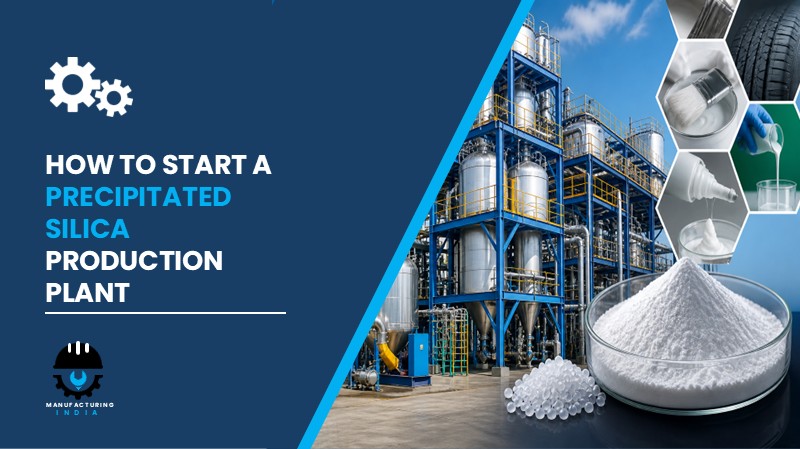
Setting up a precipitated silica production plant in India presents a compelling investment case, driven by surging demand from the automotive and tire manufacturing sector, rapid growth in personal care and cosmetics formulations, and expanding consumption in food, pharmaceuticals, and paints and coatings industries. As a multifunctional specialty chemical, precipitated silica plays an irreplaceable role in reinforcing rubber compounds, improving fuel efficiency in green tires, enhancing product texture in personal care, and acting as a free-flow additive in powdered food and feed applications – making it foundational to India’s industrial and consumer economy.
India’s accelerating urbanisation, large-scale infrastructure development, and the push under the Make in India initiative have collectively created ideal conditions for chemical manufacturing investment. States like Gujarat and Maharashtra offer established chemical industrial clusters, reliable utility infrastructure, and strong port connectivity for raw material imports. With a cost-competitive labour force, proximity to growing end-use markets, and a policy environment that actively incentivises domestic production, India stands as a strategically sound location to establish a precipitated silica production facility for both domestic supply and export.
The global precipitated silica market was valued at USD 4.45 Billion in 2025 and is projected to reach USD 7.26 Billion by 2034, growing at a CAGR of 5.6% from 2026 to 2034. India’s cost-competitive manufacturing ecosystem, combined with rising demand from tire, personal care, and food industries, makes a precipitated silica production plant in India a financially viable and strategically sound investment, with gross profit margins ranging between 30-40% and a break-even horizon of 3 to 6 years.
What is Precipitated Silica?
Precipitated silica is an artificial, non-crystalline form of silicon dioxide obtained by controlled chemical precipitation of soluble silicates. It appears as a very fine, white powder that is non-caking, possesses a large surface area, and is easily altered in terms of porosity and particle structure. The material exhibits extremely high adsorption capacity, low density, and chemical inertness, all of which contribute to its broad utility across industrial formulations.
A defining characteristic of precipitated silica is the precision with which its particle size, structure, and surface chemistry can be adjusted during the production process to meet specific application requirements. The product is water insoluble, thermally stable, and non-toxic, making it widely accepted across multiple regulated industries. The production process follows the sequence of sodium silicate preparation, precipitation, filtration, drying, milling, and surface treatment.
The end-use industries served by precipitated silica include automotive and tire manufacturing, personal care and cosmetics, food and pharmaceuticals, and paints and coatings. In application terms, it functions as a reinforcing filler, thickening agent, free-flow additive, polishing agent, and matting agent across these sectors.
Cost of Setting Up a Precipitated Silica Production Plant in India
The cost of establishing a precipitated silica production plant in India depends on several interdependent variables including plant capacity, technology selection, geographic location, level of automation, and the extent of regulatory compliance required. A thorough understanding of both capital and operational expenditure is essential before committing to this investment.
1. Capital Expenditure (CapEx)
The total capital investment in a precipitated silica production plant covers four primary categories: land and site development, civil works, machinery, and other capital costs.
Land and site development costs include charges for land registration, boundary development, and related infrastructure setup. Investors may benefit from locating the plant within a Special Economic Zone (SEZ) or a state-designated industrial estate, which can reduce land costs and provide access to fiscal incentives. Civil works encompass the construction of the production shed, laboratory, raw material and finished goods storage, effluent treatment infrastructure, and the administrative block.
Machinery costs represent the largest component of total capital expenditure. Key machinery required includes:
- Reactor vessels
- Precipitation tanks
- Filtration units (filter presses or centrifuges)
- Drying equipment (rotary or flash dryers)
- Milling machines for particle size control
- pH control systems
- Dosing units for chemicals (silica sources, acids, and bases)
- Quality testing laboratory equipment
- Classifiers
- Surface treatment systems
Other capital costs include effluent treatment plant (ETP) setup, pre-operative expenses such as feasibility studies and trial runs, commissioning charges, and applicable import duties on specialised equipment.
Request a Sample Report for In-Depth Market Insights: https://www.imarcgroup.com/precipitated-silica-manufacturing-plant-project-report/requestsample
2. Operational Expenditure (OpEx)
The operating cost structure of a precipitated silica production plant is primarily driven by raw material consumption. The core raw materials are sodium silicate (derived from quartz sand and soda ash), sulfuric acid or other mineral acids, and water. For certain process configurations, rice husk ash or silica sand may also serve as a silica source. Raw material costs collectively account for 50-60% of total operating expenses, making long-term supplier contracts essential to managing price volatility and ensuring consistent supply.
Utility costs, covering electricity, water, and steam required across the precipitation, filtration, and drying stages, constitute 20-25% of total OpEx – the second largest cost category. Additional operating costs include transportation of raw materials and finished goods, primary and secondary packaging, salaries and wages for production and administrative personnel, maintenance and repair charges, depreciation on plant and machinery, and applicable taxes. By the fifth year of operations, total operational costs are expected to increase substantially due to inflation, market fluctuations, and potential rises in the cost of key materials, as well as supply chain shifts and growing consumer demand.
3. Plant Capacity
The proposed production facility is designed with an annual production capacity ranging between 20,000 and 50,000 MT, enabling economies of scale while maintaining operational flexibility. Capacity can be customized based on specific investor requirements, available capital, and projected market offtake. As with most chemical manufacturing plants, profitability improves significantly with higher capacity utilisation rates, making scale-up planning a critical element of the investment strategy.
4. Profit Margins and Financial Projections
The project demonstrates healthy profitability potential under normal operating conditions. Gross profit margins typically range between 30-40%, supported by stable demand and the value-added nature of specialty silica applications. Net profit margins average 12-18% across a five-year projection horizon. The financial model covers NPV (net present value), IRR (internal rate of return), payback period analysis, gross and net margin tracking, income and expenditure projections, liquidity analysis, sensitivity analysis, and uncertainty analysis. The break-even period for this type of plant typically ranges from 3 to 6 years, depending on capacity utilisation, pricing strategy, and raw material cost management.
Why Setup a Precipitated Silica Plant in India?
Strategic Role in Green Tires: One of the most powerful demand drivers for precipitated silica is its critical function in green tire manufacturing, where it reduces rolling resistance, improves fuel economy, and supports automotive sustainability goals. India’s rapidly growing automotive sector and rising adoption of fuel-efficient vehicles make this application increasingly relevant.
Broad Industrial Applicability: The multifunctional characteristics of precipitated silica make it usable across a diverse range of industries – from rubber and food to pharmaceuticals and cosmetics. This broad applicability minimises sector-specific demand risk and creates a more stable, diversified revenue base for domestic producers.
Customisable Product Characteristics: Manufacturers can produce precipitated silica in different surface area configurations, particle sizes, and structures, enabling premium pricing for high-specification grades tailored to specific end-use requirements. This product flexibility supports margin expansion over time.
Cost-Competitive Manufacturing: India offers significant advantages in land costs, labour availability, and proximity to key end-use markets. Access to an established chemical manufacturing supply chain in states such as Gujarat and Maharashtra further strengthens cost competitiveness relative to imported alternatives.
Active Industry Investment: In June 2025, Aksharchem India Ltd announced the commissioning of its expanded precipitated silica manufacturing facility, aimed at meeting rising demand from end-use industries and enhancing operational efficiency – a clear indicator of market confidence in domestic production. At the global level, in January 2025, Evonik announced the formation of Smart Effects, a new business line merging its Silica and Silanes operations with 3,500 employees worldwide, further signalling the strategic importance of precipitated silica across automotive, electronics, and consumer health markets.
Regulatory Acceptance and Safety Profile: The non-toxic and chemically inert nature of precipitated silica has earned it regulatory approval for use in food, pharmaceutical, and cosmetic formulations across multiple jurisdictions, enabling producers to serve regulated, high-value markets with confidence.
Production Process – Step by Step
The precipitated silica production process uses sodium silicate preparation, precipitation, filtration, drying, milling, and surface treatment as the primary production method.
- Sodium Silicate Preparation: Quartz sand and soda ash are processed to prepare the sodium silicate solution, which serves as the primary silica source.
- Precipitation: The sodium silicate solution is reacted with sulfuric acid or another mineral acid under controlled pH and temperature conditions to precipitate silica particles from solution.
- Filtration: The precipitated slurry is passed through filter presses or centrifuges to separate silica solids from the liquid phase and remove soluble impurities through washing.
- Drying: The filtered silica cake is dried using rotary or flash dryers to achieve the required moisture content for downstream processing.
- Milling and Classification: Dried silica is milled using grinding equipment and classified to achieve the specified particle size distribution for the target application.
- Surface Treatment: Surface chemistry of the milled product is modified using treatment agents to meet specific application requirements such as hydrophobicity or improved compatibility with polymers.
- Quality Testing: Analytical instruments are used to monitor product concentration, purity, surface area, and stability against specification.
- Packaging and Dispatch: Finished precipitated silica is packaged and dispatched to end-use industries including automotive and tire manufacturing, food and pharmaceuticals, personal care and cosmetics, and paints and coatings.
Key Applications
Precipitated silica serves a wide range of end-use industries, each relying on distinct functional properties of the material:
- Rubber and Tire Industry: Used as a reinforcing filler to improve abrasion resistance, rolling resistance, and wet traction performance, particularly in green and fuel-efficient tires.
- Food and Feed Industry: Acts as an anti-caking agent and free-flow aid in powdered foods, seasonings, and animal feed premixes.
- Personal Care and Cosmetics Industry: Functions as a thickener, absorbent, and texture-enhancing agent in toothpaste, skincare creams, and cosmetics.
- Paints and Coatings Industry: Employed as a matting agent to control gloss levels and enhance surface finish quality.
- Pharmaceutical Industry: Used as a carrier, glidant, and flow-improving excipient in solid dosage formulations.
Leading Producers
Several multinational companies with extensive production capacities and diverse application portfolios dominate the global precipitated silica industry. Key players include:
- Solvay SA
- IQE Group
- Huber Engineered Materials
- Anten Chemical Co. Ltd.
- Evonik Industries
- PPG Industries Incorporated
Timeline to Start the Plant
- Feasibility study and project report preparation
- Land acquisition and site development
- Regulatory approvals and environmental clearances
- Factory licence and fire safety compliance
- Machinery procurement and installation
- Raw material supplier agreements and supply chain setup
- Trial production and quality testing
- Commercial production launch
The overall timeline from feasibility to commercial production typically ranges from 12 to 24 months, depending on regulatory approvals, equipment sourcing timelines, and site readiness.
Licences and Regulatory Requirements
Starting a precipitated silica production unit in India requires several approvals:
- Business registration (Proprietorship, LLP, or Pvt Ltd)
- Factory Licence under the Factories Act
- Environmental Clearance from State Pollution Control Board
- GST Registration
- Fire Safety NOC
- Hazardous and chemical compliance (applicable given use of sulfuric acid and reactive intermediates in the production process)
- Effluent Treatment Plant (ETP) operational clearance
- Occupational Health and Safety compliance
Key Challenges to Consider
High Capital Requirements: Establishing a precipitated silica production plant involves significant upfront investment across land, civil works, specialised machinery, and utilities infrastructure, which may require a combination of equity and debt financing.
Raw Material Price Volatility: The operating cost structure is heavily dependent on sodium silicate and sulfuric acid, which together constitute 50-60% of total OpEx. Price fluctuations in these inputs can materially impact margin performance across years.
Regulatory Compliance: The use of reactive chemicals and the generation of effluents require ongoing investment in safety systems, ETP operations, and adherence to environmental emission standards – adding to both capital and operating costs.
Technology and Innovation Pressure: As demand shifts toward customised particle size distributions and surface-modified specialty grades, continuous investment in process capability and application development is necessary to maintain competitive positioning.
Competition from Established Players: The global market is served by well-capitalised producers such as Evonik Industries, Solvay SA, Huber Engineered Materials, and PPG Industries Incorporated, requiring domestic entrants to differentiate on price, lead time, or application-specific product quality.
Skilled Manpower: Operating reactors, filtration systems, dryers, and quality testing laboratories requires technically qualified personnel, which may be constrained in locations outside major industrial hubs.
Frequently Asked Questions
1. How much does it cost to set up a precipitated silica production plant in India?
The total investment depends on plant capacity, technology, and location, covering land, civil works, machinery (reactors, filtration units, dryers, mills, classifiers), utilities, and working capital. Capacity can be customized between 20,000 and 50,000 MT per annum.
2. Is precipitated silica production profitable in India in 2026?
Yes. The project demonstrates gross profit margins of 30-40% and net margins of 12-18% under normal operating conditions, supported by stable and diversified demand across automotive, personal care, food, and pharmaceutical sectors.
3. What machinery is required for a precipitated silica plant in India?
Essential machinery includes reactor vessels, precipitation tanks, filtration units (filter presses or centrifuges), drying equipment (rotary or flash dryers), milling machines, classifiers, pH control systems, chemical dosing units, surface treatment systems, and quality testing laboratory equipment.
4. What licences and approvals are required to start a precipitated silica plant in India?
Required approvals include business registration, Factory Licence, Environmental Clearance from the State Pollution Control Board, GST Registration, Fire Safety NOC, hazardous chemical compliance, ETP operational clearance, and Occupational Health and Safety compliance.
5. What raw materials are needed for precipitated silica production?
The core raw materials are sodium silicate (produced from quartz sand and soda ash), sulfuric acid or other mineral acids, and water. For certain processes, rice husk ash or silica sand may also serve as a silica source.
6. What are the environmental compliance requirements for a precipitated silica plant in India?
The facility must obtain Environmental Clearance from the State Pollution Control Board, operate an Effluent Treatment Plant (ETP), comply with emission standards, and implement safety monitoring systems to detect process deviations or chemical leaks.
7. What is the best location to set up a precipitated silica plant in India?
The site must offer easy access to raw materials such as sodium silicate and sulfuric acid, proximity to target markets, reliable transportation and utility infrastructure, and compliance with local zoning and environmental regulations. Industrial clusters in Gujarat and Maharashtra are well-suited given their chemical sector infrastructure.
8. What is the break-even period for this type of plant in India?
Break-even typically ranges from 3 to 6 years, depending on plant capacity, market demand, capacity utilisation rates, and the management of raw material costs and operational expenses.
9. What government incentives are available for manufacturers in India?
Governments may offer capital subsidies, tax exemptions, reduced utility tariffs, export benefits, and interest subsidies to promote manufacturing under national and state industrial policies. Schemes under Make in India and state-level investment promotion frameworks are particularly relevant.
Key Takeaways for Investors
A precipitated silica production plant in India offers a well-grounded investment opportunity anchored by sustained demand from automotive and tire manufacturing, personal care, food and pharmaceuticals, and paints and coatings – sectors that are all expanding within the Indian economy. The plant demonstrates financial viability across a capacity range of 20,000 to 50,000 MT per annum, with gross margins of 30-40% and net margins of 12-18% supporting strong long-term returns. The global precipitated silica market, valued at USD 4.45 Billion in 2025, is projected to reach USD 7.26 Billion by 2034 at a CAGR of 5.6%, providing a robust demand tailwind for new production capacity established in India during this growth phase. With the green tire transition, specialty filler adoption, and regulatory acceptance across multiple high-value industries all reinforcing demand sustainability, the long-term outlook for precipitated silica production in India remains compelling.
About the Author