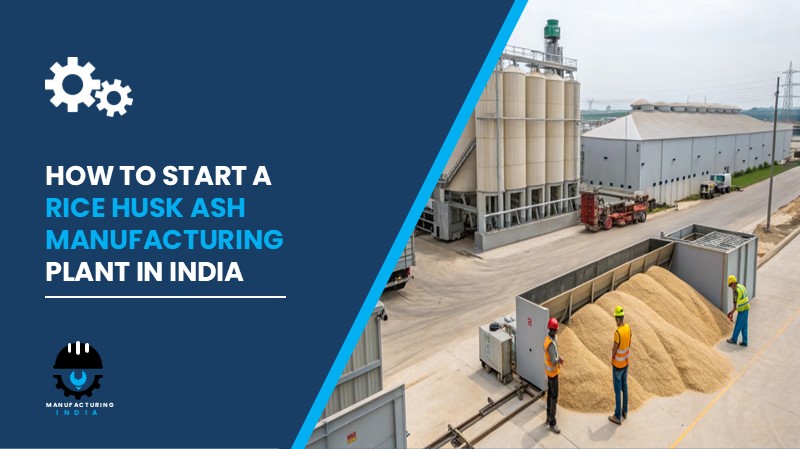
Setting up a rice husk ash manufacturing plant in India presents a compelling investment case, driven by surging demand across construction and cement, agriculture and horticulture, waste management, ceramics and glass manufacturing, and bioenergy production. As one of the world’s largest rice-producing nations, India generates enormous volumes of rice husk as a milling byproduct, creating a highly cost-advantaged raw material base for domestic producers. The rising global focus on green building materials, sustainable construction practices, and eco-friendly alternatives is accelerating demand for rice husk ash as a supplementary cementitious material, making this segment one of the most strategically promising agro-industrial investment opportunities of the decade.
India’s structural advantages further strengthen the case for this investment. Rapid urbanisation, a multi-trillion-rupee infrastructure pipeline, and the central government’s Make in India initiative together create durable tailwinds for materials that replace conventional cement and chemical inputs. States such as Punjab, Haryana, Uttar Pradesh, Andhra Pradesh, and West Bengal — all major rice-milling hubs — offer proximity to abundant rice husk supply, lower logistics costs, and established industrial infrastructure. The combination of a low-cost raw material base, growing domestic end-use markets, and policy support for sustainable manufacturing makes India a strategically sound location for rice husk ash production.
India stands at the intersection of agricultural abundance and industrial ambition — rice husk ash manufacturing leverages both. With gross profit margins ranging between 40–50% and net margins of 20–35%, this investment offers strong financial viability across capacities, supported by Make in India policy tailwinds, demand from construction and agriculture sectors, and a proven break-even case for well-capitalised plants.
What is Rice Husk Ash?
Rice husk ash is the ash produced after the controlled burning of rice husks, which are a byproduct of the rice milling process. The material is composed primarily of silica (SiO₂) and is valued for its high silica content and pozzolanic properties, which allow it to react with calcium hydroxide in concrete to form additional cementitious compounds. These chemical characteristics give the material high binding power, making it an effective supplementary cementitious material in construction applications. Beyond construction, it is used as a soil conditioner to improve soil texture, enhance water retention, and supply trace minerals to crops. Its ability to absorb toxins and filter impurities — including heavy metals — makes it a functional input in water filtration and wastewater treatment systems. Rice husk ash also serves as a key ingredient in ceramics and glass manufacturing, where its high silica content contributes to structural integrity and surface finish. The production process follows a defined multi-stage sequence: raw material sourcing, burning process, cooling and grinding, purification, and storage and packaging. End-use industries served include construction and cement, agriculture and horticulture, waste management, ceramics and glass manufacturing, and energy production.
Cost of Setting Up a Rice Husk Ash Manufacturing Plant in India
The cost of establishing a rice husk ash manufacturing plant in India depends on several interconnected variables including plant capacity, technology selection, geographic location, level of automation, and regulatory compliance requirements. A well-structured financial plan covering both capital and operational expenditure is essential for accurate investment assessment.
1. Capital Expenditure (CapEx)
The total capital investment for a rice husk ash manufacturing plant spans several major cost heads, each of which must be carefully planned to ensure efficient plant operations from commissioning onwards.
Land and Site Development involves acquisition costs, land registration charges, boundary development, and site levelling. Plants located within Special Economic Zones (SEZs) or designated industrial estates may benefit from concessional land rates, stamp duty exemptions, and access to shared utilities infrastructure — advantages that can materially reduce upfront capital deployment.
Civil Works and Construction encompasses the production shed, raw material storage area, finished goods warehouse, quality control laboratory, effluent treatment plant (ETP), and administrative block. These structures must conform to local building codes, factory safety norms, and environmental design standards applicable in India.
Machinery and Equipment represent the largest single component of capital expenditure. Key machinery required includes:
- Combustion furnaces
- Grinders and milling machines
- Sifting equipment
- Packaging machines
Other Capital Costs include pre-operative expenses such as project report preparation, feasibility studies, regulatory filing fees, commissioning charges, and import duties on specialised equipment procured from overseas suppliers where applicable.
Request a Sample Report for In-Depth Market Insights: https://www.imarcgroup.com/rice-husk-ash-manufacturing-plant-project-report/requestsample
2. Operational Expenditure (OpEx)
Raw Material Cost accounts for approximately 10–20% of total operating expenses. The primary raw material is rice husk, which must be sourced reliably from rice mills and paddy processing units. Establishing long-term supplier contracts with mills in nearby agro-processing clusters helps mitigate price volatility and ensures consistent quality of input feedstock throughout the production cycle.
Utility Cost is the dominant operating expense, accounting for 50–60% of total OpEx. Electricity consumption is high — driven by combustion furnaces, grinding mills, and sifting systems — and must be factored into site selection decisions, particularly with reference to state electricity tariff rates. Water and steam requirements for process cooling and grinding also form part of the utility cost structure.
Other Operating Costs include transportation and distribution charges, packaging materials, salaries and wages for plant operators and technical staff, routine maintenance and spare parts, depreciation on plant and machinery, and applicable taxes. By the fifth year of operations, total operational costs are projected to increase substantially due to inflation, rising input prices, market fluctuations, supply chain disruptions, and shifts in the broader economy.
3. Plant Capacity
The proposed manufacturing facility referenced in this report is designed with an annual production capacity of 5,000 metric tons of processed ash, enabling economies of scale while maintaining operational flexibility. This capacity can be customised to meet investor-specific requirements, whether for a smaller pilot-scale unit or a larger commercial operation. Profitability improves meaningfully with higher capacity utilisation, as fixed overhead costs are distributed across a greater volume of output, compressing the per-unit cost of production.
4. Profit Margins and Financial Projections
The rice husk ash manufacturing plant demonstrates healthy profitability potential under normal operating conditions. Gross profit margins typically range between 40–50%, supported by stable demand and value-added applications across construction, agriculture, and waste management. Net profit margins are projected at 20–35%, reflecting the low raw material cost as a proportion of revenue and the relatively lean utility-to-output ratio achievable at optimum capacity. Financial projections are developed around key parameters including net present value (NPV), internal rate of return (IRR), payback period, liquidity analysis, and sensitivity analysis. These projections are designed to demonstrate the project’s long-term financial viability, ROI potential, and sustainability across varying market conditions.
Why Set Up a Rice Husk Ash Plant in India?
Growing Construction and Infrastructure Demand. The rise in infrastructure development, especially in emerging economies like India, is fuelling demand for rice husk ash as a supplementary cementitious material. Its pozzolanic properties enhance both the strength and durability of concrete, making it an increasingly preferred substitute for a portion of Portland cement in large-scale construction projects.
Rising Agricultural Demand. India’s growing focus on soil health and organic farming is creating strong demand for rice husk ash as a soil amendment. It improves soil texture, enhances water retention, and provides essential trace minerals — positioning it as a cost-effective solution for horticulture and commercial agriculture operations across India’s vast agricultural belt.
Sustainability and Environmental Impact. Rice husk ash is a byproduct of the rice milling industry, and its productive use reduces industrial waste — a key advantage in a regulatory environment that increasingly penalises waste generation. This positions it as an environmentally friendly alternative to conventional materials such as cement, contributing directly to circular economy goals.
Policy and Regulatory Tailwinds. Government policies promoting sustainable construction materials and green building practices are expected to support the adoption of rice husk ash across public infrastructure projects, housing schemes, and industrial construction. The Make in India initiative further incentivises domestic production of materials that reduce import dependence.
Active Industry Investment. In November 2025, a research study demonstrated the potential of rice husk ash in concrete to improve strength and sustainability using machine learning models to predict the compressive strength of rice husk ash-based concrete mixes. In the same month, a comprehensive industry article confirmed that the high amorphous silica content of rice husk ash enables it to partially replace cement (10–20%) to improve both strength and sustainability — directly expanding its addressable market in Indian construction.
Local Supply Chain Preference. Construction firms, cement producers, agricultural input suppliers, and ceramics manufacturers in India increasingly prefer locally sourced sustainable materials to manage logistics costs and supply chain reliability. A domestic rice husk ash unit is ideally positioned to service these buyers efficiently, with the added advantage of shorter lead times and lower freight expenses.
Manufacturing Process – Step by Step
The rice husk ash manufacturing process uses raw material sourcing, burning process, cooling and grinding, purification, and storage and packaging as the primary production method. The following steps outline the operational flow:
- Raw Material Sourcing: Rice husk is procured from rice mills and paddy processing units and inspected for moisture content, purity, and consistency before being admitted to the production area.
- Burning Process: The rice husk is fed into combustion furnaces, where controlled incineration at precise temperatures converts the organic material into ash with the desired high amorphous silica content and pozzolanic properties.
- Cooling and Grinding: The hot ash exiting the furnaces is cooled and then processed through grinders and milling machines to achieve the target particle size distribution required for construction, agricultural, or industrial applications.
- Purification: Sifting equipment is used to remove unburnt carbon residues and oversized particles, ensuring the final product meets quality and purity specifications.
- Storage and Packaging: Purified rice husk ash is transferred to the finished goods storage area, packaged using dedicated packaging machines, and prepared for dispatch to construction, agricultural, waste management, ceramics, and energy sector buyers.
Key Applications
Rice husk ash serves a diverse range of industries, each leveraging its unique silica-rich and pozzolanic characteristics:
- Construction and Cement Industry: Used as a supplementary cementitious material in concrete, enhancing strength and durability through pozzolanic reaction.
- Agriculture and Horticulture Industry: Applied as a soil amendment to improve soil texture, enhance water retention, and deliver essential trace minerals to crops.
- Waste Management Industry: Used in water filtration and wastewater treatment processes to absorb toxins and filter heavy metals and other impurities.
- Ceramics and Glass Manufacturing: A high-silica input contributing to the structural integrity and surface appearance of ceramic and glass products.
- Bioenergy Production: Explored as a biomass fuel with calorific value suitable for generating heat and power in industrial energy applications.
Leading Manufacturers
The global rice husk ash industry is served by a range of established manufacturers with diversified production capacities and application portfolios. Key players operating in this space include:
- AgraTech
- Bharat Agro
- Husk Power Systems
- Karnataka Agro
- Nippon Electric Glass
- Pioneer Industries
Timeline to Start the Plant
Investors should plan for a phased execution timeline covering the following milestones:
- Feasibility study and project report preparation
- Land acquisition and site development
- Regulatory approvals and environmental clearances
- Factory licence and fire safety compliance
- Machinery procurement and installation
- Raw material supplier agreements and supply chain setup
- Trial production and quality testing
- Commercial production launch
Licences and Regulatory Requirements
Starting a rice husk ash manufacturing unit in India requires several approvals:
- Business registration (Proprietorship, LLP, or Pvt Ltd)
- Factory Licence under the Factories Act
- Environmental Clearance from State Pollution Control Board
- GST Registration
- Fire Safety NOC
- Hazardous and Chemical compliance (relevant given the combustion process and ash handling)
- Effluent Treatment Plant (ETP) operational clearance
- Occupational Health and Safety compliance
Key Challenges to Consider
High Capital Requirements. The initial investment covering land, civil works, combustion furnaces, grinding and milling machines, sifting equipment, and packaging machines demands significant upfront commitment, which can be a barrier for first-time entrants without access to structured project financing.
Raw Material Price Volatility. The primary input — rice husk — is an agricultural byproduct whose availability and pricing can fluctuate seasonally. Supply chain disruptions during lean harvesting seasons may increase procurement costs and affect plant utilisation rates.
Regulatory Compliance. Environmental clearances, ETP commissioning, and factory licensing under Indian regulations require detailed documentation, timely submissions, and ongoing compliance monitoring, all of which add to pre-operational lead times and recurring administrative costs.
Technology and Innovation Pressure. Recent industry developments, including machine learning-based prediction of compressive strength in rice husk ash concrete mixes, signal that the industry is evolving technically. Producers must stay current with quality standards demanded by sophisticated construction and ceramics buyers.
Competition. The presence of established global players including AgraTech, Bharat Agro, Husk Power Systems, Karnataka Agro, Nippon Electric Glass, and Pioneer Industries means that new entrants must compete on quality, consistency, and cost efficiency from day one of commercial operations.
Skilled Manpower. Operating combustion furnaces, milling systems, and quality control instruments requires technically trained personnel. Sourcing and retaining skilled operators and quality assurance staff in plant locations away from major urban centres can be challenging.
Frequently Asked Questions
1. How much does it cost to set up a rice husk ash manufacturing plant in India?
The total cost depends on capacity, technology, location, and automation level. Capital expenditure covers land, civil works, combustion furnaces, grinders and milling machines, sifting equipment, and packaging machines. A detailed project report with site-specific CapEx figures is recommended before committing capital.
2. Is rice husk ash manufacturing profitable in India in 2026?
Yes. Gross profit margins typically range between 40–50% and net profit margins between 20–35%, supported by low raw material costs, stable demand, and value-added applications across construction, agriculture, and waste management.
3. What machinery is required for a rice husk ash plant in India?
Key machinery includes combustion furnaces, grinders and milling machines, sifting equipment, and packaging machines. All equipment must conform to industry standards for safety, efficiency, and reliability.
4. What licences and approvals are required to start a rice husk ash plant in India?
Required approvals include business registration, Factory Licence, Environmental Clearance from the State Pollution Control Board, GST Registration, Fire Safety NOC, ETP operational clearance, and Occupational Health and Safety compliance.
5. What raw materials are needed for rice husk ash manufacturing?
The primary raw material is rice husk, a byproduct of the rice milling industry. Securing long-term supply contracts with nearby rice mills is essential for cost control and production continuity.
6. What are the environmental compliance requirements for a rice husk ash plant in India?
A rice husk ash manufacturing unit must obtain Environmental Clearance from the State Pollution Control Board, commission an operational Effluent Treatment Plant, comply with emission norms for combustion processes, and implement advanced monitoring systems to detect deviations in the production process.
7. What is the best location to set up a rice husk ash plant in India?
Ideal locations are in close proximity to large-scale rice milling operations — states such as Punjab, Haryana, Uttar Pradesh, Andhra Pradesh, and West Bengal offer strong raw material access. The site must also have reliable transportation, utilities, and waste management systems, along with compliance with local zoning regulations.
8. What is the break-even period for this type of plant in India?
The break-even period depends on plant capacity, capital investment structure, pricing, and market conditions. A detailed financial analysis covering NPV, IRR, payback period, and sensitivity analysis — as provided in a project report — is the recommended basis for this calculation.
9. What government incentives are available for manufacturers in India?
Government policies promoting sustainable construction materials and green building practices support the adoption of rice husk ash. The Make in India initiative offers additional benefits for domestic manufacturers, including access to industrial estate infrastructure, concessional financing through schemes such as those administered by SIDBI, and state-level capital subsidy programmes depending on the location of the plant.
Key Takeaways for Investors
A rice husk ash manufacturing plant in India represents a well-rounded investment opportunity anchored by durable demand from construction and cement, agriculture and horticulture, waste management, ceramics and glass manufacturing, and bioenergy production — all sectors experiencing sustained expansion in India. The financial profile is compelling across plant capacities, with gross margins of 40–50% and net margins of 20–35% achievable under normal operating conditions, supported by a low-cost raw material base and a high-value output portfolio. The global rice husk ash market was valued at USD 2.98 billion in 2025 and is projected to reach USD 4.63 billion by 2034, growing at a CAGR of 5.0% from 2026 to 2034 — with India positioned as a key growth market within this expansion. As environmental regulations tighten, green building adoption deepens, and agricultural demand for sustainable soil inputs grows, the long-term demand sustainability for this product remains firmly intact, making this a structurally sound investment for the decade ahead.
About the Author