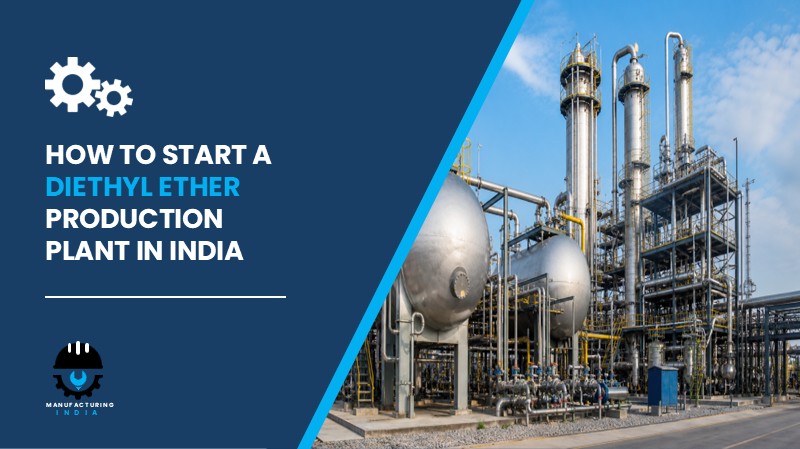
Setting up a diethyl ether production plant in India presents a compelling investment case at a time when the country’s rapidly expanding pharmaceutical industry, growing chemical manufacturing sector, deepening laboratory and research infrastructure, and increasing interest in sustainable fuel additives are collectively generating sustained demand for one of the world’s oldest, most versatile, and most commercially indispensable organic solvents. Diethyl ether (C₂H₅OC₂H₅) — a colourless, highly flammable liquid with a characteristic sweet odour produced through the acid-catalysed dehydration of ethanol — serves as a foundational solvent and reagent across pharmaceutical API extraction, chemical synthesis, laboratory separation and purification, food and cosmetics ingredient extraction, and fuel additive formulation. As India’s pharmaceutical sector targets USD 130 Billion by 2030, its chemical industry deepens its specialty chemical manufacturing base, and its research and development ecosystem expands with government investment in scientific infrastructure, the domestic requirement for reliably supplied, high-purity diethyl ether is growing into a commercially significant opportunity for domestic producers.
India’s structural positioning for diethyl ether production is well-supported and improving. The country’s established ethanol production infrastructure — built on both sugarcane molasses-based and grain-based fermentation routes and expanded significantly under the government’s ethanol blending programme — provides cost-competitive access to the primary feedstock for diethyl ether synthesis. India’s large domestic pharmaceutical manufacturing base in Hyderabad, Ahmedabad, Pune, and Mumbai creates an immediate and growing institutional customer segment for pharmaceutical-grade diethyl ether. The Make in India initiative and government support for specialty chemical manufacturing provide policy tailwinds, while chemical industrial estates in Gujarat, Maharashtra, Telangana, and Andhra Pradesh offer the acid-resistant process infrastructure, safety management expertise, and logistics connectivity that a diethyl ether production facility requires to operate safely and commercially at scale.
Investing in a diethyl ether production plant in India today aligns India’s rapidly expanding pharmaceutical industry, growing chemical and laboratory sectors, and increasing interest in sustainable biofuel additives with a global diethyl ether market growing from USD 12.50 Billion in 2025 to USD 23.97 Billion by 2034 at an exceptional CAGR of 7.5%. With gross profit margins of 20–30% and net profit margins of 10–18% at an annual production capacity of 5,000 MT, the unit economics are commercially sound, and break-even typically ranges from 3 to 5 years supported by stable multi-sector demand.
What is Diethyl Ether?
Diethyl ether (C₂H₅OC₂H₅), also known as ethyl ether, is a colourless, flammable liquid that has a characteristic sweet odour. It is one of the oldest and simplest organic solvents, traditionally used in laboratories for extraction and separation processes. Historically, diethyl ether was also used as an anaesthetic, though its medical use has decreased with the advent of more modern agents. Today, it is primarily used as a solvent in chemical and pharmaceutical industries, as well as in fuel formulations. Diethyl ether has a low boiling point and is highly volatile, which makes it useful in a variety of industrial processes that require rapid evaporation and dissolution.
It is typically produced through the acid-catalysed dehydration of ethanol using concentrated sulphuric acid as a catalyst and dehydrating agent, or via the reaction of ethene and alcohol. The product’s versatility as a solvent — dissolving a wide range of organic and inorganic materials — makes it indispensable across chemical, pharmaceutical, and laboratory applications. Using 5% diethyl ether with biodiesel improves brake thermal efficiency and reduces carbon dioxide and nitrogen oxide emissions, making it a valuable candidate for sustainable fuel solutions — a performance characteristic driving its growing adoption as an oxygenate fuel additive in the automotive and transportation sectors seeking emission reduction solutions.
The primary production process covers ethanol dehydration, etherification reaction, purification, storage and distribution. End-use industries served include pharmaceuticals, chemicals, laboratories, manufacturing, and petrochemicals and fuels. Applications span solvent use in chemical and pharmaceutical manufacturing, extraction in food and cosmetics industries, anaesthetic preparations, fuel additives in engine applications, and reagent use in organic synthesis reactions.
Cost of Setting Up a Diethyl Ether Production Plant in India
The cost of establishing a diethyl ether production plant in India depends on production capacity, feedstock ethanol grade and purity specification, process technology selection, geographic location — particularly proximity to ethanol supply and pharmaceutical customer clusters — degree of automation, and the comprehensive safety, environmental, and quality compliance requirements applicable to a highly flammable and volatile solvent manufacturing facility.
1. Capital Expenditure (CapEx)
Land and Site Development forms a foundational component of total capital investment, covering land acquisition charges, site registration, boundary development, chemical containment and bund wall infrastructure for flammable liquid storage, drainage, and site utilities. Given diethyl ether’s acute flammability — with an extremely low flash point of −45°C — site safety infrastructure including blast-rated construction, explosion-proof electrical systems throughout the production area, toxic and flammable gas detection, and comprehensive fire suppression systems represent capital requirements that go substantially beyond conventional chemical plant standards. Investors may explore chemical industrial estates in Gujarat’s Ankleshwar and Dahej zones or Telangana’s Hyderabad Pharma City, where established flammable solvent manufacturing infrastructure, experienced safety regulatory authorities, pharmaceutical customer proximity, and ethanol supply chain access together create the most commercially advantaged operating environment.
Civil Works and Construction cover the main production building with explosion-proof construction housing acid-resistant reactor systems, distillation column structures, condenser and heat exchanger banks, a diethyl ether product storage building with full secondary containment and fire suppression, ethanol raw material storage with separate fire zone, a quality control laboratory, an administrative block, and utilities infrastructure including cooling water systems and nitrogen blanketing for product storage vessels.
Machinery and Equipment represent the largest single component of total CapEx for a diethyl ether production plant. Key machinery required includes:
- Acid-resistant reactor vessels
- Distillation columns
- Heat exchangers
- Condensers
- Dryers
- Filling machines
- Packaging and labelling equipment
Other Capital Costs include an effluent treatment plant (ETP) for managing sulphuric acid-containing and ethanol-contaminated process effluents, vapour recovery systems for diethyl ether emissions during storage and filling operations, nitrogen blanketing systems for inert atmosphere product storage, pre-operative expenses, PESO approval and CCOE licensing costs, commissioning charges, and import duties on specialised distillation column internals or precision filling equipment not available domestically at the required specification.
Request a Sample Report for In-Depth Market Insights: https://www.imarcgroup.com/diethyl-ether-manufacturing-plant-project-report/requestsample
2. Operational Expenditure (OpEx)
Raw Material Cost is the overwhelmingly dominant operational expense, accounting for approximately 75–80% of total OpEx. The primary raw materials are ethanol (high purity) and concentrated sulphuric acid serving as both catalyst and dehydrating agent. Ethanol — consumed in the largest volumes as the carbon feedstock for diethyl ether synthesis — is the most cost-significant input. India’s government ethanol blending programme has catalysed a major expansion of domestic ethanol production capacity, improving the availability and cost-competitiveness of high-purity industrial ethanol from sugarcane and grain fermentation sources across multiple states. Concentrated sulphuric acid is widely available domestically from established inorganic acid producers. Long-term procurement contracts with reliable ethanol suppliers — including domestic distilleries and ethanol producers — are essential for production cost stability and supply continuity.
Utility Cost is the second-largest OpEx component, representing 15–20% of total operating expenses — a relatively high proportion reflecting the energy demands of continuous distillation column operations for product separation and purification, cooling water systems for condensers, and steam for reactor and reboiler heating. Managing utility costs through heat integration between the exothermic reactor and distillation heating requirements, and negotiating competitive industrial electricity tariffs, are important levers for improving the overall cost position of the facility.
Other Operating Costs include transportation and distribution — which for diethyl ether requires specialised flammable liquid-rated tank vehicles and ISO tanks compliant with ADR/dangerous goods transport regulations — specialised flammable liquid packaging for customer deliveries in drums and carboys, salaries and wages for chemical engineers and safety officers, routine machinery maintenance including distillation column internals inspection and heat exchanger cleaning, depreciation on production equipment, and applicable taxes. By the fifth year of operations, total operational costs are projected to increase substantially due to inflation, ethanol and sulphuric acid price movements, supply chain disruptions, rising consumer demand, and shifts in the global economy.
3. Plant Capacity
The proposed production facility for diethyl ether is designed with an annual production capacity of 5,000 metric tonnes, enabling economies of scale while maintaining the operational flexibility to serve a diversified customer base across the pharmaceutical, chemical, laboratory, food and cosmetics, and fuel additive sectors. Plant capacity can be customised per investor requirements and scaled through additional reactor and distillation train capacity as market demand and customer qualification milestones progress. Break-even in a diethyl ether production business typically ranges from 3 to 5 years depending on ethanol pricing, plant efficiency, product demand, and operational costs, with long-term supply contracts and efficient energy use reducing the payback period.
4. Profit Margins and Financial Projections
The financial projections for a diethyl ether production plant demonstrate commercially sound profitability potential under normal operating conditions. Gross profit margins typically range between 20–30%, supported by stable demand across pharmaceutical solvent, chemical synthesis, laboratory, and fuel additive customer segments. Net profit margins are projected at 10–18%. Profitability depends on several factors including market demand, production efficiency, pricing strategy, raw material cost management, and operational scale, with profit margins usually improving with capacity expansion and increased capacity utilisation rates. A comprehensive financial analysis covering NPV, IRR, payback period, and five-year projections is essential before committing capital.
Why Set Up a Diethyl Ether Production Plant in India?
Growing Pharmaceutical Industry Driving API Solvent Demand. Diethyl ether is widely used in the pharmaceutical industry as a solvent for extracting active ingredients from natural sources and in drug synthesis processes — applications that grow directly with the scale of India’s pharmaceutical manufacturing. As the global pharmaceutical industry expands with the production of drugs, anaesthetics, and active pharmaceutical ingredients (APIs), the demand for high-purity diethyl ether as a pharmaceutical-grade solvent continues to increase alongside it. India’s pharmaceutical sector — targeting USD 130 Billion by 2030 — provides one of the world’s largest and most rapidly growing domestic pharmaceutical solvent markets.
Expanding Chemical Industry and Technological Advancements in Synthesis. In the chemical industry, diethyl ether is used as a solvent in a variety of reactions including polymerisation and synthesis processes, due to its low reactivity and efficiency as a solvent. Diethyl ether’s role in chemical synthesis and polymerisation reactions in manufacturing processes enhances the efficiency and output of industrial applications. India’s growing specialty chemical manufacturing base — driven by China+1 supply chain diversification — is creating expanding domestic demand for high-quality industrial solvents including diethyl ether from producers who can guarantee consistent purity and supply reliability.
Rising Demand for Fuel Additives and Biofuel Applications. With growing interest in fuel efficiency and environmental sustainability, the use of diethyl ether as a fuel additive is expected to rise, particularly in the automotive and transportation industries seeking emission reduction solutions. Research published in November 2025 by Nanjing University of Science and Technology in Frontiers in Energy highlighted advancements in diethyl ether’s combustion characteristics, positioning it as a promising renewable biofuel alternative to traditional diesel with superior ignition performance and reduced soot formation. This growing scientific and commercial recognition of diethyl ether’s fuel application potential is driving demand in the market, particularly as governments and industries seek ways to reduce emissions and enhance biofuel efficiency.
Laboratory and Research Infrastructure Expansion. Diethyl ether is commonly used in laboratories for extraction, purification, and separation processes, with its ability to dissolve a wide range of compounds making it an essential tool in research and development. India’s expanding government investment in scientific research infrastructure — through IITs, NITs, CSIR laboratories, and private R&D centres — is growing the institutional laboratory customer base for analytical-grade diethyl ether alongside the larger pharmaceutical and industrial solvent market segments.
Food, Cosmetics, and Speciality Extraction Applications. Diethyl ether is also used as an extraction solvent in the food industry for essential oils, flavours, and fragrances, as well as in the cosmetic industry for preparing formulations — applications that are growing with India’s expanding processed food, flavour and fragrance, and premium cosmetics manufacturing sectors. These niche but premium-priced extraction applications complement the core pharmaceutical and chemical solvent revenue base, providing product mix diversity that distributes revenue risk across multiple customer channels.
Versatility and Global Market Growth at 7.5% CAGR. Diethyl ether’s high solvent power for a wide range of organic and inorganic materials makes it indispensable across chemical, pharmaceutical, and laboratory applications — a multi-sector demand profile that insulates producers from single-industry cyclicality. The global diethyl ether market, valued at USD 12.50 Billion in 2025 and projected to reach USD 23.97 Billion by 2034 at a CAGR of 7.5%, reflects the compound’s growing commercial importance across expanding industrial applications and the increasing sustainability interest in its fuel additive and biofuel roles.
Production Process — Step by Step
The diethyl ether production process uses ethanol dehydration, etherification reaction, purification, storage and distribution as the primary production method. Each stage requires precisely controlled temperature, acid catalyst concentration, reaction residence time, and distillation parameters to maximise diethyl ether yield while minimising ethylene by-product formation and achieving the purity specification required by pharmaceutical, chemical, laboratory, and fuel additive customers.
- Ethanol Receipt and Quality Verification: High-purity ethanol is received from certified suppliers, quality-checked for concentration, water content, and trace impurity levels, and transferred to ethanol storage tanks under nitrogen blanketing to prevent moisture absorption and oxidation before processing.
- Acid Catalyst Preparation: Concentrated sulphuric acid is metered and prepared in controlled quantities as both the catalyst and dehydrating agent for the etherification reaction, with safe acid handling procedures implemented throughout preparation and reactor charging operations.
- Etherification Reaction in Acid-Resistant Reactors: Ethanol is fed into acid-resistant reactor vessels containing the sulphuric acid catalyst at precisely controlled temperature — typically 130–145°C — where the acid-catalysed dehydration reaction converts two molecules of ethanol into one molecule of diethyl ether and one molecule of water. Reactor temperature control is critical: temperatures below 130°C favour incomplete reaction, while temperatures above 150°C promote the formation of ethylene as a competing by-product.
- Reaction Product Separation: The crude reaction mixture — containing diethyl ether, unreacted ethanol, water, and dissolved sulphuric acid catalyst — is drawn from the reactor and subjected to initial separation processing through a series of washing and neutralisation steps to remove residual acid and separate the ether-rich overhead fraction from the aqueous bottom fraction.
- Distillation and Purification: The ether-rich fraction is processed through distillation columns where diethyl ether is separated from ethanol, water, and trace impurities by fractional distillation, exploiting the large difference in boiling points between diethyl ether (34.6°C) and ethanol (78.4°C) to achieve high-purity product separation in a series of heat exchanger-integrated distillation stages.
- Drying: Purified diethyl ether contains trace dissolved water that must be removed to pharmaceutical or analytical specification levels through molecular sieve drying columns or activated alumina drying systems to achieve the anhydrous diethyl ether quality required for pharmaceutical API extraction and laboratory analytical applications.
- Quality Inspection: Finished diethyl ether is tested for purity by gas chromatography, water content by Karl Fischer titration, acidity, non-volatile residue, and peroxide content — the latter being a critical safety parameter as diethyl ether can form explosive peroxides on prolonged storage or exposure to oxygen — verifying specification compliance before release for storage and filling.
- Storage: Specification-compliant diethyl ether is transferred to product storage tanks constructed with full secondary containment, nitrogen blanketing to prevent peroxide formation, and continuous flammable gas monitoring in accordance with PESO and fire safety regulations for highly flammable liquid storage.
- Filling, Packaging, and Dispatch: Diethyl ether is filled into drums and carboys using filling machines under nitrogen blanket in explosion-proof filling areas, sealed, and labelled with packaging and labelling equipment before dispatch to pharmaceutical manufacturers, chemical producers, laboratory supply distributors, food and cosmetics extractors, and fuel additive blend producers under dangerous goods transport compliance.
Key Applications
Diethyl ether produced in India serves a commercially diverse and growing range of industrial and research applications across multiple sectors:
- Pharmaceuticals: Widely used as a solvent for extracting active ingredients from natural sources, in preparation of inhalational anaesthetics, and in drug synthesis processes across API manufacturing.
- Chemicals: Used as a solvent in polymerisation, synthesis, and chemical reaction processes in specialty chemical and industrial chemical manufacturing applications where low reactivity and solvent efficiency are required.
- Laboratories: Essential tool in research and development for extraction, purification, and separation of a wide range of organic and inorganic compounds across academic, industrial, and government research laboratories.
- Fuel Additives: Utilised in fuel formulations to improve combustion efficiency, reduce emissions, and act as an oxygenate enhancing biofuel performance in internal combustion engine applications.
- Food and Cosmetics: Applied as an extraction solvent for essential oils, flavours, fragrances, and cosmetic ingredient preparation across India’s growing food processing and personal care manufacturing industries.
Leading Producers
The global diethyl ether industry is served by a group of large multinational chemical companies with extensive production capacities and diversified application portfolios across pharmaceutical, chemical, laboratory, and fuel sectors. Key players in the global market include:
- LyondellBasell Industries Holdings BV
- Merck KGaA
- INEOS
- Industrial Solvents & Chemicals Pvt Ltd
- BASF SE
Timeline to Start the Plant
Establishing a diethyl ether production plant in India involves a structured multi-phase development sequence. Setting up the facility usually requires a timeline ranging from 12 to 36 months depending on plant scale, regulatory approvals, and sourcing of specialised equipment, with safety and environmental permits potentially extending the setup period for flammable chemical production. Investors should plan for the following phases:
- Feasibility study and project report preparation
- Land acquisition and site development
- Regulatory approvals and environmental clearances
- Factory licence and fire safety compliance
- Machinery procurement and installation
- Raw material supplier agreements and supply chain setup
- Trial production and quality testing
- Commercial production launch
Licences and Regulatory Requirements
Starting a diethyl ether production unit in India requires comprehensive approvals spanning business registration, flammable chemical safety, petroleum storage licensing, environmental, and pharmaceutical supply chain compliance domains:
- Business registration (Proprietorship, LLP, or Pvt Ltd)
- Factory Licence under the Factories Act
- Environmental Clearance from the State Pollution Control Board
- GST Registration
- Fire Safety NOC — critically important given diethyl ether’s extreme flammability and very low flash point
- PESO (Petroleum and Explosives Safety Organisation) licence and CCOE (Chief Controller of Explosives) approval for storage and handling of Class A flammable liquid under the Petroleum Act and Petroleum Rules
- Hazardous/Chemical compliance under the Manufacture, Storage and Import of Hazardous Chemical (MSIHC) Rules for diethyl ether as a flammable and hazardous chemical
- Effluent Treatment Plant (ETP) operational clearance for managing sulphuric acid-containing and ethanol-contaminated process effluents
- Occupational Health and Safety compliance including comprehensive On-Site Emergency Plan for flammable liquid manufacturing facility
Key Challenges to Consider
Extreme Flammability Safety Management. Diethyl ether’s very low flash point of −45°C and wide explosive limits make it one of the most fire and explosion-hazardous common industrial chemicals, placing the production facility in the highest risk category for fire safety regulation in India. Establishing and maintaining explosion-proof electrical systems, continuous gas detection, fire suppression infrastructure, and rigorous operational safety protocols across all production, storage, and filling areas demands sustained investment in safety engineering and management that exceeds any conventional chemical manufacturing operation of comparable scale.
Ethanol Feedstock Cost Concentration and Price Volatility. Ethanol (high purity) accounts for approximately 75–80% of total OpEx — among the highest feedstock cost concentrations in chemical manufacturing — with ethanol pricing influenced by sugarcane prices, grain prices, government ethanol blending mandates, and seasonal agricultural supply cycles. Managing this raw material cost dominance requires long-term ethanol supply contracts, flexible sourcing between molasses-based and grain-based ethanol, and customer contract pricing mechanisms that allow feedstock cost pass-through.
Peroxide Formation Hazard and Product Stability Management. Diethyl ether forms explosive peroxides on exposure to oxygen and prolonged storage — a product stability hazard that requires strict oxygen exclusion through nitrogen blanketing during storage and filling, regular peroxide testing of stored product, inhibitor addition management, and controlled product turnover to prevent hazardous peroxide accumulation. Managing this chemical instability adds operational complexity and ongoing safety testing requirements that must be resourced from the outset of commercial production.
Stringent PESO and CCOE Regulatory Compliance. The production, storage, and distribution of diethyl ether as a Class A flammable petroleum product requires PESO licensing under the Petroleum Act, with specific requirements for storage tank construction, bunding, fire safety spacing, and emergency response infrastructure. Achieving and maintaining CCOE compliance and satisfying fire department inspection requirements adds regulatory management complexity and capital cost relative to non-flammable chemical manufacturing.
Competition from Established Domestic and International Producers. The competitive landscape includes established multinational producers including BASF SE, INEOS, and LyondellBasell, as well as Industrial Solvents & Chemicals Pvt Ltd as a significant Indian domestic producer, all of which carry established pharmaceutical and chemical customer relationships and product qualification histories. New Indian producers must compete through supply chain proximity advantages, competitive pricing built on domestic ethanol cost efficiency, pharmaceutical-grade quality certification, and reliable delivery performance.
Dangerous Goods Transport Compliance and Distribution Complexity. Distributing diethyl ether to customers requires specialised dangerous goods transport arrangements — certified flammable liquid tank vehicles, trained drivers, transport documentation under ADR/dangerous goods rules, and approved packaging for drums and carboys — adding logistics cost and operational complexity relative to conventional chemical distribution that must be planned and costed from the initial project development stage.
Frequently Asked Questions
1. How much does it cost to set up a diethyl ether production plant in India?
The total setup cost depends on plant capacity, process technology, ethanol feedstock configuration, location, and safety infrastructure scale. CapEx covers land and site development with explosion-proof flammable liquid plant construction, core machinery including acid-resistant reactor vessels, distillation columns, heat exchangers, condensers, dryers, filling machines, and packaging and labelling equipment, along with PESO-compliant storage infrastructure, vapour recovery, ETP, and other capital costs. A detailed project report with full CapEx and OpEx breakdowns is available on request.
2. Is diethyl ether production profitable in India in 2026?
Yes. The project demonstrates gross profit margins of 20–30% and net profit margins of 10–18% under normal operating conditions, supported by growing demand from India’s pharmaceutical industry targeting USD 130 Billion by 2030, expanding chemical and laboratory sectors, and increasing fuel additive interest. The global market’s 7.5% CAGR growth from USD 12.50 Billion in 2025 to USD 23.97 Billion by 2034 confirms the sustained commercial opportunity.
3. What machinery is required for a diethyl ether production plant in India?
Key machinery includes acid-resistant reactor vessels, distillation columns, heat exchangers, condensers, dryers, filling machines, and packaging and labelling equipment. All process equipment must be constructed from acid-resistant materials — typically glass-lined or SS 316L — with explosion-proof electrical components throughout the production and storage areas, and vapour recovery systems for filling operations.
4. What licences and approvals are required to start a diethyl ether production plant in India?
Required approvals include business registration, a Factory Licence under the Factories Act, Environmental Clearance from the State Pollution Control Board, GST registration, a Fire Safety NOC, PESO licence and CCOE approval under the Petroleum Act for Class A flammable liquid, MSIHC Rules compliance for hazardous chemical handling, ETP operational clearance, and comprehensive Occupational Health and Safety and On-Site Emergency Plan compliance.
5. What raw materials are needed for diethyl ether production?
The primary raw materials are ethanol (high purity) and concentrated sulphuric acid as catalyst and dehydrating agent. Ethanol accounts for approximately 75–80% of total operating expenses, making ethanol procurement strategy, supplier contracts with domestic distilleries and ethanol producers, and feedstock price risk management the most critical cost management levers for the investment.
6. What are the environmental compliance requirements for a diethyl ether production plant in India?
The unit must obtain Environmental Clearance from the State Pollution Control Board, operate a certified ETP for sulphuric acid-containing and ethanol-contaminated process effluents, install vapour recovery systems to capture diethyl ether emissions during storage and filling operations, implement continuous flammable gas monitoring and fire suppression infrastructure, and maintain monitoring systems for air emissions and wastewater discharge.
7. What is the best location to set up a diethyl ether production plant in India?
Optimal locations offer proximity to high-purity ethanol supply from domestic distilleries, established flammable liquid chemical manufacturing infrastructure, proximity to pharmaceutical customer clusters, reliable utilities, and regulatory environments experienced with petroleum product and hazardous chemical manufacturing. Chemical industrial estates in Gujarat’s Ankleshwar corridor, Telangana’s Hyderabad Pharma City, and Maharashtra’s Raigad and Pune industrial zones are among the most strategically relevant options.
8. What is the break-even period for this type of plant in India?
Break-even in a diethyl ether production business typically ranges from 3 to 5 years depending on ethanol pricing, plant efficiency, product demand, and operational costs. Long-term supply contracts with pharmaceutical and chemical customers, and efficient energy integration between reactor and distillation operations, can reduce the payback period. A detailed financial analysis is available via the sample request link.
9. What government incentives are available for manufacturers in India?
Governments may offer incentives such as capital subsidies, tax exemptions, reduced utility tariffs, export benefits, or interest subsidies to promote production under various national or regional industrial policies. The Make in India initiative, PLI schemes for pharmaceuticals and chemicals, state-level chemical industry promotion policies in Gujarat and Telangana, and export promotion benefits under specialty chemicals categories provide applicable financial and regulatory support for diethyl ether production investments.
Key Takeaways for Investors
A diethyl ether production plant in India represents a commercially viable and strategically well-timed investment in one of the world’s most versatile and widely consumed organic solvents — positioned at the intersection of India’s rapidly expanding pharmaceutical industry, growing specialty chemical manufacturing base, deepening laboratory research infrastructure, and increasing sustainable fuel additive adoption. The project demonstrates sound financial viability at an annual production capacity of 5,000 MT, with gross profit margins of 20–30% and net profit margins of 10–18% confirming commercially reasonable unit economics when ethanol procurement is managed effectively and operational safety standards are maintained. The global diethyl ether market, valued at USD 12.50 Billion in 2025, is projected to reach USD 23.97 Billion by 2034, growing at an exceptional CAGR of 7.5%, with India’s pharmaceutical sector, chemical industry, and growing biofuel interest collectively placing the country at the centre of the compound’s most dynamic demand growth trajectories. With November 2025 research from Nanjing University confirming diethyl ether’s superior combustion characteristics as a renewable biofuel alternative, India’s domestic ethanol production expansion improving feedstock availability, and the pharmaceutical industry’s inexorable growth sustaining API solvent demand, demand sustainability for India-based diethyl ether production is structurally robust and commercially compelling across the full investment horizon.
About the Author