Finding manufacturers is easy. A web search, a trade directory or a peer referral can quickly give you dozens of potential suppliers.
The hard part is verifying whether any of them can meet your technical specification, quality requirements, production volume, compliance expectations and delivery timeline before you commit tooling, inventory and launch dates.
That verification gap is where sourcing projects go wrong. Many contract manufacturers in India list similar capabilities on their websites, yet their actual strengths differ by product. A capable panel builder may lack the assembly discipline a robot needs. Contract manufacturer identification services can help businesses evaluate technical capability, quality, capacity and supplier fit before production begins.
Why Choosing the Right Contract Manufacturer Matters
India’s electronics manufacturing base is expanding. Government data published by PIB puts electronics production at an estimated ₹13.11 lakh crore in FY 2025-26, up from about ₹1.90 lakh crore in FY 2014-15. A larger manufacturing ecosystem creates more sourcing options, but capability and quality can still vary significantly between suppliers.
The wrong choice rarely fails at the first quotation. It shows up later as:
- Inconsistent quality from batch to batch
- Production delays and missed launch dates
- Inadequate capacity when volumes rise
- Repeated engineering changes and rework
- Compliance gaps found after production
- Higher total cost than the quote suggested
- Supply disruption from single-source parts
- Difficulty scaling beyond the first order
Define Your Manufacturing Requirement Before Searching
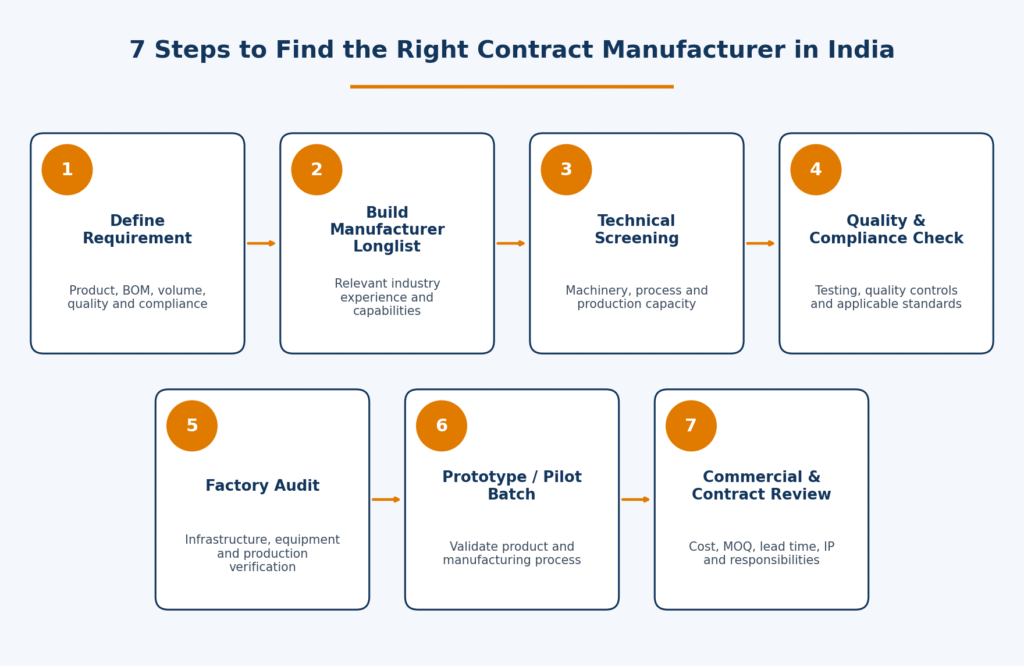
Suppliers can only be compared if every one of them quotes against the same package. Prepare it first:
- Product type and specifications
- Drawings, CAD files and the bill of materials (BOM)
- Prototype quantity and expected annual volume
- Target cost
- Quality requirements and acceptance criteria
- Delivery timeline
- Applicable certification and compliance requirements
- Packaging requirements
- IP and confidentiality requirements
An unclear RFQ produces quotations built on different assumptions about materials, tolerances, testing and volumes. You then compare numbers that are not comparable.
Check Technical Capability Before Shortlisting
Evaluate each manufacturer against your actual product, not its general capability profile.
For Robots
Look for CAD and design support, precision machining, sheet-metal fabrication, electronics integration, and experience with sensors and actuators. Then check assembly practice, functional testing and, most importantly, a track record of moving from prototype to production. Ask for examples of similar mechatronic builds.
For Electrical Panels
Check panel design ability, enclosure fabrication, wiring quality, busbar work and PLC/HMI integration. Ask how components are sourced and whether the supplier tests every panel and delivers complete technical documentation, such as drawings, test records and wiring schedules.
For Batteries
Ask about cell sourcing and battery-pack design, BMS (battery management system) integration, thermal management and the charging and discharging profile your application needs. Check safety testing, cell-to-pack traceability, pack-level testing and whether production can scale.
Compliance is not uniform across these products. It depends on the specific product, application, target market and applicable standard or regulation. A panel, a warehouse robot and a battery pack each follow different rules.
Check Quality and Compliance Before Selecting a Manufacturer
Ask to see the quality system in operation, not only the certificate. Review:
- Incoming, in-process and final inspection
- Testing capability and calibration of instruments
- Traceability of components and batches
- Non-conformance handling and corrective action
- Change control for drawings, BOMs and processes
Certification should be checked for applicability to the specific product rather than treated as a universal checklist.
Take BIS as an example. The BIS Compulsory Registration Scheme includes sealed secondary cells and batteries for portable applications under IS 16046, including lithium systems covered by IS 16046 (Part 2). Other battery products may fall under different standards or regulatory pathways. A robot, electrical panel or stationary battery system can therefore have different compliance requirements. Confirm the applicable standard and certification scope through the BIS portal before shortlisting a manufacturer. ISO 9001 indicates conformity with a quality-management-system standard; it does not by itself establish product-specific certification.
Verify Manufacturing Capacity, Not Just Claimed Capacity
Installed capacity is what the plant can produce in theory. Available capacity is what it can dedicate to your order after existing commitments.
The gap can be significant. Under the PLI scheme for Advanced Chemistry Cell batteries, 40 GWh of the targeted 50 GWh capacity had been awarded to four beneficiary firms, while beneficiary-reported cumulative investment stood at ₹3,237 crore up to 31 December 2025. Awarded capacity should not be treated as the same as capacity actually installed and available for production.
Ask suppliers about:
- Current production load and truly available capacity
- Machine capability and critical equipment
- Number of shifts and production lead time
- Bottleneck operations, such as testing, welding or curing
- Dependence on subcontractors
- Raw-material and component availability
- Ability to handle peak demand and expand
Then apply this practical test: if you need 500 panels a month, ask what the plant builds today, which stage limits output, and what happens if another customer doubles its order.
Use Prototype or Pilot Production Before Full-Scale Manufacturing
A quotation shows what a supplier says it can do. A pilot batch shows what it can actually do. The recommended sequence is:
- Prototype
- Functional validation
- Pilot batch
- Quality inspection
- Corrective actions
- Production approval
- Scale-up
This matters most for robots and batteries. Robots combine mechanical tolerances, electronics and software, so integration problems surface only when units are built and tested. Batteries add safety and consistency risks that appear only across many packs. Pilot production exposes those problems while the order is still small.
Conduct a Factory and Supplier Capability Audit
An audit confirms what the proposal and website claim. Scope it to your product; a panel audit and a battery audit will not use the same checklist. Typical areas include:
- Actual machinery and the production floor
- Testing laboratory and calibration system
- Raw-material and finished-goods storage
- Traceability and quality records
- Worker skill and training
- Safety systems and housekeeping
- Production documentation and work instructions
Watch the flow of a real job through the plant. Records and work in progress tell you more than a presentation.
Contract Manufacturer Evaluation Checklist
| Evaluation Area | What to Check | Why It Matters |
|---|---|---|
| Technical capability | Machines, processes and past work on similar products | Shows whether the shop can build your design, not just similar ones |
| Quality | Inspection stages, test records, non-conformance handling | Predicts consistency from batch to batch |
| Capacity | Available (not installed) capacity, shifts, bottleneck processes | Prevents delays when your volume ramps up |
| Compliance | Certifications and standards applicable to your product and market | Avoids rework and market-entry problems |
| Prototype/pilot capability | Ability to build small batches and support design changes | Validates the design before volume commitment |
| Supply chain | Component sourcing, alternate vendors, lead times | Reduces disruption from single-source parts |
| Cost | Unit price, tooling, testing, packaging, freight, rework | Reveals total cost, not just the quotation |
| Scalability | Expansion plans, equipment, manpower, subcontracting | Confirms the supplier can grow with demand |
| IP/confidentiality | NDA, drawing control, tool and data ownership | Protects designs, BOMs and firmware |
| Engineering/support capability | DFM feedback, change handling, after-sales support | Keeps engineering issues from stalling production |
Compare Quotes on Total Cost, Not Just Unit Price
The lowest quotation is not automatically the lowest total cost. Compare each offer across:
- Manufacturing price and tooling
- Raw materials and components
- Testing and inspection
- Packaging and freight or logistics
- Rework and engineering-change charges
- Minimum order quantity (MOQ) and payment terms
- Warranty and service terms
- Potential delay costs
A low unit price with heavy tooling charges, a high MOQ and separate testing fees can cost more over a year than a higher, all-inclusive quote.
Check IP, Confidentiality and Engineering Change Control
Engineered products carry design knowledge in drawings, BOMs and firmware. Settle these points in writing before sharing full data:
- NDA and confidentiality obligations
- Ownership of CAD files and the BOM
- Drawing control and revision management
- Approval process for engineering changes
- Tool and fixture ownership
- Firmware or software ownership, where relevant
- Data access rights
- Controls on subcontracting your work
Without change control, a supplier can substitute a part or alter a process and ship units that no longer match your validated design.
Common Mistakes When Selecting a Contract Manufacturer
- Selecting only on price
- Trusting website claims without verification
- Ignoring actual production capacity
- Skipping prototype or pilot production
- Not auditing the facility
- Ignoring supplier dependency on single vendors or subcontractors
- Leaving BOM and drawing ownership unclear
- Having no engineering change-control process
- Ignoring product-specific compliance
- Setting no quality acceptance criteria
Practical Checklist Before Signing the Contract
- Product specification is frozen.
- BOM and drawings are controlled.
- Manufacturer capability is verified.
- Production capacity is confirmed.
- Quality system is reviewed.
- Applicable compliance requirements are identified.
- Prototype/pilot has been evaluated.
- Commercial terms are comparable.
- IP/confidentiality terms are documented.
- Delivery, quality and change-control responsibilities are defined.
How IMARC Engineering Can Help
IMARC Engineering supports manufacturers and project teams with:
- Contract manufacturer identification
- Requirement definition
- Supplier capability assessment
- Manufacturing facility evaluation
- Technical and commercial comparison
- Supplier selection support
- Technology-transfer and scale-up planning
If you are evaluating manufacturing partners in India for robots, electrical panels, batteries or other engineered products, IMARC Engineering can support manufacturer identification, technical capability assessment, factory evaluation and supplier due diligence before production commitments are made.
Explore IMARC Engineering’s Contract Manufacturer Identification Services to discuss your product, volume and supplier requirements: https://www.imarcengineering.com/contact?service=contract-manufacturer-identification
Conclusion
The right contract manufacturer should not be selected only on quotation. The decision should weigh technical capability, quality, compliance, capacity, prototype readiness, total cost, supplier risk, IP protection and scalability.
Verifying a supplier before production is easier and less disruptive than correcting capability or quality problems after commercial production begins.
Contact Us:
IMARC Engineering
Phone: +91-120-433-0800
Email: sales@imarcengineering.com
India: C-130, Sector 2, Noida, Uttar Pradesh 201301
LinkedIn: https://www.linkedin.com/showcase/imarc-engineering/
About the Author